studio: show the active run's saved config in the Training Progress popover - #7217
danielhanchen merged 9 commits into
Conversation


…opover

The Training Config popover on the live Training Progress page read the
editable form store (useTrainingConfigStore), so it showed stale/static values
whenever the form changed after the run started; only the History view read the
run's saved config snapshot, which is why re-opening the same run from Recents
showed the correct values (unslothai#6853).

Wire the live view to the same authoritative source History already uses:

- Extract History's field mapping into sections/run-config-override.ts
  (mapRunConfigToOverride) so both views share one mapper over
  GET /api/train/runs/{id} config.
- LiveTrainingView fetches the run record as soon as the job id is known and
  passes the mapped override to ProgressSection; the fetched config is keyed
  by job id, and until it loads (or if the fetch fails) the form store remains
  the fallback. The run record is created at job start, so it is available
  while the run is live.
- ProgressSection prefers configOverride whenever one is present instead of
  only when isHistorical, so the live override takes effect.

Adds a source-level regression test pinning the wiring and the mapper's
backend config keys.

Fixes unslothai#6853


|
Caution The consumer version of Gemini Code Assist on GitHub has been sunset. All code review activity has officially ceased. |
![chatgpt-codex-connector[bot]](https://avatars.githubusercontent.com/in/1144995?s=60&v=4)

There was a problem hiding this comment.
💡 Codex Review
Here are some automated review suggestions for this pull request.
Reviewed commit: 3e96943d02
ℹ️ About Codex in GitHub
Codex has been enabled to automatically review pull requests in this repo. Reviews are triggered when you
- Open a pull request for review
- Mark a draft as ready
- Comment "@codex review".
If Codex has suggestions, it will comment; otherwise it will react with 👍.
When you sign up for Codex through ChatGPT, Codex can also answer questions or update the PR, like "@codex address that feedback".
…ved method

Two review fixes on the live Training Config popover source:

1. The backend creates the run row only on the first progress event, so the
   fetch issued as soon as the job id appeared commonly 404'd during
   model/dataset preparation and never retried -- leaving the popover on the
   form store for the whole run. The effect is now also keyed on
   firstStepReceived (and skips once resolved for the job), so it re-fetches
   exactly when the row is guaranteed to exist.

2. The popover's method label and LoRA-row visibility came from
   viewData.trainingMethod, still read from the editable form store; changing
   the form (e.g. LoRA -> Full) after starting a run relabeled it and hid its
   saved LoRA rows. The run-config mapper now derives trainingMethod from the
   snapshot's training_type/load_in_4bit (via parseBackendTrainingMethod, now
   exported from the feature index) and the live view prefers it.
There was a problem hiding this comment.
💡 Codex Review
Here are some automated review suggestions for this pull request.
Reviewed commit: 20a877c87a
ℹ️ About Codex in GitHub
Codex has been enabled to automatically review pull requests in this repo. Reviews are triggered when you
- Open a pull request for review
- Mark a draft as ready
- Comment "@codex review".
If Codex has suggestions, it will comment; otherwise it will react with 👍.
When you sign up for Codex through ChatGPT, Codex can also answer questions or update the PR, like "@codex address that feedback".
…rst step

The live config-popover fetch was keyed on firstStepReceived, which the runtime
store sets only when step > 0. A run that fails or completes during preparation
(before step 1) creates and finalizes its row from the terminal error/complete
event, but neither the job id nor firstStepReceived changed, so the fetch never
ran and the popover stayed on the editable form store -- showing the wrong
config/method if the form was edited afterward (Configure re-enables on failure).

Gate the fetch on a runRowReady signal = firstStepReceived OR a terminal phase
(completed/error/stopped), the states in which the backend guarantees the row
exists. This also stops the earlier fetch-then-404 churn during preparation and
lets the effect depend only on values it reads (no lint suppression needed).
There was a problem hiding this comment.
💡 Codex Review
Here are some automated review suggestions for this pull request.
Reviewed commit: 40a31877f1
ℹ️ About Codex in GitHub
Codex has been enabled to automatically review pull requests in this repo. Reviews are triggered when you
- Open a pull request for review
- Mark a draft as ready
- Comment "@codex review".
If Codex has suggestions, it will comment; otherwise it will react with 👍.
When you sign up for Codex through ChatGPT, Codex can also answer questions or update the PR, like "@codex address that feedback".

…-ready

Two ways the popover could stay stuck on the editable form store for a whole
run:

- The backend publishes the progress event that reveals the run before
  create_run commits, so the first lookup can lose that race and 404. The catch
  changed neither runRowReady nor fetchedRunConfig, leaving every effect
  dependency identical, so no further attempt was ever made for that job. The
  failure path now schedules an explicit retry, bounded and keyed by job id, so
  a genuinely absent row falls back to the form store instead of polling.

- A run recovered through status/metrics polling (SSE unavailable or blocked)
  has currentStep restored by applyStatus/applyMetrics but never
  firstStepReceived, and the phase stays training, so the row was treated as
  not ready even at step > 0. currentStep > 0 is now a readiness signal of its
  own.
There was a problem hiding this comment.
💡 Codex Review
Here are some automated review suggestions for this pull request.
Reviewed commit: 3307b5f670
ℹ️ About Codex in GitHub
Codex has been enabled to automatically review pull requests in this repo. Reviews are triggered when you
- Open a pull request for review
- Mark a draft as ready
- Comment "@codex review".
If Codex has suggestions, it will comment; otherwise it will react with 👍.
When you sign up for Codex through ChatGPT, Codex can also answer questions or update the PR, like "@codex address that feedback".
start_training() inserts the run row before the pump can consume any event --
deliberately, so the run appears in history during model loading -- and /status
exposes the job id throughout the pre-step phases. Gating the lookup on a first
step or a terminal phase therefore held the popover on the editable form store
for the whole configuring/loading/downloading window, which on a long model or
dataset load is minutes, and indefinitely for a run adopted from another client.

The job id is now the entire readiness condition; the existing bounded retry
still covers the instant before the insert commits.

… config; tighten popover comments

|
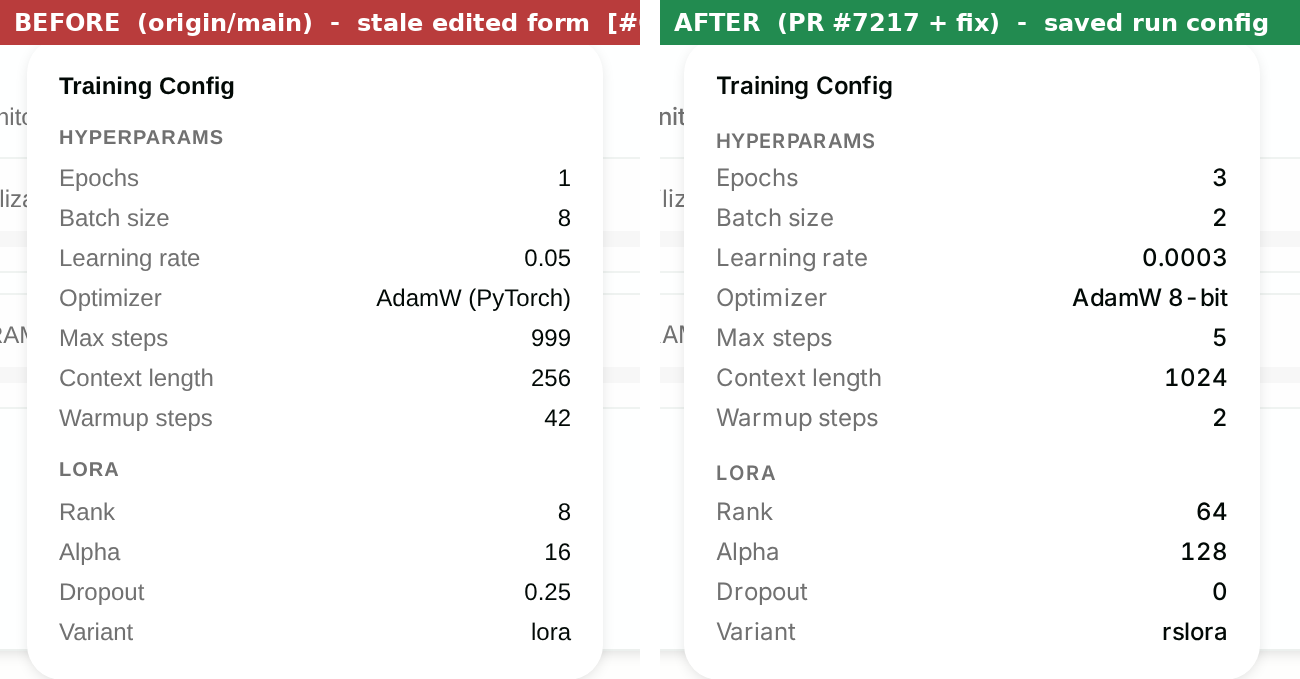
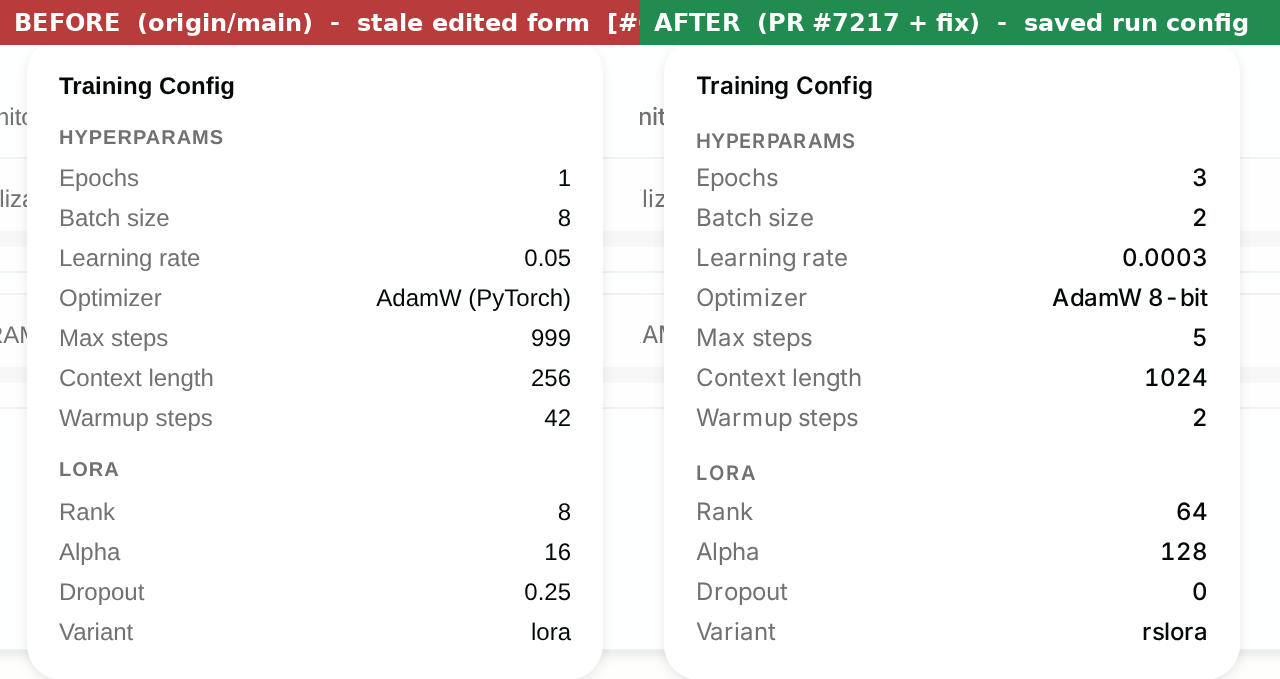
Confirmed this fix live in Unsloth Studio. I started one training run (Qwen2.5-0.5B, QLoRA, 5 steps), then changed the editable Training form to different values, mimicking a user who edits the form after the run has started (#6853). Then I opened the Training Config popover on the live Training Progress page against both Before (
It is the same run in both (identical loss 3.5124 and grad norm 97.751); only the popover's data source differs: epochs 1 vs 3, batch size 8 vs 2, learning rate 0.05 vs 0.0003, max steps 999 vs 5, context length 256 vs 1024, warmup steps 42 vs 2, rank 8 vs 64, alpha 16 vs 128, variant lora vs rslora, method LoRA vs QLoRA. I also pushed a small follow-up to this branch: the History view now keeps showing blanks when a run has no saved config snapshot, instead of falling back to the live form store, and the popover comments were tightened. |

|
Thanks! |


…opover (#7217)

* studio: show the active run's saved config in the Training Progress popover

The Training Config popover on the live Training Progress page read the
editable form store (useTrainingConfigStore), so it showed stale/static values
whenever the form changed after the run started; only the History view read the
run's saved config snapshot, which is why re-opening the same run from Recents
showed the correct values (#6853).

Wire the live view to the same authoritative source History already uses:

- Extract History's field mapping into sections/run-config-override.ts
  (mapRunConfigToOverride) so both views share one mapper over
  GET /api/train/runs/{id} config.
- LiveTrainingView fetches the run record as soon as the job id is known and
  passes the mapped override to ProgressSection; the fetched config is keyed
  by job id, and until it loads (or if the fetch fails) the form store remains
  the fallback. The run record is created at job start, so it is available
  while the run is live.
- ProgressSection prefers configOverride whenever one is present instead of
  only when isHistorical, so the live override takes effect.

Adds a source-level regression test pinning the wiring and the mapper's
backend config keys.

Fixes #6853

* studio: retry the run-config fetch after the first step, carry the saved method

Two review fixes on the live Training Config popover source:

1. The backend creates the run row only on the first progress event, so the
   fetch issued as soon as the job id appeared commonly 404'd during
   model/dataset preparation and never retried -- leaving the popover on the
   form store for the whole run. The effect is now also keyed on
   firstStepReceived (and skips once resolved for the job), so it re-fetches
   exactly when the row is guaranteed to exist.

2. The popover's method label and LoRA-row visibility came from
   viewData.trainingMethod, still read from the editable form store; changing
   the form (e.g. LoRA -> Full) after starting a run relabeled it and hid its
   saved LoRA rows. The run-config mapper now derives trainingMethod from the
   snapshot's training_type/load_in_4bit (via parseBackendTrainingMethod, now
   exported from the feature index) and the live view prefers it.

* studio: fetch the run config on a terminal phase too, not just the first step

The live config-popover fetch was keyed on firstStepReceived, which the runtime
store sets only when step > 0. A run that fails or completes during preparation
(before step 1) creates and finalizes its row from the terminal error/complete
event, but neither the job id nor firstStepReceived changed, so the fetch never
ran and the popover stayed on the editable form store -- showing the wrong
config/method if the form was edited afterward (Configure re-enables on failure).

Gate the fetch on a runRowReady signal = firstStepReceived OR a terminal phase
(completed/error/stopped), the states in which the backend guarantees the row
exists. This also stops the earlier fetch-then-404 churn during preparation and
lets the effect depend only on values it reads (no lint suppression needed).

* studio: retry the run-config lookup and accept a hydrated step as row-ready

Two ways the popover could stay stuck on the editable form store for a whole
run:

- The backend publishes the progress event that reveals the run before
  create_run commits, so the first lookup can lose that race and 404. The catch
  changed neither runRowReady nor fetchedRunConfig, leaving every effect
  dependency identical, so no further attempt was ever made for that job. The
  failure path now schedules an explicit retry, bounded and keyed by job id, so
  a genuinely absent row falls back to the form store instead of polling.

- A run recovered through status/metrics polling (SSE unavailable or blocked)
  has currentStep restored by applyStatus/applyMetrics but never
  firstStepReceived, and the phase stays training, so the row was treated as
  not ready even at step > 0. currentStep > 0 is now a readiness signal of its
  own.

* studio: fetch the saved run config as soon as the job id exists

start_training() inserts the run row before the pump can consume any event --
deliberately, so the run appears in history during model loading -- and /status
exposes the job id throughout the pre-step phases. Gating the lookup on a first
step or a terminal phase therefore held the popover on the editable form store
for the whole configuring/loading/downloading window, which on a long model or
dataset load is minutes, and indefinitely for a run adopted from another client.

The job id is now the entire readiness condition; the existing bounded retry
still covers the instant before the insert commits.

* Fix Training Config popover fallback for history runs without a saved config; tighten popover comments

---------

Co-authored-by: danielhanchen <unslothai@gmail.com>

…opover (unslothai#7217)

* studio: show the active run's saved config in the Training Progress popover

The Training Config popover on the live Training Progress page read the
editable form store (useTrainingConfigStore), so it showed stale/static values
whenever the form changed after the run started; only the History view read the
run's saved config snapshot, which is why re-opening the same run from Recents
showed the correct values (unslothai#6853).

Wire the live view to the same authoritative source History already uses:

- Extract History's field mapping into sections/run-config-override.ts
  (mapRunConfigToOverride) so both views share one mapper over
  GET /api/train/runs/{id} config.
- LiveTrainingView fetches the run record as soon as the job id is known and
  passes the mapped override to ProgressSection; the fetched config is keyed
  by job id, and until it loads (or if the fetch fails) the form store remains
  the fallback. The run record is created at job start, so it is available
  while the run is live.
- ProgressSection prefers configOverride whenever one is present instead of
  only when isHistorical, so the live override takes effect.

Adds a source-level regression test pinning the wiring and the mapper's
backend config keys.

Fixes unslothai#6853

* studio: retry the run-config fetch after the first step, carry the saved method

Two review fixes on the live Training Config popover source:

1. The backend creates the run row only on the first progress event, so the
   fetch issued as soon as the job id appeared commonly 404'd during
   model/dataset preparation and never retried -- leaving the popover on the
   form store for the whole run. The effect is now also keyed on
   firstStepReceived (and skips once resolved for the job), so it re-fetches
   exactly when the row is guaranteed to exist.

2. The popover's method label and LoRA-row visibility came from
   viewData.trainingMethod, still read from the editable form store; changing
   the form (e.g. LoRA -> Full) after starting a run relabeled it and hid its
   saved LoRA rows. The run-config mapper now derives trainingMethod from the
   snapshot's training_type/load_in_4bit (via parseBackendTrainingMethod, now
   exported from the feature index) and the live view prefers it.

* studio: fetch the run config on a terminal phase too, not just the first step

The live config-popover fetch was keyed on firstStepReceived, which the runtime
store sets only when step > 0. A run that fails or completes during preparation
(before step 1) creates and finalizes its row from the terminal error/complete
event, but neither the job id nor firstStepReceived changed, so the fetch never
ran and the popover stayed on the editable form store -- showing the wrong
config/method if the form was edited afterward (Configure re-enables on failure).

Gate the fetch on a runRowReady signal = firstStepReceived OR a terminal phase
(completed/error/stopped), the states in which the backend guarantees the row
exists. This also stops the earlier fetch-then-404 churn during preparation and
lets the effect depend only on values it reads (no lint suppression needed).

* studio: retry the run-config lookup and accept a hydrated step as row-ready

Two ways the popover could stay stuck on the editable form store for a whole
run:

- The backend publishes the progress event that reveals the run before
  create_run commits, so the first lookup can lose that race and 404. The catch
  changed neither runRowReady nor fetchedRunConfig, leaving every effect
  dependency identical, so no further attempt was ever made for that job. The
  failure path now schedules an explicit retry, bounded and keyed by job id, so
  a genuinely absent row falls back to the form store instead of polling.

- A run recovered through status/metrics polling (SSE unavailable or blocked)
  has currentStep restored by applyStatus/applyMetrics but never
  firstStepReceived, and the phase stays training, so the row was treated as
  not ready even at step > 0. currentStep > 0 is now a readiness signal of its
  own.

* studio: fetch the saved run config as soon as the job id exists

start_training() inserts the run row before the pump can consume any event --
deliberately, so the run appears in history during model loading -- and /status
exposes the job id throughout the pre-step phases. Gating the lookup on a first
step or a terminal phase therefore held the popover on the editable form store
for the whole configuring/loading/downloading window, which on a long model or
dataset load is minutes, and indefinitely for a run adopted from another client.

The job id is now the entire readiness condition; the existing bounded retry
still covers the instant before the insert commits.

* Fix Training Config popover fallback for history runs without a saved config; tighten popover comments

---------

Co-authored-by: danielhanchen <unslothai@gmail.com>
3 participants


The Training Config popover on the live Training Progress page read the
editable form store (useTrainingConfigStore), so it showed stale/static values
whenever the form changed after the run started; only the History view read the
run's saved config snapshot, which is why re-opening the same run from Recents
showed the correct values (#6853).
Wire the live view to the same authoritative source History already uses:
(mapRunConfigToOverride) so both views share one mapper over
GET /api/train/runs/{id} config.
passes the mapped override to ProgressSection; the fetched config is keyed
by job id, and until it loads (or if the fetch fails) the form store remains
the fallback. The run record is created at job start, so it is available
while the run is live.
only when isHistorical, so the live override takes effect.
Adds a source-level regression test pinning the wiring and the mapper's
backend config keys.
Fixes #6853