IBM Public Cloud Support #202
There are no files selected for viewing
| Original file line number | Diff line number | Diff line change |
|---|---|---|
| @@ -0,0 +1,243 @@ | ||
| --- | ||
| title: IBM Public Cloud Support | ||
| authors: | ||
| - "@csrwng" | ||
| reviewers: | ||
| - "@derekwaynecarr" | ||
| approvers: | ||
| - "@derekwaynecarr" | ||
| creation-date: 2020-02-04 | ||
| last-updated: 2020-02-04 | ||
| status: implementable | ||
| see-also: | ||
| replaces: | ||
| superseded-by: | ||
| --- | ||
|
|
||
| # IBM Public Cloud Support | ||
|
|
||
| ## Release Signoff Checklist | ||
|
|
||
| - [x] Enhancement is `implementable` | ||
| - [ ] Design details are appropriately documented from clear requirements | ||
| - [ ] Test plan is defined | ||
| - [ ] Graduation criteria for dev preview, tech preview, GA | ||
| - [ ] User-facing documentation is created in [openshift-docs](https://github.com/openshift/openshift-docs/) | ||
|
|
||
| ## Summary | ||
|
|
||
| IBM Public Cloud deploys Kubernetes/OpenShift clusters by hosting their control plane | ||
| as pods in a central management cluster. OpenShift v3.11 is currently offered as a managed | ||
| service using this model. This type of setup allows the hosting of many | ||
| cluster control planes on a single Kubernetes cluster. Only the worker nodes are exclusive | ||
| to an individual user cluster and may exist in a different account than the central | ||
| management cluster. | ||
|
|
||
| Supporting this type of deployment in OpenShift 4.x requires a different approach to | ||
| installing OpenShift and managing its control plane. Instead of bootstrapping a cluster | ||
| control plane from scratch on virtual machines, a cluster control plane can be created | ||
| by applying a set of manifests to an existing cluster in a new namespace. | ||
|
|
||
| Changes are required in different areas of the product in order to make clusters deployed | ||
| using this method viable. These include changes to the cluster version operator (CVO), web | ||
| console, second level operators (SLOs) deployed by the CVO, and RHCOS. | ||
|
Contributor
There was a problem hiding this comment. please don't use SLO as an acronym here. It is very commonly used for "Service Level Objectives".
Contributor
Author
There was a problem hiding this comment. ack, will do a follow-up to remove. |
||
|
|
||
| ## Motivation | ||
|
|
||
| Enable OpenShift 4.x deployment on IBM Cloud. | ||
|
|
||
| ### Goals | ||
|
|
||
| - Enable the deployment of OpenShift 4.x on IBM Public Cloud by providing the IBM | ||
| Public Cloud team the necessary tools to generate manifests needed for a hosted | ||
| control plane. | ||
| - Ensure that this deployment model remains functional through regular e2e testing | ||
| on IBM Public Cloud. | ||
|
Contributor
There was a problem hiding this comment. "regular" means we get a normal CI job in the openshift org making sure our control plane code changes don't break it?
Contributor
There was a problem hiding this comment. Will the CI job be blocking for OpenShift PRs? E.g. if deployment topology changes and some apiserver suddenly does not serve certain APIs because they moves, their CI will break.
Contributor
Author
There was a problem hiding this comment.
That is the plan. We currently have a periodic job that creates clusters based on the 4.3 branches. One will be added for the master/4.4 branch.
That will be harder. We would require capacity on the IBM Cloud to run that many jobs. Not sure that is feasible right now. The periodic job should block a release, but not individual PRs
Contributor
There was a problem hiding this comment. We describe those apiserver changes (they are happening, now for oauth) in enhancements. The IBM team has to watch that repo to be informed. |
||
| - Make the necessary product changes to make IBM Public Cloud a fully supported | ||
| cloud provider. | ||
| - Ensure that clusters running on IBM Public Cloud are conformant OpenShift clusters | ||
| (pass Kubernetes and OpenShift conformance e2e tests). Fully document any tests that | ||
| must be skipped due to differences from a traditional deployment. | ||
|
|
||
| ### Non-Goals | ||
|
|
||
| - Make hosted control planes a supported deployment model outside of IBM Public Cloud. | ||
|
Member
There was a problem hiding this comment. I find this confusing...IBM Public Cloud means a lot of different things, and a sort of baseline obvious one is having OpenShift support the default "self driving" path in their existing IaaS. But I guess we're doing hosted control plane first? Maybe the enhancement should be called: "IBM Public Cloud Hosted Control Plane" ? And one thing I would say here is that we should think of this "fairly" - if some other IaaS showed up and was willing to commit significant resources to maintaining a similar thing... clearly vast amounts of the design would likely be shared. But that can come later.
Contributor
Author
There was a problem hiding this comment. Absolutely, I think the things we learn from this work is something we can likely reuse in other cases. And perhaps at the proper time, make the pattern something standalone that's configured per provider. So definitely, this non-goal is a point-in-time statement.
Contributor
Author
There was a problem hiding this comment.
At least in the foreseeable future, supporting the self-hosted path is not a priority afaik, but @derekwaynecarr can likely provide more insight into that. |
||
| - Define the automation needed on the IBM Public Cloud side to provision new clusters. | ||
| - Create an alternate installer for OpenShift. | ||
|
|
||
| ## Proposal | ||
|
|
||
| Support for IBM Public Cloud will be added in 3 phases: | ||
|
|
||
| 1. Beta: Initial rollout. Enables users to create OpenShift clusters | ||
| using RHEL 7 worker nodes. Nodes are labeled as both worker and master to support | ||
| SLOs that have masters in their node selectors. IBM provides out of tree cloud support | ||
| for storage, service load balancers. Ingress, image registry, storage and auth are | ||
| configured after initial provisioning (day 2). Calico is used for the SDN. | ||
| 2. GA: In-tree support for ingress, image registry, storage, auth, load balancers. | ||
| 3. Post-GA: Add support for RHCOS workers | ||
|
|
||
| In more detail: | ||
|
|
||
| ### Beta | ||
|
|
||
| Enables an OpenShift cluster to be hosted on top of a Kubernetes/OpenShift cluster. | ||
|
|
||
| Given a release image, a CLI tool generates manifests that instantiate the control plane | ||
|
Member
There was a problem hiding this comment. OS upgrades for the worker nodes is owned by the customer? Or does IBM provide tooling for that? Are they using openshift-ansible? In the "Post-GA" world with RHCOS...do we forsee trying to enable the MCO to manage upgrades for the workers w/RHCOS?
Member
There was a problem hiding this comment. Isn't this covered in the Managed Workers section below?
Member
There was a problem hiding this comment. The second half is yes, thanks! |
||
| components so that they can be applied to a namespace. IBM provides the automation | ||
| that applies these manifests and instantiates worker nodes that add themselves to | ||
| the new cluster. Minting of kubelet certificates for these worker nodes is handled | ||
| by IBM automation. | ||
|
|
||
| Components that run on the management cluster include: | ||
|
Contributor
There was a problem hiding this comment. for cluster-monitoring: as apiserver monitoring is effectively being disabled when running in "ROKS mode" what is monitoring control plane components on the management cluster?
Contributor
Author
There was a problem hiding this comment. IBM is running their own monitoring solution on their management/tugboat clusters. |
||
| - etcd\+ | ||
| - kubernetes apiserver | ||
| - kubernetes controller manager | ||
| - kubernetes scheduler | ||
| - openshift apiserver | ||
|
Contributor
There was a problem hiding this comment. has it been discussed what is needed to move that into the customer cluster?
Contributor
Author
There was a problem hiding this comment. It hasn't... when we first looked at this, however, we were in a catch 22 situation, where in order to be able to schedule pods we needed the openshift crds and controller functional. |
||
| - openshift controller manager | ||
| - cluster version operator | ||
| - control plane operator(s)\* | ||
| - oauth server\+ | ||
| - vpn server\+ | ||
|
|
||
| \* - new component | ||
|
|
||
| \+ - provisioned by IBM | ||
|
|
||
| Once a control plane is running, the Kubernetes API server connects to a VPN server to | ||
| which worker nodes also connect. This enables the API server to access the pod and service | ||
| network of the worker nodes. This is needed for aggregated API services running on the | ||
| worker nodes. | ||
|
|
||
| The cluster version operator running on the management cluster connects to the Kubernetes | ||
| API server via the service network and starts applying manifests for SLOs that must run | ||
| on the worker nodes. These include (among others): | ||
|
|
||
| - network (dns, multus) | ||
| - ingress | ||
| - image registry | ||
| - OLM | ||
| - samples | ||
| - console | ||
|
|
||
| The CVO needs to skip manifests that instantiate control plane operators, machine API related | ||
| operators, and others that do not apply to this topology. These include: | ||
|
|
||
| - cluster-version-operator | ||
| - cluster-kube-apiserver-operator | ||
| - cluster-kube-controller-manager-operator | ||
| - cluster-kube-scheduler-operator | ||
| - cluster-openshift-apiserver-operator | ||
| - cluster-openshift-controller-manager-operator | ||
| - cluster-autoscaler-operator | ||
| - cluster-machine-approver | ||
| - insights-operator | ||
| - machine-config-operator | ||
| - cloud-credential-operator | ||
| - cluster-authentication-operator | ||
|
|
||
| Components/Changes needed for this to work: | ||
|
|
||
| #### OpenShift ROKS Toolkit CLI | ||
|
|
||
| CLI tool that takes a release image and a configuration file as input and produces a set | ||
| of manifests that provision a control plane that runs on an existing Kubernetes cluster. | ||
| PKI certificates are not generated by the tool. Manifests of control plane components | ||
| expect certificates to have been generated before provisioning and to exist as secrets | ||
| and configmaps on the control plane namespace following a predefined contract. | ||
|
|
||
| This tool is invoked by IBM Public Cloud provisioning code to when instantiating a new cluster. | ||
|
|
||
| #### Control Plane Operator | ||
| An operator that: | ||
| - Projects global configuration into the target cluster. Watches | ||
| and overwrites any changes to global configuration initiated inside the user | ||
| cluster. | ||
| - Ensures that the Kubernetes Controller Manager CA bundle includes self-signed CAs | ||
| generated by the router and the service CA operator. | ||
|
|
||
| #### Cluster Version Operator Changes | ||
| In phase I the cluster version operator excludes operator manifests that | ||
| have an annotation in the form: | ||
|
|
||
| `exclude.release.openshift.io/[identifier]=true` | ||
|
|
||
| whenever a global variable in the form | ||
|
|
||
| `EXCLUDE_MANIFESTS=[identifier]` | ||
|
|
||
| is present. For IBM public cloud, the value of \[identifier\] is | ||
| `internal-openshift-hosted` | ||
|
|
||
| #### Excluded Manifests | ||
| Manifests for the components that should be skipped by the CVO whenever | ||
| the `EXCLUDE_MANIFESTS=internal-openshift-hosted` environment variable is | ||
| present, should include the annotation to exclude them. In most cases, only the | ||
| minimum set of manifests to allow skipping the component should be annotated. | ||
| However, in the case of the Machine API and Machine Configuration operators, | ||
| the CRDs that represent machines, machinesets and autoscalers should also be | ||
| skipped. Monitoring alerts for components that do not get installed in the user | ||
|
Contributor
There was a problem hiding this comment. This part won't be that easy, unless we get provided with a list of it. Also it will not fire if there are no metrics for those components, so don't think its a problem.
Contributor
Author
There was a problem hiding this comment. This is what we addressed with openshift/cluster-monitoring-operator#705 |
||
| cluster should also be skipped where possible. | ||
|
|
||
| #### Console Changes | ||
| The console should not report the control plane as being down if no metrics | ||
|
Contributor
There was a problem hiding this comment. Are all edge cases for disabling monitoring of control plane components on the worker clusters covered in openshift/cluster-monitoring-operator#705 ? |
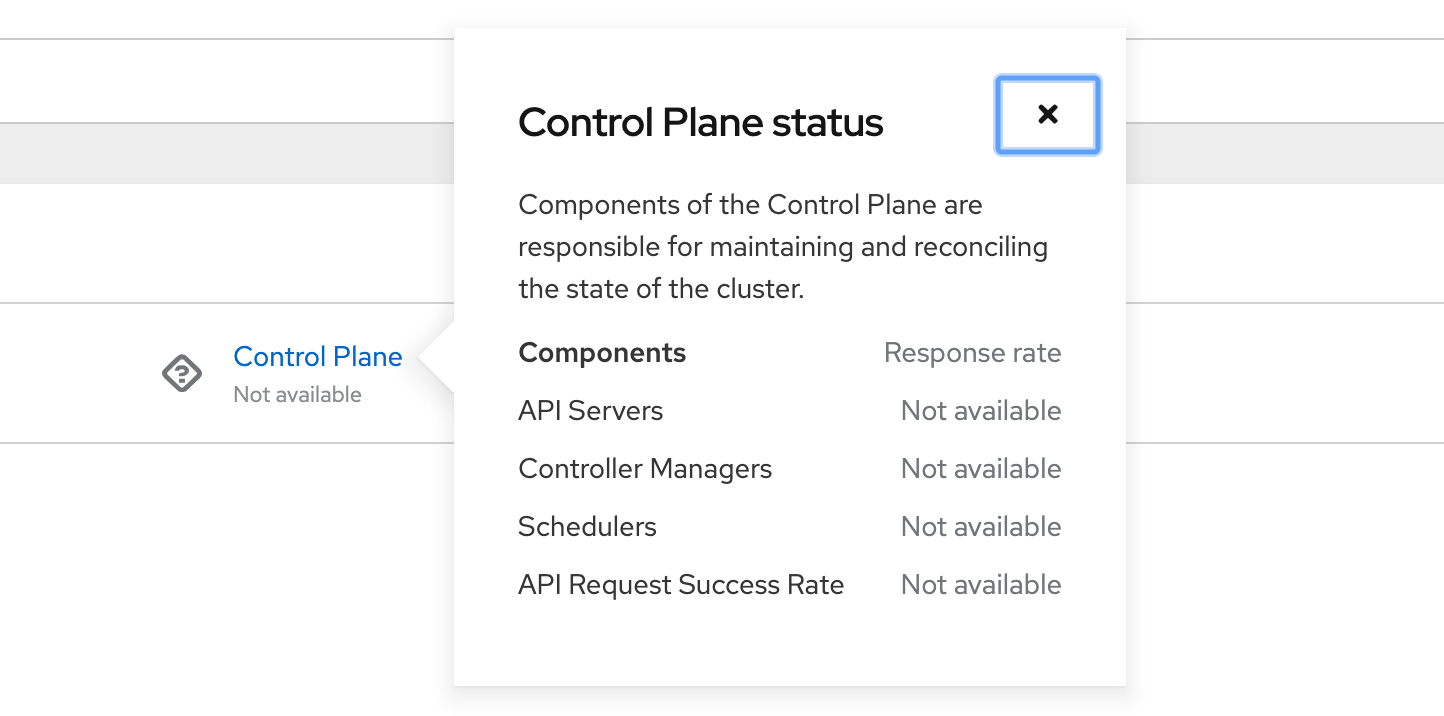
||
| datapoints exist for control plane components in this configuration. | ||
|
Member
There was a problem hiding this comment. Ack, this shouldn't be an issue. There was a problem hiding this comment. I believe Control Plane components would be shown as "Not available" if that's acceptable (better than "Down").
Member
There was a problem hiding this comment. @andybraren We probably need to remove that since we never expect to have control plane metrics. It's misleading to say not available. There was a problem hiding this comment. Agreed, created an issue to track this for 4.5 Dashboards https://issues.redhat.com/browse/MGMT-438 |
||
|
|
||
| ### GA | ||
|
|
||
| For GA, there is more native support for IBM Public Cloud as a supported | ||
| cloud provider in the product. Operators for control plane | ||
| components (based on the control plane self-hosted operators) are deployed on | ||
| the management cluster. | ||
|
|
||
| Components and changes required for this phase: | ||
|
|
||
| #### Control Plane Operators | ||
| Break up the single Beta control plane operator into different operators that | ||
| vendor code from the self-hosted control plane operators in the product. The vendored | ||
| code should include config observers that assemble a new configuration for their | ||
| respective control plane components. This will ensure that drift in future versions | ||
| is kept under control and that a single code base is used to manage control plane | ||
| configuration. | ||
|
Contributor
There was a problem hiding this comment. where is this beta control plane operator?
Contributor
Author
There was a problem hiding this comment. we're working on it, will be added to the current hypershift-toolkit repo. For the second phase we will create separate repos for each of the control plane controllers. |
||
|
|
||
| #### Cluster Version Operator Changes | ||
| The CVO should support the concept of an install profile that allows selecting manifests | ||
| based on which profile is in effect. This should make it possible to modify the node | ||
| selector of SLOs that are installed on IBM Public Cloud clusters to target worker nodes. | ||
| (See separate proposal for installation profiles). | ||
|
|
||
| #### Ingress Operator | ||
| Add native support for IBM Public Cloud as a cloud provider. | ||
|
|
||
| #### Storage Operator | ||
| Create storage classes needed for IBM Public Cloud. | ||
|
|
||
| #### Image Registry Operator | ||
| Support IBM Public Cloud natively by provisioning the appropriate storage (RWO PVC) | ||
|
|
||
| #### OAuth Server | ||
| Support IBM public cloud as a provider. | ||
|
|
||
| ### Post-GA | ||
|
|
||
| Add support for managed RHCOS nodes. | ||
|
|
||
| #### Managed Workers | ||
| RHCOS adds support for bootstrapping on IBM Public Cloud. The MCO is added to | ||
| the components that get installed on the management cluster. This enables upgrading | ||
| of RHCOS nodes using the same mechanisms as in self-hosted OpenShift. | ||
|
Member
There was a problem hiding this comment. So compute nodes still run machine-config daemons and cluster admins can write MachineConfig entries, create MachineSets, and all that good stuff? They just don't have any objects representing or control over the control-plane machines? |
||
|
|
||
| ## Design Details | ||
|
|
||
| ### Test Plan | ||
|
|
||
|
|
||
| ### Graduation Criteria | ||
|
|
||
|
|
||
| ### Upgrade / Downgrade Strategy | ||
|
|
||
|
|
||
| ### Version Skew Strategy | ||
|
|
||



There was a problem hiding this comment.
Choose a reason for hiding this comment
The reason will be displayed to describe this comment to others. Learn more.
expecting the owners of the control plane operators here, compare https://github.com/openshift/enhancements/pull/202/files#diff-8d49ecd990d312a72c0ffcdd1784ad05R92.
There was a problem hiding this comment.
Choose a reason for hiding this comment
The reason will be displayed to describe this comment to others. Learn more.
@sttts did you mean a different pr? the link above is for this one
There was a problem hiding this comment.
Choose a reason for hiding this comment
The reason will be displayed to describe this comment to others. Learn more.
No, meant this one. Just expected the owners of the mentioned operators to be informed about these plans by being reviewer of the enhancement.
There was a problem hiding this comment.
Choose a reason for hiding this comment
The reason will be displayed to describe this comment to others. Learn more.
Ack, will add more reviewers