Update to MYNN-EDMF#1063
Conversation


|
|
||
| #if ( WRF_DFI_RADAR == 1 ) | ||
| compiler error, not handled yet | ||
| !? compiler error, not handled yet |

There was a problem hiding this comment.
OK. I'll take it out.

|
@joeolson42 @weiwangncar @dudhia |
|
@joeolson42 @weiwangncar @dudhia |
…m.F and adding check to disable edmf output when bl_mynn_edmf = 0

|
Dave, I backed out the bug fix in module_big_step_utilities_em.F and added the forcing of bl_mynn_output=0 when bl_mynn_edmf=0. However, I can't push these changes back to github yet. I'm getting "Failed connect to github.com" errors. I'll keep trying... As for the question about auto-testing, the purpose of almost all of these changes are to improve the HRRR (CONUS & Alaska) and the global applications. The changes to the HRRR received unanimous thumbs up from the stakeholders during the NCEP review and this new version will become operation in June 2020. The HWRF tests has been mixed, but Evan Kalina recently found a critical bug where the MYNN-EDMF was not getting any surface stability information (rmol = 1/L) passed into it, so all results have been tainted. rmol is typically calculated in the surface layer scheme, but the current version of the GFDL surface layer scheme (HWRF's preferred surface layer scheme) doesn't output this field. Once corrected, improvements are practically guaranteed. However, I think the HWRF folks are using a slightly older version of the MYNN-EDMF in their repository, so until their code is refreshed, apples & oranges will be mixed. -joe |
|
@joeolson42 @dudhia @weiwangncar
|
|
@joeolson42 @weiwangncar @dudhia |

|
I'm ok with this PR too. |
|
@joeolson42 Is it possible to provide a pair of plots to show some results before and after the change? |

|
I can gather some results but it's almost impossible to isolate the
improvements to only these MYNN-EDMF changes, since the development spanned
at least a year and was done in parallel with changes to other model
components and data assimilation. Maybe it's best to isolate changes to
HRRR-Alaska, where the DA system was only slightly tweaked.
[image: Screen Shot 2020-01-27 at 1.48.51 PM.png]
The HRRR-CONUS results convolve physics improvements & data assimilation:
[image: Screen Shot 2020-01-27 at 2.46.28 PM.png]
…On Mon, Jan 27, 2020 at 1:18 PM weiwangncar ***@***.***> wrote:
@joeolson42 <https://github.com/joeolson42> Is it possible to provide a
pair of plots to show some results before and after the change?
—
You are receiving this because you were mentioned.
Reply to this email directly, view it on GitHub
<#1063?email_source=notifications&email_token=ADLRR3XW7L6CLIQBHKJPZCLQ746QFA5CNFSM4KLUBF32YY3PNVWWK3TUL52HS4DFVREXG43VMVBW63LNMVXHJKTDN5WW2ZLOORPWSZGOEKA5CEY#issuecomment-578933011>,
or unsubscribe
<https://github.com/notifications/unsubscribe-auth/ADLRR3WRJB5EKEPUWAAQOFLQ746QFANCNFSM4KLUBF3Q>
.
--
Joseph Olson
Meteorologist
Model Development Branch
Global Systems Division
NOAA-Earth System Research Lab
Boulder, Colorado
|
|
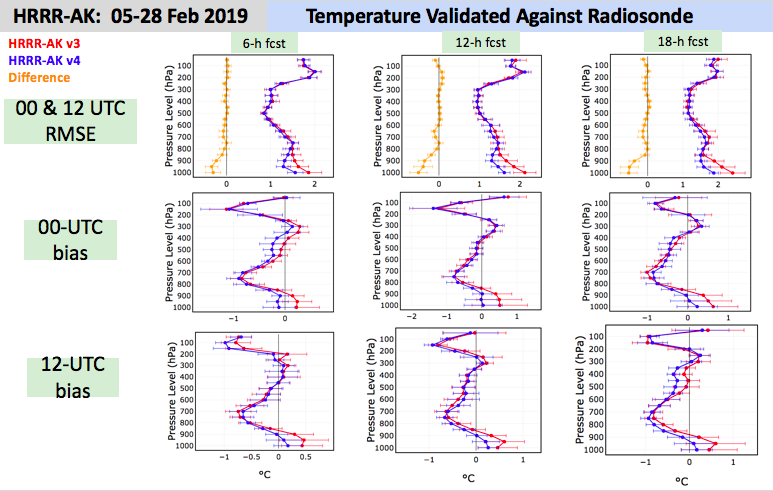
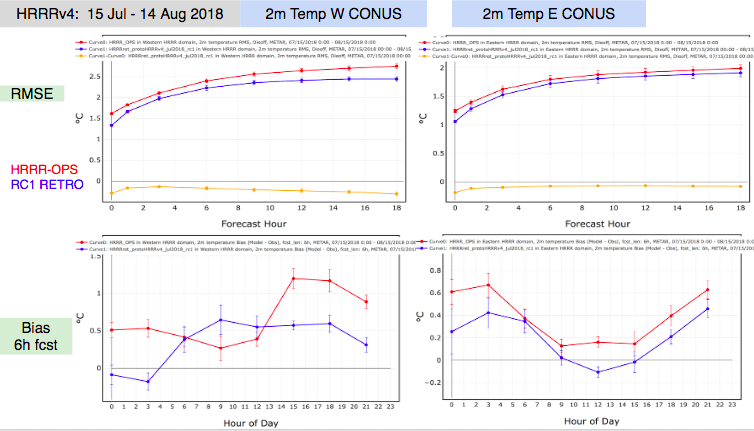
Here are some figure's that demonstrate some of the improvement in the upcoming version of the HRRR-Alaska. The focus on HRRR-Alaska is because the data assimilation changes are relatively minor for the new HRRR-Alaska product, making it easier to attribute improvements to the model physics, in this case, primarily the MYNN-EDMF and MYNN surface layer scheme. Hew HRRR (Blue), old HRRR (red) and difference (orange): And here's a figure to demonstrate improvement to 2-m temperature over the CONUS, but here, data assimilation improvements are also contributing to some of the improvement. Hew HRRR (Blue), old HRRR (red) and difference (orange): |
|
@joeolson42 Thanks for providing the plots. Would you expect some improvement from this update even if someone is doing cold start from GFS, for example? |
|
Yes, in general, but it may depend on the forecast variable and the
magnitude of the improvements will vary seasonally. This version of the
MYNN-EDMF does work better for global simulations cold started from the GFS
- tested with the rest of the HRRR suite (and with the updated surface
layer scheme coming next). The updates that are specific for cycling have a
small impact beyond 1hr forecasts, they definitely won't impact cold starts.
…On Mon, Jan 27, 2020 at 5:40 PM weiwangncar ***@***.***> wrote:
@joeolson42 <https://github.com/joeolson42> Thanks for providing the
plots. Would you expect some improvement from this update even if someone
is doing cold start from GFS, for example?
—
You are receiving this because you were mentioned.
Reply to this email directly, view it on GitHub
<#1063?email_source=notifications&email_token=ADLRR3VEH4HVAQ5WDG5L7V3Q755IZA5CNFSM4KLUBF32YY3PNVWWK3TUL52HS4DFVREXG43VMVBW63LNMVXHJKTDN5WW2ZLOORPWSZGOEKBTTRY#issuecomment-579025351>,
or unsubscribe
<https://github.com/notifications/unsubscribe-auth/ADLRR3RCZSC5GE5PZP5BPLLQ755IZANCNFSM4KLUBF3Q>
.
--
Joseph Olson
Meteorologist
Model Development Branch
Global Systems Division
NOAA-Earth System Research Lab
Boulder, Colorado
|
|
@joeolson42 Thanks for the reply. I'm good with this PR. |

3 participants


TYPE: bug fix, enhancement, and new feature
KEYWORDS: mass-flux, diffusivity, subgrid clouds, memory reduction
SOURCE: Joseph Olson (NOAA) with contributions from Jaymes Kenyon (NOAA/CIRES)
DESCRIPTION OF CHANGES:
- slight increase in diffusion in convective conditions
- relaxed criteria for mass-flux activation/strength
- added capability to cycle TKE for continuity in hourly updating HRRR
- added effects of compensational environmental subsidence in mass-flux scheme,
which resulted in tweaks to detrainment rates.
a very small, but primarily positive, impact on SW-down biases.
slightly reduces excessive SGS clouds in polar region. No impact warm clouds.
allocation and output of 10 3D variables. Most people will want this
set to 0 (default) to save memory and disk space.
LIST OF MODIFIED FILES:
M Registry/Registry.EM_COMMON
M share/module_check_a_mundo.F
M dyn_em/module_first_rk_step_part1.F
M phys/module_bl_mynn.F
M phys/module_pbl_driver.F
M phys/module_physics_init.F
TESTS CONDUCTED:
Single case study looked good - similar to GSD's v3.9+ code. Here are some figure's that demonstrate some of the improvement in the upcoming version of the HRRR-Alaska. The focus on HRRR-Alaska is because the data assimilation changes are relatively minor for the new HRRR-Alaska product, making it easier to attribute improvements to the model physics, in this case, primarily the MYNN-EDMF and MYNN surface layer scheme.
New HRRR (Blue), old HRRR (red) and difference (orange):

And here's a figure to demonstrate improvement to 2-m temperature over the CONUS, but here, data assimilation improvements are also contributing to some of the improvement.
New HRRR (Blue), old HRRR (red) and difference (orange):

RELEASE NOTE: This version of the MYNN-EDMF code is very similar to what's in the HRRRv4, which has received unanimous thumbs up from the stakeholders during the NCEP review. This new version will become operation in June 2020.