Repository navigation
[PyTorch-MPS] Fuse Q/K RoPE with a bundled Metal kernel - #1052
Merged
Merged
Conversation


WindChimeRan
marked this pull request as ready for review
October 8, 2026 04:01
WindChimeRan
force-pushed
the
ran/mps-rope
branch
from
October 8, 2026 05:10
ae566b9 to
90a8958
Compare
WindChimeRan
force-pushed
the
ran/mps-rope
branch
from
October 8, 2026 05:38
90a8958 to
809fb71
Compare
WindChimeRan
marked this pull request as draft
October 13, 2026 06:43
WindChimeRan
force-pushed
the
ran/mps-rope
branch
from
October 14, 2026 01:12
809fb71 to
b32095f
Compare
WindChimeRan
marked this pull request as ready for review
October 14, 2026 01:15
WindChimeRan
force-pushed
the
ran/mps-rope
branch
2 times, most recently
from
October 14, 2026 05:02
8bba8ef to
47354f3
Compare

Register the upstream RoPE layer through register_oot and retain its cosine/sine cache. Rotate packed Q/K rows in one dispatch, preserving FP16/BF16 intermediate rounding and projection strides.

Compile the shader with the existing release artifacts and load it through torch.mps.load_metallib. No runtime compiler dependency or new C++ launcher is needed.

Signed-off-by: Ranran <ranranhaoranzhang@gmail.com>
WindChimeRan
force-pushed
the
ran/mps-rope
branch
from
October 14, 2026 20:18
47354f3 to
a1ef0aa
Compare

ricky-chaoju
approved these changes
Oct 15, 2026
This was referenced Oct 16, 2026
Merged
Open
WindChimeRan
added a commit
that referenced
this pull request
Nov 1, 2026
## PR series

- PR1 [vllm-omni
#8943](vllm-project/vllm-omni#8943): external
operator registration and compatibility fixes (merged)
- PR1.5 [vllm-omni
#9285](vllm-project/vllm-omni#9285):
publication-ordering fix (merged)
- PR2 [vllm-omni
#8946](vllm-project/vllm-omni#8946):
shared-memory storage hooks (merged)
- PR3 [vllm-omni
#8949](vllm-project/vllm-omni#8949): eager
predictor KV reuse (optimization, merged)
- [vllm-metal
#1109](#1109): Qwen3-TTS
serving on Apple Silicon
- **[vllm-metal
#1117](#1117): Torch
nightly for earlier GPU submission (optimization)**
- [vllm-metal
#1052](#1052): fused Q/K
RoPE (optimization, merged)

## Core motivation

* Fresh MPS/MLX top-5 parity passed on Qwen3-0.6B and LFM2.5-1.2B;
details below.
* Earlier measurements show MPS speedups on the text models below and
Qwen3-TTS in #1109.

## Summary

Pin PyTorch `2.16.0.dev20261013` for [upstream earlier MPS
submission](pytorch/pytorch#200181). The tested
nightly contains it; PyTorch 2.15.0 does not. Install it after vLLM and
build matching native extensions.

PyTorch now submits queued GPU work earlier, roughly every 16 encoded
operations, subject to an in-flight limit, so GPU execution can overlap
CPU encoding. Each iteration still encodes its operations.

user installation is the same

## Benchmark

Earlier throughput gains versus Torch 2.13 on M5 Pro (BF16, Sonnet
1024/128, 100 requests per setting). These measurements predate the
current rebase and were not rerun:

| Model | Concurrency 1 | Concurrency 8 |
|---|---:|---:|
| Qwen3-0.6B | +30% | +33% |
| LFM2.5-1.2B | +11% | +21% |

<details>
<summary>Validation</summary>

Runtime validation at `c1d27dca`, based on main `487e7316`: vLLM 0.32.0,
Torch `2.16.0.dev20261013`, MLX 0.32.4; `PYTORCH_ENABLE_MPS_FALLBACK=0`.

- `pytest tests/test_platform.py tests/test_metal_build_cache.py -q`:
**228 passed, 10 skipped**. `VLLM_METAL_BACKEND=mps pytest
tests/test_mps_backend.py -q`: **30 passed**.
- Fresh `tools/check_parity.py` checks: the first eight shared corpus
prompts, 16 output tokens, matching checkpoints/input IDs, top-k 5,
batches 1/8. **15 EXACT, 17 TOP_K_MATCH, 0 FAIL** across both models.
Qwen3: 4/4 at each batch; LFM2.5: 3/5 then 4/4 (EXACT/TOP_K_MATCH).
Top-k matches are checked at the first divergence.
- Native artifacts rebuilt with nightly. The built wheel includes the
Torch requirements and loads its prebuilt MPS launcher without compiler
tooling. All three pinned Python 3.12/Apple Silicon wheels remain
downloadable.
- ShellCheck, Bash/Ruby syntax, Ruff lint/format and whitespace checks
passed.
- Homebrew fix at `93ae0bc3`: `brew style Formula/vllm-metal.rb` passed.
A cleanup/relocation probe preserved both required `RECORD` files;
TVM-FFI library discovery and xgrammar native parsing passed.
- The earlier benchmark used one serving run per setting and completed
all 800 requests; it measures the complete nightly upgrade. That
benchmark and a clean Homebrew installation were not rerun.

</details>

## Related PRs

mps "cuda graph like" record & replay
pytorch/pytorch#189019

## Retirement Plan

* Replace the nightly with a stable Torch release containing the
optimization.
* Remove the override once the supported vLLM release declares a
compatible Torch version.

---------

Signed-off-by: Ranran <ranranhaoranzhang@gmail.com>
WindChimeRan
added a commit
that referenced
this pull request
Nov 1, 2026
## PR series All merged! upstream vllm-omni plumbing - PR1 [vllm-omni #8943](vllm-project/vllm-omni#8943): external operator registration and compatibility fixes (merged) - PR1.5 [vllm-omni #9285](vllm-project/vllm-omni#9285): publication-ordering fix (merged) - PR2 [vllm-omni #8946](vllm-project/vllm-omni#8946): shared-memory storage hooks (merged) - PR3 [vllm-omni #8949](vllm-project/vllm-omni#8949): eager predictor KV reuse (optimization, merged) vllm-metal PRs. - **[vllm-metal #1109](#1109): Qwen3-TTS serving on Apple Silicon** - [vllm-metal #1117](#1117): Torch nightly for earlier GPU submission (optimization) - [vllm-metal #1052](#1052): fused Q/K RoPE (optimization, merged) ## Purpose Adds optional Qwen3-TTS speech serving on Apple Silicon through vLLM-Omni, with streaming audio and concurrent requests. This preview uses greedy decoding. See the [usage guide](https://github.com/vllm-project/vllm-metal/blob/ran/omni-qwen3-tts/docs/qwen3-tts-mps.md). Rebased onto Metal main `0433ac61`. MPS defaults live in Metal's packaged deployment profile, selected with `--deploy-config` as shown in the guide. Predictor KV reuse is automatic upstream. All Omni prerequisites are merged. The `omni` extra, also included in `all`, now pins [upstream `c4ac0642`](vllm-project/vllm-omni@c4ac064). Validation on the rebased head: **206 passed, 10 skipped**, including speech streaming at C=1/4/8. Fresh Transformers/MPS trace parity for Base, CustomVoice and VoiceDesign at B=1/3: **322 EXACT, 2 TOP_K_MATCH, 0 FAIL**. Both top-5 matches are tied highest logits in the reference. Tested with the pinned Omni revision and Torch 2.13. ## Framework comparison Pre-rebase Qwen3-TTS 0.6B Base measurements on 100 [Seed-TTS samples](https://huggingface.co/datasets/zhaochenyang20/seed-tts-eval), split evenly between English and Chinese: 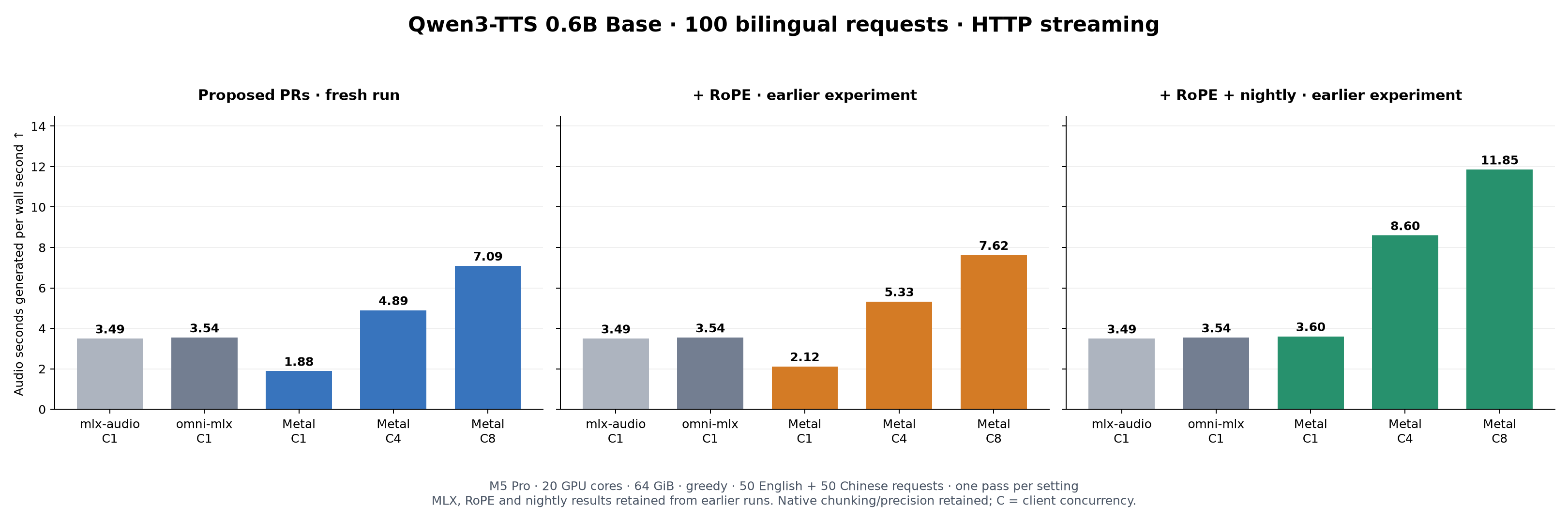 All results below predate this rebase. “Proposed PRs (fresh)” in the figure refers to `f2887704`; the RoPE and nightly panels are earlier experiments. These are not measurements of the rebased head. | Version | C | Total time (s) | Audio s/s | First audio (ms) | | --- | ---: | ---: | ---: | ---: | | mlx-audio (earlier) | 1 | 149.65 | 3.491 | 169.3 | | vllm-omni-mlx (earlier) | 1 | 147.45 | 3.543 | 66.5 | | PR before rebase (`f2887704`) | 1 | 271.46 | 1.884 | 407.9 | | PR before rebase (`f2887704`) | 4 | 104.62 | 4.894 | 539.7 | | PR before rebase (`f2887704`) | 8 | 72.18 | 7.090 | 753.9 | | + RoPE (earlier) | 1 | 241.63 | 2.117 | 407.9 | | + RoPE (earlier) | 4 | 96.63 | 5.325 | 532.7 | | + RoPE (earlier) | 8 | 67.82 | 7.621 | 767.8 | | + RoPE + nightly (earlier) | 1 | 143.28 | 3.603 | 196.4 | | + RoPE + nightly (earlier) | 4 | 59.90 | 8.596 | 290.1 | | + RoPE + nightly (earlier) | 8 | 43.66 | 11.848 | 431.4 | <details> <summary>Measurement setup</summary> - M5 Pro, 20 GPU cores, 64 GiB, macOS 27.0.1. Same unquantized checkpoint, ordered texts, reference audio and eight excluded warmups. Real HTTP streaming, greedy decoding, repetition penalty 1.5, automatic language selection, and a 1024-token cap. One 100-request pass per setting. C denotes client concurrency, not a fixed decode batch size. - Pre-rebase PR runs: Metal `f2887704`, installed Omni preview `4bb27684`, PyTorch 2.13.0, vLLM 0.31.0. Installed runtime sources were checked against the pinned preview. Stage-0 active-request peaks reached 1/4/8. No thermal warnings or swap-outs during timed windows; desktop activity was not isolated. - Earlier runs: Metal `85ef619`, Omni `d3e17ab`; RoPE used PyTorch 2.13.0, and the nightly arm used 2.16.0.dev20261013. The nightly includes [pytorch/pytorch#200181](pytorch/pytorch#200181) and other upstream changes. - Earlier baselines: mlx-audio 0.5.8; vllm-omni-mlx `210cc4e`; MLX 0.32.1. Audio s/s is generated audio duration divided by wall time; first audio is mean client latency. Framework-native precision, prompting, repetition history and chunking differ. Single passes do not estimate run-to-run variation. </details> <details> <summary>Previously reported validation (before this rebase)</summary> - All 300 pre-rebase timed requests completed below the output cap. C1 PCM matches the prior validated run for all 100 utterances. C4/C8 match 21/100 and 2/100; concurrent generation is not claimed to be bit-identical. ASR was not rerun for those concurrent outputs. For model additions, follow the [contributor pattern](https://github.com/vllm-project/vllm-metal/blob/ran/omni-qwen3-tts/docs/pytorch-mps.md#adding-omni-models). </details> ## Earlier KV reuse measurement Base 0.6B, BF16, M5 Pro (64 GiB), PyTorch 2.13.0, vLLM 0.32.0. Same 50 EN + 50 ZH Seed-TTS requests in each setting; only predictor KV reuse changes. | HTTP concurrency | KV off: audio s/s | KV on: audio s/s | Speedup | | --- | ---: | ---: | ---: | | C=1 | 1.795 | 1.917 | **1.07×** | | C=8 | 5.688 | 7.132 | **1.25×** | C is client concurrency, not a fixed decode batch. The fixed-batch predictor measurements are in #8949. <details> <summary>Validation and benchmark setup</summary> Metal `8073051b`, Omni preview `c2b3c229`. Native artifacts rebuilt from this checkout; `PYTORCH_ENABLE_MPS_FALLBACK=0`. - **167 passed, 10 skipped:** platform 135/10; MPS backend 28; real CustomVoice HTTP 4 (streaming at C=1/4/8 and rejection of random sampling). - Base serving benchmark: **400/400 completed, zero failures**, using upstream `vllm-omni bench serve --omni --backend openai-audio-speech`. One pass per setting; 50 requests per locale, with four warmups and the tool's initial probe per locale. The server used the built Metal adapter and packaged profile. - C=1 wall time: 290.19 → 271.79 s; generated audio: 520.96 → 521.04 s. C=8: 91.16 → 73.12 s; audio: 518.48 → 521.52 s. Throughput is total audio / summed benchmark time. BF16 outputs need not be bit-identical; no ASR rerun. - Actual worker KV off/on dispatch confirmed separately. AC power; no observed thermal warnings or new swap-outs. Desktop not isolated; single passes do not estimate variance. - Ruff lint/format and whitespace checks passed. Built wheel includes the MPS profile and updated preview pin; `all` includes build, Omni and development extras. ```bash PYTORCH_ENABLE_MPS_FALLBACK=0 pytest tests/test_platform.py -q VLLM_METAL_BACKEND=mps PYTORCH_ENABLE_MPS_FALLBACK=0 pytest tests/test_mps_backend.py -q QWEN3_TTS_TEST_MODEL=<local-CustomVoice-checkpoint> PYTORCH_ENABLE_MPS_FALLBACK=0 \ pytest tests/test_mps_omni_serving.py -q ``` </details> --------- Signed-off-by: Ranran <ranranhaoranzhang@gmail.com>
This file contains hidden or bidirectional Unicode text that may be interpreted or compiled differently than what appears below. To review, open the file in an editor that reveals hidden Unicode characters.
Learn more about bidirectional Unicode characters
Sign up for free
to join this conversation on GitHub.
Already have an account?
Sign in to comment



Add this suggestion to a batch that can be applied as a single commit.This suggestion is invalid because no changes were made to the code.Suggestions cannot be applied while the pull request is closed.Suggestions cannot be applied while viewing a subset of changes.Only one suggestion per line can be applied in a batch.Add this suggestion to a batch that can be applied as a single commit.Applying suggestions on deleted lines is not supported.You must change the existing code in this line in order to create a valid suggestion.Outdated suggestions cannot be applied.This suggestion has been applied or marked resolved.Suggestions cannot be applied from pending reviews.Suggestions cannot be applied on multi-line comments.Suggestions cannot be applied while the pull request is queued to merge.Suggestion cannot be applied right now. Please check back later.
Stacked on #1001 (PR5).
Qwen3's eager MPS RoPE path performs separate cache lookup, rotation, and output assembly operations. This PR applies packed Q/K rotation in one Metal dispatch, using vLLM's existing model definitions and cosine/sine caches.
The kernel handles FP16/BF16 full-head NeoX RoPE. Other rotary variants retain vLLM's native implementation. The shader is bundled in the wheel and loaded through
torch.mps.load_metallib; no new dependency or C++ launcher is added.Parity
PyTorch-MPS vs native MLX-LM on b32095fe, using matching BF16 checkpoints and input token IDs: 40 prompts, 16 output tokens, request batches 1 and 2, prefix caching off, and optional CPU fallback disabled.
Cells report EXACT / TOP_K_MATCH / FAIL. Top-5 requires mutual membership at the first divergence; later continuation tokens are not compared. All 320 MPS output token sequences are identical to PR4.
Checkpoints and environment
Apple M5 Pro, 64 GiB; vLLM 0.31.0, PyTorch 2.13.0, MLX 0.32.1, MLX-LM 0.32.0. Runs use prebuilt native artifacts. The built wheel also completed Qwen3 generation with compiler imports blocked and TileLang absent; 448 fused RoPE calls were observed.
c1899de289a04d12100db370d81485cdf75e47cade940610ab5d45b4fedbd37e08444d0dc502837c48d788eca847d4d7548f375ad03d3c9312f6139edf58c174f05ff733f83f8cae10ea9298224c8006Performance
Qwen3-0.6B BF16, Sonnet 1024/128, 100 requests at 10/s, concurrency 32. Means of two fresh-server runs per path, in PR4/PR5/PR5/PR4 order.
Benchmark setup and individual runs
PR4 3f0c9afd vs PR5 b32095fe, on the same M5 Pro and software environment as the parity runs. Both paths use BF16, async scheduling, max model length/batched tokens 2048, block size 16, 2,340 KV blocks, prefix caching off, seed 0, greedy decoding, four warmups, and no logprobs. Each run completed 100 timed requests with 101,230 input tokens, 12,800 output tokens, identical input lengths, and zero preemptions.
AC power; no recorded thermal/performance warnings. Desktop activity was not isolated. About 7.7 GiB of swap was already allocated; 7.5–33.8 MiB of swap-ins and no swap-outs were recorded per run. The individual results show the observed variation.
For each checkout, start a fresh server:
After the server is ready, run the client from another terminal. Use a separate result directory for each run: