Skip to content

Conversation

@robertnishihara
Copy link
Collaborator

@robertnishihara robertnishihara commented Jan 7, 2019

This does part of #3411. Earlier versions include #3629 and #3666. This is a breaking API change. However, we log a warning when an integer is passed into ray.wait.

@AmplabJenkins
Copy link

Test FAILed.
Refer to this link for build results (access rights to CI server needed):
https://amplab.cs.berkeley.edu/jenkins//job/Ray-PRB/10641/
Test FAILed.

@AmplabJenkins
Copy link

Test FAILed.
Refer to this link for build results (access rights to CI server needed):
https://amplab.cs.berkeley.edu/jenkins//job/Ray-PRB/10646/
Test FAILed.

@AmplabJenkins
Copy link

Test PASSed.
Refer to this link for build results (access rights to CI server needed):
https://amplab.cs.berkeley.edu/jenkins//job/Ray-PRB/10655/
Test PASSed.

@AmplabJenkins
Copy link

Test PASSed.
Refer to this link for build results (access rights to CI server needed):
https://amplab.cs.berkeley.edu/jenkins//job/Ray-PRB/10665/
Test PASSed.

@suquark
Copy link
Member

suquark commented Jan 8, 2019

I think we should also document it about this change. It is quite important to notify existing users about it, because this breaking change will not introduce exceptions for old code; instead users could think that ray.wait just stop working. 1000x slower looks like being stuck in most cases.

Returns:
copy (Filter): Copy of self"""
A copy of self.
"""
Copy link
Collaborator Author

Choose a reason for hiding this comment

The reason will be displayed to describe this comment to others. Learn more.

I needed to make this change to build the documentation locally.

Copy link
Contributor

Choose a reason for hiding this comment

The reason will be displayed to describe this comment to others. Learn more.

lgtm

@robertnishihara
Copy link
Collaborator Author

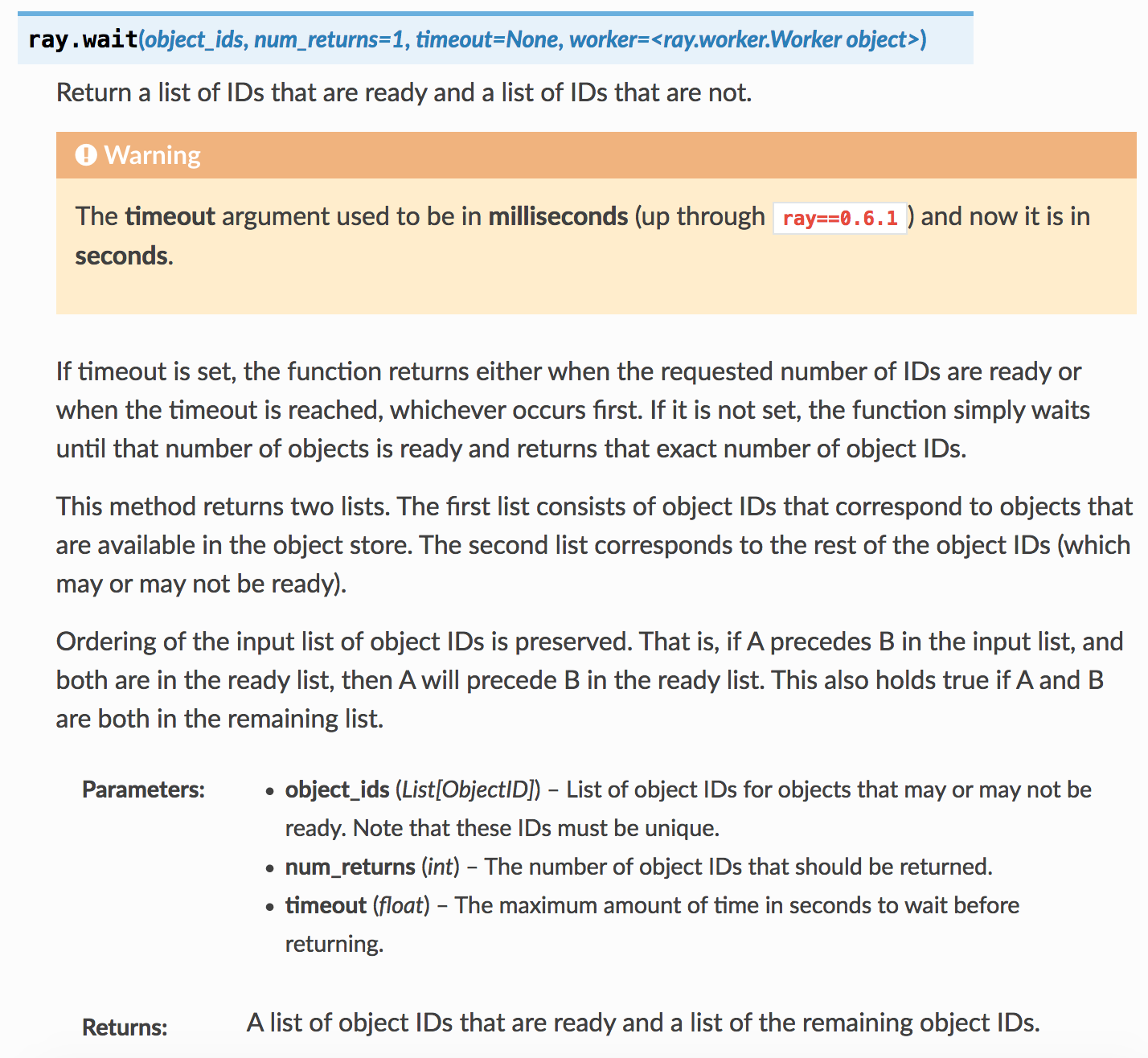
@suquark I added a prominent warning to the API documentation. It should now look like this

screen shot 2019-01-08 at 1 31 56 pm

@AmplabJenkins
Copy link

Test PASSed.
Refer to this link for build results (access rights to CI server needed):
https://amplab.cs.berkeley.edu/jenkins//job/Ray-PRB/10688/
Test PASSed.

@raulchen
Copy link
Contributor

raulchen commented Jan 9, 2019

What is the purpose of this change? Is it because we want wait to be more aligned with Python's built-in functions like time.sleep?

Also, I'm afraid this change may be dangerous . As @suquark mentioned, if users didn't notice the document, their old code can still run with no exception. But wait just get 1000x slow. And this may even cause application logic error (assuming application logic may depending on the timeout).

If we do want to make this change. I think a safer way is to add another timeout_seconds parameter, and throw an exception if the users still use timeout parameter.

@pcmoritz
Copy link
Contributor

pcmoritz commented Jan 9, 2019

@raulchen The reason for this PR is that python uses function(timeout=seconds) universally when there are timeouts.

We could also deal with this is to raise a deprecation warning for some grace period and keep the interpretation as milliseconds if the timeout is an int, and interpret it in seconds if it is a float (and raise no deprecation warning). Once we have done that for one release say, we change the behavior to be seconds for both ints and floats and remove the warning.

Copy link
Contributor

@pcmoritz pcmoritz left a comment

Choose a reason for hiding this comment

The reason will be displayed to describe this comment to others. Learn more.

The warning looks good to me and should be enough.

@pcmoritz pcmoritz merged commit d1e21b7 into ray-project:master Jan 9, 2019
@robertnishihara robertnishihara deleted the timeoutseconds branch January 9, 2019 06:16
@robertnishihara
Copy link
Collaborator Author

@raulchen I agree it is definitely not ideal, but I think for Python users this will be much more intuitive. I'm hoping the warning messages will be sufficiently prominent.

Shall we do the same thing in the Java API? I'm not actually sure what would be most intuitive for Java users, e.g., Thread.sleep seems to take milliseconds [1], future.get takes an int and a time unit [2]

[1] https://www.tutorialspoint.com/java/lang/thread_sleep_millis.htm
[2] https://docs.oracle.com/javase/8/docs/api/java/util/concurrent/Future.html#get-long-java.util.concurrent.TimeUnit-

@raulchen
Copy link
Contributor

raulchen commented Jan 9, 2019

@raulchen I agree it is definitely not ideal, but I think for Python users this will be much more intuitive. I'm hoping the warning messages will be sufficiently prominent.

Shall we do the same thing in the Java API? I'm not actually sure what would be most intuitive for Java users, e.g., Thread.sleep seems to take milliseconds [1], future.get takes an int and a time unit [2]

[1] https://www.tutorialspoint.com/java/lang/thread_sleep_millis.htm
[2] https://docs.oracle.com/javase/8/docs/api/java/util/concurrent/Future.html#get-long-java.util.concurrent.TimeUnit-

  1. old Java API usually use long values in milliseconds for timeouts;
  2. TimeUnit was introduced in Java 1.5, and is commonly used in the concurrent lib.
  3. Java 8 introduced another Duration class to represent a period of time.

I don't prefer 2, because it requires 2 parameters for timeout. 1 and 3 are both okay.

Sign up for free to join this conversation on GitHub. Already have an account? Sign in to comment

Labels

None yet

Projects

None yet

Development

Successfully merging this pull request may close these issues.

6 participants