[WIP] New algorithm for RB using transpiled Cliffords #851
There are no files selected for viewing
| Original file line number | Diff line number | Diff line change |
|---|---|---|
|
|
@@ -13,13 +13,26 @@ | |
| Utilities for using the Clifford group in randomized benchmarking | ||
| """ | ||
|
|
||
| import os | ||
| from typing import List | ||
| from functools import lru_cache | ||
| from math import isclose | ||
| import numpy as np | ||
|
|
||
| from qiskit import QuantumCircuit, QuantumRegister | ||
| from qiskit.circuit import Gate | ||
| from qiskit.circuit.library import SdgGate, HGate, SGate, SXdgGate | ||
| from qiskit.exceptions import QiskitError | ||
| from qiskit.quantum_info import Clifford | ||
|
|
||
| from .clifford_data import ( | ||
| CLIFF_SINGLE_GATE_MAP_1Q, | ||
| CLIFF_SINGLE_GATE_MAP_2Q, | ||
| CLIFF_COMPOSE_DATA_1Q, | ||
| CLIFF_COMPOSE_DATA_2Q, | ||
| CLIFF_INVERSE_DATA_1Q, | ||
| CLIFF_INVERSE_DATA_2Q, | ||
| ) | ||
|
|
||
|
|
||
| class VGate(Gate): | ||
|
|
@@ -64,67 +77,35 @@ class CliffordUtils: | |
| (2, 2, 3, 3, 3, 3, 4, 4), | ||
| (2, 2, 3, 3, 4, 4), | ||
| ] | ||
| GENERAL_CLIFF_LIST = ["id", "h", "sdg", "s", "x", "sx", "sxdg", "y", "z", "cx"] | ||
| TRANSPILED_CLIFF_LIST = ["sx", "rz", "cx"] | ||
|
Collaborator
There was a problem hiding this comment. This assumes a particular IBM-ish backend. Other providers may use different basis set depending on their hardware architecture, or, even us may want to use different set, e.g. "ecr" rather than "cx" which are locally equivalent.
Contributor
There was a problem hiding this comment. It is difficult to make the code efficient without optimizing it for a specific set of basis gates.
Collaborator
There was a problem hiding this comment. Right, but Qiskit is backend agnostic. This violates very important policy of Qiskit. |
||
| CLIFF_SINGLE_GATE_MAP = {1: CLIFF_SINGLE_GATE_MAP_1Q, 2: CLIFF_SINGLE_GATE_MAP_2Q} | ||
| CLIFF_COMPOSE_DATA = {1: CLIFF_COMPOSE_DATA_1Q, 2: CLIFF_COMPOSE_DATA_2Q} | ||
| CLIFF_INVERSE_DATA = {1: CLIFF_INVERSE_DATA_1Q, 2: CLIFF_INVERSE_DATA_2Q} | ||
|
|
||
| @classmethod | ||
| def clifford_1_qubit(cls, num): | ||
|
Collaborator
There was a problem hiding this comment. I was planning to deprecate
Contributor
Author
There was a problem hiding this comment. We could remove
Contributor
There was a problem hiding this comment. When the method does not access any class-relevant data (i.e. doesn't use the
Collaborator
There was a problem hiding this comment. Right, but still these are just a collection of functions. I wonder why these must be class methods, i.e. from qiskit_experiments.library.randomized_benchmarking import clifford_utils
clifford_utils.clifford_1_qubits(...)v.s. from qiskit_experiments.library.randomized_benchmarking.clifford_utils import CliffordUtils
CliffordUtils.clifford_1_qubits(...) |
||
| """Return the 1-qubit clifford element corresponding to `num` | ||
| where `num` is between 0 and 23. | ||
| """ | ||
| return Clifford(cls.clifford_1_qubit_circuit(num), validate=False) | ||
|
|
||
| @classmethod | ||
| def clifford_2_qubit(cls, num): | ||
| """Return the 2-qubit clifford element corresponding to `num` | ||
| where `num` is between 0 and 11519. | ||
| """ | ||
|
merav-aharoni marked this conversation as resolved.
|
||
|
merav-aharoni marked this conversation as resolved.
|
||
| return Clifford(cls.clifford_2_qubit_circuit(num), validate=False) | ||
|
|
||
| @classmethod | ||
| @lru_cache(maxsize=24) | ||
| def clifford_1_qubit_circuit(cls, num): | ||
| """Return the 1-qubit clifford circuit corresponding to `num` | ||
| where `num` is between 0 and 23. | ||
| """ | ||
| # pylint: disable=unbalanced-tuple-unpacking | ||
| # This is safe since `_unpack_num` returns list the size of the sig | ||
| (i, j, p) = cls._unpack_num(num, cls.CLIFFORD_1_QUBIT_SIG) | ||
| qr = QuantumRegister(1) | ||
| qc = QuantumCircuit(qr) | ||
| if i == 1: | ||
|
|
@@ -141,12 +122,13 @@ def clifford_1_qubit_circuit(self, num): | |
| qc.z(0) | ||
| return qc | ||
|
|
||
| @classmethod | ||
| @lru_cache(maxsize=11520) | ||
| def clifford_2_qubit_circuit(cls, num): | ||
| """Return the 2-qubit clifford circuit corresponding to `num` | ||
| where `num` is between 0 and 11519. | ||
| """ | ||
| vals = cls._unpack_num_multi_sigs(num, cls.CLIFFORD_2_QUBIT_SIGS) | ||
| qr = QuantumRegister(2) | ||
| qc = QuantumCircuit(qr) | ||
| if vals[0] == 0 or vals[0] == 3: | ||
|
|
@@ -195,7 +177,8 @@ def clifford_2_qubit_circuit(self, num): | |
| qc.z(1) | ||
| return qc | ||
|
|
||
|
Contributor
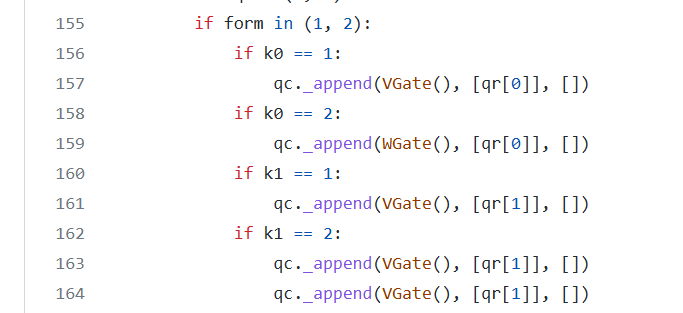
There was a problem hiding this comment. In lines 206-207 above - can replace: by:
Contributor
Author
There was a problem hiding this comment. Why is this equivalent? I can't see it. I also tried running and comparing the two, and didn't get the same.
Contributor
There was a problem hiding this comment. One can replace two VGate by one WGate. VGate is of order 3, and WGate is the inverse of VGate.
|
||
| @staticmethod | ||
| def _unpack_num(num, sig): | ||
| r"""Returns a tuple :math:`(a_1, \ldots, a_n)` where | ||
| :math:`0 \le a_i \le \sigma_i` where | ||
| sig=:math:`(\sigma_1, \ldots, \sigma_n)` and num is the sequential | ||
|
|
@@ -207,7 +190,8 @@ def _unpack_num(self, num, sig): | |
| num //= k | ||
| return res | ||
|
|
||
| @classmethod | ||
| def _unpack_num_multi_sigs(cls, num, sigs): | ||
| """Returns the result of `_unpack_num` on one of the | ||
| signatures in `sigs` | ||
| """ | ||
|
|
@@ -216,6 +200,104 @@ def _unpack_num_multi_sigs(self, num, sigs): | |
| for k in sig: | ||
| sig_size *= k | ||
| if num < sig_size: | ||
| return [i] + cls._unpack_num(num, sig) | ||
| num -= sig_size | ||
| return None | ||
|
|
||
| @classmethod | ||
| def num_from_clifford_single_gate(cls, inst, qubits, rb_num_qubits, basis_gates): | ||
| """ | ||
| This method does the reverse of clifford_1_qubit_circuit and clifford_2_qubit_circuit - | ||
| given a clifford, it returns the corresponding integer, with the mapping | ||
| defined in the above method. | ||
| The mapping is in the context of the basis_gates. Therefore, we define here | ||
| the possible supersets of basis gates, and verify that the given inst belong to | ||
| one of these sets. | ||
| """ | ||
| name = inst.name | ||
| gates_with_delay = basis_gates.copy() | ||
| gates_with_delay.append("delay") | ||
|
|
||
| if not name in gates_with_delay: | ||
| raise QiskitError("Instruction {} is not in the basis gates".format(inst.name)) | ||
| if set(basis_gates).issubset(set(cls.GENERAL_CLIFF_LIST)): | ||
| if name == "delay": | ||
| return 0 | ||
| map_index = name | ||
|
|
||
| if set(basis_gates).issubset(set(cls.TRANSPILED_CLIFF_LIST)): | ||
| if name in {"sx", "cx"}: | ||
| map_index = name | ||
| elif name == "delay": | ||
|
Contributor
There was a problem hiding this comment. You can do this check once in the beginning of the method |
||
| return 0 | ||
| elif name == "rz": | ||
| # The next two are identical up to a phase, which makes no difference | ||
| # for the associated Cliffords | ||
| if isclose(inst.params[0], np.pi) or isclose(inst.params[0], -np.pi): | ||
| map_index = "z" | ||
| elif isclose(inst.params[0], np.pi / 2): | ||
| map_index = "s" | ||
| elif isclose(inst.params[0], -np.pi / 2): | ||
| map_index = "sdg" | ||
| else: | ||
| raise QiskitError("wrong param {} for rz in clifford".format(inst.params[0])) | ||
| else: | ||
| raise QiskitError( | ||
| "Instruction {} could not be converted to Clifford gate".format(name) | ||
| ) | ||
|
|
||
| return cls.CLIFF_SINGLE_GATE_MAP[rb_num_qubits][(map_index, str(qubits))] | ||
|
|
||
| @classmethod | ||
| def compose_num_with_clifford( | ||
| cls, num_qubits: int, composed_num: int, qc: QuantumCircuit, basis_gates: List[str] | ||
| ) -> int: | ||
| """Compose a number that represents a Clifford, with a single-gate Clifford, and return the | ||
| number that represents the resulting Clifford.""" | ||
|
|
||
| # The numbers corresponding to single gate Cliffords are not in sequence - | ||
| # see num_from_1q_clifford_single_gate. To compute the index in | ||
| # the array CLIFF_COMPOSE_DATA_1Q, we map the numbers to [0, 8]. | ||
| map_clifford_num_to_array_index = {} | ||
| num_single_gate_cliffs = len(cls.CLIFF_SINGLE_GATE_MAP[num_qubits]) | ||
| for k in list(cls.CLIFF_SINGLE_GATE_MAP[num_qubits]): | ||
| map_clifford_num_to_array_index[cls.CLIFF_SINGLE_GATE_MAP[num_qubits][k]] = list( | ||
| cls.CLIFF_SINGLE_GATE_MAP[num_qubits].keys() | ||
| ).index(k) | ||
| if num_qubits == 1: | ||
| for inst, qargs, _ in qc: | ||
| num = cls.num_from_clifford_single_gate( | ||
| inst=inst, qubits=[0], rb_num_qubits=1, basis_gates=basis_gates | ||
| ) | ||
| index = num_single_gate_cliffs * composed_num + map_clifford_num_to_array_index[num] | ||
| composed_num = cls.CLIFF_COMPOSE_DATA[num_qubits][index] | ||
| else: | ||
| for inst, qargs, _ in qc: | ||
| if inst.num_qubits == 2: | ||
| qubits = [qc.find_bit(qargs[0]).index, qc.find_bit(qargs[1]).index] | ||
| else: | ||
| qubits = [qc.find_bit(qargs[0]).index] | ||
| num = cls.num_from_clifford_single_gate( | ||
| inst=inst, qubits=qubits, rb_num_qubits=2, basis_gates=basis_gates | ||
| ) | ||
| index = num_single_gate_cliffs * composed_num + map_clifford_num_to_array_index[num] | ||
| composed_num = cls.CLIFF_COMPOSE_DATA[num_qubits][index] | ||
| return composed_num | ||
|
|
||
| @classmethod | ||
| def clifford_inverse_by_num(cls, num: int, num_qubits: int): | ||
| """Return the number of the inverse Clifford to the input num""" | ||
| return cls.CLIFF_INVERSE_DATA[num_qubits][num] | ||
|
|
||
| @staticmethod | ||
| def file_name(num_qubits, basis_gates): | ||
| """Return the name of the file containing the transpiled Cliffords""" | ||
| suffix = "" | ||
| for n in basis_gates[0:-1]: | ||
| suffix += "_" + n | ||
| if num_qubits == 2: | ||
| suffix += "_" + basis_gates[-1] | ||
| circs_file_name = "/transpiled_circs_" + str(num_qubits) + "q" + suffix + ".qpy" | ||
|
Contributor
There was a problem hiding this comment. another possibility: |
||
| root_dir = os.path.dirname(os.path.abspath(__file__)) | ||
| transpiled_circs_file = root_dir + circs_file_name | ||
|
Contributor
There was a problem hiding this comment. Using |
||
| return transpiled_circs_file | ||


There was a problem hiding this comment.
Choose a reason for hiding this comment
The reason will be displayed to describe this comment to others. Learn more.
Why not use this set as a default if the user does not pass this option?
There was a problem hiding this comment.
Choose a reason for hiding this comment
The reason will be displayed to describe this comment to others. Learn more.
It is possible. The question is whether we think it is better to have a default, or to make sure the user specifies their needs. @nkanazawa1989 , @ShellyGarion ? what do you think?
Uh oh!
There was an error while loading. Please reload this page.
There was a problem hiding this comment.
Choose a reason for hiding this comment
The reason will be displayed to describe this comment to others. Learn more.
RB experiment itself should be general. Experiment must define a protocol, not executable (target) code.