[lenny] integrate upstream block/main bfc3848558 (8 commits) - #28
Open
mfethe1 wants to merge 19 commits into
Open
[lenny] integrate upstream block/main bfc3848558 (8 commits)#28mfethe1 wants to merge 19 commits into
mfethe1 wants to merge 19 commits into
Conversation


## Summary Inline code on mobile renders as **bold body text on a faint background wash** — no monospace face, no chip, and it cannot wrap. block#5257 diagnosed this as a missing `highlightBuilder`. That is no longer the right fix. `gpt_markdown` 1.2.0 deprecates `highlightBuilder` (removal in 2.0.0), renders inline code as a real chip, and adds `InlineCodeStyle` for restyling it. The package author confirmed this on the issue. So this PR is an upgrade — 1.1.6 → 1.2.1 — plus one theme declaration, rather than the builder the issue originally asked for. **Where the style is declared.** `GptMarkdownThemeData` goes in `AppTheme._buildTheme`, which both `light()` and `dark()` call. That reaches all four `GptMarkdown` call sites — `message_content`, `transcript_item_widget`, `token_pill`, `custom_emoji_render` — so the style is stated once instead of per widget. A widget-level `inlineCodeStyle` would have covered channel messages only, leaving the other three on the package's defaults. **What is declared.** Face, size, ink, chip fill and outline — not the face alone. A face name on its own leaves the rest on the package's defaults, which put inline code at 14.1sp beside a fenced block's 13, on a neutral `onSurface` tint rather than the app's code surface. In dark that tint is *lighter* than the surface, while every other code surface in the app is recessed, so the chip read as a different kind of object. All of it now comes from one `CodeStyle` declaration that the fenced block reads from too, so the two cannot be edited apart. **Three adaptations the upgrade requires.** Each was found by running the gate, not by reading the changelog: 1. **`imageBuilder` widened** to `(context, url, width, height)`. This is a hard compile error, and it is **not listed in the package's migration guide**, which states "nothing here stops code compiling". Worth reporting upstream. 2. **`autolink` now defaults to `true`.** `normalizeBareLinks()` already rewrites bare URLs into Markdown links before rendering, so both would run. `message_content` opts out with `autolink: false` to keep current behaviour exactly. The migration guide argues for dropping the pre-processor instead — a better fix, but a behavioural change that belongs in its own PR. 3. **`gpt_markdown.dart` now re-exports `markdown_config.dart`**, making two direct imports redundant. `flutter analyze` reports `No issues found!` on 1.1.6 and flags both on 1.2.1, so these warnings are new, not pre-existing. **Deliberately out of scope.** The three non-message call sites now autolink bare URLs, since only `message_content` has a pre-processor to collide with. Custom inline components (`_MentionMd`, `CustomEmojiMd`, `_ChannelLinkMd`) could additionally declare `allScopesExceptLinkLabel` — 1.2.0 offers it as the fix for a `WidgetSpan` chip going blank inside a link label on iOS — but current behaviour is unchanged without it, so that stays a separate change. ### Related issue Fixes block#5257 Duplicate scan: searched `gpt_markdown`, `inline code mobile`, `highlightBuilder` and `InlineCodeStyle` across both PRs and issues. No open PR touches inline code styling. block#6135 (link labels) and block#6166 (text selection) also touch mobile Markdown but address different defects. ### Testing Full gate, `just ci` — exit 0: | Stage | Result | |---|---| | Rust (33 suites) | 4768 passed, 0 failed | | Desktop | 5799 passed, 0 failed | | Mobile | **2011 passed**, 0 failed | | `flutter analyze` | `No issues found!` | | Desktop + web build | ok | Run on the branch with `main` merged in, so these numbers match what CI builds. **New regression test** — `renders inline code in the app code style`. It resolves the `CodeTextSpan` the package tags inline code with, which carries both the resolved `TextStyle` and the colours the chip behind it is painted with, so face, size, ink, fill and outline are all asserted rather than a widget's presence. It is negative-controlled: reverting only the theme declaration fails it with ```text Expected: a numeric value within <0.001> of <13.0> Actual: <14.1> ``` and dropping the declaration entirely falls back to `packages/gpt_markdown/JetBrainsMono` — so the test measures the real thing, and it would catch a future regression that silently drops the theme extension. The test passes `baseStyle: messageBodyTextStyle`, the style the message surfaces actually use; the widget's own fallback is the smaller `bodyMedium`, which would move the expected size. The test finds paragraphs with `find.byWidgetPredicate((widget) => widget is RichText)`, not `find.byType(RichText)`: inline code renders through `BidiRichText`, a `RichText` subclass, and `byType` matches exact runtime types. That is a hazard for any test that reads text back out of a paragraph, and one landed after this branch was cut: `message_content_custom_emoji_test.dart` arrived with block#6996 and its `code keeps literal emoji while adjacent known tokens render` case reads a code span through `find.byType(RichText)`. It passes on `main` and fails on the merge result, which is what CI builds, so it went red only once CI was authorized. It now uses the same predicate. The two other `byType(RichText)` call sites — the rest of that file and `message_author_meta_test.dart` — were re-run and pass: their content carries no code span, so the exact type still matches. They were left alone. ### Screenshots Rendered through the real `MessageContent` widget with the app's own fonts loaded, at 390pt wide, 3x DPR. Sample text: ``Set `BUZZ_RELAY_URL` before launch, then run `just mobile-test` to verify.`` | | Before (1.1.6) | After (1.2.1) | |---|---|---| | Light | 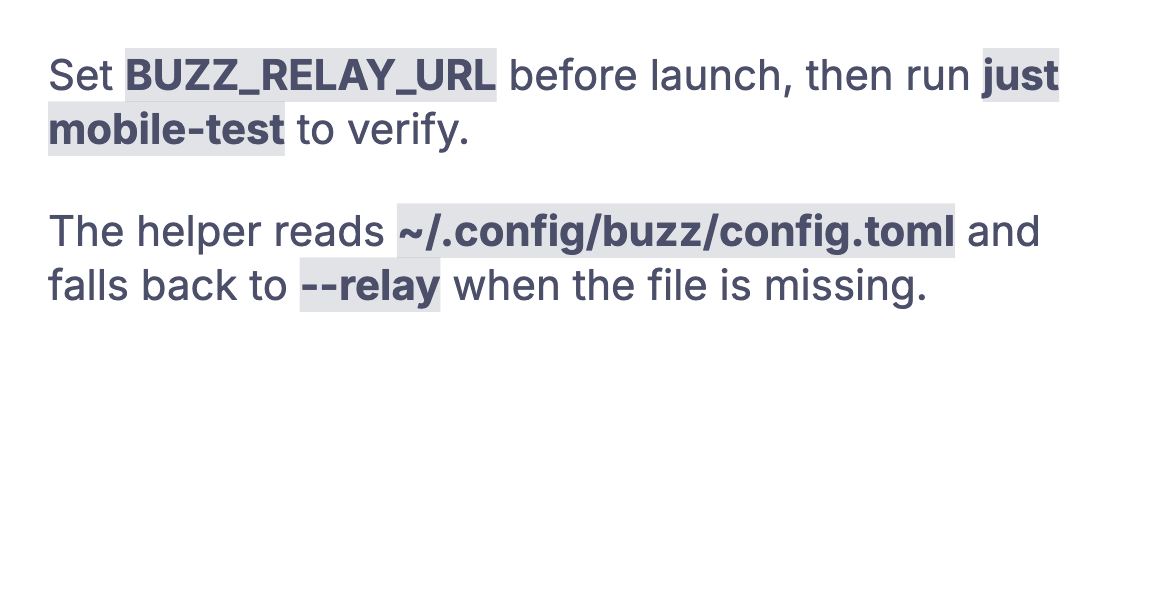 | 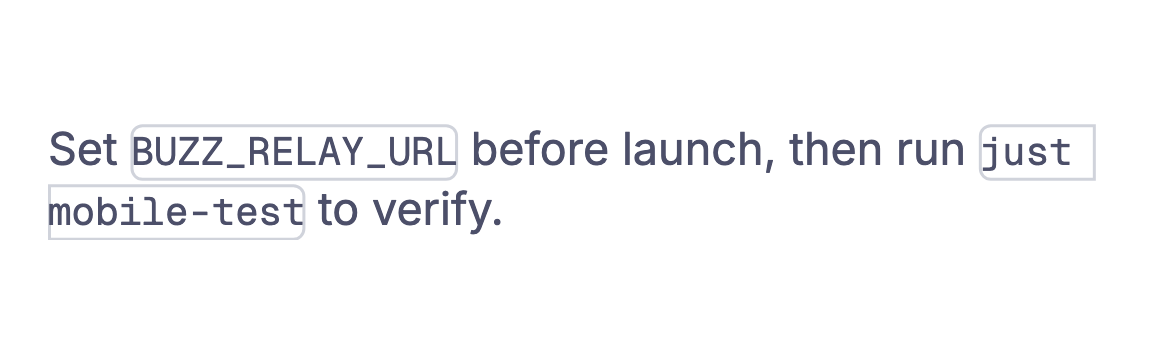 | | Dark | 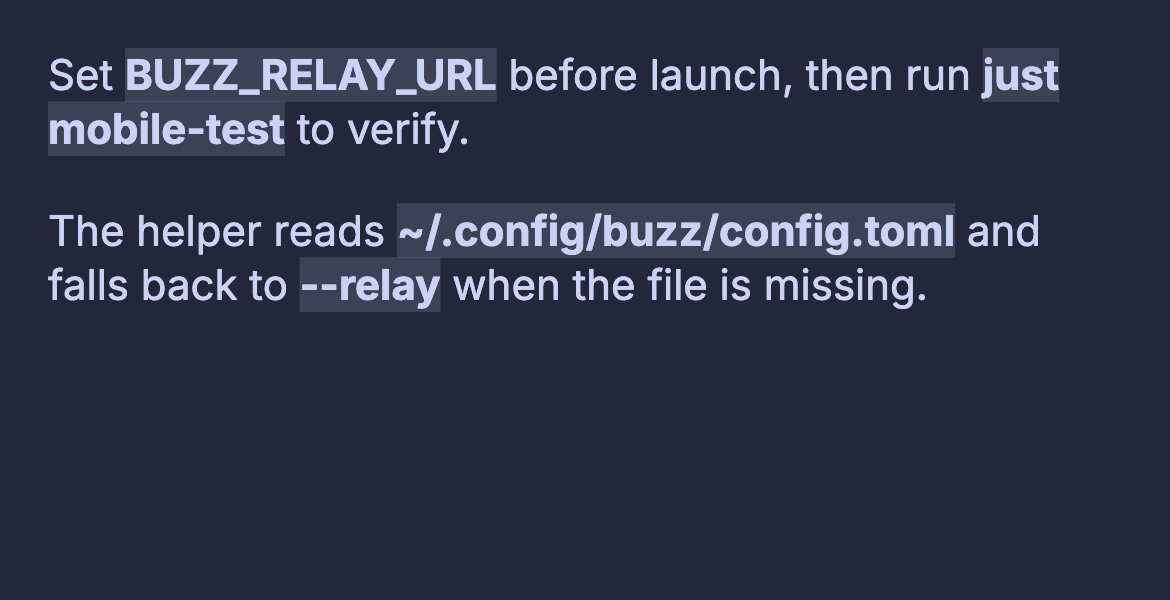 | 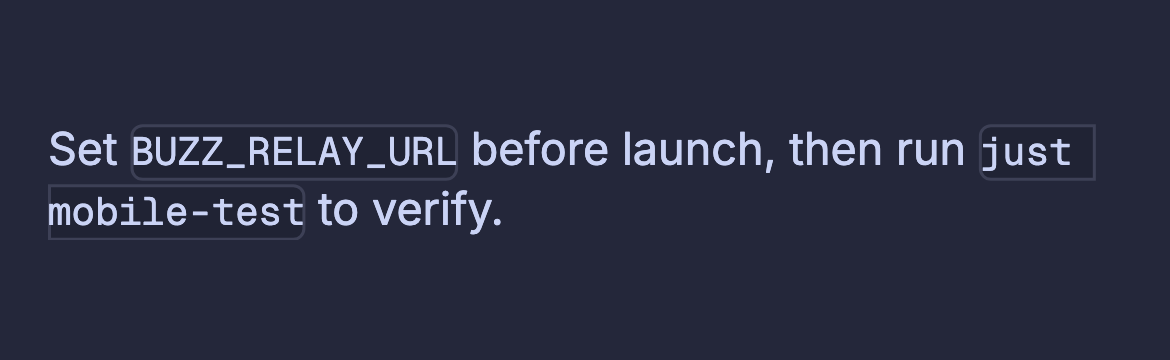 | Before: bold Inter on a flat wash, no chip edge, and `just mobile-test` breaks across the line with the wash simply ending. After: Geist Mono in a bordered, rounded chip, and the wrapped fragment gets its own chip on each line. --------- Signed-off-by: Tolga Cinisli <tolgacinisli@gmail.com> Co-authored-by: Tolga Cinisli <tolgacinisli@gmail.com>

…#7340)

## Summary

Adds an independent deadline wakeup so held thread work dispatches after
its 10-second bound even when the relay loop is otherwise quiet. Fences
session ownership by generation so a worker returning after a fork
cannot make an older provider session claimable again.

This follows up on the two post-merge findings from
[block#7337](block#7337 (review)).

### Related issue

Follow-up to block#7337.

### Testing

- `cargo test -p buzz-acp`
- `cargo clippy -p buzz-acp --all-targets -- -D warnings`
- Pre-push file-size, differential Rust test, and desktop Tauri gates

No UI changes.

---
**Update Sep 4, 15:35:** Addressed both Codex review findings.
- Queue-cap eviction now prunes orphaned hold deadlines.
- An expired hold stays expired until a worker is successfully claimed.
- Hold timers remain disabled while every worker is busy; worker return
wakes dispatch directly.
- Added regressions for queue eviction and pool exhaustion.

Generated with Codex

---------

Signed-off-by: Salman Mohammed <smohammed@squareup.com>


## Summary
Route Databricks Unity Catalog model services to OpenAI Responses when
their service name matches GPT-5 or newer. These models can reject tools
plus reasoning on Chat Completions.

Match only the service component, using the existing family-token
boundaries and a numeric major version. Catalog and schema names cannot
select the protocol. Keep neutral effort capabilities and the full model
ID unchanged; other services still use MLflow Chat Completions.

Keep the Rust and desktop resolvers in sync, add shared boundary cases
and a captured-HTTP regression for completion and summarization, and
update the documented FQN rule.

### Related issue
No duplicate found in searches for “FQN responses” PRs or “astra”
issues. Related: block#6918 introduced Unity Catalog discovery.

Originating conversation:
buzz://message?channel=0b881928-a3a6-4c01-b981-8e64268f01ce&id=770949343bc96a9ed88acd90a1b37d358a0efc52c79237d0fdb491ce02b8d4ed

### Testing
No live Databricks inference test. The gateway must accept the full
model-service ID on its OpenAI Responses route; this remains the
integration risk.

The local `just ci` attempt exceeded its five-minute deadline during
`mobile-check`, so the full repository gate was not completed. All
push-hook checks passed.

Generated with Codex

Signed-off-by: Fizz <400e8babadcee6a7f420103f10a2849d84c4a9c71d5bd04f3948c814216648a3@buzz.block.builderlab.xyz>
Co-authored-by: Fizz <400e8babadcee6a7f420103f10a2849d84c4a9c71d5bd04f3948c814216648a3@buzz.block.builderlab.xyz>


…lock#6189)

Upgrades Buzz's mesh-llm dependencies through the released `v0.76.0-rc8`
tag (`2040765d`), including the Qwen3.8 curated recommendation and rc8's
scheduler/runtime improvements.

**Scope note:** the earlier open-relay/unenforced-admission mode has
been removed from this PR at Mic's direction — it is not a product mode
we want. Mesh admission remains roster/allowlist driven, exactly as on
`main`: on a relay with no NIP-43 membership snapshot the mesh runs
self-only. No NIP-11 mode probing, no mode-transition restarts. A future
perimeter/admission strategy for open relays will be designed
separately.

This PR also:
- seeds `BUZZ_AGENT_LLM_TIMEOUT_SECS=660` for mesh agents, above
MeshLLM's 600-second backend timeout;
- makes `desktop-tauri-clippy` lint both default and `mesh-llm` cfg
graphs;
- runs the feature-enabled desktop test suite in CI;
- recommends Qwen3.8 27B Q4_K_M for 64 GB-and-larger machines, then
ladders down through Gemma 4 E4B and Qwen 9B for smaller machines;
- keeps stored shared-compute `auto` translated to MeshLLM's supported
wire model `mesh`.

RC8 verification:
- `just ci` passed locally at
`92ecc7ec933bdd4df804cc9f28a2b51efa5313c5`.
- Pre-push differential gates passed, including both desktop Tauri cfg
graphs and package tests.
- A prior isolated runtime smoke used the RC8 binary's OpenAI endpoint
for a Buzz-shaped system/user/tool/tool-result/final-response loop; all
assertions passed and the isolated process was shut down.

Perf previously measured on M5 Metal, Qwen3.8-27B-Q4_K_M: TTFT 0.22–0.32
s, ~25 tok/s streaming; agent-shaped turns ~1 s to first token after the
first (prefix cache).

---------

Signed-off-by: Michael Neale <michael.neale@gmail.com>
Signed-off-by: Jimmy <1fe240cd1a8cf775f6f3060f115e5a303181f3abf28ad4cb0c2515f4a02b36a8@meshllm.communities.buzz.xyz>
Signed-off-by: Alessandro Joabar <sandro@squareup.com>
Co-authored-by: Michael Neale <michael.neale@gmail.com>
Co-authored-by: Jimmy <1fe240cd1a8cf775f6f3060f115e5a303181f3abf28ad4cb0c2515f4a02b36a8@meshllm.communities.buzz.xyz>
Co-authored-by: Mic Neale <305999590+micspiral@users.noreply.github.com>
Co-authored-by: Alessandro Joabar <sandro@squareup.com>

**Category:** fix
**User Impact:** Link previews can keep loading while a message is being
composed, while sending still has a finite escape hatch and stalled
network transports cannot occupy preview slots forever.

**Problem:** Native metadata and image deadlines could collapse slow
previews into fallback cards while the user was still composing, and a
shared image-host cooldown made pasted batches fail inconsistently after
one rate limit. **Solution:** Keep preview resolution user-paced with no
aggregate request deadline, bound transport inactivity (15s DNS/connect,
30s idle read), serialize image requests by host, and allow at most one
server-directed cooldown wait of up to 30s across an image fetch and its
redirects. The existing bounded post-Send preparation and immediate Skip
paths remain unchanged.

<details>
<summary>File changes</summary>

**desktop/src-tauri/src/commands/link_preview.rs**
Removes aggregate native deadlines so composer metadata work can
complete at the user's pace, while retaining DNS/connect/idle-read
liveness bounds. Adds bounded host-paced image request coordination that
releases its gate during cooldown, waits inline at most once for at most
30 seconds, and cannot renew that wait through redirects or the outer
transient retry. Same-host image and favicon requests remain
deliberately serialized to align with host rate limits.

**desktop/src-tauri/src/commands/link_preview_rate_limit.rs**
Adds a fixed-size striped host gate so concurrent image requests are
serialized without retaining an unbounded attacker-controlled hostname
map.

**desktop/src-tauri/src/commands/link_preview_tests.rs**
Moves native link-preview tests into a dedicated module and covers the
user-paced metadata contract, bounded one-shot cooldown behavior, and
gate release while a rate-limited request sleeps—including a different
host sharing the same bounded gate stripe.

**desktop/src-tauri/src/commands/link_preview_youtube.rs**
Removes the thumbnail fetch deadline so YouTube previews follow the same
composer lifecycle contract while using the shared bounded transport.

**desktop/src/shared/lib/useResolvedLinkPreviews.ts**
Adds development-only metadata outcome diagnostics with elapsed time and
image/fallback state, without logging encoded image payloads.

</details>

### Reproduction steps

1. Open the desktop composer and paste several GitHub pull request links
whose OpenGraph images share a host.
2. Observe that image requests are paced by host instead of racing, and
slow-but-progressing preview work remains pending rather than
immediately becoming a completed favicon fallback.
3. Send while preview work is still pending and confirm **Preparing link
preview** remains bounded by the existing post-Send budget.
4. Use **Skip** during preparation and confirm the message proceeds
immediately.
5. In a development build, inspect the console for `[link-preview]
metadata fetch completed` diagnostics containing elapsed time and image
state without base64 payloads.

### Related issue

N/A — scoped from the linked Buzz implementation room.

### Testing

At current head `dfb394aafbee537e9ffb04ad3732d08f65f30b8e`:

- Production-bound paused-time metadata regression passed through
`fetch_link_preview_metadata`; restoring the former 10-second aggregate
wrapper makes it fail at the pending assertion.
- Native link-preview module: 19/19 passed.
- `cargo check --manifest-path desktop/src-tauri/Cargo.toml` passed.
- Rust formatting and `git diff --check` passed.
- Pre-push `push-head-scope`, org safety, differential file-size,
branch-skew, and `desktop-tauri-checks` hooks passed.

At prior head `59e2dcf167b15c7a3e637ad2608008b7f9cef5f3`:

- Full Tauri Rust suite: 3,056 passed, 19 ignored; integration crates 7
+ 3 passed.
- Focused native link-preview suite: 26/26 passed.
- The pasted multi-preview workflow was exercised in the desktop app and
confirmed improved before draft publication.

---------

Signed-off-by: Taylor Ho <taylorkmho@gmail.com>
Co-authored-by: Carl <acda9e433d19dcd0e6b6840f7f4b98f3a56f1fab98049d444c087019e6d36560@buzz.block.builderlab.xyz>
Co-authored-by: Carl <acda9e433d19dcd0e6b6840f7f4b98f3a56f1fab98049d444c087019e6d36560@users.noreply.github.com>

…#7325)

🤖
## Summary

When a Buzz agent falls behind on incoming messages, its connection can
make the backlog worse while trying to recover. The connection buffers
messages from the relay server until the agent is ready to process them;
if that buffer overflows, recovery previously requested history for
**every subscribed channel** and paused socket reads while sending those
requests. That adds traffic to an already overloaded connection. This
change requests history only for affected subscriptions, once the code
consuming those messages has room, with at least five seconds between
attempts.

The recovery path now:

- Combines repeated losses into one pending recovery per affected
subscription, keeping the oldest dropped timestamp so replay starts
early enough.
- Waits until at least half the consumer queue is free and the relay's
existing rate-limit delay has expired. The queue wakes recovery when
space becomes available; recovery does not periodically sample capacity
or hold queue space away from live messages.
- Attempts one subscription at a time, choosing the least recently
attempted so a busy channel cannot crowd out other channels or
membership notifications. The five-second delay starts when an attempt
finishes, including a failed write; failed writes leave recovery
pending.

Recovery is paced by available capacity, not by how often messages are
lost. This is not a larger buffer or a cutoff that abandons recovery.
Subscription identifiers, message filters, replay timestamp overlap and
duplicate filtering are unchanged; no downstream agent changes are
required.

This targets a reproducible overload **amplifier**, not every cause of
overload or every catch-up limitation. The initial live overload's cause
has not been established. Recovery remains best effort: a successful
request write is not proof of delivery, and existing history/retention
limits, bounded duplicate tracking and replay limitations still apply.
There is no exactly-once or complete catch-up guarantee. A stalled write
can still pause socket reads for the existing ten-second timeout; the
pacing bound does not cover initial subscriptions, reconnects or other
retry paths.

### Related issue

Closest related: block#5014 (channel re-subscription); also block#6661 (membership
reconciliation) and block#6090 (relay backpressure gap signaling). This
addresses local overflow recovery scheduling, not those separate
mechanisms.

### Testing

Recorded offline comparisons against the previous behavior, with the
final implementation at `8000636f3073167c5a5107bb179c7d91160f1729`:

| Same fixture: 18 subscriptions, three overload rounds | Before | After
|
| --- | --- | --- |
| Recovery history requests | 108 | 3 |
| Ping-response delay | About 4.6 seconds | Below the measurement's 1 ms
resolution |

A separate bounded-history fixture delivered all 320 events plus
subsequent live traffic in **both** versions. Regression coverage
exercises the real socket-handling task, including intermittent consumer
capacity, fairness, failed writes and cancellation of capacity waits
before live delivery. These are synthetic results, not production
throughput measurements or evidence of a deployed cure.

The full local `RUST_TEST_THREADS=4 just ci` run passed on September 4,
2026. Earlier unsuccessful local runs remain part of the validation
history. The [recorded validation evidence and separate desktop
follow-up](block#7325 (comment))
preserve the original desktop mock-history scroll failure, its passing
rerun and the remaining investigation. That desktop path does not run
the agent connection code; neither this repair nor the passing rerun
fixes the observed scroll problem.

---------

Signed-off-by: Logan Johnson <loganj@squareup.com>
…7494)

🤖

## Summary

When an iOS push notification comes from someone the app has no cached
name for, the notification title showed the first characters of the
sender's raw public key — for example `aa4fc866…`. That fragment is
unreadable and doesn't match how the same person appears anywhere else
in Buzz. This PR changes that title to the compact form of the sender's
npub (npub is the human-readable encoding of a Nostr public key): first
8 and last 4 characters — for example `npub14f8…9nsy`, the same identity
shape used across the desktop and mobile apps.

- Unnamed senders: raw hex fragment → compact npub.
- Named senders: unchanged — a sender the app has a display name for
still titles the notification with that name.
- Unverifiable sender identities (malformed keys, or lookalike strings
that are not literal 64-hex-digit keys) now render a neutral "Someone"
instead of partial raw key material.
- Everything else about the notification is unchanged: body text,
subtitle, thread matching and grouping, deep-link navigation, thread
identifiers, and the internal hex public key the resolver matches on.

The native iOS notification-service package (`BuzzPushKit`) gains a
minimal in-house bech32 codec (bech32 is the checksummed string encoding
npubs use) — checksum-validated, 32-byte keys only, and no new external
dependency. The hex input branch accepts exactly a 64 ASCII hex digit
key before any parsing, so strings that merely parse like hex (for
example a run of `+a` pairs) cannot become a displayed identity; this is
input validation for presentation. Event signature verification is
untouched.

### Related issue

Fixes: N/A. Searched existing issues/PRs for push-notification npub
identity — closest related: none found.

### Testing

At head `3e3f2813b8864b76257ccb50dea3a4b31fa4de0d` (base
`44316ff72f5f7de014c66b01cbf534298a70c249`; 4 files, +321/−4):

- CI `Mobile Swift` lane, at this exact head — all passed: `swift test`
(73 tests, 0 failures), the SwiftPM debug and release builds of
`mobile/ios/BuzzPushKit`, and the unsigned iOS release build.
- Test coverage: npub encoding cross-checked against independent
nostr-rs/NIP-19 vectors; rejection of bad checksums, mixed case, wrong
lengths, invalid alphabet, padding, and non-32-byte payloads; resolver
boundary matrix — hex/npub/invalid sender keys render compact npub or
"Someone" while body, subtitle, sender key, and thread identifier pass
through; named senders keep cached display names.

### Task provenance

Buzz channel: `1f0e4a3d-7e01-4efe-bb16-843b357f85c9`

Task:
buzz://message?channel=1f0e4a3d-7e01-4efe-bb16-843b357f85c9&id=86b34eb4bd84a1472419e9af22636c011c0fe273e3c196f967d7a36996e149b6

---------

Signed-off-by: Logan Johnson <loganj@squareup.com>
Co-authored-by: Larry <627498bd4bd1f281a16431e3c6cce3b5c25b6692798c78672298aefbf2f8f8b5@buzz.block.builderlab.xyz>
…gate, strict parser) (block#7488)

🤖
## Summary

Identity keys in the desktop app are displayed as raw 64-character hex.
A person's key shows up as something like `953d3363…` — unreadable,
impossible to recognize as the same identity on another screen, and a
hazard when copied by hand. Nostr (the protocol Buzz runs on) has a
human-readable spelling for identity keys — the `npub1…` form — but the
desktop app did not use it consistently.

This is the foundation of the desktop npub changes: it adds the shared
pieces every identity surface builds on, and two follow-up slices stack
directly on this branch — block#7489 converts the identity controls (profile,
settings, allowlist, workflow key fields) and block#7495 converts the
everyday display surfaces (mentions, member lists, sidebar, and other
name fallbacks).

After this change:

- The shared identity widget shows the compact npub form —
`npub1j57...fjmv` — instead of a hex prefix, everywhere it renders (for
example the owned-agent public-key row on a profile). Copying it puts
the full npub on the clipboard.
- Copy is a real interaction, verified end-to-end: both popover variants
put the exact canonical npub on the actual clipboard — never the raw hex
the popover also lists, never a truncation — and a portaled popover's
clicks no longer steal focus from the new-DM To-field mid-copy. Pointer
copy, a natural Space-then-Enter path, and inner/outer Escape are
covered.
- Anything that isn't a valid identity key fails neutrally: short or
corrupt values — including degenerate values that technically encode to
a checksum-valid npub but aren't real identity keys — show "Unavailable"
with no copy button, instead of a misleading value.
- Both valid npub spellings display: all-lowercase `npub1…` and
all-uppercase `NPUB1…` (Bech32, npub's encoding, permits either casing)
both render the same canonical lowercase npub. Mixed case is rejected by
the display path as written — `canonicalNpub` and the widget don't
case-normalize input — while input parsing (`parsePubkeyInput`) keeps
its trim-and-lowercase normalization and accepts mixed-case npubs; both
paths require the decoded payload to be exactly a 64-character identity
key.
- Identity-key input is strict on payload: an npub whose decoded payload
isn't exactly a 64-character identity key is rejected, matching the
validation the app's Rust side already applies to agent allowlists.

Intentional scope boundary: only surfaces that render through the shared
widget change here. Outer profile copy, settings identity cards, the
respond-to allowlist, and workflow key fields still show hex — they move
to npub in the controls follow-up (block#7489). Nothing else changes identity
representation: display names, private keys, event IDs, and the hex the
app stores, sends, and matches internally are untouched; only the
user-facing spelling of an identity key changes.

## Details

- `desktop/src/shared/lib/pubkey.ts` — `canonicalNpub()`: strict
canonical full-npub helper (64-char hex in any case, or a
checksum-validated npub, returns the canonical npub; anything else
returns `null`); `truncateNpub()`: the compact display form; existing
exports unchanged.
- `desktop/src/shared/ui/PubKey.tsx` — the shared widget's identity gate
validates through `canonicalNpub`; the popover copies the npub only.
- `desktop/src/shared/lib/nostrUtils.ts` — `parsePubkeyInput` rejects
npubs whose payload is not exactly a 64-character identity key.
- `desktop/src/features/messages/ui/NewMessageScreen.tsx` — the To-field
focuses its search input only for clicks that land inside the field
itself, so portaled recipient popovers keep their focus while open (a
popover click previously dismissed it mid-copy).
- Unit suites cover the helper, widget, and parser (including the
degenerate-encode and uppercase regressions); the e2e specs that render
these rows assert the npub display.

### Related issue

- Fixes: N/A. Searched existing issues/PRs for npub identity display —
no existing match.
- Stack: block#7489 is based on this branch and builds on these primitives;
it does not stand alone on main.

### Testing

At head `b3310c248` (base: main `44316ff72`; 12 files, +440/−39):

- Focused unit suites (pubkey, PubKey, parsePubkeyInput): 20/20 green;
mutation-checked — removing the decoded-length predicate fails the
short/empty checksum-valid-npub assertions in `canonicalNpub` and the
widget, and a wrong-identity clipboard value fails the new copy
assertions.
- `pnpm typecheck` and `pnpm check`: pass; full desktop unit suite
6459/6459 at this exact head.
- Targeted e2e at this exact head: 8/8 across the two specs that own the
clipboard flows — `agent-access-warning.spec.ts` (compact variant,
agent-access owner hint) and `pubkey-display-screenshots.spec.ts` (full
variant, new-DM recipient verification: pointer copy, popover surviving
the copy, inner/outer Escape, Space-then-Enter).
- No Rust-side or build files change in this PR, so those results are
unaffected.

### Task provenance

Buzz channel: `1f0e4a3d-7e01-4efe-bb16-843b357f85c9`

Task:
buzz://message?channel=1f0e4a3d-7e01-4efe-bb16-843b357f85c9&id=86b34eb4bd84a1472419e9af22636c011c0fe273e3c196f967d7a36996e149b6

---------

Signed-off-by: Logan Johnson <loganj@squareup.com>
Co-authored-by: Larry <627498bd4bd1f281a16431e3c6cce3b5c25b6692798c78672298aefbf2f8f8b5@buzz.block.builderlab.xyz>

…n (8 commits)

Upstream delta 3c7f288..bfc3848: 8 commits, 70 files, no migrations.
Highlights: shared npub identity foundation (block#7488), push sender npub (block#7494),
ACP paced overflow recovery (block#7325), user-paced composer link previews (block#7211),
mesh-llm 0.76.0-rc8 + Qwen3.8 27B (block#6189), GPT-5+ FQN routing (block#7358),
ACP wake/fence forked sessions (block#7340), mobile mono inline code (block#6631).

Zero merge conflicts. HW-014 retry() seam intact post-merge.

Gates re-run on merged tree: buzz-db 126/0, buzz-core 262/0, buzz-acp 983/0
green; buzz-relay 1066/1 (demo_join_forwarded_arm_round_trips_echo, known
baseline failure, byte-identical upstream code, reproduced on untouched
bfc3848). Desktop typecheck rc=0, all five check:* guards rc=0. Mobile
analyze 7 issues = baseline 7 (identical signature set); full suite 2433
tests, 15 failures with failure name set IDENTICAL to untouched baseline
(comm -23 empty). No real regressions.

Root Cargo.lock: merged lock was malformed by git's naive interleave; took
upstream's lock and let cargo regenerate, preserving all fork-only entries
(buzz-test-client, async-trait/rusqlite/tempfile/url in buzz-acp).

Signed-off-by: Michael Feth <mfethe1@gmail.com>

|
Important Review skippedAuto reviews are disabled on base/target branches other than the default branch. Please check the settings in the CodeRabbit UI or the ⚙️ Run configurationConfiguration used: Organization UI Review profile: ASSERTIVE Plan: Advanced Run ID: You can disable this status message by setting the Use the checkbox below for a quick retry:
Thanks for using CodeRabbit! It's free for OSS, and your support helps us grow. If you like it, consider giving us a shout-out. Comment |
Signed-off-by: Michael Feth <mfethe1@gmail.com>
…w surfaces (block#7495)

🤖
## Summary

Every Buzz account is identified by a long public key. Before this
change, when someone had no display name, surfaces fell back to
inconsistent labels — mostly raw hex fragments like `abcd1234…wxyz`,
sometimes a generic role label with no key — so the same person looked
different from surface to surface, and nothing looked like an npub
address. This PR applies the npub identity foundation from block#7488 to the
everyday surfaces: a person without a display name now falls back to the
same compact npub everywhere — `npub1xxxx…yyyy`, the human-readable
spelling of their public key (first 8 + last 4 characters of the full
npub) — across messages and mentions, reactions, huddles, member and
participant lists, the sidebar and channel activity, search, projects,
tray, notifications, and workflow surfaces.

- **Mentions and messages**: key-only mention chips render the compact
npub. Pasting a copied mention back still re-binds it byte-exactly to
the identity it declares, for both the new npub chips and legacy
hex-truncated chips copied by older clients — wrong, missing, or
tampered key qualification is rejected instead of silently degrading to
plain text.
- **Reactions and huddles**: huddle reaction events and the huddle
roster/participants render the compact npub for unnamed participants;
workflow reaction triggers describe authors with the same form.
- **Members and sidebar**: channel and community member lists,
add-member results and invites, the members sidebar, the
channel-activity popover, search, projects (assignees/reviewers/PR
panels), the tray menu, and desktop notifications all fall back to the
compact npub; titles and aria labels keep the machine-readable full
labels.
- **Profile labels**: panel/popover display names and owner handles fall
back to the compact npub (never raw hex) when there is no name;
linked-event (nevent) message metadata shows the npub-shaped author
fallback while the event lookup and event IDs are unchanged.
- **Workflows**: author-picker secondary labels, step destination keys,
and trigger-author references render compact npubs; event and blob IDs
keep their existing hex compacts (they are not identities).
- **Avatars stay distinct**: fallback avatars for key-only identities
derive initials from the key's tail, so prefixed role labels like
"Participant npub1…" no longer collapse every unnamed participant onto
the same initials; people with names keep their name initials.

Preserved exactly: display names and distinct avatars, internal hex keys
(storage/API forms unchanged), clipboard identity roundtrips, event/blob
ID compaction, private keys (no nsec path is touched), and nevent link
handling.

Scope: this PR changes what identity labels **display**, not identity
controls — profile/settings copy controls, the respond-to allowlist,
workflow key fields, and agent dialogs are the sibling slice block#7489, and
the shared primitives (`canonicalNpub`, `truncateNpub`, the `<PubKey>`
gate, strict input parsing) come from the foundation block#7488.

### Related issue

- Fixes: N/A. Searched existing issues/PRs for duplicates — none found;
the related work is the npub identity stack this slice belongs to.
- Base/dependency: stacks on block#7488 (foundation) — this PR does not stand
alone on main.
- block#7489 is a sibling slice on the same block#7488 base
(profile/agent/workflow controls), not a dependency: this PR does not
require block#7489, and block#7489 does not require this PR — both only require
block#7488.

### Testing

At exact head `4763cbeae1dd521309755e6d61f657324cb98667` (base:
`fix/desktop-npub-identity-d1a` @
`5f3a4a8111998c8aa41ad77cf66992bd1c85343c`; 71 files, +656/−189 —
production +277/−136, test support +379/−53):

- At this head: targeted `mentions.spec.ts` (1/1), the e2e build,
typecheck, and biome — green.
- 9 changed/related unit files: 100/100 green; typecheck, e2e build,
biome, and px text/truncation checks clean; huddle-roster focused run
green; channel-activity e2e 11/11; mutation checks confirm the fallback
wiring (removing it collapses shared initials and drops fallback rows).
- Known pre-existing local e2e failures, unchanged by this PR and
reproduced identically at the upstream merge-base: huddle-transcription
voice-menu attribution (25 pass / 1 fail) and the
`workflow-local-controls` 438px caret drift. Not claimed green locally.
- Update at head `236af9e6137386737e84d3a474d6bc808a704c50` (test-only
follow-ups `1143af345` + `236af9e6`): the `workflow-local-controls`
races were fixed in the test drivers, and the 438px diff was shown to be
a stale Darwin snapshot baseline (name-row enable switch already absent
and `message_posted` already MessageSquare at recording commit
`9390e11c9`) and refreshed — the focused screenshot test, including
keyboard/caret assertions, now passes locally (twice). The full spec was
not rerun after the snapshot refresh; the huddle-transcription item
above is unchanged.

Label/copy text changes are asserted by the e2e specs (`mentions`,
`mention-recipients`, `pubkey-display-screenshots`,
`huddle-transcription`, `channel-activity-popover`,
`workflow-local-controls`) rather than new screenshots; the screenshot
spec pins the compact npub text forms.

### Task provenance

Buzz channel: `1f0e4a3d-7e01-4efe-bb16-843b357f85c9`

Task:
buzz://message?channel=1f0e4a3d-7e01-4efe-bb16-843b357f85c9&id=86b34eb4bd84a1472419e9af22636c011c0fe273e3c196f967d7a36996e149b6

---------

Signed-off-by: Logan Johnson <loganj@squareup.com>
Co-authored-by: Larry <627498bd4bd1f281a16431e3c6cce3b5c25b6692798c78672298aefbf2f8f8b5@buzz.block.builderlab.xyz>
…flows (block#7489)

🤖
## Summary

Building on block#7488's npub foundation, this PR finishes the identity
display change for the controls where you actually manage people and
keys: profile, settings, agent access, and workflows. Everywhere in
these surfaces, an identity key shows — and copies — as its canonical
npub (npub is the human-readable encoding of a Nostr public key: the
compact `npub1j57...fjmv` form where space is tight, the full npub where
the whole key matters), and accepts npub as input.

After this change:

- Profile panel: the public-key row and the managed-by / declared-owner
copies show the full npub. If a key can't be encoded, you see
"Unavailable" with no copy button — never a raw or partial key.
- Settings: the identity card shows and copies the npub. The
hosted-communities account identity derives from the bound key
(`pubkey_hex`) — the same authority as the mismatch gate and hosted
operations — so the display can never disagree with what the app acts
on; an unusable hex falls back to a neutral label instead of rendering
the unverified server npub. The connected claim and a community's
Connect action require that same usable bound key to match the local one
— with no usable binding the card cannot claim connected or start
Connect, while the community list, linking, and delete/rebind recovery
stay available.
- Hosted create/onboarding: the account and device identity rows in the
create flow and owner onboarding derive from the same authoritative
fields (bound key / local key), with the same neutral fallback;
readiness requires a usable bound key that matches the local one.
- Respond-to allowlist (controls who may respond to an agent): entries
can be typed or pasted as hex or npub; both spellings of the same key
are recognized as one entry and dedupe. Search results, chips, and
remove buttons use the compact npub.
- Workflow key fields: to/from keys display as npubs in the form and
save back as canonical hex. Templates like `{{trigger.author}}`, roles,
and free text pass through untouched; placeholders accept both
spellings.
- Recipient and agent dialogs: the verify popover is npub-only (the
raw-hex line is gone); denied-membership screens never show a raw key.
- The Rust-side truncated display name (used for native surfaces) shows
the same compact npub, so those surfaces match the web UI.

Internal representation is unchanged: keys are still stored, sent, and
matched as canonical 64-character hex — npub is a display and input
spelling, normalized to hex at the boundary, so existing data and
integrations keep working. Bound-key usability and comparison use one
normalized form (trimmed, lowercased, 64 hex characters; npub rejected),
so padded or mixed-case spellings of the same key match. Display names,
private keys, and event IDs are untouched.

## Details

- `respondToAllowlist` / `RespondToField`: npub entries normalize to
canonical hex; cross-form dedupe; compact npub in rows and chips;
direct-add accepts npub and stores canonical hex.
- `workflowFormTypes` / `WorkflowStepCard`: hex → npub for display, npub
→ canonical hex on save; templates, roles, and free text pass through in
both directions (roundtrip-tested).
- `UserProfilePanelFields`, `ProfileSettingsCard`,
`HostedCommunitiesSettingsCard`, `MembershipDenied`,
`SelectedRecipientChip`, `AddAgentToChannelDialog`: npub display and
copy; invalid keys → "Unavailable" with no copy; hosted identity rows
derive from the bound `pubkey_hex` (create/onboarding rows from the
bound and local keys), never the unverified server npub;
connected/readiness/Connect gates use the same usable-bound-key
predicate, and the settings Connect invocation callback re-checks it
before starting.
- `src-tauri/src/commands/identity.rs`: `truncated_display_name`
compacts to the first 8 + last 4 characters of the npub (above a 12-char
threshold), mirroring `truncateNpub`.
- e2e: profile key rows and clipboard polls assert npub forms and
raw-hex suppression; the display-screenshots spec pins the npub-only
popover; hosted specs drive the real settings card, create flow, and
onboarding rows through their real providers, and the unlinked/npub-only
identity cases assert no connected claim and no Connect action.

### Related issue

- Fixes: N/A. No separate issue; the related work is the stack below.
- Stack: builds on block#7488 (shared npub foundation), now merged; this PR
is rebased onto main and stands on its own.

### Testing

At head `303c90ffa` (base: main `bfc38485`; 24 files, +1125/−146):

- Focused unit suites (respondToAllowlist, workflowFormTypes,
hostedCommunityApi bound-key helpers) green; mutation-checked — dropping
allowlist canonicalization fails the dedupe case, and dropping bound-key
normalization fails the npub-in-hex and padded same-key cases.
- Full desktop unit suite 6,477/6,477, `desktop-typecheck`,
`desktop-check` (formatting fixed narrowly with `biome check --write` on
the touched files only), and a fresh E2E build at the current head; the
add-community + hosted-communities-settings specs 18/18 and onboarding
integration 69/69 on a fresh dedicated port, with focused new-case runs
4+4 covering padded same-key (ready, Connect kept — no false rebind) and
npub-in-hex (neutral label, recovery, no Connect) across the settings
card, create flow, and first-community onboarding, plus the
unlinked-account settings regression asserting Connect cannot occur.
- `cargo fmt`/clippy (both feature sets) and `cargo test identity` (71
pass) passed at the earlier full-change head; since then, the only
production changes in this PR's delta are the hosted identity display
authority and its fail-closed bound-key gating/normalization above
(base-side fixes carry block#7488's receipts) — every other change is
test-only.

### Task provenance

Buzz channel: `1f0e4a3d-7e01-4efe-bb16-843b357f85c9`

Task:
buzz://message?channel=1f0e4a3d-7e01-4efe-bb16-843b357f85c9&id=86b34eb4bd84a1472419e9af22636c011c0fe273e3c196f967d7a36996e149b6

---------

Signed-off-by: Logan Johnson <loganj@squareup.com>
Co-authored-by: Larry <627498bd4bd1f281a16431e3c6cce3b5c25b6692798c78672298aefbf2f8f8b5@buzz.block.builderlab.xyz>
)

🤖

## Summary

In the mobile app, anyone who hasn't set a display name shows up as a
raw 64-character hex key (e.g. `3a5d4f9c…`) — unreadable, and
unrecognizable as the same identity across screens. Profile and Settings
also let you copy that raw hex. Nostr public keys have a standard
readable form — `npub1…`, the same encoding other Nostr apps and our
desktop app already display. This PR makes every mobile identity surface
render npub instead:

- **Unnamed people everywhere** — message and thread authors, reactions,
typing indicators, member lists, channel details, DM headers and tiles,
inbox, search, forum cards, Pulse notes and reply context, mention
suggestions, and invite rows — now show a compact npub label: first 8 +
last 4 characters of the full npub joined by an ellipsis
(`npub1abcd…wxyz`), the same truncation desktop uses. Previously these
showed truncated raw hex.
- **DM fallback avatars and blank names** — 1:1 DM tiles and headers key
their fallback avatar to the same non-self counterpart the label names,
including self-first participant order; a self-DM keeps its
hex-key-derived initial. Blank or whitespace-only display names fall
back to the compact npub instead of rendering empty, while nonblank
authored names render verbatim (padding included).
- **Profile sheet → "Copy public key"** now copies the full canonical
npub — never raw hex. When the identity string isn't a valid public key,
the copy tile is disabled, so a malformed key never reaches the
clipboard.
- **Settings → Identity (pubkey)** displays and copies the full npub; an
invalid identity reads "Identity unavailable" with copy disabled.
- **Invalid identities never leak truncated raw hex** into the UI
anywhere — they render a neutral "Unknown identity" label.
- **Unchanged on purpose:** display names and verified handles (NIP-05 —
the `name@domain` badge) still render as before. Unnamed avatars keep
distinct per-key initials, derived from the underlying hex key rather
than the npub — otherwise every unnamed key would render the same "N"
initial. Event IDs are not public keys, so they keep their hex
truncation (in Pulse's "Replying to", the parent author shows npub while
an event-id fallback still shows hex). The nevent share link, private
keys, and internal hex storage are untouched. Inputs that accept a key
(invite/member entry) accept both hex and npub and keep working in hex
internally.

### Related issue

N/A. Searched open issues/PRs for npub identity display on mobile —
closest related: none found. Desktop's parallel npub standardization
lives in the stacked desktop PRs (block#7488 foundation, block#7489 controls,
block#7495 display surfaces); this is the independent mobile slice (based
directly on `main`, not on those branches).

### Testing

At exact head `5a620e420a1fd57d9d8011ac26434eed32fcf765` (base: `main`
`44316ff72`; 40 files, +1,345/−154):

- Full mobile suite: 2,098 tests passing (`cd mobile && flutter test`);
`flutter analyze` clean; `dart format --set-exit-if-changed .` clean —
the same checks CI runs.
- Widget/unit coverage at production seams: compact labels and hex-keyed
avatar initials for DM headers/tiles, member rows, mention suggestions,
and Pulse reply context; DM fallback avatars keyed to the labeled
counterpart (self-first order and self-DMs); blank/whitespace
display-name npub fallback with nonblank authored labels verbatim,
including the Activity inbox sender and profile-sheet heading (each with
its own empty/whitespace production-seam regression); full-npub copy and
disabled-copy semantics in profile and settings; invalid-key
suppression; and hex↔npub input round-trips.

Verified via unit and widget tests — no device/simulator validation is
claimed.

### Task provenance

Buzz channel: `1f0e4a3d-7e01-4efe-bb16-843b357f85c9`

Task:
buzz://message?channel=1f0e4a3d-7e01-4efe-bb16-843b357f85c9&id=86b34eb4bd84a1472419e9af22636c011c0fe273e3c196f967d7a36996e149b6

---------

Signed-off-by: Logan Johnson <loganj@squareup.com>
Co-authored-by: Larry <627498bd4bd1f281a16431e3c6cce3b5c25b6692798c78672298aefbf2f8f8b5@buzz.block.builderlab.xyz>
…n (3 commits: block#7489 block#7495 block#7493 npub identity follow-ups)

Signed-off-by: Michael Feth <mfethe1@gmail.com>

# Conflicts:
#	desktop/src/features/agents/ui/RespondToField.tsx
Upstream block#7488/block#7493 made the compact npub the canonical identity label
and made shortPubkey return 'Unknown identity' for non-key strings. Three
fork tests still expected raw-hex truncation or accepted invalid keys:
update fixtures/expectations to the npub contract. Behavior under test
(plain-text actor labels, digest author naming) is unchanged.

Signed-off-by: Michael Feth <mfethe1@gmail.com>
…ock#7503)

🤖

## Summary

- Channel members appear in the Members sidebar. A member who has never
set a display name is listed under an abbreviated form of their public
key (npub), and the sidebar previously sorted those unnamed members by
that short label. Short labels are not unique — different keys can share
one — so the order of unnamed members could look arbitrary or unstable.
Unnamed members now sort by their full public key, so the order is
deterministic.
- When two members display the same name, the previous tiebreak was
membership order (who joined first), which is not visible to a reader
and can shift as roster data loads in. The tiebreak is now the full
public key, so identical display names always land in the same order.
- Nothing gets noisier on screen: the full key is used only for sorting,
and the sidebar still shows the compact abbreviated form. Priorities are
unchanged — authored (custom) names still outrank fallback labels, and
role/current-user grouping still applies.
- Scope is the desktop app's Members sidebar and member management: the
two existing sort comparators. Mobile and other lists in the app are
untouched.

### Related issue

Based on block#7495 (introduced the abbreviated npub labels this follows up
on). The original five presentation PRs remain independently reviewable.
No closer duplicate found.

### Testing

- 6469 desktop unit tests, typecheck, and check pass.
- The 3 existing consumer-seam E2E tests still pass; a new E2E test
asserts the sidebar lists unnamed members in full-key order, with
fixture members deliberately inserted in the opposite order so incoming
membership order cannot mask the sort.
- Negative check: reverting only this change makes the new ordering
assertion fail, so it genuinely binds the new sort.
- CI has not run on this PR yet.

Buzz provenance: channel 1f0e4a3d-7e01-4efe-bb16-843b357f85c9 / task
340c3de9b27dbedb8453c0c7652220f9080d30fcc70a7c4f6e27fdd4fa378056

---------

Signed-off-by: Logan Johnson <loganj@squareup.com>
Co-authored-by: Larry <627498bd4bd1f281a16431e3c6cce3b5c25b6692798c78672298aefbf2f8f8b5@buzz.block.builderlab.xyz>

## Summary

Buzz considers codex-acp 1.6.2 current because the supported adapter
floor is still 1.1.7. That adapter bundles Codex 0.148.0, so updating a
separate Codex CLI to 0.153.4 leaves managed agents on the older runtime
and unable to use GPT-6 Astra.

Raise the supported adapter floor to the published 1.10.0 release, which
depends on `@openai/codex ^0.153.3`. Existing discovery and installation
code then classifies older adapters as outdated and offers the managed
reinstall path. Update the availability and install-plan regressions to
cover the observed 1.6.2 installation and the new minimum.

This follows the existing version-floor policy. It does not
automatically update a running installation: the user must complete
Buzz’s offered adapter upgrade. Future upstream compatibility changes
may require another floor update.

### Related issue

No exact duplicate found in searches for Astra, CODEX_PATH, bundled
Codex, outdated runtime, and codex-acp 1.10. Related: block#3097 raised the
older floor to 1.1.7 (already present on main); block#2422 covers lost error
details for runtime mismatches. Neither resolves this version gap.

Originating conversation:
buzz://message?channel=3286cd76-f83e-4c7d-8317-10a16580744d&id=8b79a73078217222b870fff144c27e7d27bcd5a67c966869c18fe726db716898

### Testing

- Isolated npm install of codex-acp 1.10.0 resolved bundled Codex
0.153.4, with no CODEX_PATH override.
- Live macOS ACP probe: initialize protocol v1 → session/new → select
gpt-6-astra[medium] → prompt. Received `OK` and `stopReason: end_turn`;
usage metadata confirms gpt-6-astra.
- Existing adapter 1.6.2 initialized but advertised no Astra model in
the same probe.
- Desktop Rust formatting and `git diff --check` pass.
- `just desktop-tauri-test`: 3,266 passed, 20 ignored, zero failures
across the Desktop workspace and integration tests.
- Workspace and Desktop Clippy, frontend static checks, and `just
file-size-check` pass.
- Repository `just ci`: still running the remaining
mobile/build/workspace-test stages.

The installed Buzz app and managed adapter were not replaced or
restarted. The live check validates the new adapter/runtime path; a
complete packaged Desktop upgrade workflow remains untested.

Signed-off-by: Stephen DeLorme <stephen@d.elor.me>





## Summary

When an agent reports model-not-found, Buzz retries the unavailable
model and delays the failure reply until retries are exhausted. Stop
retrying this error and immediately post a threaded recovery notice. The
notice tells users to select a different model in agent settings, save,
restart the agent to apply the configuration, and re-send their request.

This adds one error-handling branch and regression coverage in
`buzz-acp`. It matches `-32002` errors containing `model not found`.
Other resource-not-found errors, such as stale sessions, retain the
existing retry behavior. Detailed error events remain available for
diagnosis. The existing restart policy is unchanged.

### Related issue

None found in existing issue/PR searches for model-not-found recovery.

### Testing

Playwright captured and visually checked the thread UI with seeded
conversation data and the exact recovery text. The check opens the
request's thread, confirms no reply before the failure, injects the
notice, and verifies the full text is visible. [Before/after
screenshots](block#7538 (comment))
show the corrected save-and-restart instructions. These are local test
captures, not a deployed provider recovery flow.

Generated with Codex

---------

Signed-off-by: Diem Nguyen <diem@squareup.com>
This file contains hidden or bidirectional Unicode text that may be interpreted or compiled differently than what appears below. To review, open the file in an editor that reveals hidden Unicode characters.
Learn more about bidirectional Unicode characters
Sign up for free
to join this conversation on GitHub.
Already have an account?
Sign in to comment
9 participants


Add this suggestion to a batch that can be applied as a single commit.This suggestion is invalid because no changes were made to the code.Suggestions cannot be applied while the pull request is closed.Suggestions cannot be applied while viewing a subset of changes.Only one suggestion per line can be applied in a batch.Add this suggestion to a batch that can be applied as a single commit.Applying suggestions on deleted lines is not supported.You must change the existing code in this line in order to create a valid suggestion.Outdated suggestions cannot be applied.This suggestion has been applied or marked resolved.Suggestions cannot be applied from pending reviews.Suggestions cannot be applied on multi-line comments.Suggestions cannot be applied while the pull request is queued to merge.Suggestion cannot be applied right now. Please check back later.
Upstream integration — bfc3848 + 82656ff → product/main (11 upstream commits)
Builds on the previous head (bfc3848, 8 commits) by integrating the 3 npub-identity follow-ups: block#7489 (desktop npub identity controls), block#7495 (mention/member/workflow npub displays), block#7493 (mobile npub identity display standardization).
New on this head (ac55660):
Gates re-run independently on the merged tree (all green)
Known CI-only issues (chronic, not merge-related; see digest run 93)
Sensitive paths
desktop/src/features/agents/ui/RespondToField.tsx, desktop/src/features/agents/lib/respondToAllowlist.ts (npub parsing/normalization — fork allowlist semantics preserved); upstream mobile identity display (string_utils.dart, task/thread surfaces).
UNVERIFIED
Linux golden rendering parity; Windows pool tests (no prior-green product/main CI baseline survives — job data expired).
Required checks: Secret Scan ✅, Dependency Audit (cargo-deny) ✅ — both green on this head.