Pr1 nodedb warmstore - #10705
Conversation


⚡ Try this PR in the Web Flasher
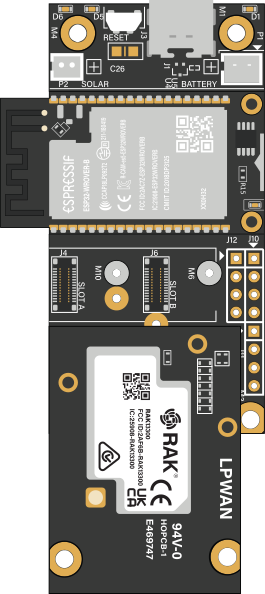
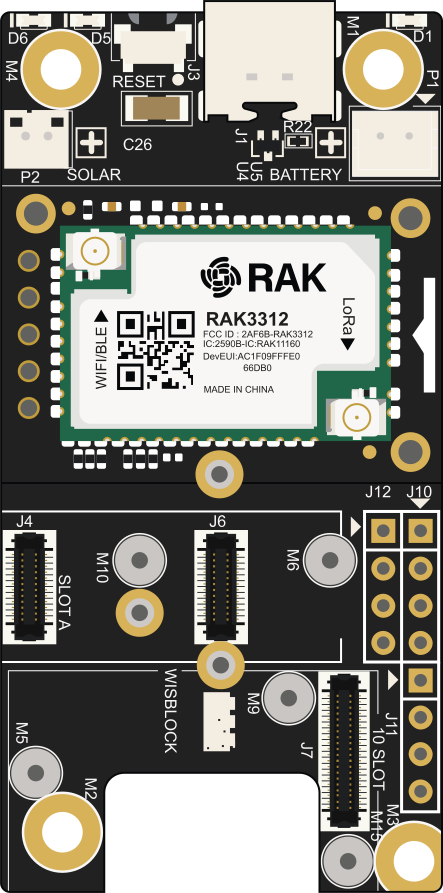
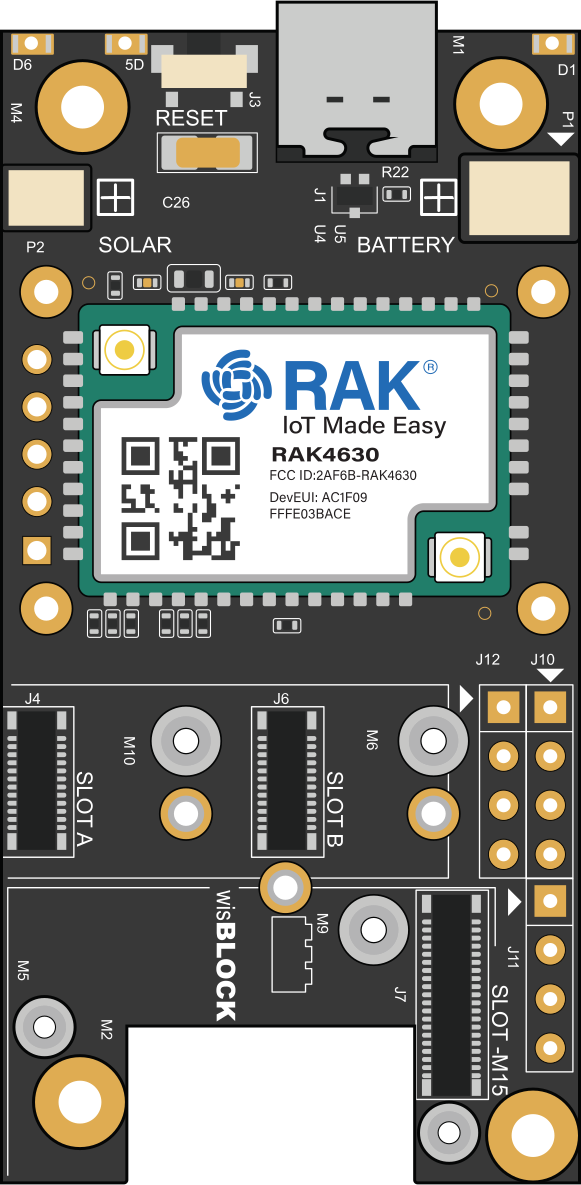
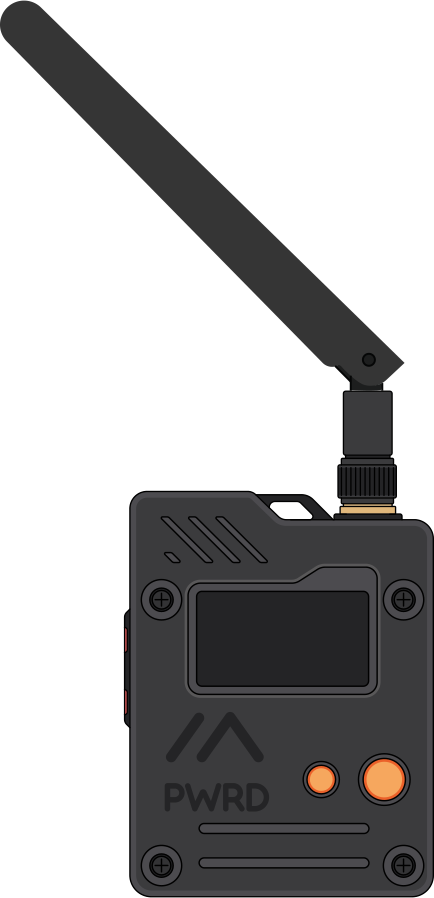
Warning This is an automated, unreviewed CI test build. Back up your device configuration Supported boards built by this PR (24)
Build artifacts expire on 2026-07-18. Updated for |





 github-actions
Bot
added
needs-review
NomDeTom
added
2.8
ai-generated
github-actions
Bot
added
needs-review
NomDeTom
added
2.8
ai-generated

There was a problem hiding this comment.
Pull request overview
This PR reworks NodeDB into a tiered storage model by adding a warm (“long-tail”) node tier that preserves minimal identity (notably PKI public keys) for nodes evicted from the hot NodeInfoLite store, and tightens retention/eviction rules for protected nodes (favorite/ignored/verified). It also adds a raw-flash persistence backend for the warm tier on nRF52840 and caps satellite-map growth to bound memory and nodes.db size.
Changes:
- Add
WarmNodeStore(RAM + persistence) and integrate it intoNodeDBload/evict/cleanup flows, plusRouterPKI key resolution viaNodeDB::copyPublicKey(). - Enforce satellite-map caps (
MAX_SATELLITE_NODES) and protected-node cap (MAX_NUM_NODES - 2) with user-facing warnings in some admin/UI paths. - Add unit tests for warm-tier policy and blocked/protected-node eviction/migration behavior; add nRF52840 linker/guard tooling to reserve flash for the warm ring.
Reviewed changes
Copilot reviewed 15 out of 16 changed files in this pull request and generated 4 comments.
Show a summary per file
| File | Description |
|---|---|
| variants/nrf52840/nrf52840.ini | Force capped linker script for S140 v6 boards to keep the warm raw-flash region clear. |
| variants/nrf52840/nrf52.ini | Add post-link guard script to prevent images from overlapping the warm-store flash reservation. |
| extra_scripts/nrf52_warm_region.py | Post-link nm-based guard ensuring the firmware image ends below the reserved warm-store region. |
| src/platform/nrf52/nrf52840_s140_v6.ld | New linker script variant capping FLASH length to protect the warm-store ring area (S140 v6 layout). |
| src/platform/nrf52/nrf52840_s140_v7.ld | Cap FLASH length for S140 v7 layout to protect the warm-store ring area. |
| src/mesh/WarmNodeStore.h | Define warm-tier entry format, policies, and nRF52840 ring layout constants. |
| src/mesh/WarmNodeStore.cpp | Implement warm-tier admission/eviction, persistence (raw-flash ring vs /prefs/warm.dat), and replay. |
| src/mesh/NodeDB.h | Add warm-tier member + copyPublicKey(), setProtectedFlag(), and related helpers. |
| src/mesh/NodeDB.cpp | Integrate warm tier into eviction/migration/cleanup/reset flows; add satellite caps; add protected-cap enforcement. |
| src/mesh/Router.cpp | Resolve PKI keys via NodeDB::copyPublicKey() so long-tail nodes can still encrypt/decrypt DMs. |
| src/modules/AdminModule.cpp | Route favorite/ignore through setProtectedFlag(); allow blocking unknown nodes via getOrCreateMeshNode(). |
| src/graphics/draw/MenuHandler.cpp | Use setProtectedFlag() for ignore toggling (cap-aware). |
| src/mesh/mesh-pb-constants.h | Set new defaults for MAX_NUM_NODES, add MAX_SATELLITE_NODES, and define WARM_NODE_COUNT per platform. |
| src/mesh/generated/meshtastic/deviceonly.pb.h | Add persisted snr_q4 field to NodeInfoLite generated struct. |
| test/test_warm_store/test_main.cpp | New unit tests for warm-store admission/eviction/take/persistence behavior. |
| test/test_nodedb_blocked/test_main.cpp | New unit tests for hot-store migration and favorite/ignored retention + protected cap behavior. |
7c1e1c3 to
17ada5b
Compare
Firmware Size Report22 targets | vs
Show 17 more target(s)
Updated for ca08228 |
0770379 to
20114e1
Compare
There was a problem hiding this comment.
Pull request overview
Copilot reviewed 18 out of 18 changed files in this pull request and generated no new comments.
Comments suppressed due to low confidence (1)
src/mesh/NodeDB.cpp:3252
- NodeDB::getOrCreateMeshNode() will happily create an entry for NodeNum 0. Across the codebase, node num 0 is used as a sentinel for “local” (e.g. MeshPacket.from == 0), so allowing 0 into the hot store can create a bogus protected/ignored node, consume a slot, and potentially trigger avoidable evictions (now that AdminModule can create nodes by ID). It should defensively reject n==0 up front.
meshtastic_NodeInfoLite *NodeDB::getOrCreateMeshNode(NodeNum n)
{
    meshtastic_NodeInfoLite *lite = getMeshNode(n);

    if (!lite) {


…ty retention)

Introduces a tiered NodeDB so the device retains identity (public key,
last_heard) for far more nodes than fit in the full-record hot store,
without growing heap or the persisted nodes.proto unboundedly.

- Hot store: full NodeInfoLite, MAX_NUM_NODES (120 on nRF52).
- Satellite maps: position/telemetry/environment/status capped at
  MAX_SATELLITE_NODES (40 freshest); eviction via enforceSatelliteCaps /
  evictSatelliteOverCap.
- Warm tier (WarmNodeStore): 40 B {num,last_heard,public_key} records for
  evicted nodes so DMs to/from long-tail nodes keep encrypting/decrypting.
  Persisted to /prefs/warm.dat, or on nRF52840 a dedicated 12 KB raw-flash
  record-ring below LittleFS (3x4 KB pages; see linker scripts + the
  nrf52_warm_region.py post-link guard).

NodeDB::getOrCreateMeshNode now demotes evicted nodes into the warm tier and
re-admits them (restoring key/last_heard). Router PKI decrypt/encode resolve
the peer key via NodeDB::copyPublicKey (hot store, then warm tier).

NodeInfoLite gains snr_q4 (sint32, Q4-encoded dB); the float snr is zeroed on
disk. NodeInfoLite grows 105 -> 112 B; backup 2432 -> 2468 B.

Note: the snr_q4 .proto change still needs to land in the protobufs submodule
(generated header is updated here; submodule pointer left at upstream).

Co-Authored-By: Claude Opus 4.8 (1M context) <noreply@anthropic.com>
Hardens how ignored/favourite nodes are received over admin and retained,
closing paths where a block could be lost or accidentally cleared.

- Blocking keeps the node's public key (admin set_ignored_node and
  addFromContact no longer zero it / drop the warm-tier key), so a blocked
  peer stays a verifiable identity.
- set_ignored_node creates the node if absent, so a block by node ID sticks
  even for a node we've never heard from (e.g. pushed by a remote admin) with
  no NodeInfo or key.
- Eviction protection (favourite/ignored/manually-verified) now also applies to
  the load-time hot-store migration and is never undone by cleanupMeshDB, which
  previously purged ignored nodes that lacked user info.
- The hot-store migration leaves our own node (index 0) in place and prefers to
  demote non-protected nodes, like the runtime eviction scan.

Caps the protected set (favourite + ignored + verified) at MAX_NUM_NODES-2 via
NodeDB::setProtectedFlag(), so at least two evictable slots always remain and
getOrCreateMeshNode can always make room — replacing the previous unconditional
append that could run off the end of the node vector when every node was
protected. A locally-set favourite/ignore that hits the cap reports back to the
phone via a ClientNotification.

Adds test_nodedb_blocked covering the migration, favourite/ignored eviction
protection, ignored-survives-cleanup, and the protected-node cap. The
maintenance methods stay private in production; the test reaches them through a
PIO_UNIT_TESTING-guarded friend shim.

Co-Authored-By: Claude Opus 4.8 (1M context) <noreply@anthropic.com>

# Conflicts:
#	src/mesh/NodeDB.h
Zero-initialise `stranded[]` and `seqs[]/order[]` VLAs so cppcheck can
verify there are no unguarded reads of uninitialised memory (the guards
exist but are not visible to static analysis). Mark two local pointers
`const` where the pointed-to entry is never mutated after assignment.

Co-Authored-By: Claude Sonnet 4.6 <noreply@anthropic.com>


…NT=0)

The warmstore (meshtastic#10705) reboots RP2350/W5500 boards via the 8s hardware
watchdog when a full NodeDB (120) save is followed by the extra warm.dat
write. RP2350 has no dedicated branch in the per-platform WARM_NODE_COUNT
selector (src/mesh/mesh-pb-constants.h) so it inherits the generic #else
(320). Disable the warm tier on both W5500 variants via WARM_NODE_COUNT=0
(compiles clean thanks to the new #if WARM_NODE_COUNT > 0 guards).

Validated on-hardware (wiznet_5500_evb_pico2_e22p): DB filled to 120,
the exact eviction-at-full sequence fired, board survived with no
watchdog reboot. See firmware#10746.

Co-Authored-By: Claude Opus 4.8 (1M context) <noreply@anthropic.com>


|
getting hard reboots from this PR on ESP32-S3 nodes with no PSRAM like the Wireless Paper. Crash happens when connected to Bluetooth or attempting to connect. It's chocking heap @NomDeTom |
|
clanker suggests
|


…10759)

* fix: right-size warm tier for constrained platforms and feed RP2040 watchdog during NodeDB save

* fix: size warm tier and traffic cache per-MCU RAM, lowering no-PSRAM ESP32 (classic/S2/C3) tiers

* docs: document nRF52/RP2040 #else fall-through in warm tier and TM cache cascades
* NodeDB: 3-tier node store with persistent warm tier (long-tail identity retention)

Introduces a tiered NodeDB so the device retains identity (public key,
last_heard) for far more nodes than fit in the full-record hot store,
without growing heap or the persisted nodes.proto unboundedly.

- Hot store: full NodeInfoLite, MAX_NUM_NODES (120 on nRF52).
- Satellite maps: position/telemetry/environment/status capped at
  MAX_SATELLITE_NODES (40 freshest); eviction via enforceSatelliteCaps /
  evictSatelliteOverCap.
- Warm tier (WarmNodeStore): 40 B {num,last_heard,public_key} records for
  evicted nodes so DMs to/from long-tail nodes keep encrypting/decrypting.
  Persisted to /prefs/warm.dat, or on nRF52840 a dedicated 12 KB raw-flash
  record-ring below LittleFS (3x4 KB pages; see linker scripts + the
  nrf52_warm_region.py post-link guard).

NodeDB::getOrCreateMeshNode now demotes evicted nodes into the warm tier and
re-admits them (restoring key/last_heard). Router PKI decrypt/encode resolve
the peer key via NodeDB::copyPublicKey (hot store, then warm tier).

NodeInfoLite gains snr_q4 (sint32, Q4-encoded dB); the float snr is zeroed on
disk. NodeInfoLite grows 105 -> 112 B; backup 2432 -> 2468 B.

Note: the snr_q4 .proto change still needs to land in the protobufs submodule
(generated header is updated here; submodule pointer left at upstream).

Co-Authored-By: Claude Opus 4.8 (1M context) <noreply@anthropic.com>

* NodeDB: robust receive + retention for blocked (ignored) nodes

Hardens how ignored/favourite nodes are received over admin and retained,
closing paths where a block could be lost or accidentally cleared.

- Blocking keeps the node's public key (admin set_ignored_node and
  addFromContact no longer zero it / drop the warm-tier key), so a blocked
  peer stays a verifiable identity.
- set_ignored_node creates the node if absent, so a block by node ID sticks
  even for a node we've never heard from (e.g. pushed by a remote admin) with
  no NodeInfo or key.
- Eviction protection (favourite/ignored/manually-verified) now also applies to
  the load-time hot-store migration and is never undone by cleanupMeshDB, which
  previously purged ignored nodes that lacked user info.
- The hot-store migration leaves our own node (index 0) in place and prefers to
  demote non-protected nodes, like the runtime eviction scan.

Caps the protected set (favourite + ignored + verified) at MAX_NUM_NODES-2 via
NodeDB::setProtectedFlag(), so at least two evictable slots always remain and
getOrCreateMeshNode can always make room — replacing the previous unconditional
append that could run off the end of the node vector when every node was
protected. A locally-set favourite/ignore that hits the cap reports back to the
phone via a ClientNotification.

Adds test_nodedb_blocked covering the migration, favourite/ignored eviction
protection, ignored-survives-cleanup, and the protected-node cap. The
maintenance methods stay private in production; the test reaches them through a
PIO_UNIT_TESTING-guarded friend shim.

Co-Authored-By: Claude Opus 4.8 (1M context) <noreply@anthropic.com>

# Conflicts:
#	src/mesh/NodeDB.h

* fix copilot comments

* once again

* WarmNodeStore: fix cppcheck warnings (uninitvar, constVariablePointer)

Zero-initialise `stranded[]` and `seqs[]/order[]` VLAs so cppcheck can
verify there are no unguarded reads of uninitialised memory (the guards
exist but are not visible to static analysis). Mark two local pointers
`const` where the pointed-to entry is never mutated after assignment.

Co-Authored-By: Claude Sonnet 4.6 <noreply@anthropic.com>

* self-care added to assist 2.7 and 2.8 nodedb migration

* Tidy warm-store/self-care: comments, guards, log + flash cleanup

Style/cleanup pass over the branch (no behavior change except the noted
preprocessor simplifications, which are semantically identical):

- Comments: move function descriptions to the headers, cap in-function
  comments at ~3-4 lines, drop leading-number step markers, label stacked
  #endif blocks, de-decorate banner comments.
- dumpToLog: fully gate decl + definition + AdminModule call site behind
  MESHTASTIC_NODEDB_MIGRATION_VERBOSE so it compiles out when disabled
  (~1.2 KB when off).
- mesh-pb-constants: drop the dead nRF52832 WARM_NODE_COUNT branch and trim
  the macro docs.
- WarmNodeStore: simplify the redundant `ARCH_NRF52 && NRF52840_XXAA` guards
  to `NRF52840_XXAA`, add a kNoPage sentinel for the ring page state.
- Shorten the always-on LOG_WARN strings (~120 B flash).

Co-Authored-By: Claude Opus 4.8 (1M context) <noreply@anthropic.com>

* more tidying up, aligning with docs and undoing other-arch regressions

* Update protobufs (meshtastic#19)

Co-authored-by: NomDeTom <116762865+NomDeTom@users.noreply.github.com>

* made the migration pathway cleareer

* address copilot review

* fixed a copilot review on a downstream PR.

* Address Copilot review comments for PR meshtastic#10705 (warmstore/nodedb)

- WarmNodeStore.h: default MIGRATION_VERBOSE to 0 (suppress info-level
  chatter on production builds; opt in with =1)
- WarmNodeStore.cpp load(): move memset to top of function so all
  failure paths (header-read fail, invalid header) leave entries clear
- WarmNodeStore.cpp save(): replace manual spiLock lock/unlock around
  mkdir with LockGuard covering the full SafeFile sequence, matching
  the lock discipline in load()
- Router.cpp: memcpy(&p->public_key.bytes, ...) -> memcpy(p->public_key.bytes,
  ...) — pass decayed uint8_t* rather than pointer-to-array
- AdminModule.cpp: check setProtectedFlag return for PKC auto-favorite;
  log cap-refusal warning instead of unconditional "auto-favoriting"
- nrf52_warm_region.py: error message references both v6.ld and v7.ld

Co-Authored-By: Claude Sonnet 4.6 <noreply@anthropic.com>

* NodeDB: formatting cleanup (blank lines after preprocessor blocks)

Co-Authored-By: Claude Sonnet 4.6 <noreply@anthropic.com>

* Lukewarm store

---------

Co-authored-by: Claude Opus 4.8 (1M context) <noreply@anthropic.com>
Co-authored-by: github-actions[bot] <41898282+github-actions[bot]@users.noreply.github.com>
Co-authored-by: Ben Meadors <benmmeadors@gmail.com>
…meshtastic#10705) (meshtastic#10759)

* fix: right-size warm tier for constrained platforms and feed RP2040 watchdog during NodeDB save

* fix: size warm tier and traffic cache per-MCU RAM, lowering no-PSRAM ESP32 (classic/S2/C3) tiers

* docs: document nRF52/RP2040 #else fall-through in warm tier and TM cache cascades


The previous edit, while right that the reconfigure is invoked on the main
task (not the BLE callback thread), oversimplified the failure. The crash
is cross-thread: the main-task setStandby()+SPI reprogram collides with the
radio's off-main NotifiedWorkerThread over the shared non-recursive spiLock
(FreeRTOS binary semaphore), locking it up and tripping the watchdog reboot
(meshtastic#11146; same spiLock hazard as meshtastic#10705/meshtastic#10728). Restore that in both the
Axis 1 rationale and the hardware test-1 description. Does not change the
serial-is-sufficient conclusion (the collision is transport-independent).
The previous edit, while right that the reconfigure is invoked on the main
task (not the BLE callback thread), oversimplified the failure. The crash
is cross-thread: the main-task setStandby()+SPI reprogram collides with the
radio's off-main NotifiedWorkerThread over the shared non-recursive spiLock
(FreeRTOS binary semaphore), locking it up and tripping the watchdog reboot
(meshtastic#11146; same spiLock hazard as meshtastic#10705/meshtastic#10728). Restore that in both the
Axis 1 rationale and the hardware test-1 description. Does not change the
serial-is-sufficient conclusion (the collision is transport-independent).
The previous edit, while right that the reconfigure is invoked on the main
task (not the BLE callback thread), oversimplified the failure. The crash
is cross-thread: the main-task setStandby()+SPI reprogram collides with the
radio's off-main NotifiedWorkerThread over the shared non-recursive spiLock
(FreeRTOS binary semaphore), locking it up and tripping the watchdog reboot
(meshtastic#11146; same spiLock hazard as meshtastic#10705/meshtastic#10728). Restore that in both the
Axis 1 rationale and the hardware test-1 description. Does not change the
serial-is-sufficient conclusion (the collision is transport-independent).
The previous edit, while right that the reconfigure is invoked on the main
task (not the BLE callback thread), oversimplified the failure. The crash
is cross-thread: the main-task setStandby()+SPI reprogram collides with the
radio's off-main NotifiedWorkerThread over the shared non-recursive spiLock
(FreeRTOS binary semaphore), locking it up and tripping the watchdog reboot
(meshtastic#11146; same spiLock hazard as meshtastic#10705/meshtastic#10728). Restore that in both the
Axis 1 rationale and the hardware test-1 description. Does not change the
serial-is-sufficient conclusion (the collision is transport-independent).
The previous edit, while right that the reconfigure is invoked on the main
task (not the BLE callback thread), oversimplified the failure. The crash
is cross-thread: the main-task setStandby()+SPI reprogram collides with the
radio's off-main NotifiedWorkerThread over the shared non-recursive spiLock
(FreeRTOS binary semaphore), locking it up and tripping the watchdog reboot
(meshtastic#11146; same spiLock hazard as meshtastic#10705/meshtastic#10728). Restore that in both the
Axis 1 rationale and the hardware test-1 description. Does not change the
serial-is-sufficient conclusion (the collision is transport-independent).
The previous edit, while right that the reconfigure is invoked on the main
task (not the BLE callback thread), oversimplified the failure. The crash
is cross-thread: the main-task setStandby()+SPI reprogram collides with the
radio's off-main NotifiedWorkerThread over the shared non-recursive spiLock
(FreeRTOS binary semaphore), locking it up and tripping the watchdog reboot
(meshtastic#11146; same spiLock hazard as meshtastic#10705/meshtastic#10728). Restore that in both the
Axis 1 rationale and the hardware test-1 description. Does not change the
serial-is-sufficient conclusion (the collision is transport-independent).
The previous edit, while right that the reconfigure is invoked on the main
task (not the BLE callback thread), oversimplified the failure. The crash
is cross-thread: the main-task setStandby()+SPI reprogram collides with the
radio's off-main NotifiedWorkerThread over the shared non-recursive spiLock
(FreeRTOS binary semaphore), locking it up and tripping the watchdog reboot
(meshtastic#11146; same spiLock hazard as meshtastic#10705/meshtastic#10728). Restore that in both the
Axis 1 rationale and the hardware test-1 description. Does not change the
serial-is-sufficient conclusion (the collision is transport-independent).

* reconfigure tests

* Narrow radio-reload trigger to LoRa-affecting saves only

reloadConfig() inferred "the radio needs reconfiguring" from whether
saveWhat included SEGMENT_CONFIG. But Config is a monolithic segment
(device/position/power/network/display/lora/bluetooth/security share one
file), so every non-LoRa AdminModule save still fired the live SX126x
reconfigure - the same live-SPI-on-the-admin-thread sequence that crashes
on a favorite (meshtastic#11146), just reached via a Bluetooth toggle, WiFi PSK
change, or keypair rotation.

Separate the two concerns: add an explicit radioAffected flag threaded
through AdminModule::saveChanges() into MeshService::reloadConfig(). The
gate becomes `radioAffected && (saveWhat & (SEGMENT_CONFIG|SEGMENT_CHANNELS))`
- the bitmask inference is kept as a backstop and only suppressible, and
radioAffected defaults to true so the ~35 existing reloadConfig() callers
(MenuHandler, MenuApplet, portduino) keep today's behavior untouched.

Only handleSetConfig()'s lora_tag sets radioAffected; every other
sub-message, plus set_fixed_position/remove_fixed_position and position's
nested save, opt out. set_channel/commit_edit_settings/restore keep the
default and still reload.

Add native coverage in test_admin_radio for each non-LoRa sub-message
(asserting no reconfigure), regression guards that lora/set_channel still
reconfigure, and direct reloadConfig() guards pinning the fail-safe default.

* mark up todo sites for checking reloadConfig use

* added clarifying note

* Don't reboot on no-op position/network/bluetooth config sets

handleSetConfig() starts requiresReboot=true and device/power/display each
gate it back down when nothing reboot-worthy changed, but position,
network, and bluetooth never touched requiresReboot - so they rebooted on
*every* set, including a client re-pushing byte-identical config (which
happens routinely on connect/retry).

Add a no-op gate to those three: if the incoming sub-message is
byte-identical to the current one, skip the reboot. A whole-struct memcmp
is the right tool here (unlike the field-by-field device/power/display
gates, which must ignore benign fields) - it answers "did anything change?"
and fails safe: its only error mode is padding-byte differences causing an
unnecessary reboot, never a missed change. All three sub-messages are POD
(no pb_callback_t fields). Any real change still reboots exactly as before.

This is Tier 1 of plan-narrow-reboot-trigger; Tier 2 will further narrow
position to reboot only on boot-only fields (GPIO/GPS).

Adds native coverage asserting rebootAtMsec stays unset on a no-op set and
is armed on a real change, for each of the three sub-messages.

* Apply live position config changes without a reboot

Tier 2 of plan-narrow-reboot-trigger. A position set that touches only
fields the position module consumes live now applies without restarting.

PositionModule reads position_broadcast_secs, position_broadcast_smart_enabled,
broadcast_smart_minimum_distance, position_flags, and fixed_position directly
from config on every send/schedule cycle (fixed_position also has dedicated
live admin handlers) - changing only those needs no reboot. Everything else
stays on the reboot path: GPS driver state (gps_mode/gps_enabled/
gps_update_interval/gps_attempt_time) and GPIO pin assignments (rx_gpio/
tx_gpio/gps_en_gpio), all of which touch subsystem/hardware init.

The live set is deliberately limited to what static analysis proves is
applied live, so this ships without hardware verification; GPS-timing fields
that might also be live were left rebooting (fail toward current behavior).
The gate neutralizes the live fields in a copy and reboots if any other byte
differs, so a future PositionConfig field reboots until explicitly cleared
as live - fail safe for schema growth.

This supersedes the Tier 1 no-op memcmp gate for position (network/bluetooth
keep theirs). Native coverage: a broadcast-interval change does not schedule
a reboot; gps_mode and rx_gpio changes still do.

* docs: config-save radio-reload & reboot gating

Document the AdminModule config-save side-effect work: the radioAffected
and requiresReboot axes, which operations now skip the radio reload or the
reboot, and the operations deliberately left unchanged (commit_edit_settings,
network/bluetooth live-apply, GPS-timing position fields, module config,
and the on-device menu reloadConfig sites) with the reason for each.

* docs: add hardware testing section to config-save gating

The doc only mentioned the outstanding GPS-timing pass in one line and
omitted the radio-reload/crash validation entirely, with no procedure.
Add a Hardware testing section covering: the meshtastic-mcp setup
(BLE connected throughout, nRF52840 SX126x reference board); the
radio-reload/crash regression guard for the favorite-node fix (with a
lora/set_channel positive control); and a per-field procedure with
pass/fail criteria for deciding whether GPS-timing position fields can be
reclassified as live - fail toward rebooting.

* docs: clarify hardware tests run over serial, not menus/BLE

The hardware section implied a BLE connection was required and that the
crash ran on the BLE callback thread. On nRF52 the BLE onWrite only queues;
handleToRadio -> saveChanges -> reloadConfig runs on the main FreeRTOS task,
same context SerialConsole uses. So serial drives the exact code/thread
under test, the on-device menus are unrelated (separate path), and the
original crash was serial-proven. State that serial is sufficient and
correct the thread references accordingly.

* docs: correct crash mechanism to the off-main-thread spiLock lockup

The previous edit, while right that the reconfigure is invoked on the main
task (not the BLE callback thread), oversimplified the failure. The crash
is cross-thread: the main-task setStandby()+SPI reprogram collides with the
radio's off-main NotifiedWorkerThread over the shared non-recursive spiLock
(FreeRTOS binary semaphore), locking it up and tripping the watchdog reboot
(meshtastic#11146; same spiLock hazard as meshtastic#10705/meshtastic#10728). Restore that in both the
Axis 1 rationale and the hardware test-1 description. Does not change the
serial-is-sufficient conclusion (the collision is transport-independent).

* docs: clarify config save behavior for GPS position updates

* menu actions

* menu actions reboot

* Persist telemetry screen toggles from the frame menu

The three moduleConfig.telemetry.*_screen_enabled toggles in the frame-toggle
menu changed the value in memory and never wrote it, so they reverted on any
reboot that did not happen to go through the reboot menu (which saves every
segment). Their sibling entries in the same menu persist via
Screen::toggleFrameVisibility -> saveFrameVisibility, so half the menu was
durable and three entries were not.

These three live in moduleConfig rather than the hiddenFrames blob, so they need
their own SEGMENT_MODULECONFIG save. radioAffected is false: a screen preference
has no business re-initialising the LoRa chip.

clod helped too

* Drop redundant and over-broad config writes from the menus

reloadConfig() ends with an unconditional saveToDisk(saveWhat), outside the
radioAffected guard, so nine sites in the InkHUD menu were writing the same
proto file twice in a row: saveToDisk(X) immediately followed by
reloadConfig(X, ...). One of the nine is the shared applyConfigReload() helper,
so thirteen menu actions were affected.

Five sites in the BaseUI menu called saveUIConfig() after changing a field that
lives in config.proto. saveUIConfig() only writes /prefs/uiconfig.proto, so
those writes could not persist the changed field and did nothing but cost a
flash write. GPSFormatMenu had the mirror image: a uiconfig-only change that
also called reloadConfig(), rewriting config.proto for a field not in it.

Three bare saveToDisk() calls rewrote all five segments to change one bit -
a channel mute flag and two NodeInfoLite bits - so they now pass the segment
they actually touch. NodeInfoLite is written by saveNodeDatabaseToDisk() under
SEGMENT_NODEDATABASE, not SEGMENT_DEVICESTATE. The reboot menu keeps its bare
call: a full flush before a deliberate reboot is correct.

reloadConfig() becomes virtual so tests can count calls; the accompanying test
pins down the saveToDisk equivalence the nine deletions rely on.

clod helped too

* Route config saves through one MeshService::applyConfigChange helper

Applying a config change involves three independent decisions: which proto files
to persist, whether the LoRa chip needs re-initialising, and whether the field
only takes effect after a restart. Those were spread across four helpers with
three different parameter orders, two of which took adjacent bools that compile
fine when transposed. InkHUD's applyConfigReload was the sharp edge: its second
parameter was `reboot`, sitting exactly where reloadConfig and saveChanges take
`radioAffected`.

There is now a single entry point taking a flags enum, so each call site states
its intent and cannot silently mean the opposite. Migrated 23 BaseUI sites, 20
InkHUD sites and the wasm glue. applyConfigReload is deleted and its five
callers inlined; applyLoRaRegion and applyLoRaPreset stay, since they hold real
domain logic beyond bundling, and just delegate.

Adjacent `rebootAtMsec = millis() + ...` assignments fold into the reboot flag.
The one caller that deliberately uses a shorter delay keeps it via the trailing
rebootSeconds parameter. Reboot scheduling itself moves into requestReboot() in
main.cpp, next to the global it sets: previously only AdminModule had a helper
for this, and it was private, which is why every menu open-coded the deadline.
requestReboot carries no UI, because BaseUI already renders the notice at draw
time whenever rebootAtMsec is set.

saveChanges keeps its signature and its edit-transaction deferral, so its
fourteen call sites and the existing gating tests are untouched.

clod helped too

* Extract menu config actions into testable functions

None of the menu save behaviour was reachable from a test: every action lived in
a lambda assigned to BannerOverlayOptions.bannerCallback, which only ever runs
via screen->showOverlayBanner(), so exercising one needed a live Screen. That is
why the defects this series fixes went unnoticed - MenuHandler.cpp compiles in
the native test build, but nothing in it could be called.

Three actions move out into functions that own the whole decision: which segment
to persist, whether the radio needs reconfiguring, and whether to reboot. Chosen
because each covers a defect this series touched - the telemetry toggles that
never persisted, the smart-position reboot that PR meshtastic#11181 removed, and a node-DB
bit write that must not reach the radio.

Deliberately picked extractions that also deduplicate: three telemetry call
sites collapse onto one function and two smart-position sites onto another, so
the promicro image is byte-identical to before. Worth knowing, because that board
has under 1.4 KB of headroom before the warmstore region.

toggleNodeMuted also gains a guard for an unknown node, so a stale
pickedNodeNum can no longer cause a pointless flash write.

clod helped too

* Sort out InkHUD applying-changes notifications

notifyApplyingChanges() was doing two jobs at its call sites in MenuApplet.cpp:
signalling a live change that is applied without restarting, and warning of an
imminent reboot. Audited every site. The finding is that none of them are
redundant, so this records why rather than removing anything.

The two live-change calls - LoRa region and modem preset - cover the seconds the
e-ink takes to redraw while the radio reconfigures, and nothing else raises them.
The reboot-path calls warn before the display goes. requestReboot() cannot absorb
those: it deliberately carries no UI, because BaseUI renders its own notice at
draw time from rebootAtMsec, while e-ink only draws when pushed.

Also worth recording: the existing notifyReboot Observable (sleep.h, fired from
Power::reboot) is a different moment - reboot execution, not scheduling - and
InkHUD already observes it to save settings and shut applets down. A new
"reboot scheduled" observable to centralise these calls would be a third reboot
signal for no functional gain, so it is not added.

clod helped too

* stylee

* Fix stale doc references and document the menu path

Addresses review feedback.

Four comments pointed at plan documents that were never committed
(plan-narrow-reboot-trigger.md, plan-decouple-nodedb-admin-saves.md), so the
rationale they cited was not discoverable. They now point at
docs/admin-config-save-gating.md, which is in-repo.

The doc listed the commit SHAs it described. All five had already been orphaned
by the rebases this branch has been through, exactly as predicted, so it cites
the PR instead. "Status: Implemented" also overstated things while hardware
validation is still outstanding.

The doc's biggest problem was that it had gone out of date within its own PR: it
described the on-device menus as an untouched code path that still reloads the
radio on any Config save, with per-site TODO markers. That stopped being true
when the menus moved onto applyConfigChange. Replaced with a section covering the
new entry point, the flags, why they are a flags enum rather than two bools, and
the saveToDisk equivalence that makes pairing the two calls a double write.

clod helped too

* Fix smart-broadcast-interval reboot and carry transaction flags

Four review findings.

broadcast_smart_minimum_interval_secs is not read live, despite the comment this
branch added claiming it was. PositionModule::minimumTimeThreshold is a const
data member initialised when the module is constructed, so the value is captured
at boot; only the sibling distance field is genuinely re-read (PositionModule.cpp
:630). The InkHUD menu therefore applied it with no reboot and it silently did
nothing until the next restart. It now reboots, matching the AdminModule path.
Note the review suggested the opposite fix - adding the field to AdminModule's
live-field list - which would have made the admin path silently ineffective too.

While an edit transaction is open saveChanges() defers the write, which threw
away the per-field reboot and radio decisions; the commit then used the parameter
defaults and always rebooted and reconfigured the radio. Since phone apps write
config through transactions, none of this branch's narrowing reached them. The
deferred decisions now accumulate and the commit honours them.

Two test fixes: the set_ignored_node test relied on an earlier RUN_TEST having
created the node, which breaks under -f or a registration reorder. And the
telemetry test asserted only values it had just assigned - replaced with one that
drives the real toggle and checks the save path sets has_telemetry, the flag
whose absence caused the TAK persistence bug fixed upstream in meshtastic#11216.

clod helped too

* Stop the edit transaction discarding the per-field save decisions

Review of this branch's own output, plus the two findings Copilot raised on

The headline defect is that none of this branch's narrowing reached phone apps.
saveChanges() defers while an edit transaction is open, and radioAffected
defaulted to true, so eight call sites that never thought about the radio - the
five node-DB handlers, set_owner, set_module_config, and the nested save in the
position case - accumulated a true into deferredRadioAffected. Outside a
transaction that was harmless, because reloadConfig()'s
saveWhat & (SEGMENT_CONFIG | SEGMENT_CHANNELS) bitmask independently blocks a
node-DB-only save from reaching the radio whatever it asks for. Inside one the
commit saves under a fixed full mask, so the bitmask always passes and
radioAffected is the only thing left deciding it. Favouriting a node from the
phone app therefore still ran the live SX126x reconfigure at commit - the

The fix is to remove the default from saveChanges() rather than gate the
deferred flag on the segment mask, which is what the review suggested. Gating
would reinstate exactly the segment-to-radio inference this branch exists to
delete - NodeDB.h now carries a comment telling the next person not to do that -
and it fixes the symptom while leaving the wrong default in place for the next
call site. With no default the compiler makes all fourteen sites state the
answer. The commit also consumes and clears the deferred flags, so a stray
second commit cannot inherit the previous transaction's answer.

That gap existed because every radio test ran outside a transaction, which is
the one arrangement where the bug is unreachable. Nine tests now cover the
deferred path, asserting both axes independently across a commit. Verified they
fail against the old behaviour: five go red while every pre-existing test stays
green, which is the point.

requestReboot()'s comment had the semantics backwards - it claimed a negative
delay meant "now" and that rebootAtMsec == 0 was an immediate-reboot sentinel.
Both are inverted: 0 means no reboot pending at every read site, and
admin.proto documents reboot_seconds "<0 to cancel reboot". The expression was a
faithful copy of AdminModule's, so only the comment was wrong, but it was wrong
on the newly-created central helper. The negative branch now says so and logs
it. Five sites still open-coded the deadline despite that helper existing; they
are pure reboots with no config save, so applyConfigChange() does not fit but
requestReboot() does exactly.

SET_SMART_BROADCAST_INTERVAL was the only CONFIG_APPLY_REBOOT site in the InkHUD
menu without a notifyApplyingChanges() beside it - re-adding its reboot last
commit dropped the warning that applyConfigReload() used to raise, so the e-ink
would go dark unannounced. And four channel actions carried CONFIG_APPLY_RADIO
for uplink/downlink and position_precision, none of which touch the name, PSK or
frequency slot the radio derives anything from; they had it only because the old
reloadConfig(SEGMENT_CHANNELS) inferred it from the bitmask.

The doc had gone stale inside its own PR again: it still listed
commit_edit_settings under "intentionally left unchanged". Replaced with a
section on why the bitmask stops protecting you inside a transaction, since that
is the non-obvious part. Also dropped a commit SHA that had already been
orphaned by rebase, exactly as its own note predicted, and a stale plan-doc
reference in the tests that the last doc pass missed.

Full native suite green, 810 cases across 40 suites. t-echo and t-echo-inkhud
both build, covering the menu changes no native env compiles.

* post rebase fixes

* gps-toggle-noreboot

* fix(admin): preserve live config transactions

* fix(admin): avoid unnecessary config restarts

* fix(admin): keep edit timeout dormant while idle

* fix(admin): skip normalized no-op reboots

* fix(admin): disable idle transaction timer

---------

Co-authored-by: nomdetom <nomdetom@protonmail.com>
The previous edit, while right that the reconfigure is invoked on the main
task (not the BLE callback thread), oversimplified the failure. The crash
is cross-thread: the main-task setStandby()+SPI reprogram collides with the
radio's off-main NotifiedWorkerThread over the shared non-recursive spiLock
(FreeRTOS binary semaphore), locking it up and tripping the watchdog reboot
(meshtastic#11146; same spiLock hazard as meshtastic#10705/meshtastic#10728). Restore that in both the
Axis 1 rationale and the hardware test-1 description. Does not change the
serial-is-sufficient conclusion (the collision is transport-independent).
* reconfigure tests

* Narrow radio-reload trigger to LoRa-affecting saves only

reloadConfig() inferred "the radio needs reconfiguring" from whether
saveWhat included SEGMENT_CONFIG. But Config is a monolithic segment
(device/position/power/network/display/lora/bluetooth/security share one
file), so every non-LoRa AdminModule save still fired the live SX126x
reconfigure - the same live-SPI-on-the-admin-thread sequence that crashes
on a favorite (meshtastic#11146), just reached via a Bluetooth toggle, WiFi PSK
change, or keypair rotation.

Separate the two concerns: add an explicit radioAffected flag threaded
through AdminModule::saveChanges() into MeshService::reloadConfig(). The
gate becomes `radioAffected && (saveWhat & (SEGMENT_CONFIG|SEGMENT_CHANNELS))`
- the bitmask inference is kept as a backstop and only suppressible, and
radioAffected defaults to true so the ~35 existing reloadConfig() callers
(MenuHandler, MenuApplet, portduino) keep today's behavior untouched.

Only handleSetConfig()'s lora_tag sets radioAffected; every other
sub-message, plus set_fixed_position/remove_fixed_position and position's
nested save, opt out. set_channel/commit_edit_settings/restore keep the
default and still reload.

Add native coverage in test_admin_radio for each non-LoRa sub-message
(asserting no reconfigure), regression guards that lora/set_channel still
reconfigure, and direct reloadConfig() guards pinning the fail-safe default.

* mark up todo sites for checking reloadConfig use

* added clarifying note

* Don't reboot on no-op position/network/bluetooth config sets

handleSetConfig() starts requiresReboot=true and device/power/display each
gate it back down when nothing reboot-worthy changed, but position,
network, and bluetooth never touched requiresReboot - so they rebooted on
*every* set, including a client re-pushing byte-identical config (which
happens routinely on connect/retry).

Add a no-op gate to those three: if the incoming sub-message is
byte-identical to the current one, skip the reboot. A whole-struct memcmp
is the right tool here (unlike the field-by-field device/power/display
gates, which must ignore benign fields) - it answers "did anything change?"
and fails safe: its only error mode is padding-byte differences causing an
unnecessary reboot, never a missed change. All three sub-messages are POD
(no pb_callback_t fields). Any real change still reboots exactly as before.

This is Tier 1 of plan-narrow-reboot-trigger; Tier 2 will further narrow
position to reboot only on boot-only fields (GPIO/GPS).

Adds native coverage asserting rebootAtMsec stays unset on a no-op set and
is armed on a real change, for each of the three sub-messages.

* Apply live position config changes without a reboot

Tier 2 of plan-narrow-reboot-trigger. A position set that touches only
fields the position module consumes live now applies without restarting.

PositionModule reads position_broadcast_secs, position_broadcast_smart_enabled,
broadcast_smart_minimum_distance, position_flags, and fixed_position directly
from config on every send/schedule cycle (fixed_position also has dedicated
live admin handlers) - changing only those needs no reboot. Everything else
stays on the reboot path: GPS driver state (gps_mode/gps_enabled/
gps_update_interval/gps_attempt_time) and GPIO pin assignments (rx_gpio/
tx_gpio/gps_en_gpio), all of which touch subsystem/hardware init.

The live set is deliberately limited to what static analysis proves is
applied live, so this ships without hardware verification; GPS-timing fields
that might also be live were left rebooting (fail toward current behavior).
The gate neutralizes the live fields in a copy and reboots if any other byte
differs, so a future PositionConfig field reboots until explicitly cleared
as live - fail safe for schema growth.

This supersedes the Tier 1 no-op memcmp gate for position (network/bluetooth
keep theirs). Native coverage: a broadcast-interval change does not schedule
a reboot; gps_mode and rx_gpio changes still do.

* docs: config-save radio-reload & reboot gating

Document the AdminModule config-save side-effect work: the radioAffected
and requiresReboot axes, which operations now skip the radio reload or the
reboot, and the operations deliberately left unchanged (commit_edit_settings,
network/bluetooth live-apply, GPS-timing position fields, module config,
and the on-device menu reloadConfig sites) with the reason for each.

* docs: add hardware testing section to config-save gating

The doc only mentioned the outstanding GPS-timing pass in one line and
omitted the radio-reload/crash validation entirely, with no procedure.
Add a Hardware testing section covering: the meshtastic-mcp setup
(BLE connected throughout, nRF52840 SX126x reference board); the
radio-reload/crash regression guard for the favorite-node fix (with a
lora/set_channel positive control); and a per-field procedure with
pass/fail criteria for deciding whether GPS-timing position fields can be
reclassified as live - fail toward rebooting.

* docs: clarify hardware tests run over serial, not menus/BLE

The hardware section implied a BLE connection was required and that the
crash ran on the BLE callback thread. On nRF52 the BLE onWrite only queues;
handleToRadio -> saveChanges -> reloadConfig runs on the main FreeRTOS task,
same context SerialConsole uses. So serial drives the exact code/thread
under test, the on-device menus are unrelated (separate path), and the
original crash was serial-proven. State that serial is sufficient and
correct the thread references accordingly.

* docs: correct crash mechanism to the off-main-thread spiLock lockup

The previous edit, while right that the reconfigure is invoked on the main
task (not the BLE callback thread), oversimplified the failure. The crash
is cross-thread: the main-task setStandby()+SPI reprogram collides with the
radio's off-main NotifiedWorkerThread over the shared non-recursive spiLock
(FreeRTOS binary semaphore), locking it up and tripping the watchdog reboot
(meshtastic#11146; same spiLock hazard as meshtastic#10705/meshtastic#10728). Restore that in both the
Axis 1 rationale and the hardware test-1 description. Does not change the
serial-is-sufficient conclusion (the collision is transport-independent).

* docs: clarify config save behavior for GPS position updates

* menu actions

* menu actions reboot

* Persist telemetry screen toggles from the frame menu

The three moduleConfig.telemetry.*_screen_enabled toggles in the frame-toggle
menu changed the value in memory and never wrote it, so they reverted on any
reboot that did not happen to go through the reboot menu (which saves every
segment). Their sibling entries in the same menu persist via
Screen::toggleFrameVisibility -> saveFrameVisibility, so half the menu was
durable and three entries were not.

These three live in moduleConfig rather than the hiddenFrames blob, so they need
their own SEGMENT_MODULECONFIG save. radioAffected is false: a screen preference
has no business re-initialising the LoRa chip.

clod helped too

* Drop redundant and over-broad config writes from the menus

reloadConfig() ends with an unconditional saveToDisk(saveWhat), outside the
radioAffected guard, so nine sites in the InkHUD menu were writing the same
proto file twice in a row: saveToDisk(X) immediately followed by
reloadConfig(X, ...). One of the nine is the shared applyConfigReload() helper,
so thirteen menu actions were affected.

Five sites in the BaseUI menu called saveUIConfig() after changing a field that
lives in config.proto. saveUIConfig() only writes /prefs/uiconfig.proto, so
those writes could not persist the changed field and did nothing but cost a
flash write. GPSFormatMenu had the mirror image: a uiconfig-only change that
also called reloadConfig(), rewriting config.proto for a field not in it.

Three bare saveToDisk() calls rewrote all five segments to change one bit -
a channel mute flag and two NodeInfoLite bits - so they now pass the segment
they actually touch. NodeInfoLite is written by saveNodeDatabaseToDisk() under
SEGMENT_NODEDATABASE, not SEGMENT_DEVICESTATE. The reboot menu keeps its bare
call: a full flush before a deliberate reboot is correct.

reloadConfig() becomes virtual so tests can count calls; the accompanying test
pins down the saveToDisk equivalence the nine deletions rely on.

clod helped too

* Route config saves through one MeshService::applyConfigChange helper

Applying a config change involves three independent decisions: which proto files
to persist, whether the LoRa chip needs re-initialising, and whether the field
only takes effect after a restart. Those were spread across four helpers with
three different parameter orders, two of which took adjacent bools that compile
fine when transposed. InkHUD's applyConfigReload was the sharp edge: its second
parameter was `reboot`, sitting exactly where reloadConfig and saveChanges take
`radioAffected`.

There is now a single entry point taking a flags enum, so each call site states
its intent and cannot silently mean the opposite. Migrated 23 BaseUI sites, 20
InkHUD sites and the wasm glue. applyConfigReload is deleted and its five
callers inlined; applyLoRaRegion and applyLoRaPreset stay, since they hold real
domain logic beyond bundling, and just delegate.

Adjacent `rebootAtMsec = millis() + ...` assignments fold into the reboot flag.
The one caller that deliberately uses a shorter delay keeps it via the trailing
rebootSeconds parameter. Reboot scheduling itself moves into requestReboot() in
main.cpp, next to the global it sets: previously only AdminModule had a helper
for this, and it was private, which is why every menu open-coded the deadline.
requestReboot carries no UI, because BaseUI already renders the notice at draw
time whenever rebootAtMsec is set.

saveChanges keeps its signature and its edit-transaction deferral, so its
fourteen call sites and the existing gating tests are untouched.

clod helped too

* Extract menu config actions into testable functions

None of the menu save behaviour was reachable from a test: every action lived in
a lambda assigned to BannerOverlayOptions.bannerCallback, which only ever runs
via screen->showOverlayBanner(), so exercising one needed a live Screen. That is
why the defects this series fixes went unnoticed - MenuHandler.cpp compiles in
the native test build, but nothing in it could be called.

Three actions move out into functions that own the whole decision: which segment
to persist, whether the radio needs reconfiguring, and whether to reboot. Chosen
because each covers a defect this series touched - the telemetry toggles that
never persisted, the smart-position reboot that PR meshtastic#11181 removed, and a node-DB
bit write that must not reach the radio.

Deliberately picked extractions that also deduplicate: three telemetry call
sites collapse onto one function and two smart-position sites onto another, so
the promicro image is byte-identical to before. Worth knowing, because that board
has under 1.4 KB of headroom before the warmstore region.

toggleNodeMuted also gains a guard for an unknown node, so a stale
pickedNodeNum can no longer cause a pointless flash write.

clod helped too

* Sort out InkHUD applying-changes notifications

notifyApplyingChanges() was doing two jobs at its call sites in MenuApplet.cpp:
signalling a live change that is applied without restarting, and warning of an
imminent reboot. Audited every site. The finding is that none of them are
redundant, so this records why rather than removing anything.

The two live-change calls - LoRa region and modem preset - cover the seconds the
e-ink takes to redraw while the radio reconfigures, and nothing else raises them.
The reboot-path calls warn before the display goes. requestReboot() cannot absorb
those: it deliberately carries no UI, because BaseUI renders its own notice at
draw time from rebootAtMsec, while e-ink only draws when pushed.

Also worth recording: the existing notifyReboot Observable (sleep.h, fired from
Power::reboot) is a different moment - reboot execution, not scheduling - and
InkHUD already observes it to save settings and shut applets down. A new
"reboot scheduled" observable to centralise these calls would be a third reboot
signal for no functional gain, so it is not added.

clod helped too

* stylee

* Fix stale doc references and document the menu path

Addresses review feedback.

Four comments pointed at plan documents that were never committed
(plan-narrow-reboot-trigger.md, plan-decouple-nodedb-admin-saves.md), so the
rationale they cited was not discoverable. They now point at
docs/admin-config-save-gating.md, which is in-repo.

The doc listed the commit SHAs it described. All five had already been orphaned
by the rebases this branch has been through, exactly as predicted, so it cites
the PR instead. "Status: Implemented" also overstated things while hardware
validation is still outstanding.

The doc's biggest problem was that it had gone out of date within its own PR: it
described the on-device menus as an untouched code path that still reloads the
radio on any Config save, with per-site TODO markers. That stopped being true
when the menus moved onto applyConfigChange. Replaced with a section covering the
new entry point, the flags, why they are a flags enum rather than two bools, and
the saveToDisk equivalence that makes pairing the two calls a double write.

clod helped too

* Fix smart-broadcast-interval reboot and carry transaction flags

Four review findings.

broadcast_smart_minimum_interval_secs is not read live, despite the comment this
branch added claiming it was. PositionModule::minimumTimeThreshold is a const
data member initialised when the module is constructed, so the value is captured
at boot; only the sibling distance field is genuinely re-read (PositionModule.cpp
:630). The InkHUD menu therefore applied it with no reboot and it silently did
nothing until the next restart. It now reboots, matching the AdminModule path.
Note the review suggested the opposite fix - adding the field to AdminModule's
live-field list - which would have made the admin path silently ineffective too.

While an edit transaction is open saveChanges() defers the write, which threw
away the per-field reboot and radio decisions; the commit then used the parameter
defaults and always rebooted and reconfigured the radio. Since phone apps write
config through transactions, none of this branch's narrowing reached them. The
deferred decisions now accumulate and the commit honours them.

Two test fixes: the set_ignored_node test relied on an earlier RUN_TEST having
created the node, which breaks under -f or a registration reorder. And the
telemetry test asserted only values it had just assigned - replaced with one that
drives the real toggle and checks the save path sets has_telemetry, the flag
whose absence caused the TAK persistence bug fixed upstream in meshtastic#11216.

clod helped too

* Stop the edit transaction discarding the per-field save decisions

Review of this branch's own output, plus the two findings Copilot raised on

The headline defect is that none of this branch's narrowing reached phone apps.
saveChanges() defers while an edit transaction is open, and radioAffected
defaulted to true, so eight call sites that never thought about the radio - the
five node-DB handlers, set_owner, set_module_config, and the nested save in the
position case - accumulated a true into deferredRadioAffected. Outside a
transaction that was harmless, because reloadConfig()'s
saveWhat & (SEGMENT_CONFIG | SEGMENT_CHANNELS) bitmask independently blocks a
node-DB-only save from reaching the radio whatever it asks for. Inside one the
commit saves under a fixed full mask, so the bitmask always passes and
radioAffected is the only thing left deciding it. Favouriting a node from the
phone app therefore still ran the live SX126x reconfigure at commit - the

The fix is to remove the default from saveChanges() rather than gate the
deferred flag on the segment mask, which is what the review suggested. Gating
would reinstate exactly the segment-to-radio inference this branch exists to
delete - NodeDB.h now carries a comment telling the next person not to do that -
and it fixes the symptom while leaving the wrong default in place for the next
call site. With no default the compiler makes all fourteen sites state the
answer. The commit also consumes and clears the deferred flags, so a stray
second commit cannot inherit the previous transaction's answer.

That gap existed because every radio test ran outside a transaction, which is
the one arrangement where the bug is unreachable. Nine tests now cover the
deferred path, asserting both axes independently across a commit. Verified they
fail against the old behaviour: five go red while every pre-existing test stays
green, which is the point.

requestReboot()'s comment had the semantics backwards - it claimed a negative
delay meant "now" and that rebootAtMsec == 0 was an immediate-reboot sentinel.
Both are inverted: 0 means no reboot pending at every read site, and
admin.proto documents reboot_seconds "<0 to cancel reboot". The expression was a
faithful copy of AdminModule's, so only the comment was wrong, but it was wrong
on the newly-created central helper. The negative branch now says so and logs
it. Five sites still open-coded the deadline despite that helper existing; they
are pure reboots with no config save, so applyConfigChange() does not fit but
requestReboot() does exactly.

SET_SMART_BROADCAST_INTERVAL was the only CONFIG_APPLY_REBOOT site in the InkHUD
menu without a notifyApplyingChanges() beside it - re-adding its reboot last
commit dropped the warning that applyConfigReload() used to raise, so the e-ink
would go dark unannounced. And four channel actions carried CONFIG_APPLY_RADIO
for uplink/downlink and position_precision, none of which touch the name, PSK or
frequency slot the radio derives anything from; they had it only because the old
reloadConfig(SEGMENT_CHANNELS) inferred it from the bitmask.

The doc had gone stale inside its own PR again: it still listed
commit_edit_settings under "intentionally left unchanged". Replaced with a
section on why the bitmask stops protecting you inside a transaction, since that
is the non-obvious part. Also dropped a commit SHA that had already been
orphaned by rebase, exactly as its own note predicted, and a stale plan-doc
reference in the tests that the last doc pass missed.

Full native suite green, 810 cases across 40 suites. t-echo and t-echo-inkhud
both build, covering the menu changes no native env compiles.

* post rebase fixes

* gps-toggle-noreboot

* fix(admin): preserve live config transactions

* fix(admin): avoid unnecessary config restarts

* fix(admin): keep edit timeout dormant while idle

* fix(admin): skip normalized no-op reboots

* fix(admin): disable idle transaction timer

---------

Co-authored-by: nomdetom <nomdetom@protonmail.com>
The previous edit, while right that the reconfigure is invoked on the main
task (not the BLE callback thread), oversimplified the failure. The crash
is cross-thread: the main-task setStandby()+SPI reprogram collides with the
radio's off-main NotifiedWorkerThread over the shared non-recursive spiLock
(FreeRTOS binary semaphore), locking it up and tripping the watchdog reboot
(meshtastic#11146; same spiLock hazard as meshtastic#10705/meshtastic#10728). Restore that in both the
Axis 1 rationale and the hardware test-1 description. Does not change the
serial-is-sufficient conclusion (the collision is transport-independent).
* reconfigure tests

* Narrow radio-reload trigger to LoRa-affecting saves only

reloadConfig() inferred "the radio needs reconfiguring" from whether
saveWhat included SEGMENT_CONFIG. But Config is a monolithic segment
(device/position/power/network/display/lora/bluetooth/security share one
file), so every non-LoRa AdminModule save still fired the live SX126x
reconfigure - the same live-SPI-on-the-admin-thread sequence that crashes
on a favorite (meshtastic#11146), just reached via a Bluetooth toggle, WiFi PSK
change, or keypair rotation.

Separate the two concerns: add an explicit radioAffected flag threaded
through AdminModule::saveChanges() into MeshService::reloadConfig(). The
gate becomes `radioAffected && (saveWhat & (SEGMENT_CONFIG|SEGMENT_CHANNELS))`
- the bitmask inference is kept as a backstop and only suppressible, and
radioAffected defaults to true so the ~35 existing reloadConfig() callers
(MenuHandler, MenuApplet, portduino) keep today's behavior untouched.

Only handleSetConfig()'s lora_tag sets radioAffected; every other
sub-message, plus set_fixed_position/remove_fixed_position and position's
nested save, opt out. set_channel/commit_edit_settings/restore keep the
default and still reload.

Add native coverage in test_admin_radio for each non-LoRa sub-message
(asserting no reconfigure), regression guards that lora/set_channel still
reconfigure, and direct reloadConfig() guards pinning the fail-safe default.

* mark up todo sites for checking reloadConfig use

* added clarifying note

* Don't reboot on no-op position/network/bluetooth config sets

handleSetConfig() starts requiresReboot=true and device/power/display each
gate it back down when nothing reboot-worthy changed, but position,
network, and bluetooth never touched requiresReboot - so they rebooted on
*every* set, including a client re-pushing byte-identical config (which
happens routinely on connect/retry).

Add a no-op gate to those three: if the incoming sub-message is
byte-identical to the current one, skip the reboot. A whole-struct memcmp
is the right tool here (unlike the field-by-field device/power/display
gates, which must ignore benign fields) - it answers "did anything change?"
and fails safe: its only error mode is padding-byte differences causing an
unnecessary reboot, never a missed change. All three sub-messages are POD
(no pb_callback_t fields). Any real change still reboots exactly as before.

This is Tier 1 of plan-narrow-reboot-trigger; Tier 2 will further narrow
position to reboot only on boot-only fields (GPIO/GPS).

Adds native coverage asserting rebootAtMsec stays unset on a no-op set and
is armed on a real change, for each of the three sub-messages.

* Apply live position config changes without a reboot

Tier 2 of plan-narrow-reboot-trigger. A position set that touches only
fields the position module consumes live now applies without restarting.

PositionModule reads position_broadcast_secs, position_broadcast_smart_enabled,
broadcast_smart_minimum_distance, position_flags, and fixed_position directly
from config on every send/schedule cycle (fixed_position also has dedicated
live admin handlers) - changing only those needs no reboot. Everything else
stays on the reboot path: GPS driver state (gps_mode/gps_enabled/
gps_update_interval/gps_attempt_time) and GPIO pin assignments (rx_gpio/
tx_gpio/gps_en_gpio), all of which touch subsystem/hardware init.

The live set is deliberately limited to what static analysis proves is
applied live, so this ships without hardware verification; GPS-timing fields
that might also be live were left rebooting (fail toward current behavior).
The gate neutralizes the live fields in a copy and reboots if any other byte
differs, so a future PositionConfig field reboots until explicitly cleared
as live - fail safe for schema growth.

This supersedes the Tier 1 no-op memcmp gate for position (network/bluetooth
keep theirs). Native coverage: a broadcast-interval change does not schedule
a reboot; gps_mode and rx_gpio changes still do.

* docs: config-save radio-reload & reboot gating

Document the AdminModule config-save side-effect work: the radioAffected
and requiresReboot axes, which operations now skip the radio reload or the
reboot, and the operations deliberately left unchanged (commit_edit_settings,
network/bluetooth live-apply, GPS-timing position fields, module config,
and the on-device menu reloadConfig sites) with the reason for each.

* docs: add hardware testing section to config-save gating

The doc only mentioned the outstanding GPS-timing pass in one line and
omitted the radio-reload/crash validation entirely, with no procedure.
Add a Hardware testing section covering: the meshtastic-mcp setup
(BLE connected throughout, nRF52840 SX126x reference board); the
radio-reload/crash regression guard for the favorite-node fix (with a
lora/set_channel positive control); and a per-field procedure with
pass/fail criteria for deciding whether GPS-timing position fields can be
reclassified as live - fail toward rebooting.

* docs: clarify hardware tests run over serial, not menus/BLE

The hardware section implied a BLE connection was required and that the
crash ran on the BLE callback thread. On nRF52 the BLE onWrite only queues;
handleToRadio -> saveChanges -> reloadConfig runs on the main FreeRTOS task,
same context SerialConsole uses. So serial drives the exact code/thread
under test, the on-device menus are unrelated (separate path), and the
original crash was serial-proven. State that serial is sufficient and
correct the thread references accordingly.

* docs: correct crash mechanism to the off-main-thread spiLock lockup

The previous edit, while right that the reconfigure is invoked on the main
task (not the BLE callback thread), oversimplified the failure. The crash
is cross-thread: the main-task setStandby()+SPI reprogram collides with the
radio's off-main NotifiedWorkerThread over the shared non-recursive spiLock
(FreeRTOS binary semaphore), locking it up and tripping the watchdog reboot
(meshtastic#11146; same spiLock hazard as meshtastic#10705/meshtastic#10728). Restore that in both the
Axis 1 rationale and the hardware test-1 description. Does not change the
serial-is-sufficient conclusion (the collision is transport-independent).

* docs: clarify config save behavior for GPS position updates

* menu actions

* menu actions reboot

* Persist telemetry screen toggles from the frame menu

The three moduleConfig.telemetry.*_screen_enabled toggles in the frame-toggle
menu changed the value in memory and never wrote it, so they reverted on any
reboot that did not happen to go through the reboot menu (which saves every
segment). Their sibling entries in the same menu persist via
Screen::toggleFrameVisibility -> saveFrameVisibility, so half the menu was
durable and three entries were not.

These three live in moduleConfig rather than the hiddenFrames blob, so they need
their own SEGMENT_MODULECONFIG save. radioAffected is false: a screen preference
has no business re-initialising the LoRa chip.

clod helped too

* Drop redundant and over-broad config writes from the menus

reloadConfig() ends with an unconditional saveToDisk(saveWhat), outside the
radioAffected guard, so nine sites in the InkHUD menu were writing the same
proto file twice in a row: saveToDisk(X) immediately followed by
reloadConfig(X, ...). One of the nine is the shared applyConfigReload() helper,
so thirteen menu actions were affected.

Five sites in the BaseUI menu called saveUIConfig() after changing a field that
lives in config.proto. saveUIConfig() only writes /prefs/uiconfig.proto, so
those writes could not persist the changed field and did nothing but cost a
flash write. GPSFormatMenu had the mirror image: a uiconfig-only change that
also called reloadConfig(), rewriting config.proto for a field not in it.

Three bare saveToDisk() calls rewrote all five segments to change one bit -
a channel mute flag and two NodeInfoLite bits - so they now pass the segment
they actually touch. NodeInfoLite is written by saveNodeDatabaseToDisk() under
SEGMENT_NODEDATABASE, not SEGMENT_DEVICESTATE. The reboot menu keeps its bare
call: a full flush before a deliberate reboot is correct.

reloadConfig() becomes virtual so tests can count calls; the accompanying test
pins down the saveToDisk equivalence the nine deletions rely on.

clod helped too

* Route config saves through one MeshService::applyConfigChange helper

Applying a config change involves three independent decisions: which proto files
to persist, whether the LoRa chip needs re-initialising, and whether the field
only takes effect after a restart. Those were spread across four helpers with
three different parameter orders, two of which took adjacent bools that compile
fine when transposed. InkHUD's applyConfigReload was the sharp edge: its second
parameter was `reboot`, sitting exactly where reloadConfig and saveChanges take
`radioAffected`.

There is now a single entry point taking a flags enum, so each call site states
its intent and cannot silently mean the opposite. Migrated 23 BaseUI sites, 20
InkHUD sites and the wasm glue. applyConfigReload is deleted and its five
callers inlined; applyLoRaRegion and applyLoRaPreset stay, since they hold real
domain logic beyond bundling, and just delegate.

Adjacent `rebootAtMsec = millis() + ...` assignments fold into the reboot flag.
The one caller that deliberately uses a shorter delay keeps it via the trailing
rebootSeconds parameter. Reboot scheduling itself moves into requestReboot() in
main.cpp, next to the global it sets: previously only AdminModule had a helper
for this, and it was private, which is why every menu open-coded the deadline.
requestReboot carries no UI, because BaseUI already renders the notice at draw
time whenever rebootAtMsec is set.

saveChanges keeps its signature and its edit-transaction deferral, so its
fourteen call sites and the existing gating tests are untouched.

clod helped too

* Extract menu config actions into testable functions

None of the menu save behaviour was reachable from a test: every action lived in
a lambda assigned to BannerOverlayOptions.bannerCallback, which only ever runs
via screen->showOverlayBanner(), so exercising one needed a live Screen. That is
why the defects this series fixes went unnoticed - MenuHandler.cpp compiles in
the native test build, but nothing in it could be called.

Three actions move out into functions that own the whole decision: which segment
to persist, whether the radio needs reconfiguring, and whether to reboot. Chosen
because each covers a defect this series touched - the telemetry toggles that
never persisted, the smart-position reboot that PR meshtastic#11181 removed, and a node-DB
bit write that must not reach the radio.

Deliberately picked extractions that also deduplicate: three telemetry call
sites collapse onto one function and two smart-position sites onto another, so
the promicro image is byte-identical to before. Worth knowing, because that board
has under 1.4 KB of headroom before the warmstore region.

toggleNodeMuted also gains a guard for an unknown node, so a stale
pickedNodeNum can no longer cause a pointless flash write.

clod helped too

* Sort out InkHUD applying-changes notifications

notifyApplyingChanges() was doing two jobs at its call sites in MenuApplet.cpp:
signalling a live change that is applied without restarting, and warning of an
imminent reboot. Audited every site. The finding is that none of them are
redundant, so this records why rather than removing anything.

The two live-change calls - LoRa region and modem preset - cover the seconds the
e-ink takes to redraw while the radio reconfigures, and nothing else raises them.
The reboot-path calls warn before the display goes. requestReboot() cannot absorb
those: it deliberately carries no UI, because BaseUI renders its own notice at
draw time from rebootAtMsec, while e-ink only draws when pushed.

Also worth recording: the existing notifyReboot Observable (sleep.h, fired from
Power::reboot) is a different moment - reboot execution, not scheduling - and
InkHUD already observes it to save settings and shut applets down. A new
"reboot scheduled" observable to centralise these calls would be a third reboot
signal for no functional gain, so it is not added.

clod helped too

* stylee

* Fix stale doc references and document the menu path

Addresses review feedback.

Four comments pointed at plan documents that were never committed
(plan-narrow-reboot-trigger.md, plan-decouple-nodedb-admin-saves.md), so the
rationale they cited was not discoverable. They now point at
docs/admin-config-save-gating.md, which is in-repo.

The doc listed the commit SHAs it described. All five had already been orphaned
by the rebases this branch has been through, exactly as predicted, so it cites
the PR instead. "Status: Implemented" also overstated things while hardware
validation is still outstanding.

The doc's biggest problem was that it had gone out of date within its own PR: it
described the on-device menus as an untouched code path that still reloads the
radio on any Config save, with per-site TODO markers. That stopped being true
when the menus moved onto applyConfigChange. Replaced with a section covering the
new entry point, the flags, why they are a flags enum rather than two bools, and
the saveToDisk equivalence that makes pairing the two calls a double write.

clod helped too

* Fix smart-broadcast-interval reboot and carry transaction flags

Four review findings.

broadcast_smart_minimum_interval_secs is not read live, despite the comment this
branch added claiming it was. PositionModule::minimumTimeThreshold is a const
data member initialised when the module is constructed, so the value is captured
at boot; only the sibling distance field is genuinely re-read (PositionModule.cpp
:630). The InkHUD menu therefore applied it with no reboot and it silently did
nothing until the next restart. It now reboots, matching the AdminModule path.
Note the review suggested the opposite fix - adding the field to AdminModule's
live-field list - which would have made the admin path silently ineffective too.

While an edit transaction is open saveChanges() defers the write, which threw
away the per-field reboot and radio decisions; the commit then used the parameter
defaults and always rebooted and reconfigured the radio. Since phone apps write
config through transactions, none of this branch's narrowing reached them. The
deferred decisions now accumulate and the commit honours them.

Two test fixes: the set_ignored_node test relied on an earlier RUN_TEST having
created the node, which breaks under -f or a registration reorder. And the
telemetry test asserted only values it had just assigned - replaced with one that
drives the real toggle and checks the save path sets has_telemetry, the flag
whose absence caused the TAK persistence bug fixed upstream in meshtastic#11216.

clod helped too

* Stop the edit transaction discarding the per-field save decisions

Review of this branch's own output, plus the two findings Copilot raised on

The headline defect is that none of this branch's narrowing reached phone apps.
saveChanges() defers while an edit transaction is open, and radioAffected
defaulted to true, so eight call sites that never thought about the radio - the
five node-DB handlers, set_owner, set_module_config, and the nested save in the
position case - accumulated a true into deferredRadioAffected. Outside a
transaction that was harmless, because reloadConfig()'s
saveWhat & (SEGMENT_CONFIG | SEGMENT_CHANNELS) bitmask independently blocks a
node-DB-only save from reaching the radio whatever it asks for. Inside one the
commit saves under a fixed full mask, so the bitmask always passes and
radioAffected is the only thing left deciding it. Favouriting a node from the
phone app therefore still ran the live SX126x reconfigure at commit - the

The fix is to remove the default from saveChanges() rather than gate the
deferred flag on the segment mask, which is what the review suggested. Gating
would reinstate exactly the segment-to-radio inference this branch exists to
delete - NodeDB.h now carries a comment telling the next person not to do that -
and it fixes the symptom while leaving the wrong default in place for the next
call site. With no default the compiler makes all fourteen sites state the
answer. The commit also consumes and clears the deferred flags, so a stray
second commit cannot inherit the previous transaction's answer.

That gap existed because every radio test ran outside a transaction, which is
the one arrangement where the bug is unreachable. Nine tests now cover the
deferred path, asserting both axes independently across a commit. Verified they
fail against the old behaviour: five go red while every pre-existing test stays
green, which is the point.

requestReboot()'s comment had the semantics backwards - it claimed a negative
delay meant "now" and that rebootAtMsec == 0 was an immediate-reboot sentinel.
Both are inverted: 0 means no reboot pending at every read site, and
admin.proto documents reboot_seconds "<0 to cancel reboot". The expression was a
faithful copy of AdminModule's, so only the comment was wrong, but it was wrong
on the newly-created central helper. The negative branch now says so and logs
it. Five sites still open-coded the deadline despite that helper existing; they
are pure reboots with no config save, so applyConfigChange() does not fit but
requestReboot() does exactly.

SET_SMART_BROADCAST_INTERVAL was the only CONFIG_APPLY_REBOOT site in the InkHUD
menu without a notifyApplyingChanges() beside it - re-adding its reboot last
commit dropped the warning that applyConfigReload() used to raise, so the e-ink
would go dark unannounced. And four channel actions carried CONFIG_APPLY_RADIO
for uplink/downlink and position_precision, none of which touch the name, PSK or
frequency slot the radio derives anything from; they had it only because the old
reloadConfig(SEGMENT_CHANNELS) inferred it from the bitmask.

The doc had gone stale inside its own PR again: it still listed
commit_edit_settings under "intentionally left unchanged". Replaced with a
section on why the bitmask stops protecting you inside a transaction, since that
is the non-obvious part. Also dropped a commit SHA that had already been
orphaned by rebase, exactly as its own note predicted, and a stale plan-doc
reference in the tests that the last doc pass missed.

Full native suite green, 810 cases across 40 suites. t-echo and t-echo-inkhud
both build, covering the menu changes no native env compiles.

* post rebase fixes

* gps-toggle-noreboot

* fix(admin): preserve live config transactions

* fix(admin): avoid unnecessary config restarts

* fix(admin): keep edit timeout dormant while idle

* fix(admin): skip normalized no-op reboots

* fix(admin): disable idle transaction timer

---------

Co-authored-by: nomdetom <nomdetom@protonmail.com>
The previous edit, while right that the reconfigure is invoked on the main
task (not the BLE callback thread), oversimplified the failure. The crash
is cross-thread: the main-task setStandby()+SPI reprogram collides with the
radio's off-main NotifiedWorkerThread over the shared non-recursive spiLock
(FreeRTOS binary semaphore), locking it up and tripping the watchdog reboot
(meshtastic#11146; same spiLock hazard as meshtastic#10705/meshtastic#10728). Restore that in both the
Axis 1 rationale and the hardware test-1 description. Does not change the
serial-is-sufficient conclusion (the collision is transport-independent).
* reconfigure tests

* Narrow radio-reload trigger to LoRa-affecting saves only

reloadConfig() inferred "the radio needs reconfiguring" from whether
saveWhat included SEGMENT_CONFIG. But Config is a monolithic segment
(device/position/power/network/display/lora/bluetooth/security share one
file), so every non-LoRa AdminModule save still fired the live SX126x
reconfigure - the same live-SPI-on-the-admin-thread sequence that crashes
on a favorite (meshtastic#11146), just reached via a Bluetooth toggle, WiFi PSK
change, or keypair rotation.

Separate the two concerns: add an explicit radioAffected flag threaded
through AdminModule::saveChanges() into MeshService::reloadConfig(). The
gate becomes `radioAffected && (saveWhat & (SEGMENT_CONFIG|SEGMENT_CHANNELS))`
- the bitmask inference is kept as a backstop and only suppressible, and
radioAffected defaults to true so the ~35 existing reloadConfig() callers
(MenuHandler, MenuApplet, portduino) keep today's behavior untouched.

Only handleSetConfig()'s lora_tag sets radioAffected; every other
sub-message, plus set_fixed_position/remove_fixed_position and position's
nested save, opt out. set_channel/commit_edit_settings/restore keep the
default and still reload.

Add native coverage in test_admin_radio for each non-LoRa sub-message
(asserting no reconfigure), regression guards that lora/set_channel still
reconfigure, and direct reloadConfig() guards pinning the fail-safe default.

* mark up todo sites for checking reloadConfig use

* added clarifying note

* Don't reboot on no-op position/network/bluetooth config sets

handleSetConfig() starts requiresReboot=true and device/power/display each
gate it back down when nothing reboot-worthy changed, but position,
network, and bluetooth never touched requiresReboot - so they rebooted on
*every* set, including a client re-pushing byte-identical config (which
happens routinely on connect/retry).

Add a no-op gate to those three: if the incoming sub-message is
byte-identical to the current one, skip the reboot. A whole-struct memcmp
is the right tool here (unlike the field-by-field device/power/display
gates, which must ignore benign fields) - it answers "did anything change?"
and fails safe: its only error mode is padding-byte differences causing an
unnecessary reboot, never a missed change. All three sub-messages are POD
(no pb_callback_t fields). Any real change still reboots exactly as before.

This is Tier 1 of plan-narrow-reboot-trigger; Tier 2 will further narrow
position to reboot only on boot-only fields (GPIO/GPS).

Adds native coverage asserting rebootAtMsec stays unset on a no-op set and
is armed on a real change, for each of the three sub-messages.

* Apply live position config changes without a reboot

Tier 2 of plan-narrow-reboot-trigger. A position set that touches only
fields the position module consumes live now applies without restarting.

PositionModule reads position_broadcast_secs, position_broadcast_smart_enabled,
broadcast_smart_minimum_distance, position_flags, and fixed_position directly
from config on every send/schedule cycle (fixed_position also has dedicated
live admin handlers) - changing only those needs no reboot. Everything else
stays on the reboot path: GPS driver state (gps_mode/gps_enabled/
gps_update_interval/gps_attempt_time) and GPIO pin assignments (rx_gpio/
tx_gpio/gps_en_gpio), all of which touch subsystem/hardware init.

The live set is deliberately limited to what static analysis proves is
applied live, so this ships without hardware verification; GPS-timing fields
that might also be live were left rebooting (fail toward current behavior).
The gate neutralizes the live fields in a copy and reboots if any other byte
differs, so a future PositionConfig field reboots until explicitly cleared
as live - fail safe for schema growth.

This supersedes the Tier 1 no-op memcmp gate for position (network/bluetooth
keep theirs). Native coverage: a broadcast-interval change does not schedule
a reboot; gps_mode and rx_gpio changes still do.

* docs: config-save radio-reload & reboot gating

Document the AdminModule config-save side-effect work: the radioAffected
and requiresReboot axes, which operations now skip the radio reload or the
reboot, and the operations deliberately left unchanged (commit_edit_settings,
network/bluetooth live-apply, GPS-timing position fields, module config,
and the on-device menu reloadConfig sites) with the reason for each.

* docs: add hardware testing section to config-save gating

The doc only mentioned the outstanding GPS-timing pass in one line and
omitted the radio-reload/crash validation entirely, with no procedure.
Add a Hardware testing section covering: the meshtastic-mcp setup
(BLE connected throughout, nRF52840 SX126x reference board); the
radio-reload/crash regression guard for the favorite-node fix (with a
lora/set_channel positive control); and a per-field procedure with
pass/fail criteria for deciding whether GPS-timing position fields can be
reclassified as live - fail toward rebooting.

* docs: clarify hardware tests run over serial, not menus/BLE

The hardware section implied a BLE connection was required and that the
crash ran on the BLE callback thread. On nRF52 the BLE onWrite only queues;
handleToRadio -> saveChanges -> reloadConfig runs on the main FreeRTOS task,
same context SerialConsole uses. So serial drives the exact code/thread
under test, the on-device menus are unrelated (separate path), and the
original crash was serial-proven. State that serial is sufficient and
correct the thread references accordingly.

* docs: correct crash mechanism to the off-main-thread spiLock lockup

The previous edit, while right that the reconfigure is invoked on the main
task (not the BLE callback thread), oversimplified the failure. The crash
is cross-thread: the main-task setStandby()+SPI reprogram collides with the
radio's off-main NotifiedWorkerThread over the shared non-recursive spiLock
(FreeRTOS binary semaphore), locking it up and tripping the watchdog reboot
(meshtastic#11146; same spiLock hazard as meshtastic#10705/meshtastic#10728). Restore that in both the
Axis 1 rationale and the hardware test-1 description. Does not change the
serial-is-sufficient conclusion (the collision is transport-independent).

* docs: clarify config save behavior for GPS position updates

* menu actions

* menu actions reboot

* Persist telemetry screen toggles from the frame menu

The three moduleConfig.telemetry.*_screen_enabled toggles in the frame-toggle
menu changed the value in memory and never wrote it, so they reverted on any
reboot that did not happen to go through the reboot menu (which saves every
segment). Their sibling entries in the same menu persist via
Screen::toggleFrameVisibility -> saveFrameVisibility, so half the menu was
durable and three entries were not.

These three live in moduleConfig rather than the hiddenFrames blob, so they need
their own SEGMENT_MODULECONFIG save. radioAffected is false: a screen preference
has no business re-initialising the LoRa chip.

clod helped too

* Drop redundant and over-broad config writes from the menus

reloadConfig() ends with an unconditional saveToDisk(saveWhat), outside the
radioAffected guard, so nine sites in the InkHUD menu were writing the same
proto file twice in a row: saveToDisk(X) immediately followed by
reloadConfig(X, ...). One of the nine is the shared applyConfigReload() helper,
so thirteen menu actions were affected.

Five sites in the BaseUI menu called saveUIConfig() after changing a field that
lives in config.proto. saveUIConfig() only writes /prefs/uiconfig.proto, so
those writes could not persist the changed field and did nothing but cost a
flash write. GPSFormatMenu had the mirror image: a uiconfig-only change that
also called reloadConfig(), rewriting config.proto for a field not in it.

Three bare saveToDisk() calls rewrote all five segments to change one bit -
a channel mute flag and two NodeInfoLite bits - so they now pass the segment
they actually touch. NodeInfoLite is written by saveNodeDatabaseToDisk() under
SEGMENT_NODEDATABASE, not SEGMENT_DEVICESTATE. The reboot menu keeps its bare
call: a full flush before a deliberate reboot is correct.

reloadConfig() becomes virtual so tests can count calls; the accompanying test
pins down the saveToDisk equivalence the nine deletions rely on.

clod helped too

* Route config saves through one MeshService::applyConfigChange helper

Applying a config change involves three independent decisions: which proto files
to persist, whether the LoRa chip needs re-initialising, and whether the field
only takes effect after a restart. Those were spread across four helpers with
three different parameter orders, two of which took adjacent bools that compile
fine when transposed. InkHUD's applyConfigReload was the sharp edge: its second
parameter was `reboot`, sitting exactly where reloadConfig and saveChanges take
`radioAffected`.

There is now a single entry point taking a flags enum, so each call site states
its intent and cannot silently mean the opposite. Migrated 23 BaseUI sites, 20
InkHUD sites and the wasm glue. applyConfigReload is deleted and its five
callers inlined; applyLoRaRegion and applyLoRaPreset stay, since they hold real
domain logic beyond bundling, and just delegate.

Adjacent `rebootAtMsec = millis() + ...` assignments fold into the reboot flag.
The one caller that deliberately uses a shorter delay keeps it via the trailing
rebootSeconds parameter. Reboot scheduling itself moves into requestReboot() in
main.cpp, next to the global it sets: previously only AdminModule had a helper
for this, and it was private, which is why every menu open-coded the deadline.
requestReboot carries no UI, because BaseUI already renders the notice at draw
time whenever rebootAtMsec is set.

saveChanges keeps its signature and its edit-transaction deferral, so its
fourteen call sites and the existing gating tests are untouched.

clod helped too

* Extract menu config actions into testable functions

None of the menu save behaviour was reachable from a test: every action lived in
a lambda assigned to BannerOverlayOptions.bannerCallback, which only ever runs
via screen->showOverlayBanner(), so exercising one needed a live Screen. That is
why the defects this series fixes went unnoticed - MenuHandler.cpp compiles in
the native test build, but nothing in it could be called.

Three actions move out into functions that own the whole decision: which segment
to persist, whether the radio needs reconfiguring, and whether to reboot. Chosen
because each covers a defect this series touched - the telemetry toggles that
never persisted, the smart-position reboot that PR meshtastic#11181 removed, and a node-DB
bit write that must not reach the radio.

Deliberately picked extractions that also deduplicate: three telemetry call
sites collapse onto one function and two smart-position sites onto another, so
the promicro image is byte-identical to before. Worth knowing, because that board
has under 1.4 KB of headroom before the warmstore region.

toggleNodeMuted also gains a guard for an unknown node, so a stale
pickedNodeNum can no longer cause a pointless flash write.

clod helped too

* Sort out InkHUD applying-changes notifications

notifyApplyingChanges() was doing two jobs at its call sites in MenuApplet.cpp:
signalling a live change that is applied without restarting, and warning of an
imminent reboot. Audited every site. The finding is that none of them are
redundant, so this records why rather than removing anything.

The two live-change calls - LoRa region and modem preset - cover the seconds the
e-ink takes to redraw while the radio reconfigures, and nothing else raises them.
The reboot-path calls warn before the display goes. requestReboot() cannot absorb
those: it deliberately carries no UI, because BaseUI renders its own notice at
draw time from rebootAtMsec, while e-ink only draws when pushed.

Also worth recording: the existing notifyReboot Observable (sleep.h, fired from
Power::reboot) is a different moment - reboot execution, not scheduling - and
InkHUD already observes it to save settings and shut applets down. A new
"reboot scheduled" observable to centralise these calls would be a third reboot
signal for no functional gain, so it is not added.

clod helped too

* stylee

* Fix stale doc references and document the menu path

Addresses review feedback.

Four comments pointed at plan documents that were never committed
(plan-narrow-reboot-trigger.md, plan-decouple-nodedb-admin-saves.md), so the
rationale they cited was not discoverable. They now point at
docs/admin-config-save-gating.md, which is in-repo.

The doc listed the commit SHAs it described. All five had already been orphaned
by the rebases this branch has been through, exactly as predicted, so it cites
the PR instead. "Status: Implemented" also overstated things while hardware
validation is still outstanding.

The doc's biggest problem was that it had gone out of date within its own PR: it
described the on-device menus as an untouched code path that still reloads the
radio on any Config save, with per-site TODO markers. That stopped being true
when the menus moved onto applyConfigChange. Replaced with a section covering the
new entry point, the flags, why they are a flags enum rather than two bools, and
the saveToDisk equivalence that makes pairing the two calls a double write.

clod helped too

* Fix smart-broadcast-interval reboot and carry transaction flags

Four review findings.

broadcast_smart_minimum_interval_secs is not read live, despite the comment this
branch added claiming it was. PositionModule::minimumTimeThreshold is a const
data member initialised when the module is constructed, so the value is captured
at boot; only the sibling distance field is genuinely re-read (PositionModule.cpp
:630). The InkHUD menu therefore applied it with no reboot and it silently did
nothing until the next restart. It now reboots, matching the AdminModule path.
Note the review suggested the opposite fix - adding the field to AdminModule's
live-field list - which would have made the admin path silently ineffective too.

While an edit transaction is open saveChanges() defers the write, which threw
away the per-field reboot and radio decisions; the commit then used the parameter
defaults and always rebooted and reconfigured the radio. Since phone apps write
config through transactions, none of this branch's narrowing reached them. The
deferred decisions now accumulate and the commit honours them.

Two test fixes: the set_ignored_node test relied on an earlier RUN_TEST having
created the node, which breaks under -f or a registration reorder. And the
telemetry test asserted only values it had just assigned - replaced with one that
drives the real toggle and checks the save path sets has_telemetry, the flag
whose absence caused the TAK persistence bug fixed upstream in meshtastic#11216.

clod helped too

* Stop the edit transaction discarding the per-field save decisions

Review of this branch's own output, plus the two findings Copilot raised on

The headline defect is that none of this branch's narrowing reached phone apps.
saveChanges() defers while an edit transaction is open, and radioAffected
defaulted to true, so eight call sites that never thought about the radio - the
five node-DB handlers, set_owner, set_module_config, and the nested save in the
position case - accumulated a true into deferredRadioAffected. Outside a
transaction that was harmless, because reloadConfig()'s
saveWhat & (SEGMENT_CONFIG | SEGMENT_CHANNELS) bitmask independently blocks a
node-DB-only save from reaching the radio whatever it asks for. Inside one the
commit saves under a fixed full mask, so the bitmask always passes and
radioAffected is the only thing left deciding it. Favouriting a node from the
phone app therefore still ran the live SX126x reconfigure at commit - the

The fix is to remove the default from saveChanges() rather than gate the
deferred flag on the segment mask, which is what the review suggested. Gating
would reinstate exactly the segment-to-radio inference this branch exists to
delete - NodeDB.h now carries a comment telling the next person not to do that -
and it fixes the symptom while leaving the wrong default in place for the next
call site. With no default the compiler makes all fourteen sites state the
answer. The commit also consumes and clears the deferred flags, so a stray
second commit cannot inherit the previous transaction's answer.

That gap existed because every radio test ran outside a transaction, which is
the one arrangement where the bug is unreachable. Nine tests now cover the
deferred path, asserting both axes independently across a commit. Verified they
fail against the old behaviour: five go red while every pre-existing test stays
green, which is the point.

requestReboot()'s comment had the semantics backwards - it claimed a negative
delay meant "now" and that rebootAtMsec == 0 was an immediate-reboot sentinel.
Both are inverted: 0 means no reboot pending at every read site, and
admin.proto documents reboot_seconds "<0 to cancel reboot". The expression was a
faithful copy of AdminModule's, so only the comment was wrong, but it was wrong
on the newly-created central helper. The negative branch now says so and logs
it. Five sites still open-coded the deadline despite that helper existing; they
are pure reboots with no config save, so applyConfigChange() does not fit but
requestReboot() does exactly.

SET_SMART_BROADCAST_INTERVAL was the only CONFIG_APPLY_REBOOT site in the InkHUD
menu without a notifyApplyingChanges() beside it - re-adding its reboot last
commit dropped the warning that applyConfigReload() used to raise, so the e-ink
would go dark unannounced. And four channel actions carried CONFIG_APPLY_RADIO
for uplink/downlink and position_precision, none of which touch the name, PSK or
frequency slot the radio derives anything from; they had it only because the old
reloadConfig(SEGMENT_CHANNELS) inferred it from the bitmask.

The doc had gone stale inside its own PR again: it still listed
commit_edit_settings under "intentionally left unchanged". Replaced with a
section on why the bitmask stops protecting you inside a transaction, since that
is the non-obvious part. Also dropped a commit SHA that had already been
orphaned by rebase, exactly as its own note predicted, and a stale plan-doc
reference in the tests that the last doc pass missed.

Full native suite green, 810 cases across 40 suites. t-echo and t-echo-inkhud
both build, covering the menu changes no native env compiles.

* post rebase fixes

* gps-toggle-noreboot

* fix(admin): preserve live config transactions

* fix(admin): avoid unnecessary config restarts

* fix(admin): keep edit timeout dormant while idle

* fix(admin): skip normalized no-op reboots

* fix(admin): disable idle transaction timer

---------

Co-authored-by: nomdetom <nomdetom@protonmail.com>
The previous edit, while right that the reconfigure is invoked on the main
task (not the BLE callback thread), oversimplified the failure. The crash
is cross-thread: the main-task setStandby()+SPI reprogram collides with the
radio's off-main NotifiedWorkerThread over the shared non-recursive spiLock
(FreeRTOS binary semaphore), locking it up and tripping the watchdog reboot
(meshtastic#11146; same spiLock hazard as meshtastic#10705/meshtastic#10728). Restore that in both the
Axis 1 rationale and the hardware test-1 description. Does not change the
serial-is-sufficient conclusion (the collision is transport-independent).
* reconfigure tests

* Narrow radio-reload trigger to LoRa-affecting saves only

reloadConfig() inferred "the radio needs reconfiguring" from whether
saveWhat included SEGMENT_CONFIG. But Config is a monolithic segment
(device/position/power/network/display/lora/bluetooth/security share one
file), so every non-LoRa AdminModule save still fired the live SX126x
reconfigure - the same live-SPI-on-the-admin-thread sequence that crashes
on a favorite (meshtastic#11146), just reached via a Bluetooth toggle, WiFi PSK
change, or keypair rotation.

Separate the two concerns: add an explicit radioAffected flag threaded
through AdminModule::saveChanges() into MeshService::reloadConfig(). The
gate becomes `radioAffected && (saveWhat & (SEGMENT_CONFIG|SEGMENT_CHANNELS))`
- the bitmask inference is kept as a backstop and only suppressible, and
radioAffected defaults to true so the ~35 existing reloadConfig() callers
(MenuHandler, MenuApplet, portduino) keep today's behavior untouched.

Only handleSetConfig()'s lora_tag sets radioAffected; every other
sub-message, plus set_fixed_position/remove_fixed_position and position's
nested save, opt out. set_channel/commit_edit_settings/restore keep the
default and still reload.

Add native coverage in test_admin_radio for each non-LoRa sub-message
(asserting no reconfigure), regression guards that lora/set_channel still
reconfigure, and direct reloadConfig() guards pinning the fail-safe default.

* mark up todo sites for checking reloadConfig use

* added clarifying note

* Don't reboot on no-op position/network/bluetooth config sets

handleSetConfig() starts requiresReboot=true and device/power/display each
gate it back down when nothing reboot-worthy changed, but position,
network, and bluetooth never touched requiresReboot - so they rebooted on
*every* set, including a client re-pushing byte-identical config (which
happens routinely on connect/retry).

Add a no-op gate to those three: if the incoming sub-message is
byte-identical to the current one, skip the reboot. A whole-struct memcmp
is the right tool here (unlike the field-by-field device/power/display
gates, which must ignore benign fields) - it answers "did anything change?"
and fails safe: its only error mode is padding-byte differences causing an
unnecessary reboot, never a missed change. All three sub-messages are POD
(no pb_callback_t fields). Any real change still reboots exactly as before.

This is Tier 1 of plan-narrow-reboot-trigger; Tier 2 will further narrow
position to reboot only on boot-only fields (GPIO/GPS).

Adds native coverage asserting rebootAtMsec stays unset on a no-op set and
is armed on a real change, for each of the three sub-messages.

* Apply live position config changes without a reboot

Tier 2 of plan-narrow-reboot-trigger. A position set that touches only
fields the position module consumes live now applies without restarting.

PositionModule reads position_broadcast_secs, position_broadcast_smart_enabled,
broadcast_smart_minimum_distance, position_flags, and fixed_position directly
from config on every send/schedule cycle (fixed_position also has dedicated
live admin handlers) - changing only those needs no reboot. Everything else
stays on the reboot path: GPS driver state (gps_mode/gps_enabled/
gps_update_interval/gps_attempt_time) and GPIO pin assignments (rx_gpio/
tx_gpio/gps_en_gpio), all of which touch subsystem/hardware init.

The live set is deliberately limited to what static analysis proves is
applied live, so this ships without hardware verification; GPS-timing fields
that might also be live were left rebooting (fail toward current behavior).
The gate neutralizes the live fields in a copy and reboots if any other byte
differs, so a future PositionConfig field reboots until explicitly cleared
as live - fail safe for schema growth.

This supersedes the Tier 1 no-op memcmp gate for position (network/bluetooth
keep theirs). Native coverage: a broadcast-interval change does not schedule
a reboot; gps_mode and rx_gpio changes still do.

* docs: config-save radio-reload & reboot gating

Document the AdminModule config-save side-effect work: the radioAffected
and requiresReboot axes, which operations now skip the radio reload or the
reboot, and the operations deliberately left unchanged (commit_edit_settings,
network/bluetooth live-apply, GPS-timing position fields, module config,
and the on-device menu reloadConfig sites) with the reason for each.

* docs: add hardware testing section to config-save gating

The doc only mentioned the outstanding GPS-timing pass in one line and
omitted the radio-reload/crash validation entirely, with no procedure.
Add a Hardware testing section covering: the meshtastic-mcp setup
(BLE connected throughout, nRF52840 SX126x reference board); the
radio-reload/crash regression guard for the favorite-node fix (with a
lora/set_channel positive control); and a per-field procedure with
pass/fail criteria for deciding whether GPS-timing position fields can be
reclassified as live - fail toward rebooting.

* docs: clarify hardware tests run over serial, not menus/BLE

The hardware section implied a BLE connection was required and that the
crash ran on the BLE callback thread. On nRF52 the BLE onWrite only queues;
handleToRadio -> saveChanges -> reloadConfig runs on the main FreeRTOS task,
same context SerialConsole uses. So serial drives the exact code/thread
under test, the on-device menus are unrelated (separate path), and the
original crash was serial-proven. State that serial is sufficient and
correct the thread references accordingly.

* docs: correct crash mechanism to the off-main-thread spiLock lockup

The previous edit, while right that the reconfigure is invoked on the main
task (not the BLE callback thread), oversimplified the failure. The crash
is cross-thread: the main-task setStandby()+SPI reprogram collides with the
radio's off-main NotifiedWorkerThread over the shared non-recursive spiLock
(FreeRTOS binary semaphore), locking it up and tripping the watchdog reboot
(meshtastic#11146; same spiLock hazard as meshtastic#10705/meshtastic#10728). Restore that in both the
Axis 1 rationale and the hardware test-1 description. Does not change the
serial-is-sufficient conclusion (the collision is transport-independent).

* docs: clarify config save behavior for GPS position updates

* menu actions

* menu actions reboot

* Persist telemetry screen toggles from the frame menu

The three moduleConfig.telemetry.*_screen_enabled toggles in the frame-toggle
menu changed the value in memory and never wrote it, so they reverted on any
reboot that did not happen to go through the reboot menu (which saves every
segment). Their sibling entries in the same menu persist via
Screen::toggleFrameVisibility -> saveFrameVisibility, so half the menu was
durable and three entries were not.

These three live in moduleConfig rather than the hiddenFrames blob, so they need
their own SEGMENT_MODULECONFIG save. radioAffected is false: a screen preference
has no business re-initialising the LoRa chip.

clod helped too

* Drop redundant and over-broad config writes from the menus

reloadConfig() ends with an unconditional saveToDisk(saveWhat), outside the
radioAffected guard, so nine sites in the InkHUD menu were writing the same
proto file twice in a row: saveToDisk(X) immediately followed by
reloadConfig(X, ...). One of the nine is the shared applyConfigReload() helper,
so thirteen menu actions were affected.

Five sites in the BaseUI menu called saveUIConfig() after changing a field that
lives in config.proto. saveUIConfig() only writes /prefs/uiconfig.proto, so
those writes could not persist the changed field and did nothing but cost a
flash write. GPSFormatMenu had the mirror image: a uiconfig-only change that
also called reloadConfig(), rewriting config.proto for a field not in it.

Three bare saveToDisk() calls rewrote all five segments to change one bit -
a channel mute flag and two NodeInfoLite bits - so they now pass the segment
they actually touch. NodeInfoLite is written by saveNodeDatabaseToDisk() under
SEGMENT_NODEDATABASE, not SEGMENT_DEVICESTATE. The reboot menu keeps its bare
call: a full flush before a deliberate reboot is correct.

reloadConfig() becomes virtual so tests can count calls; the accompanying test
pins down the saveToDisk equivalence the nine deletions rely on.

clod helped too

* Route config saves through one MeshService::applyConfigChange helper

Applying a config change involves three independent decisions: which proto files
to persist, whether the LoRa chip needs re-initialising, and whether the field
only takes effect after a restart. Those were spread across four helpers with
three different parameter orders, two of which took adjacent bools that compile
fine when transposed. InkHUD's applyConfigReload was the sharp edge: its second
parameter was `reboot`, sitting exactly where reloadConfig and saveChanges take
`radioAffected`.

There is now a single entry point taking a flags enum, so each call site states
its intent and cannot silently mean the opposite. Migrated 23 BaseUI sites, 20
InkHUD sites and the wasm glue. applyConfigReload is deleted and its five
callers inlined; applyLoRaRegion and applyLoRaPreset stay, since they hold real
domain logic beyond bundling, and just delegate.

Adjacent `rebootAtMsec = millis() + ...` assignments fold into the reboot flag.
The one caller that deliberately uses a shorter delay keeps it via the trailing
rebootSeconds parameter. Reboot scheduling itself moves into requestReboot() in
main.cpp, next to the global it sets: previously only AdminModule had a helper
for this, and it was private, which is why every menu open-coded the deadline.
requestReboot carries no UI, because BaseUI already renders the notice at draw
time whenever rebootAtMsec is set.

saveChanges keeps its signature and its edit-transaction deferral, so its
fourteen call sites and the existing gating tests are untouched.

clod helped too

* Extract menu config actions into testable functions

None of the menu save behaviour was reachable from a test: every action lived in
a lambda assigned to BannerOverlayOptions.bannerCallback, which only ever runs
via screen->showOverlayBanner(), so exercising one needed a live Screen. That is
why the defects this series fixes went unnoticed - MenuHandler.cpp compiles in
the native test build, but nothing in it could be called.

Three actions move out into functions that own the whole decision: which segment
to persist, whether the radio needs reconfiguring, and whether to reboot. Chosen
because each covers a defect this series touched - the telemetry toggles that
never persisted, the smart-position reboot that PR meshtastic#11181 removed, and a node-DB
bit write that must not reach the radio.

Deliberately picked extractions that also deduplicate: three telemetry call
sites collapse onto one function and two smart-position sites onto another, so
the promicro image is byte-identical to before. Worth knowing, because that board
has under 1.4 KB of headroom before the warmstore region.

toggleNodeMuted also gains a guard for an unknown node, so a stale
pickedNodeNum can no longer cause a pointless flash write.

clod helped too

* Sort out InkHUD applying-changes notifications

notifyApplyingChanges() was doing two jobs at its call sites in MenuApplet.cpp:
signalling a live change that is applied without restarting, and warning of an
imminent reboot. Audited every site. The finding is that none of them are
redundant, so this records why rather than removing anything.

The two live-change calls - LoRa region and modem preset - cover the seconds the
e-ink takes to redraw while the radio reconfigures, and nothing else raises them.
The reboot-path calls warn before the display goes. requestReboot() cannot absorb
those: it deliberately carries no UI, because BaseUI renders its own notice at
draw time from rebootAtMsec, while e-ink only draws when pushed.

Also worth recording: the existing notifyReboot Observable (sleep.h, fired from
Power::reboot) is a different moment - reboot execution, not scheduling - and
InkHUD already observes it to save settings and shut applets down. A new
"reboot scheduled" observable to centralise these calls would be a third reboot
signal for no functional gain, so it is not added.

clod helped too

* stylee

* Fix stale doc references and document the menu path

Addresses review feedback.

Four comments pointed at plan documents that were never committed
(plan-narrow-reboot-trigger.md, plan-decouple-nodedb-admin-saves.md), so the
rationale they cited was not discoverable. They now point at
docs/admin-config-save-gating.md, which is in-repo.

The doc listed the commit SHAs it described. All five had already been orphaned
by the rebases this branch has been through, exactly as predicted, so it cites
the PR instead. "Status: Implemented" also overstated things while hardware
validation is still outstanding.

The doc's biggest problem was that it had gone out of date within its own PR: it
described the on-device menus as an untouched code path that still reloads the
radio on any Config save, with per-site TODO markers. That stopped being true
when the menus moved onto applyConfigChange. Replaced with a section covering the
new entry point, the flags, why they are a flags enum rather than two bools, and
the saveToDisk equivalence that makes pairing the two calls a double write.

clod helped too

* Fix smart-broadcast-interval reboot and carry transaction flags

Four review findings.

broadcast_smart_minimum_interval_secs is not read live, despite the comment this
branch added claiming it was. PositionModule::minimumTimeThreshold is a const
data member initialised when the module is constructed, so the value is captured
at boot; only the sibling distance field is genuinely re-read (PositionModule.cpp
:630). The InkHUD menu therefore applied it with no reboot and it silently did
nothing until the next restart. It now reboots, matching the AdminModule path.
Note the review suggested the opposite fix - adding the field to AdminModule's
live-field list - which would have made the admin path silently ineffective too.

While an edit transaction is open saveChanges() defers the write, which threw
away the per-field reboot and radio decisions; the commit then used the parameter
defaults and always rebooted and reconfigured the radio. Since phone apps write
config through transactions, none of this branch's narrowing reached them. The
deferred decisions now accumulate and the commit honours them.

Two test fixes: the set_ignored_node test relied on an earlier RUN_TEST having
created the node, which breaks under -f or a registration reorder. And the
telemetry test asserted only values it had just assigned - replaced with one that
drives the real toggle and checks the save path sets has_telemetry, the flag
whose absence caused the TAK persistence bug fixed upstream in meshtastic#11216.

clod helped too

* Stop the edit transaction discarding the per-field save decisions

Review of this branch's own output, plus the two findings Copilot raised on

The headline defect is that none of this branch's narrowing reached phone apps.
saveChanges() defers while an edit transaction is open, and radioAffected
defaulted to true, so eight call sites that never thought about the radio - the
five node-DB handlers, set_owner, set_module_config, and the nested save in the
position case - accumulated a true into deferredRadioAffected. Outside a
transaction that was harmless, because reloadConfig()'s
saveWhat & (SEGMENT_CONFIG | SEGMENT_CHANNELS) bitmask independently blocks a
node-DB-only save from reaching the radio whatever it asks for. Inside one the
commit saves under a fixed full mask, so the bitmask always passes and
radioAffected is the only thing left deciding it. Favouriting a node from the
phone app therefore still ran the live SX126x reconfigure at commit - the

The fix is to remove the default from saveChanges() rather than gate the
deferred flag on the segment mask, which is what the review suggested. Gating
would reinstate exactly the segment-to-radio inference this branch exists to
delete - NodeDB.h now carries a comment telling the next person not to do that -
and it fixes the symptom while leaving the wrong default in place for the next
call site. With no default the compiler makes all fourteen sites state the
answer. The commit also consumes and clears the deferred flags, so a stray
second commit cannot inherit the previous transaction's answer.

That gap existed because every radio test ran outside a transaction, which is
the one arrangement where the bug is unreachable. Nine tests now cover the
deferred path, asserting both axes independently across a commit. Verified they
fail against the old behaviour: five go red while every pre-existing test stays
green, which is the point.

requestReboot()'s comment had the semantics backwards - it claimed a negative
delay meant "now" and that rebootAtMsec == 0 was an immediate-reboot sentinel.
Both are inverted: 0 means no reboot pending at every read site, and
admin.proto documents reboot_seconds "<0 to cancel reboot". The expression was a
faithful copy of AdminModule's, so only the comment was wrong, but it was wrong
on the newly-created central helper. The negative branch now says so and logs
it. Five sites still open-coded the deadline despite that helper existing; they
are pure reboots with no config save, so applyConfigChange() does not fit but
requestReboot() does exactly.

SET_SMART_BROADCAST_INTERVAL was the only CONFIG_APPLY_REBOOT site in the InkHUD
menu without a notifyApplyingChanges() beside it - re-adding its reboot last
commit dropped the warning that applyConfigReload() used to raise, so the e-ink
would go dark unannounced. And four channel actions carried CONFIG_APPLY_RADIO
for uplink/downlink and position_precision, none of which touch the name, PSK or
frequency slot the radio derives anything from; they had it only because the old
reloadConfig(SEGMENT_CHANNELS) inferred it from the bitmask.

The doc had gone stale inside its own PR again: it still listed
commit_edit_settings under "intentionally left unchanged". Replaced with a
section on why the bitmask stops protecting you inside a transaction, since that
is the non-obvious part. Also dropped a commit SHA that had already been
orphaned by rebase, exactly as its own note predicted, and a stale plan-doc
reference in the tests that the last doc pass missed.

Full native suite green, 810 cases across 40 suites. t-echo and t-echo-inkhud
both build, covering the menu changes no native env compiles.

* post rebase fixes

* gps-toggle-noreboot

* fix(admin): preserve live config transactions

* fix(admin): avoid unnecessary config restarts

* fix(admin): keep edit timeout dormant while idle

* fix(admin): skip normalized no-op reboots

* fix(admin): disable idle transaction timer

---------

Co-authored-by: nomdetom <nomdetom@protonmail.com>
* NodeDB: 3-tier node store with persistent warm tier (long-tail identity retention)

Introduces a tiered NodeDB so the device retains identity (public key,
last_heard) for far more nodes than fit in the full-record hot store,
without growing heap or the persisted nodes.proto unboundedly.

- Hot store: full NodeInfoLite, MAX_NUM_NODES (120 on nRF52).
- Satellite maps: position/telemetry/environment/status capped at
  MAX_SATELLITE_NODES (40 freshest); eviction via enforceSatelliteCaps /
  evictSatelliteOverCap.
- Warm tier (WarmNodeStore): 40 B {num,last_heard,public_key} records for
  evicted nodes so DMs to/from long-tail nodes keep encrypting/decrypting.
  Persisted to /prefs/warm.dat, or on nRF52840 a dedicated 12 KB raw-flash
  record-ring below LittleFS (3x4 KB pages; see linker scripts + the
  nrf52_warm_region.py post-link guard).

NodeDB::getOrCreateMeshNode now demotes evicted nodes into the warm tier and
re-admits them (restoring key/last_heard). Router PKI decrypt/encode resolve
the peer key via NodeDB::copyPublicKey (hot store, then warm tier).

NodeInfoLite gains snr_q4 (sint32, Q4-encoded dB); the float snr is zeroed on
disk. NodeInfoLite grows 105 -> 112 B; backup 2432 -> 2468 B.

Note: the snr_q4 .proto change still needs to land in the protobufs submodule
(generated header is updated here; submodule pointer left at upstream).

Co-Authored-By: Claude Opus 4.8 (1M context) <noreply@anthropic.com>

* NodeDB: robust receive + retention for blocked (ignored) nodes

Hardens how ignored/favourite nodes are received over admin and retained,
closing paths where a block could be lost or accidentally cleared.

- Blocking keeps the node's public key (admin set_ignored_node and
  addFromContact no longer zero it / drop the warm-tier key), so a blocked
  peer stays a verifiable identity.
- set_ignored_node creates the node if absent, so a block by node ID sticks
  even for a node we've never heard from (e.g. pushed by a remote admin) with
  no NodeInfo or key.
- Eviction protection (favourite/ignored/manually-verified) now also applies to
  the load-time hot-store migration and is never undone by cleanupMeshDB, which
  previously purged ignored nodes that lacked user info.
- The hot-store migration leaves our own node (index 0) in place and prefers to
  demote non-protected nodes, like the runtime eviction scan.

Caps the protected set (favourite + ignored + verified) at MAX_NUM_NODES-2 via
NodeDB::setProtectedFlag(), so at least two evictable slots always remain and
getOrCreateMeshNode can always make room — replacing the previous unconditional
append that could run off the end of the node vector when every node was
protected. A locally-set favourite/ignore that hits the cap reports back to the
phone via a ClientNotification.

Adds test_nodedb_blocked covering the migration, favourite/ignored eviction
protection, ignored-survives-cleanup, and the protected-node cap. The
maintenance methods stay private in production; the test reaches them through a
PIO_UNIT_TESTING-guarded friend shim.

Co-Authored-By: Claude Opus 4.8 (1M context) <noreply@anthropic.com>

# Conflicts:
#	src/mesh/NodeDB.h

* fix copilot comments

* once again

* WarmNodeStore: fix cppcheck warnings (uninitvar, constVariablePointer)

Zero-initialise `stranded[]` and `seqs[]/order[]` VLAs so cppcheck can
verify there are no unguarded reads of uninitialised memory (the guards
exist but are not visible to static analysis). Mark two local pointers
`const` where the pointed-to entry is never mutated after assignment.

Co-Authored-By: Claude Sonnet 4.6 <noreply@anthropic.com>

* self-care added to assist 2.7 and 2.8 nodedb migration

* Tidy warm-store/self-care: comments, guards, log + flash cleanup

Style/cleanup pass over the branch (no behavior change except the noted
preprocessor simplifications, which are semantically identical):

- Comments: move function descriptions to the headers, cap in-function
  comments at ~3-4 lines, drop leading-number step markers, label stacked
  #endif blocks, de-decorate banner comments.
- dumpToLog: fully gate decl + definition + AdminModule call site behind
  MESHTASTIC_NODEDB_MIGRATION_VERBOSE so it compiles out when disabled
  (~1.2 KB when off).
- mesh-pb-constants: drop the dead nRF52832 WARM_NODE_COUNT branch and trim
  the macro docs.
- WarmNodeStore: simplify the redundant `ARCH_NRF52 && NRF52840_XXAA` guards
  to `NRF52840_XXAA`, add a kNoPage sentinel for the ring page state.
- Shorten the always-on LOG_WARN strings (~120 B flash).

Co-Authored-By: Claude Opus 4.8 (1M context) <noreply@anthropic.com>

* more tidying up, aligning with docs and undoing other-arch regressions

* Update protobufs (meshtastic#19)

Co-authored-by: NomDeTom <116762865+NomDeTom@users.noreply.github.com>

* made the migration pathway cleareer

* address copilot review

* fixed a copilot review on a downstream PR.

* Address Copilot review comments for PR meshtastic#10705 (warmstore/nodedb)

- WarmNodeStore.h: default MIGRATION_VERBOSE to 0 (suppress info-level
  chatter on production builds; opt in with =1)
- WarmNodeStore.cpp load(): move memset to top of function so all
  failure paths (header-read fail, invalid header) leave entries clear
- WarmNodeStore.cpp save(): replace manual spiLock lock/unlock around
  mkdir with LockGuard covering the full SafeFile sequence, matching
  the lock discipline in load()
- Router.cpp: memcpy(&p->public_key.bytes, ...) -> memcpy(p->public_key.bytes,
  ...) — pass decayed uint8_t* rather than pointer-to-array
- AdminModule.cpp: check setProtectedFlag return for PKC auto-favorite;
  log cap-refusal warning instead of unconditional "auto-favoriting"
- nrf52_warm_region.py: error message references both v6.ld and v7.ld

Co-Authored-By: Claude Sonnet 4.6 <noreply@anthropic.com>

* NodeDB: formatting cleanup (blank lines after preprocessor blocks)

Co-Authored-By: Claude Sonnet 4.6 <noreply@anthropic.com>

* Lukewarm store

---------

Co-authored-by: Claude Opus 4.8 (1M context) <noreply@anthropic.com>
Co-authored-by: github-actions[bot] <41898282+github-actions[bot]@users.noreply.github.com>
Co-authored-by: Ben Meadors <benmmeadors@gmail.com>
…meshtastic#10705) (meshtastic#10759)

* fix: right-size warm tier for constrained platforms and feed RP2040 watchdog during NodeDB save

* fix: size warm tier and traffic cache per-MCU RAM, lowering no-PSRAM ESP32 (classic/S2/C3) tiers

* docs: document nRF52/RP2040 #else fall-through in warm tier and TM cache cascades


NodeDB: 3-tier node store with warm tier + blocked-node retention
Reworks the NodeDB into a tiered store so the device retains identity for far more nodes than fit in the full-record store, and hardens how blocked (ignored) nodes are received and kept.
What it does
Load-time migration
Blocked-node handling
Tests:
test_warm_store,
test_nodedb_blocked (migration, favourite/ignored eviction protection, protected-cap).
Note: the snr_q4 field needs the matching deviceonly.proto change in the protobufs submodule before merge (generated header is updated here).
MCP server used to confirm migration behaviour - 150 nodes becomes 120 cleanly after startup.
🤝 Attestations
@alecperkins has tested on a heltec V4 - many thanks