chore: catch up with block/buzz:main (19 commits) — fully current - #16
Merged
Conversation


…3813)

## What

Clearing an edit to empty and hitting accept now **deletes the message**
instead of hanging. One of Sam's frequent workflows is to delete a
message by editing it, clearing the text, and pressing Enter — which
previously no-op'd (a deliberate guard blocked empty edits).

## How

Pure client-side wiring — **no relay, schema, or Rust changes.**

1. **`MessageComposer.tsx`** — the edit path had a guard that *blocked*
empty edits (`if (!trimmed && !hasMedia) return;`). That guard is simply
**removed**, so empty content flows through the normal edit path to
`onEditSave("", [], [])`. `buildOutgoingMessage("")` is a safe no-op.
2. **`handleEditSave` in `useChannelPaneHandlers.ts`** — when an edit is
submitted with empty text and no media tags, it exits edit mode and
opens the **same "Delete message?" confirmation** the Delete menu action
shows, rather than publishing an empty edit.
3. **`DeleteMessageConfirmDialog.tsx`** — the confirmation dialog,
extracted into **one shared component**. `MessageActionBar` renders it
for the Delete menu action (previously inline), and `ChannelScreen`
renders it for the empty-edit path. No duplicated dialog UI. **Delete**
runs the existing `deleteMutate`; **Cancel** leaves the message
untouched.

Because both the main timeline and the thread panel already route
edit-save through `handleEditSave`, this covers both surfaces with a
single dialog at the `ChannelScreen` level — no per-composer plumbing.

- Image-only edits (empty text but attachments present) still publish
normally — only a *fully* empty edit prompts to delete.
- An empty edit can never publish an empty body: `handleEditSave`
returns before the edit mutation.

## Review history

This PR was reworked three times in response to review — each pass made
it smaller:

1. First cut wrapped this in a new "Delete message?" `AlertDialog`
rendered from a composer hook — a verbatim duplicate of the confirmation
already in `MessageActionBar.tsx`. Removed.
2. Second cut threaded a dedicated `onDeleteEditTarget` callback down
`ChannelScreen → ChannelPane → MessageComposer / MessageThreadPanel`.
Also redundant — the delete decision moved entirely into
`handleEditSave`, which every edit-save already flows through.
3. Third cut added a special-case empty branch to the composer, which
pushed `MessageComposer.tsx` over the file-size ratchet and led to an
unrelated emoji-helper extraction to make room. Both gone: deleting the
pre-existing guard (rather than adding a branch) is net-negative, so
there's no ratchet pressure and **nothing emoji-related in this PR**.
`MessageComposer.types.ts` is back to baseline too.
4. Fourth pass (this one): an unconfirmed, no-undo delete was too sharp.
The empty-edit path now routes through the same **"Delete message?"
confirmation** as the menu action — shared as one
`DeleteMessageConfirmDialog` component (so it's reuse, not the duplicate
dialog from cut #1).

## Testing

- **E2E:** `desktop/tests/e2e/empty-edit-delete.spec.ts` (Playwright,
smoke project), three tests, all passing locally:
- *clearing an edit to empty prompts to delete, then deletes on confirm*
— edits the mock identity's own `#general` message, clears it, Enter →
the **"Delete message?"** dialog appears; Delete → the row disappears
and edit mode exits.
- *cancelling the empty-edit delete keeps the message* — same up to the
dialog, then Cancel → the message survives.
- *a non-empty edit still edits and never deletes* — guards the other
direction (no dialog).
- `pnpm typecheck`, biome, file-size + px-text guards all clean; full
desktop unit suite (3847 tests) passing locally.

> Heads-up for the reviewer: pushed with `--no-verify` because the
pre-push hook runs the Rust **integration** suite, which needs Docker
(Postgres/Redis) that isn't available in this environment — it doesn't
apply to this desktop-only change. CI runs the real gates.

---

🐝 Built by Bumble in Buzz, from a conversation in #test-swesterman.

---------

Signed-off-by: Sam Westerman <swesterman@squareup.com>
Co-authored-by: Claude Opus 4.8 (1M context) <noreply@anthropic.com>


## Context

Buzz Desktop currently installs an older Pocket TTS model bundle. The
current
bundle changes the tokenizer, learned BOS input, recurrent-state
contract, and
prompt behavior, so updating download URLs alone is not compatible.

## Summary

This PR upgrades Buzz Desktop to the current pinned Pocket TTS model. It
preserves existing product behavior and the hard 50-token model-input
limit
while adding the required runtime support, verified acquisition, and
crash-safe
cache migration.

## Changes

- Pins an immutable Pocket TTS revision, artifact names, exact byte
sizes,
  SHA-256 checksums, Mary reference voice, and license.
- Loads the bundle-matched SentencePiece tokenizer, learned BOS
embedding, and
  bundle-declared recurrent states.
- Uses one pinned Pocket TTS configuration; no precision or
model-version
  selector is added.
- Preserves the resident engine's exact `<= 50` token contract without
changing
  Desktop segmentation policy.
- Bumps the Pocket cache manifest to v4, verifies size and checksum
before
adoption, atomically swaps the cache, and recovers the last verified
cache
  after interrupted installs, including an incomplete final directory.
- Keeps acquisition, cache migration, worker adoption, and tests within
the
  existing Desktop implementation.
- Removes the obsolete model-quality harness, which was coupled to the
  superseded production prompt and model layout.

## Related issue

None.

## Testing

Manual listening completed on the exact Desktop build. The updated model
improved speech quality and resolved the phrase-start and sample-onset
artifacts. Reproducible integrity and model checks are below.

## Screenshots

N/A. This changes model installation and speech synthesis, not a visual
surface.

## Reviewer-reproducible examples

### Before and after model identity

```sh
git show 35305bf:desktop/src-tauri/src/huddle/models.rs \
  | grep -E 'sherpa-onnx-pocket-tts|TTS_MODEL_VERSION'

git show 211d17c:desktop/src-tauri/src/huddle/pocket_models.rs \
  | grep -E 'MODEL_REPOSITORY|MODEL_REVISION|MODEL_PRECISION|MAX_TOKENS'
```

The target branch identifies the January bundle. The PR branch
identifies the
immutable April revision, INT8 precision, and 50-token maximum.

### Deterministic runtime validation

Use the pinned artifacts listed in `pocket_models.rs` and run the
model-dependent Pocket tests with the model directory supplied by the
test environment. The checked-in long-sentence fixture must preserve its
expected 48 and 44 token split and produce non-silent PCM.

### Manual listening validation

John listened to an untrimmed Pocket TTS onset-stress clip generated
from the exact user-provided passage, with every sentence synthesized
separately and identical 100 ms digital-silence boundaries. The clip
used no leading period, onset trimming, gain adjustment, or loudness
normalization.

The updated model produced better-quality speech and resolved the
start-of-sample artifacts.

---------

Signed-off-by: John Tennant <jtennant@block.xyz>
Signed-off-by: npub1mprnacetjua2xx3p5eddmhxyk6wv929ymm5py8kd2xfxurxahspqqlgyta <d8473ee32b973aa31a21a65adddcc4b69cc2a8a4dee8121ecd51926e0cddbc02@buzz.block.builderlab.xyz>
Co-authored-by: John Tennant <jtennant@block.xyz>
Co-authored-by: npub1mprnacetjua2xx3p5eddmhxyk6wv929ymm5py8kd2xfxurxahspqqlgyta <d8473ee32b973aa31a21a65adddcc4b69cc2a8a4dee8121ecd51926e0cddbc02@buzz.block.builderlab.xyz>

…lock#3763)

## Why

A Buzz agent's assistant text and reasoning are never shown to anyone —
only what it posts through the CLI. A turn that runs fifteen tool calls
and never publishes is a silent failure: the requester waits on a result
that was produced and thrown away.

This adds an optional reminder at the end-of-turn gate, off by default.

Tyler asked for it in buzz-mesh; plan iterated to **9.5/10 with @wren**
(Minimalness 9.7, Elegance 9.5, Correctness 9.3).

## What

`BUZZ_AGENT_REQUIRE_REPLY=1` (default off, per-agent opt-in). A turn
about to end with no recognized attempt to post gets a reminder and is
rerolled. **At most two, then the turn ends regardless** — the guard
catches accidental omission, it does not compel speech. The reminder
text explicitly licenses silence so it cannot fight the base prompt's
"silence is usually correct."

**This is not a new MCP hook.** `RunCtx::run` *is* the turn, so the two
per-turn locals need no plumbing, and every tool call already passes
through it with arguments visible. The objection is appended at the
existing `_Stop` gate and rides `push_hook_outputs_as_tool_results`, so
the model receives it as a lower-trust tool result with `{hook, server,
text}` attribution. No new trust path, no new lifecycle event, no
dev-mcp or CLI protocol change.

Earlier revisions of this plan needed four crates (a `_UserPromptSubmit`
hook, a marker file, a `buzz-cli` change, dev-mcp state). Tyler pointed
out the agent already knows both facts; that deleted all of it. Net
runtime change is ~35 lines in `agent.rs` + ~4 in `config.rs`.

### Recognition contract

A registered non-hook tool whose qualified name ends in `__shell`, whose
`command` argument contains `messages send` or `reactions add`.

- **The `__` separator is exact, not approximate.** Given `has()` +
`!is_hook()`, `ends_with("__shell")` is *provably equivalent* to a bare
name of `shell`: registration forbids `__` in server and bare names
(`mcp.rs:227,268`) and qnames are `{server}__{bare}`, so a trailing
`__shell` could only straddle the separator if the bare name began with
`_` — which `is_hook` excludes. Without the separator, `powershell` and
`noshell` would match.
- **Reads the structured `command` field**, not serialized arguments, so
a `description` that quotes a send cannot disarm the guard, and a
non-string `command` is rejected rather than coerced.
- **Detects an attempt, not a successful publish.** A failed send
already returns non-zero exit and error JSON — louder than this
reminder. The variable is named `buzz_reply_call_seen` so the code can't
pretend otherwise.
- **Checked after the per-turn tool-call cap**, since a discarded call
never ran.
- `messages send` also covers `messages send-diff`. Reactions count
because the base prompt directs agents to react rather than post a bare
acknowledgement.

**Known limits, both deliberate and documented:** a command assembled at
runtime (`$CMD`) or hidden in a wrapper script is missed; text that
merely quotes a send (`echo "buzz messages send"`) matches. Missing a
real post is the expensive direction and substring matching is the
forgiving one there. Neither edge is pinned by a test, so the matcher
stays free to improve.

### Budget

Reminders share `BUZZ_AGENT_STOP_MAX_REJECTIONS`, the existing outer cap
on every end-turn objection. Default 3 fits both; at 1 only one fits; at
0 the guard is off with the hooks. A round carrying both a hook
objection and a reminder costs one rejection and delivers both texts. An
independent budget would either violate that bound or need a second
arbitration rule.

## Prior art

- **block#3467** (closed) built the same detector one layer up in `buzz-acp`
for a different remedy. None of its symbols are on main — this borrows
its permission to be coarse, but reads structured data that ACP didn't
have.
- **block#3648** (open) detects turns with *no output at all*; a turn with
fifteen tool calls and no post counts as output there, so it does not
cover this case.
- **block#3741** (merged) is mesh-only.

## Testing

**14 new tests.** 4 unit tests on the matcher; 10 integration tests
through the ACP wire harness: off by default, `=0` still off, opted-in
silent → exactly 2 reminders then `end_turn`, registered `fake__shell`
send → 0 reminders, hallucinated `fake__shell` → still reminded, publish
call truncated past the 64-call cap → still reminded, budget 1 → 1
reminder, budget 0 → off, combined `_Stop` hook objection + reminder →
one round both texts and after 2 reminders the hook objection continues
alone, unparseable `=true` → startup error naming the key.

**10 mutation checks, each breaking a specific named test** — neutralize
the nag cap, stop sharing the budget, neutralize `buzz_reply_call_seen`,
drop `has`/`is_hook`, ignore the flag, drop the `__`, drop `reactions
add`, read serialized args, move detection before truncation.

`tests/bin/fake_mcp.rs` gains `FAKE_MCP_SHELL_TOOL=1`: it previously
exposed no tool with a bare name of `shell`, so the satisfied-guard path
was untestable.

Full `cargo test -p buzz-agent` green at 9e0ae1f; clippy `-D warnings`
and `cargo fmt --check` clean.

**Unrelated flake found:**
`cancelled_turn_with_usage_emits_notification_before_response`
(`tests/fake_llm.rs`) is timing-sensitive. Under 10 loaded cores it
fails **2/20 on this branch and 1/20 at unmodified
`origin/main@02be413`** — pre-existing, not caused by this change
(which is inert without the env var). Flagging so it isn't misattributed
to the next PR that's open when CI hits it.

## Docs

`crates/buzz-agent/README.md` is the primary home (env var, recognition
contract, limits, budget interaction). `docs/MCP_DRIVEN_HOOKS.md` gets a
short cross-reference explaining this is *not* a hook — otherwise
readers hunt for a `_ReplyGuard` tool that doesn't exist.

---------

Signed-off-by: tlongwell-block <109685178+tlongwell-block@users.noreply.github.com>
Signed-off-by: npub1mprnacetjua2xx3p5eddmhxyk6wv929ymm5py8kd2xfxurxahspqqlgyta <d8473ee32b973aa31a21a65adddcc4b69cc2a8a4dee8121ecd51926e0cddbc02@buzz.block.builderlab.xyz>
Co-authored-by: Dawn (sprout agent) <c6237ef84fa537c78dcee78efd2d4e59f728859c7f194da42ac51ededfa0be05@sprout-oss.stage.blox.sqprod.co>
Co-authored-by: npub1mprnacetjua2xx3p5eddmhxyk6wv929ymm5py8kd2xfxurxahspqqlgyta <d8473ee32b973aa31a21a65adddcc4b69cc2a8a4dee8121ecd51926e0cddbc02@buzz.block.builderlab.xyz>
## Context Before this change, every huddle initialized with transcription off. Joining or adding an agent did not enable it, so the agent could not receive spoken conversation until a person clicked the transcript control. Starting a huddle from an agent DM could also omit that agent, and adding an agent who already belonged to the parent channel could attempt an unnecessary role change and show a warning. Agent detection uses authoritative huddle membership. A participant counts as an agent when the ephemeral membership identifies it with the `bot` role, or when the existing agent identity model identifies the participant in an agent DM. ## Summary Buzz now enables transcription once when the first authoritative agent is present. After that initial automatic action, explicit user control is authoritative: manual ON or OFF survives membership refreshes, reconnects, and UI remounts. Removing the last agent does not change the current transcription state. Agent-DM huddles enroll the agent automatically. Adding an agent who already belongs to the parent channel preserves the existing parent role and completes without a role-mutation warning. | Scenario | Before | With this change | | --- | --- | --- | | First authoritative agent joins or is hydrated | Transcription stays off | Transcription turns on once | | User explicitly turns transcription on or off | Manual control exists without an agent policy | The explicit choice suppresses later automatic changes | | Last agent leaves | No defined agent-presence behavior | The current transcription state remains unchanged | | Huddle starts from an agent DM | The agent can be omitted | The known agent is enrolled automatically | | Added agent already belongs to the parent channel | Buzz can attempt a role rewrite and warn | Existing parent membership and role are preserved | | Transcription is active | The control is not visually distinct | The control is highlighted and exposes `aria-pressed=true` | ## Changes - Derive agent presence from authoritative bot-role huddle membership and known agent-DM identity. - Apply the one-time auto-enable rule during create, join, membership hydration, reconnect, pipeline startup, and local agent addition. - Preserve explicit user state and use huddle-generation guards so stale asynchronous work cannot alter a replacement huddle. - Keep backend and React transcription state synchronized, with a visible and accessible active control. - Enroll known agent-DM participants and make parent-channel membership updates idempotent. - Cover hydration ordering, reconnects, remounts, explicit OFF, last-agent removal, DM enrollment, existing membership, and active styling. ## Related issue None found. ## Testing Manual validation in `pending-seed` confirmed the product contract: 1. Started a huddle from the owned, running Fizz agent DM. 2. Confirmed the authoritative roster contained the human and Fizz as an agent. 3. Confirmed transcription enabled without clicking the control: `Stop transcript`, `aria-pressed=true`, with the highlighted active background. 4. Turned transcription off and confirmed `Start transcript`, `aria-pressed=false` remained stable. 5. Removed Fizz while transcription was off and confirmed the state stayed off. 6. Left the huddle cleanly. ## Screenshots The same control has distinct active and inactive states. 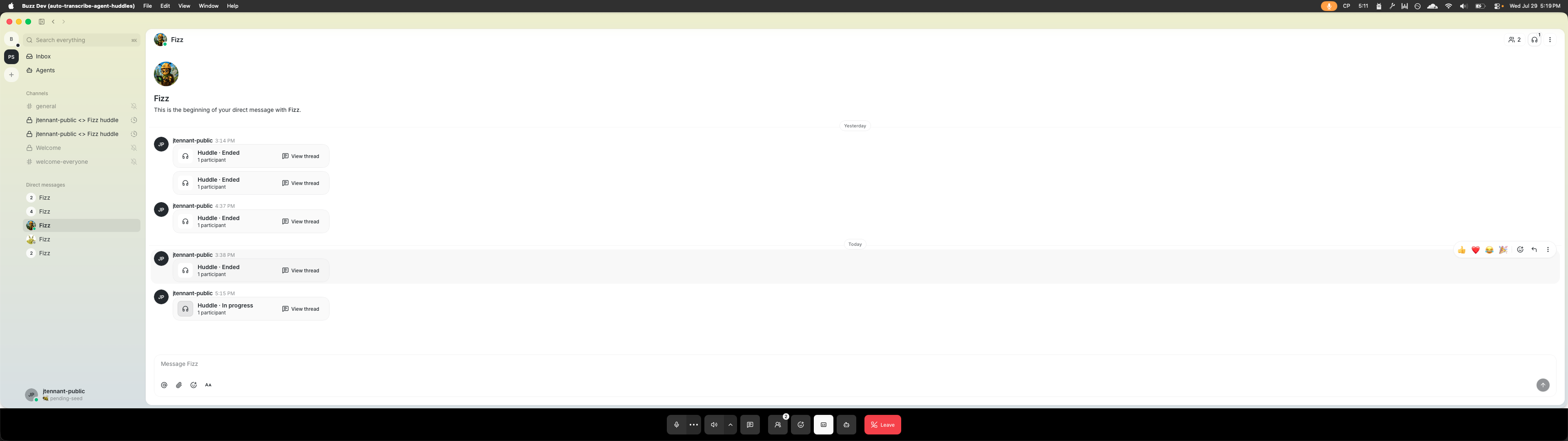 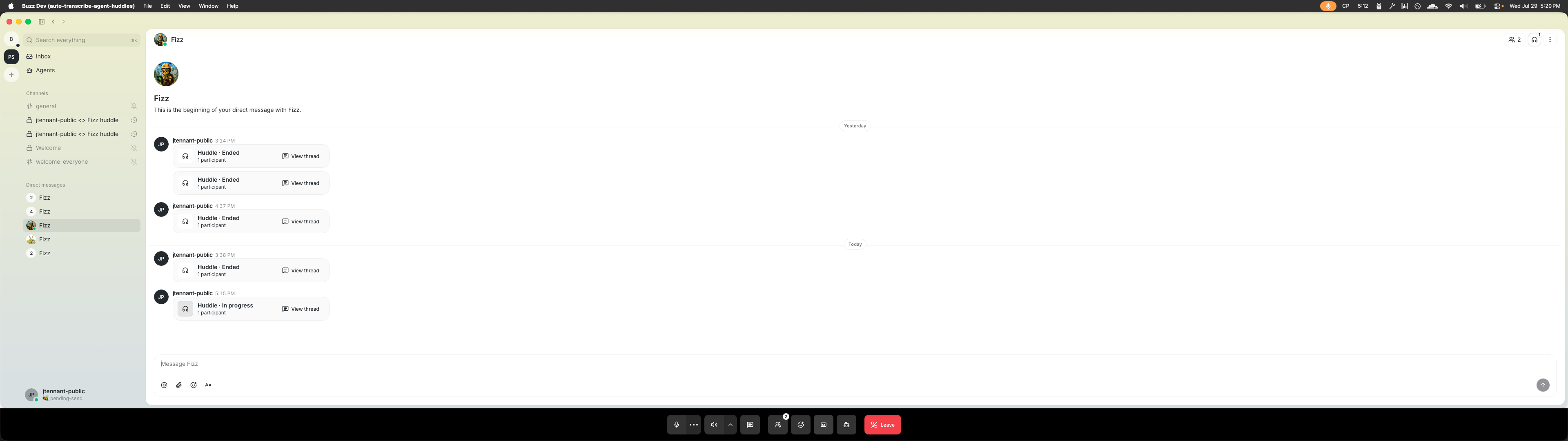 ## Reviewer-reproducible examples From a fresh checkout: ```bash pnpm --dir desktop build:e2e pnpm --dir desktop exec playwright test tests/e2e/huddle-transcription.spec.ts --project=smoke pnpm --dir desktop exec playwright test tests/e2e/mentions.spec.ts --project=smoke --grep "system agent profile exposes owned agent actions|system agent avatar exposes owned agent actions|owned bot profile exposes message and huddle actions|owned agent mention profile exposes message and huddle actions" ``` The huddle scenario exercises initial authoritative hydration, exactly one automatic enable, explicit OFF persistence, unchanged state after last-agent removal, newer events winning over delayed hydration, agent-DM enrollment, and idempotent parent membership. It also asserts `aria-pressed` and distinct computed active styling. --------- Signed-off-by: John Tennant <jtennant@squareup.com> Signed-off-by: npub1jh9wn95s0472h86ahapupaf7m6kx4v9sx2n0atj2hltcfer8k06s5n3pyf <95cae996907d7cab9f5dbf43c0f53edeac6ab0b032a6feae4abfd784e467b3f5@buzz.block.builderlab.xyz> Co-authored-by: npub1jh9wn95s0472h86ahapupaf7m6kx4v9sx2n0atj2hltcfer8k06s5n3pyf <95cae996907d7cab9f5dbf43c0f53edeac6ab0b032a6feae4abfd784e467b3f5@buzz.block.builderlab.xyz>
## What

Adds `VISION_REMOTE_AGENTS.md` — the vision doc for remote agents,
joining the VISION family (`VISION_AGENT.md`, `VISION_MESH.md`,
`VISION_SOVEREIGN.md`, …).

The one-line thesis: **the relay is the management plane** — an agent's
identity, history, presence, and ordinary control all live on the relay,
so the body (a pod today, anything tomorrow) is replaceable, and
deployment never grows a second control plane.

## Provenance

- Distilled from the remote-agents spec (`docs/remote-agents.md`, PR
block#3748); this doc stays deliberately generic where the spec is
Kubernetes-specific.
- Five review rounds in the #buzz-remote-agents channel; both reviewers
(Wren: thesis/shape/scope, Dawn: truthfulness/minimalness/elegance)
converged at 9/9/9, scored against spec head `b4f4ed1a6` with
command-level receipts.
- Final editorial pass by Tyler (opening line, vignette phrasing,
closing tagline), applied live in-channel before this PR.

Doc-only change — no code, no effect on block#3748, which remains blocked
solely on the Open Decisions A–I rulings.

---------

Signed-off-by: npub1qyvc0c5kl4gqv2fd97fsk46tu378sqgy35vc83rvgfwne90sel7s0ed67d <011987e296fd5006292d2f930b574be47c7801048d1983c46c425d3c95f0cffd@buzz.block.builderlab.xyz>
Signed-off-by: tlongwell-block <109685178+tlongwell-block@users.noreply.github.com>
Co-authored-by: npub1qyvc0c5kl4gqv2fd97fsk46tu378sqgy35vc83rvgfwne90sel7s0ed67d <011987e296fd5006292d2f930b574be47c7801048d1983c46c425d3c95f0cffd@buzz.block.builderlab.xyz>
…ttings (relands block#2467 + block#3208) (block#3910)

Relands **block#2467** (extract `buzz-voice` crate) and **block#3208** (Pocket
voice settings) onto main, after block#3266 and block#3180 merged.

## Why a fresh PR
The repo is squash-only with delete-branch-on-merge. Squashing block#3266
deleted `jtennant/pocket-tts-2026-04`, which was block#2467's base — GitHub
auto-closed block#2467 and it cannot be reopened. Squash merges also sever
ancestry, so GitHub's natural merge-base reports phantom conflicts for
the whole remaining stack.

## Content provenance
- Byte-identical to the blessed `jt/buzz-voice-refactor` branch
(`93029c577`, tree `6729e0eff` — reviewed by Dawn (block#2467) and Max
(block#3208) at exact heads) **except** the three files where block#3180 and block#3208
genuinely interact.
- Three-file resolution (union of both sides):
- `huddle/mod.rs` — block#3180's pipeline re-exports + block#3208's
`agent_tts_routing` imports.
- `huddle/state.rs` — `reset_preserving_generation` preserves both
`huddle_generation` (block#3180) and `tts_enabled` (block#3208); test sets merged
into one `tests` module.
- `desktop/src/testing/e2eBridge.ts` — both switch arms kept; no
duplicate case labels.

## Verification at cf32dac
- `cargo test` (desktop/src-tauri, pinned 1.95.0): **2047 + 3 pass / 0
fail** (14 ignored: 8 keychain, 4 real_relay, 2 flag-gated)
- `cargo clippy --all-targets -- -D warnings`: clean; `cargo fmt
--check`: clean
- `cargo check --workspace` (root, includes new `buzz-voice` member):
clean; `cargo test -p buzz-voice`: 5/0
- `pnpm test`: **3885 / 0**; `tsc --noEmit`: clean; lint: clean

The 3180×3208 interaction resolution is getting an independent team
re-review before merge.

Buzz channel: buzz-desktop-voice `fd5fb402-b651-4238-89b1-bb3e2fa4dc96`,
thread `b4798ecc`.

Signed-off-by: npub1qyvc0c5kl4gqv2fd97fsk46tu378sqgy35vc83rvgfwne90sel7s0ed67d <011987e296fd5006292d2f930b574be47c7801048d1983c46c425d3c95f0cffd@buzz.block.builderlab.xyz>
Co-authored-by: npub1qyvc0c5kl4gqv2fd97fsk46tu378sqgy35vc83rvgfwne90sel7s0ed67d <011987e296fd5006292d2f930b574be47c7801048d1983c46c425d3c95f0cffd@buzz.block.builderlab.xyz>


## Summary
- show profile descriptions in hover cards as a single truncated line
- open the profile panel when avatars are clicked across desktop
surfaces
- make the direct-message intro avatar clickable

## Validation
- Desktop static checks
- 3,807 desktop tests via pre-push

---------

Signed-off-by: kenny lopez <klopez4212@gmail.com>
Signed-off-by: Wes <wesbillman@users.noreply.github.com>
Co-authored-by: Wes <wesbillman@users.noreply.github.com>
Co-authored-by: Carl <c7ebe626f000404285d3686e1dc74cc07cc60a9754a150041ba132e14bd3e2ec@buzz.block.builderlab.xyz>
## Context Pocket TTS currently offers bundled reference voices. People also need a local, private way to add a voice without sending audio to a cloud service. ## Summary Add a Pocket voice import flow to Voice settings. Buzz opens the native file picker, decodes common audio formats in the reusable `buzz-voice` crate, canonicalizes the selected audio, stores it under a content-derived identity in app data, selects it, and lets the user delete it later. ## Changes - Accept WAV, M4A, MP3, FLAC, OGG, and AIFF files between 2 and 30 seconds, including multichannel sources. - Decode and downmix accepted audio to canonical mono 32 kHz PCM16 WAV before hashing and storage. - Store imported voices behind stable `pocket:imported:<sha256>` identities and content-addressed files. - Keep absolute file paths inside the native process and expose only voice metadata to React. - Include imported voices in Pocket preview and live huddle playback. - Add Add voice and delete controls while preserving the bundled Pocket voice catalog. - Fall back to Mary when the selected imported voice is deleted. - Keep durable import, selection, and deletion successful when a live TTS worker acknowledgement is delayed. - Preserve bundled voices when optional import metadata is unreadable and keep failed deletion retryable. ## Related issue None found. ## Testing Production decoding was exercised with WAV, M4A with AAC, MP3, FLAC, OGG Vorbis, and AIFF fixtures. Each format canonicalized to mono 32 kHz PCM16 WAV. Manual validation in the combined daily-driver build covered native-picker import, Preview, live-huddle playback, deletion, and Mary fallback. ## Screenshots The Voice settings card preserves the bundled Pocket catalog and adds the local Add voice action. 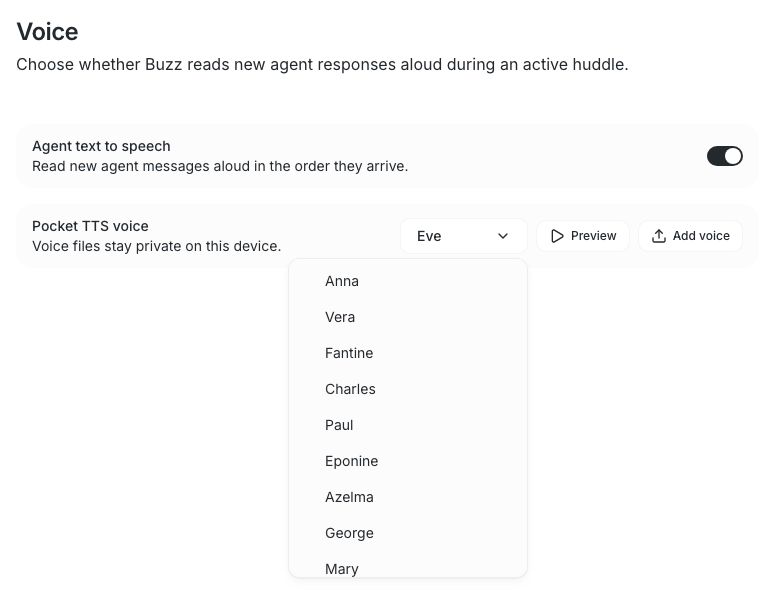 ## Reviewer-reproducible examples Create common-format fixtures and run them through the production importer: ```bash . ./bin/activate-hermit fixtures="$(mktemp -d)" ffmpeg -hide_banner -loglevel error -f lavfi -i "sine=frequency=220:duration=3" -ac 2 -ar 44100 "$fixtures/voice.wav" ffmpeg -hide_banner -loglevel error -i "$fixtures/voice.wav" -c:a aac "$fixtures/voice.m4a" ffmpeg -hide_banner -loglevel error -i "$fixtures/voice.wav" "$fixtures/voice.mp3" ffmpeg -hide_banner -loglevel error -i "$fixtures/voice.wav" "$fixtures/voice.flac" ffmpeg -hide_banner -loglevel error -i "$fixtures/voice.wav" -c:a libvorbis "$fixtures/voice.ogg" ffmpeg -hide_banner -loglevel error -i "$fixtures/voice.wav" -c:a pcm_s16be "$fixtures/voice.aiff" BUZZ_VOICE_IMPORT_TEST_DIR="$fixtures" \ cargo test -p buzz-voice imports_common_audio_format_fixtures -- --ignored --nocapture ``` Exercise import persistence, synthesis, deletion, and bundled-voice fallback with an installed Pocket model: ```bash BUZZ_POCKET_MODEL_DIR=/path/to/pocket-model-bundle \ cargo test -p buzz-voice --test pocket_import_audio \ objective_import_synthesis_delete_and_mary_fallback \ -- --ignored --nocapture ``` Exercise the native-picker boundary, selection, preview dispatch, deletion, cancellation, and invalid-file states: ```bash cd desktop pnpm build:e2e pnpm exec playwright test tests/e2e/voice-settings.spec.ts --project=smoke ``` --------- Signed-off-by: John Tennant <jtennant@block.xyz> Signed-off-by: John Tennant <johnmatthewtennant@gmail.com> Signed-off-by: John Tennant <jtennant@squareup.com> Signed-off-by: npub1qyvc0c5kl4gqv2fd97fsk46tu378sqgy35vc83rvgfwne90sel7s0ed67d <011987e296fd5006292d2f930b574be47c7801048d1983c46c425d3c95f0cffd@buzz.block.builderlab.xyz> Signed-off-by: npub12gtutshhh76rx0jx697f32f9tffd4hhp3hx58fp4x6u4uemkm7sqf8f757 <5217c5c2f7bfb4333e46d17c98a9255a52dadee18dcd43a43536b95e6776dfa0@buzz.block.builderlab.xyz> Co-authored-by: John Tennant <jtennant@block.xyz> Co-authored-by: npub1qyvc0c5kl4gqv2fd97fsk46tu378sqgy35vc83rvgfwne90sel7s0ed67d <011987e296fd5006292d2f930b574be47c7801048d1983c46c425d3c95f0cffd@buzz.block.builderlab.xyz> Co-authored-by: npub12gtutshhh76rx0jx697f32f9tffd4hhp3hx58fp4x6u4uemkm7sqf8f757 <5217c5c2f7bfb4333e46d17c98a9255a52dadee18dcd43a43536b95e6776dfa0@buzz.block.builderlab.xyz>
## Summary

- document `Prepare Desktop Release` as the canonical desktop release
entry point
- describe the frozen candidate, exact-head approval, and true
merge-commit contract
- document all platform outputs and complete release App/signing
configuration
- link the release runbook from the README
- allow stable reruns to repair the rolling updater manifest after the
versioned release has already published

## Release blocker

The live repository cannot currently complete this flow: repository
settings disable merge commits and the `main` ruleset allows only
squash, while `scripts/verify-desktop-release-merge.sh` requires a
two-parent merge whose second parent is the approved candidate. Those
settings must allow merge commits before a desktop release PR is merged.

## Validation

- `bash scripts/test-desktop-release-candidate.sh`
- `bash scripts/test-release-ref-contract.sh`
- `git diff --check`
- verified live repository merge settings, `main` ruleset, release tag
ruleset, Actions variable names, and secret names with GitHub API
- independent review by Princess Donut; incorporated all findings,
including the rolling-manifest retry gap and unsigned Windows labeling

Signed-off-by: Wes <wesbillman@users.noreply.github.com>
Co-authored-by: Carl <c7ebe626f000404285d3686e1dc74cc07cc60a9754a150041ba132e14bd3e2ec@buzz.block.builderlab.xyz>

Co-authored-by: Release Automation <release-automation@users.noreply.github.com>
Signed-off-by: Wes <wesbillman@users.noreply.github.com>
chore(release): release Buzz Desktop version 0.5.3

…rification model to NIP-RS (block#2864)

## Summary

Amends `docs/nips/NIP-RS.md` with the manual mark-as-unread override
layer and includes `docs/formal/nip-rs-unread/`, the bounded exhaustive
verification model that preceded and informed the spec.

All `ov_*` override state lives in exactly one coordinate per
installation. That single constraint is what makes the rest of the
amendment small: override state never moves between coordinates, so
there is no slot lifecycle to make crash-safe, and the only durability
obligation is carry-forward on `client_id` rotation.

## Spec changes (`docs/nips/NIP-RS.md`)

- **Non-Goals:** drop the stale line stating mark-as-unread is out of
scope; state the `ov_*` durability exception to the
best-effort/time-horizon model.
- **Reserved Namespace:** `ov_` stem and `esc:` escape marker reserved.
Escape on publish (prepend `esc:` to raw IDs beginning with `ov_` or
`esc:`), unescape on receive (strip exactly one `esc:`). Bijection, with
the pre-amendment backward-compat residual documented as a stated
limitation.
- **Content Validation:** override entries are collected and validated
as a complete logical group *before* any decoding, zero-filling,
merging, or canonicalizing. Only two wire shapes are accepted — a
complete live three-key group, or an `ov_c:`-only tombstone floor. Any
other shape rejects the whole group while retaining the frontier entry;
applying the generic per-entry discard rule first is prohibited.
- **`d` Tag:** `<slot-id>` is exactly 32 lowercase hexadecimal
characters, replacing "a random opaque string" of 1–64 ASCII characters.
The fixed shape lets a relay recognize a read-state coordinate
structurally from the `d` tag alone, without decrypting anything, and
apply per-coordinate protections to it — under the old wording a
conforming client could pick a shape that silently forfeits them.
Recognizable coordinates are also what let a relay replace superseded
versions outright rather than accumulating one retained row per publish,
which keeps the coordinate count a full-state load must enumerate near
one per installation. Every client designates one **primary** coordinate
with a stable `<slot-id>` for the installation's lifetime. All `ov_*`
entries, and the frontier entries of the contexts they belong to, MUST
live in the primary. Additional coordinates remain legal for frontier
volume but MUST NOT carry `ov_*`, which keeps them freely rewritable and
freely deletable.
- **`t` Tag:** described as a discoverability marker rather than a
guarantee of relay-side selectivity. A relay MAY apply tag constraints
after its result cap, and `kind:30078` is shared with unrelated
application data, so clients MUST apply the tag as a correctness filter
locally, MUST NOT infer completeness from a short result, and MUST omit
the tag entirely when performing a full-state load.
- **Fetching / Full-State Load:** clients implementing the override
layer MUST NOT apply a finite `since` filter — an encrypted payload
means a relay filter cannot select for override-bearing events, so any
event-level window can exclude the only coordinate holding a tombstone
floor. Removing `since` is not sufficient: relays MAY cap historical
results, MAY cap below the requested `limit`, and emit
end-of-stored-events after the capped query, so neither EOSE nor a short
page proves completeness. No test against the client's requested `limit`
can detect truncation either: the effective cap belongs to the relay, a
relay MAY cap below what was requested, and an advertised maximum limit
is not necessarily the limit enforced.

A full-state load is therefore enumerated on `{"kinds": [30078],
"authors": [<pubkey>], "limit": <n>}` with **no tag constraint**. A
relay MAY apply tag constraints only after its result cap and withhold
the events that fail them, so under a tag-constrained filter the
delivered count is not the count the cap selected — a delivered page can
be empty while older coordinates still exist below it, and `kind:30078`
is arbitrary application data whose `d` tag namespace is open to every
application that has written under the user's key. Omitting the tag
makes delivery observable; read-state selection moves client-side, where
the validation rules already place it.

Completeness is then established by enumeration on a strictly decreasing
cursor: collect a page, descend on the lowest `created_at` across all
delivered events, exhaust that second with a window pinned to it,
continue below it, and treat only an empty delivery as complete. Every
query carries the same explicit `limit` `n` with `n >= L`. Per-second
exhaustion is discharged by comparing the pinned window's delivery
against the largest delivery the relay has already demonstrated in the
same load, floored at `L = 2` so that the ordinary single-coordinate
installation can reach *complete* at all. The comparison fails safe: an
inconclusive window reports *cannot prove complete* rather than
*complete*, and that verdict is terminal for the load.

Because these are addressable events, a coordinate republished mid-load
moves *above* the descending cursor while its previous version stops
existing, so neither is reachable by any later query. A full-state load
is therefore fenced by a live subscription on the same tag-free filter,
established — defined as receipt of end-of-stored-events — before the
first enumeration query and held unbroken on the same connection for the
load's duration. Fence deliveries are collected like enumerated events
but do not contribute to the cursor or to the demonstrated-delivery
bound. Collection deduplicates coordinates on the full NIP-01
addressable ordering — greatest `created_at`, lowest event id on ties —
because an equal-timestamp replacement is legal and is the version the
relay retains. A lapsed or reconnected fence makes the load potentially
incomplete, and a client MUST NOT publish to its own coordinates during
its own load.

Five relay behaviours the *complete* verdict rests on are stated as
normative conformance preconditions rather than assumptions, because
none is verifiable from the responses a client receives: newest-first
prefix delivery with lowest-id tie-breaking (what NIP-01 already
specifies for `limit`), a non-decreasing effective cap within a load,
the floor `L`, push delivery on an open subscription, and a delivery
barrier ordering accepted matching events ahead of a query's
end-of-stored-events on the same connection. Conditioning *complete* on
positive proof of these instead would withdraw the override layer from
every client rather than from the non-conforming relays. A client MUST
NOT load against a relay it has evidence violates them, and MUST treat
any such load as potentially incomplete.

A load that is potentially incomplete, or that failed on any relay the
client publishes to, MUST NOT authorize canonical compaction, publishing
a canonicalized override blob, deleting or abandoning a coordinate, or
reporting a mark-read as successful; the client falls back to local
state.
- **Client-ID Rotation / Orphaned Blob Deletion:** rotation is the only
event that changes an override-bearing coordinate. Before deleting or
abandoning its previous primary, a client MUST republish the
componentwise `max()` of every register that primary holds — every
tombstone ceiling included — under its new primary, and MUST confirm
acceptance on **every relay** from which the old primary will be deleted
or allowed to lapse. Acceptance on one relay does not authorize deletion
on another. Frontier-only orphans are deletable unconditionally; an
unknown same-`client_id` coordinate is treated as a live carrier until
merged.
- **Live Subscription and Convergence:** the re-publish trigger and its
suppression are evaluated on canonicalized state, so a retained live
peer blob the client has already tombstoned cannot trigger an identical
write on every replay.
- **Manual-Unread Override Layer** (new section):
- **Wire encoding:** `ov_s:<ctx>`, `ov_c:<ctx>`, `ov_b:<ctx>` as uint32
siblings in the existing `contexts` map.
- **Merge rule:** componentwise `max()` per counter — no new wire merge
logic.
- **Liveness predicate:** `S > 0 AND F <= B AND S > C`, transcribed from
`model.py::override_set_b`.
- **Actions:** mark-unread bumps S and captures the effective frontier
as B; mark-read bumps C; a natural frontier advance past B deactivates a
stale set with no counter update. Every action requires a complete
full-state load. At the uint32 ceiling, wrapping and resetting are
prohibited: mark-unread is refused, and mark-read completes only if the
resulting state has `override_active == false` — otherwise it fails
visibly rather than reporting success over a still-live override.
- **Tombstone floor:** a dead ever-active register compacts to `RegB(0,
max(S,C), 0)` — a single `ov_c:` key. A virgin register is omitted
entirely. This blocks counter reuse and the resulting resurrection.
- **Mandatory canonical publication:** a protocol requirement, not an
optimization. Publishing raw dead registers lets two independently-dead
registers from different devices produce a live join.
- **Override group co-location rule:** a context's frontier entry and
all its `ov_*` siblings MUST travel in the same event, and that event
MUST be the primary coordinate. An override-bearing context therefore
has exactly one legal destination for its whole group; only
frontier-only groups may be distributed across additional coordinates.
Grouping is per logical context, never per key.
- **Unescape-before-group rule:** the frontier wire key MUST be
unescaped to its raw logical context ID before use as group identity.
Equal normative weight to atomic grouping.
- **Tie policy:** clear-wins is MUST. The tie verdict is not encoded on
the wire, so a selectable policy makes two conforming clients diverge
permanently on both the unread verdict and the canonical wire form.
- **Override State Durability:** `ov_*` entries are exempt from age
pruning and budget eviction permanently, and durability is defined over
retrievable logical state — the containing event must stay reachable and
the load must establish completeness, not merely retain keys. There is
no safe finite GC horizon.
- **Bounds and budget:** byte/key analysis at both small-counter and
uint32-maximum values. Confining `ov_*` to one blob makes its plaintext
budget a hard lifetime ceiling on ever-overridden contexts — roughly 600
tombstones at the worst-case ~54 bytes against 32 KiB, ~730 at the
common ~45 bytes, ~199 simultaneously live overrides at ~164 bytes. At
the ceiling a client MUST refuse mark-unread and MUST NOT split override
state, drop floors, or publish a truncated override set. Same policy
shape as counter exhaustion: visible failure, never silent degradation.
- **Verification artifact:** `docs/formal/nip-rs-unread/`. The model is
a broader predecessor of this NIP: its `split_blob_into_slots` permits
override groups in any slot, so verified atomicity covers every
arrangement this NIP allows, but the converse does not follow. The model
does not verify the single-primary rule, the completeness procedure, the
relay conformance requirements or the mutation fence, or carry-forward;
malformed-group wire validation is likewise normative but outside
verified scope.

- **Abstract / Non-Goals / Backwards Compatibility:** the absolute "no
relay-side logic" and "no relay behavior changes" claims are narrowed to
what remains true — no new event kind, no new wire message, no
relay-stored read-state logic — with the override layer's relay
conformance contract named as the exception. Frontier sync and clients
that skip the override layer are unaffected on any relay.

## Verification model (`docs/formal/nip-rs-unread/`)

Four Python files constituting a bounded exhaustive verification model
for the override layer's register algebra.

**What it does:** constructs a toy universe — 2–3 devices, 2 channels,
every action that can happen (mark-unread, mark-read, late/duplicate
syncs, app reinstall, storage compaction) — and brute-forces every
reachable ordering (14,258 BFS states; 672-point deep-history parameter
cube; 9-mutant harness over ~45,000 merge pairs). After each world-state
it asks: did all devices converge? Did any unread flag get resurrected
after being cleared, or vanish while live?

**What it found and fixed:**

1. **Killed candidate A.** The model produced a concrete kill sequence:
an old client that doesn't know about the new field rewrites its
read-state blob and silently erases unread flags. That witness is why
the spec uses candidate B (two counters that only count up, plus a
snapshot) instead.
2. **Candidate B passes everything.** All delivery orders converge; the
frontier high-water mark never regresses; duplicated/replayed syncs are
harmless; old clients can't destroy it; compaction never resurrects a
dead unread or drops a live one, including
cleanup-followed-by-weeks-late-stale-sync and
tombstone-landing-on-unrelated-live-state corner cases.
3. **Caught a second real bug late.** Two devices each publishing "this
unread is cleared" could, on merge, reactivate it. The fix (canonicalize
before publishing) is a mandatory rule in the spec; the model re-checks
it across ~45,000 merge pairs.

**Scope and caveats:** bounded to 2–3 devices and 2 channels. Can't
prove the infinite case. `NOTE.md` documents the exact verification
scope and the gap between the model's `split_blob_into_slots` generality
and the single-primary rule the spec adds on top.

**Why it's in the repo:** the spec asserts "verified by bounded
exhaustive model checking." Keeping the artifact in-repo means anyone
who later amends the merge/compaction rules can `python3 exhaustive.py
&& python3 mutation.py` (deterministic, exit 0) and confirm the
guarantees hold. Without it the spec claims a proof nobody can check.

## Diff scope

`docs/nips/NIP-RS.md` — spec amendment, zero product code.

`docs/formal/nip-rs-unread/{NOTE.md,model.py,exhaustive.py,mutation.py}`
— bounded exhaustive verification model, zero product code.
`.gitignore` — `__pycache__/` and `*.pyc` entries for the model
directory.

---------

Signed-off-by: Will Pfleger <pfleger.will@gmail.com>
Co-authored-by: npub1mn7jgtj4w2pd0g0zeuhxsa6jy6p0rewxz4kujt98my82ahfmp72sxjexk7 <dcfd242e557282d7a1e2cf2e6877522682f1e5c6156dc92ca7d90eaedd3b0f95@buzz.block.builderlab.xyz>
## Summary
- validate desktop release candidates before merge and keep the
repository squash-only
- tag the squash commit only after proving frozen-base parent and
complete-tree identity with the validated PR head
- accept either an exact-head approval or the durable Default-ruleset
bypass record as release authorization
- remove the unusable App-backed preparation workflow; retain `just
release-desktop`

## Ruleset follow-up
After this PR merges, update Default ruleset `13596885` to:
- enable strict required status checks
- dismiss stale reviews on push and require approval after the last push
- require the integration-bound `Desktop Release Candidate` check

The next desktop release should be cut only after that settings update.

## Verification
At commit `d8c254db427eedbcffac1a6e078e90d1d0f5e151` with a clean
worktree:
- `scripts/test-release-ref-contract.sh`
- `scripts/test-desktop-release-candidate.sh`
- `bash -n scripts/verify-desktop-release-merge.sh
scripts/prepare-desktop-release.sh scripts/test-release-ref-contract.sh`
- `git diff --check`

The bypass test fixture is the captured rule-suite shape from real
squash merge PR block#2864 / suite `3520068134`.

---------

Signed-off-by: Wes <wesbillman@users.noreply.github.com>
Co-authored-by: Carl <c7ebe626f000404285d3686e1dc74cc07cc60a9754a150041ba132e14bd3e2ec@buzz.block.builderlab.xyz>
## Summary
- require an exact-head trusted approval before desktop auto-tagging
- remove rule-suite authorization that `GITHUB_TOKEN` cannot access
- pin review pagination to `page=1` and test the deployed `gh` control
flow

## Why
The previous verifier unconditionally queried repository rule-suite
endpoints with `github.token`. Those endpoints require Administration:
read, which Actions `GITHUB_TOKEN` cannot receive. Its paginated list
request also duplicated page one when no explicit page was supplied.

This deliberately removes admin-bypass authorization rather than
introducing a second credential during release recovery. Desktop release
PRs must now have GitHub's overall `APPROVED` decision and a
MEMBER/OWNER/COLLABORATOR approval attached to the exact candidate SHA.

## Validation
- `scripts/test-desktop-release-authorization.sh`
- `scripts/test-release-ref-contract.sh`
- `bash -n scripts/verify-desktop-release-merge.sh
scripts/verify-desktop-release-authorization.sh
scripts/test-desktop-release-authorization.sh
scripts/test-release-ref-contract.sh`
- `git diff --check origin/main...HEAD`

The new flow test uses a stub `gh` executable, asserts the exact
`page=1` request, fails any rule-suite API call, and rejects stale-SHA,
untrusted-author, changes-requested review, and non-approved
aggregate-decision cases.

Signed-off-by: Wes <wesbillman@users.noreply.github.com>
Co-authored-by: Carl <c7ebe626f000404285d3686e1dc74cc07cc60a9754a150041ba132e14bd3e2ec@buzz.block.builderlab.xyz>
## Buzz Desktop release v0.5.3

- **Frozen main:** `54c8ef30a9bb9c59a4415a8a7ee84c7c5454b48a`
- **Reviewed candidate:** `d0c06978bbf494ded6fe1a55d69d810ae9b65863`
- **Previous desktop release:** `v0.5.2`
- **Proposed immutable tag:** `desktop-v0.5.3`

This PR must be **squash merged** only after the Desktop Release
Candidate check passes. The branch must remain based directly on current
; stale base, payload drift, incomplete notes, or an unauthorized merge
produce no tag.

The checked-in changelog accounts for every non-merge commit in the
release range. Publication remains bound to the immutable candidate tag.

Signed-off-by: Wes <wesbillman@users.noreply.github.com>
Co-authored-by: Release Automation <release-automation@users.noreply.github.com>
## Summary
- escape the Markdown backticks around `main` in the desktop release PR
body
- prevent the shell from executing `main` as command substitution
- lock the heredoc contract into the release-ref test

## Verification
- `scripts/test-release-ref-contract.sh`
- `bash -n scripts/prepare-desktop-release.sh
scripts/test-release-ref-contract.sh`
- `git diff --check origin/main...HEAD`

This is a follow-up to the cosmetic PR-body issue observed on block#3972. It
does not modify that frozen release candidate.

Signed-off-by: Wes <wesbillman@users.noreply.github.com>
Co-authored-by: Carl <c7ebe626f000404285d3686e1dc74cc07cc60a9754a150041ba132e14bd3e2ec@buzz.block.builderlab.xyz>
)

Buzz renders one card per `kind:30617`, so a project spanning several
repositories has no representation.
[NIP-MP](block#3163) defines `kind:30621`
as an addressable container holding a group's name, description, channel
binding, and member coordinates. This adds the kind to `buzz-core` and
its structural validation to the relay ingest path.

## Event shape

```json
{
  "kind": 30621,
  "tags": [
    ["d", "platform"],
    ["name", "Platform"],
    ["description", "Relay, desktop, and mobile."],
    ["a", "30617:<owner-a-hex>:buzz"],
    ["a", "30617:<owner-b-hex>:buzz-infra"],
    ["buzz-channel", "<channel-uuid>"],
    ["buzz-visibility", "listed"]
  ]
}
```

## Validation at ingest

| Rule | Behavior |
|------|----------|
| `d` tag | exactly one, non-empty (length already bounded by the
generic `D_TAG_MAX_LEN` check) |
| member `a` tag arity | exactly 2 or 3 elements per NIP-01's `a` tag
grammar; a 4th element has no defined meaning and is rejected |
| member `a` tag coordinate | must parse as
`30617:<lowercase-64-hex-owner>:<non-empty-d>` |
| duplicate members | rejected on exact string match of the canonical
coordinate |
| member cap | 64, counted over raw `a` tags |
| metadata cardinality | at most one each of `name`, `description`,
`buzz-channel`, `buzz-visibility` |
| metadata length | `name` ≤ 256 bytes, `description` ≤ 2048 bytes,
`buzz-channel` ≤ 256 bytes, `buzz-visibility` ≤ 256 bytes |
| zero members | valid |
| unknown tags | ignored |

Rejection order is normative so a client can predict which rule fires:
`d`-cardinality → `d`-empty → member-cap → member-arity → coordinate
parse → member-duplicate → metadata cardinality → metadata length.

## Design notes

**No membership authorization.** Members are `a` tags, so one project
may name repositories owned by different pubkeys — the entire point of
the kind. That is safe because membership grants nothing: push policy
reads a repository's own `kind:30617` (`api/git/policy.rs`) and never a
project. `buzz-channel` is a metadata reference, not a routing
directive, so projects are classified global-only.

**Owner-only editing is free.** NIP-33 addressing keys replacement on
`(pubkey, kind, d)`, so one signer can never overwrite another's
project. No relay-side permission check exists or is needed, and
`test_project_same_d_under_two_authors_are_independent` pins it.

**Duplicates are rejected, not deduped.** A relay cannot rewrite tags
inside a signed event without invalidating its id and signature, so the
alternative to rejection is a stored duplicate-member head that every
consumer must apply a first-wins rule to.

**The cap is checked before the duplicate set is built.** Counting raw
`a` tags rather than distinct coordinates means an event naming one
coordinate thousands of times is refused on count, instead of being
bounded only by the relay frame limit.

**No side-effect handler.** Generic NIP-33 replacement and generic
NIP-09 coordinate soft-delete already cover replacement and deletion;
`kind:30621` needs no entry in `is_side_effect_kind`.

## Generic NIP-09 fix carried along

`soft_delete_by_coordinate` (`crates/buzz-db/src/event.rs`) previously
deleted the live coordinate head regardless of the tombstone's own
`created_at`, so a delayed or replayed `a`-tag deletion signed between
two versions destroyed the newer replacement. NIP-09 scopes an `a`-tag
deletion to versions at or before the deletion request, so the `UPDATE`
now carries `created_at <= $5` and `handle_a_tag_deletion` threads the
deletion event's `created_at` through.

The bug predates `kind:30621` and affected every
parameterized-replaceable kind on the generic path — `kind:30617`
repository announcements included — so the fix lands there rather than
as a project special case. `events.created_at` is immutable per row, so
the predicate guarantees a tombstone can never erase a version newer
than itself; the UPDATE re-evaluates its WHERE clause after any lock
wait. Under READ COMMITTED, a same-coordinate replacement racing the
deletion may cause the deletion to evaluate before the new head lands,
returning `Ok(false)` — but that outcome is state-identical to the
deletion having arrived first, a valid Nostr ordering Nostr never fixes.
The return value feeds only a debug log. No coordinate-level lock is
needed.

## Coverage

32 unit tests in `crates/buzz-relay/src/handlers/ingest.rs` pin the
envelope contract (accept: minimal, cross-owner, zero-member, same repo
`d` under two owners, colon-bearing repo `d`, cap boundary, unknown
tags, relay hint on member `a` tag, max-length metadata, stranger-owned
member, uninterpreted metadata values, non-empty content; reject: every
rule above plus valueless `d`/`a` tags). A fixture-driven test
(`project_envelope_validates_all_shared_fixtures`) runs every case in
the shared `NIP-MP.fixtures.json` oracle (11 accept + 20 reject) against
`validate_project_envelope`, so any future change that breaks a case
turns the test suite red.

6 `#[ignore]`d e2e tests in
`crates/buzz-test-client/tests/e2e_project.rs` cover behavior that only
exists past storage — coordinate round-trip, newer-wins replacement, two
authors sharing a `d`, an `a`-tag tombstone that removes the project
while leaving referenced `kind:30617`s intact, and a tombstone
timestamped between V1 and V2 that must leave V2 live. The negative e2e
case asserts on the rejection message so a refusal for an unrelated
reason cannot satisfy it; that is what proves the validator is reachable
from the live write path rather than merely correct in isolation. The
new e2e binary is wired into the Relay E2E job.

The timestamp predicate is additionally pinned at the storage layer by
`coordinate_delete_spares_head_newer_than_the_deletion` in
`crates/buzz-db/src/lib.rs`, which asserts both directions: a stale
tombstone deletes nothing and leaves the newer head readable, and a
tombstone at the head's own timestamp still deletes it. This test is
wired into the Backend Integration job.

Related: block#3163 (the NIP-MP spec and shared conformance fixtures).
Independent — either can merge first.

---------

Signed-off-by: Will Pfleger <pfleger.will@gmail.com>
Co-authored-by: npub1mn7jgtj4w2pd0g0zeuhxsa6jy6p0rewxz4kujt98my82ahfmp72sxjexk7 <dcfd242e557282d7a1e2cf2e6877522682f1e5c6156dc92ca7d90eaedd3b0f95@buzz.block.builderlab.xyz>
…block#3999)

## Problem

`buzz-agent` measures and sends `accumulatedCachedInputTokens` on the
wire (`usage.rs:93`). `buzz-acp` deserializes it correctly — but then
drops it: `TurnUsage` had no cache field, and `build_turn_metric_counts`
hardcoded `cache_read_tokens: None` and `cache_write_tokens: None` into
both `turn` and `cumulative` `TokenCounts`. Every kind:44200 event
published permanently lacked data the harness measured. The archive is
append-only — this is unrecoverable data loss per turn, every turn,
until fixed.

NIP-AM already specifies the fields (`cacheReadTokens` /
`cacheWriteTokens` inside `turn` and `cumulative`). This is a pure
threading fix.

## Changes

**`crates/buzz-acp/src/usage.rs`**

- `SessionState` gains `last_cached_input: u64` to track the committed
cache-read baseline.
- `TurnUsage` gains `turn_cache_read_tokens: Option<u64>` (field-local;
`None` when no baseline or counter decreased) and
`cumulative_cache_read_tokens: u64` (always present; zero when no cache
hits reported).
- `record()` computes the cache-read delta with field-local taint
semantics: a decrease in the cumulative counter nulls only
`turn_cache_read_tokens` — it does not flip `delta_reliable` or
invalidate `turn_input_tokens`/`turn_output_tokens`. Identical to the
`accumulatedTotalTokens` pattern already present.
- `take()` and the setup-notification branch both advance
`last_cached_input` in the committed baseline.

**`crates/buzz-acp/src/pool.rs`**

- `build_turn_metric_counts` wires `turn_cache_read_tokens` into
`turn.cache_read_tokens` (when `delta_reliable`) and
`Some(cumulative_cache_read_tokens)` into
`cumulative.cache_read_tokens`.
- `cache_write_tokens` remains `None` on both counts with an explanatory
comment: buzz-agent does not emit a write-side count on the wire today.
- Six existing `TurnUsage` struct literals in tests updated with the two
new fields.

## Tests

**`usage.rs` — new cache-read section (5 tests):**
-
`cache_read_first_turn_produces_none_turn_delta_and_passes_cumulative_through`
— no baseline → delta None, cumulative passes through
- `cache_read_second_turn_delta_computed_correctly` — delta = current −
previous
- `cache_read_decrease_nulls_turn_cache_but_leaves_delta_reliable` —
field-local taint: decrease nulls cache delta only, input/output stay
reliable
- `cache_read_zero_payload_after_baseline_produces_zero_delta` — zero on
both sides → `Some(0)`, not `None`
- `cache_read_threads_through_setup_notification_baseline` — setup
notification baseline correctly seeds the cache counter

**`pool.rs` — new acceptance test (1 test):**
- `test_build_turn_metric_counts_cache_read_tokens_thread_through` —
wire-parses a buzz-agent payload with nonzero
`accumulatedCachedInputTokens`, runs two turns through the tracker and
`build_turn_metric_counts`, and asserts nonzero `cacheReadTokens` in
cumulative + correct per-turn delta in `turn`; also asserts
`cache_write_tokens` is `None` throughout

## Quality gates at tip `c6405eb43f532572e3b7775e0dee826dc9cb3f82`

| Gate | Result |
|---|---|
| `cargo test -p buzz-acp` | **655/655**, 0 failed |
| `cargo clippy -p buzz-acp --all-targets -- -D warnings` | clean |
| `cargo fmt --check` | clean |

Note: the pre-push hook `mobile-test` gate fails on `origin/main` before
this branch (Flutter test in `channels_page_test.dart` /
`compose_bar_test.dart` — verified independently). My changes touch only
`crates/buzz-acp/src/`; the mobile failure is unrelated and
pre-existing.

---------

Signed-off-by: Will Pfleger <pfleger.will@gmail.com>
Co-authored-by: npub1g8493u0xfsjrvflg4n08ezd7vec99mnwzlv0qgwpr9d7gvjwhuzqx59rhw <41ea58f1e64c243627e8acde7c89be667052ee6e17d8f021c1195be4324ebf04@buzz.block.builderlab.xyz>




…am-4

Catch-up to block/buzz@b1b283cd4, 19 commits.

One conflict, in Cargo.toml, and the benign kind: both sides appended a
workspace member -- our crates/buzz-kannaka against upstream's new
crates/buzz-voice. Kept both, and confirmed crates/buzz-voice actually exists
so the member resolves rather than breaking the workspace.

Notably the crest extraction did its job: desktop/playwright.config.ts and
MachineOnboardingFlow.tsx both auto-merged this time, where the previous sync
conflicted in exactly that component.

Verified: check-kannaka-theme OK, tsc --noEmit clean, cargo check clean across
buzz-kannaka, buzz-workflow, buzz-dev-mcp and buzz-relay.

Co-Authored-By: Claude Opus 5 (1M context) <noreply@anthropic.com>

This file contains hidden or bidirectional Unicode text that may be interpreted or compiled differently than what appears below. To review, open the file in an editor that reveals hidden Unicode characters.
Learn more about bidirectional Unicode characters
Sign up for free
to join this conversation on GitHub.
Already have an account?
Sign in to comment
7 participants


Add this suggestion to a batch that can be applied as a single commit.This suggestion is invalid because no changes were made to the code.Suggestions cannot be applied while the pull request is closed.Suggestions cannot be applied while viewing a subset of changes.Only one suggestion per line can be applied in a batch.Add this suggestion to a batch that can be applied as a single commit.Applying suggestions on deleted lines is not supported.You must change the existing code in this line in order to create a valid suggestion.Outdated suggestions cannot be applied.This suggestion has been applied or marked resolved.Suggestions cannot be applied from pending reviews.Suggestions cannot be applied on multi-line comments.Suggestions cannot be applied while the pull request is queued to merge.Suggestion cannot be applied right now. Please check back later.
Merge of
block/buzz@b1b283cd4. With this the fork is at gap 0 — level with upstream, not merely closer to it.The one conflict
Cargo.toml, and the benign kind: both sides appended a workspace member — ourcrates/buzz-kannakaagainst upstream's newcrates/buzz-voice. Kept both, and checkedcrates/buzz-voiceactually exists on disk so the member resolves instead of breaking the workspace for everyone.The crest extraction already paid off
MachineOnboardingFlow.tsxanddesktop/playwright.config.tsauto-merged this time. That component is precisely where the previous sync (#15) conflicted, which is what motivated moving the crest out of it. One sync later the change is already earning its keep.Verification
check-kannaka-theme.mjs→ OK. Upstream renamed no brand token and still renders the wordmark the crest anchors on.tsc --noEmit→ clean.cargo check --all-targets→ clean acrossbuzz-kannaka,buzz-workflow,buzz-dev-mcp,buzz-relay. Worth running rather than assuming:crates/buzz-relay/src/handlers/ingest.rsauto-merged in our territory again.mainbefore pushing.The crest E2E spec added in #15 rides along here, so this run also re-verifies the crest renders against 19 commits of new upstream — which is exactly the event that spec exists to catch.
🤖 Generated with Claude Code