[synthetics] Document the request parameter
#2071
Conversation


|
This pull request does not have a backport label. Could you fix it @colleenmcginnis? 🙏
|

|
A documentation preview will be available soon: |
 mergify
bot
added
the
backport-skip
mergify
bot
added
the
backport-skip
 colleenmcginnis
added
backport-8.4
colleenmcginnis
added
backport-8.4

I agree, it seems a little odd for it to go in the params and secrets section as it's out of context for the rest of that page. I think it might be better on the write a test page. I think the reference to |
colleenmcginnis
changed the title
request parameterrequest parameter

 colleenmcginnis
left a comment
colleenmcginnis
left a comment
colleenmcginnis
left a comment
There was a problem hiding this comment.
This is ready for review -- a few questions/comments below.

 andrewvc
left a comment
andrewvc
left a comment
andrewvc
left a comment
There was a problem hiding this comment.
I like the new docs but found some bugs!

 paulb-elastic
left a comment
paulb-elastic
left a comment
paulb-elastic
left a comment
There was a problem hiding this comment.
Agree that the example maybe does look a bit complex as there are other things in there about decoding that aren’t necessarily related to the request.
If the purpose of the docs is to show how a request can be made and they used in the script (irrespective of having an example in our demos are at some point), maybe a simpler example would be useful.
I’ll defer to @andrewvc’s suggestions here, but here is an example I put together for something recently (it makes a request for a quote of the day, then uses this in a Google search):
step("Google Page", async () => {
  // HTTP request for the quote
  const resp = await  request.get("http://quotes.stormconsultancy.co.uk/random.json");
  // parse the response
  quote = JSON.parse((await resp.body()).toString()).quote;
  // visit Google with the quote
  await page.goto('https://www.google.com?q=' + quote);
});
(Maybe this is too simple and not a realistic enough scenario, so feel free to use it or not)
I'll LGTM and defer to Andrew's suggestion regarding the specifics of the example.

| // The Elastic Synthetics `request` parameter is similar to Playwright's | ||
| // https://playwright.dev/docs/api/class-apirequestcontext[`APIRequestContext`], but | ||
| // it comes built into Elastic Synthetics and doesn't have to be imported separately. | ||
| // This reduces the code needed and allows you to make API requests in inline journeys. |
There was a problem hiding this comment.
We want to mention how this is different from the other request objects that is exposed by Playwright.
@vigneshshanmugam is this what you had in mind? Are there other differences?

There was a problem hiding this comment.
I was thinking something along the lines of
- Top level
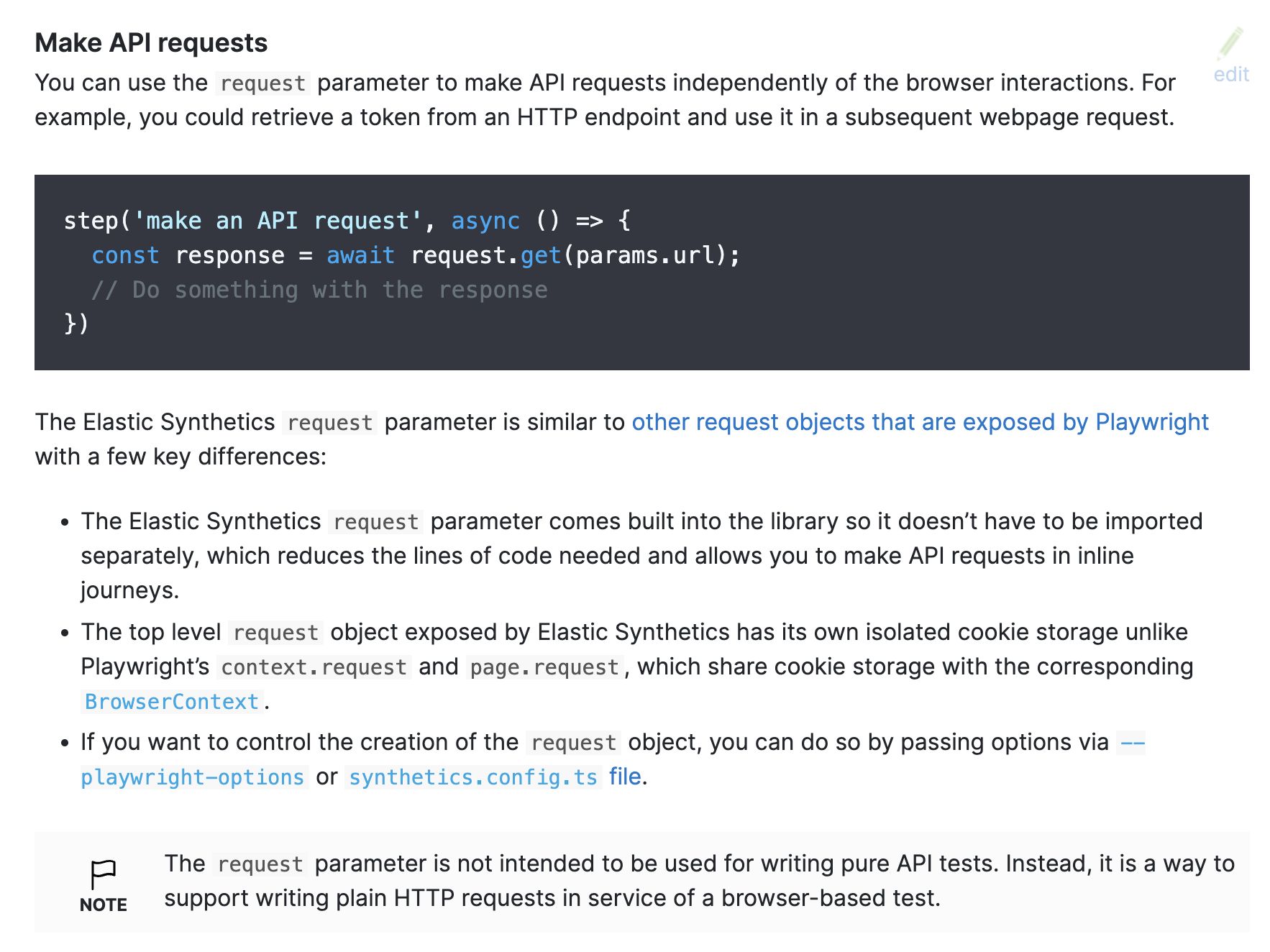
requestobject exposed by synthetics have its own isolated cookie storage and its different from thecontext.requestandpage.requestas they shares cookie storage with the corresponding BrowserContext. - If you want to control the creation of this request object - https://playwright.dev/docs/api/class-apirequest#api-request-new-context, you can do so by passing options via
--playwright-optionsorsynthetics.config.tsfile.
There was a problem hiding this comment.
 colleenmcginnis
dismissed
andrewvc’s stale review
colleenmcginnis
dismissed
andrewvc’s stale review
I'm moving forward with other approvals -- I can make additional changes as needed in a follow-up PR.
* initial approach

* move from params/secrets to write a test

* remove detailed examples

* add info on how synthetics request is different than playwright request

* final clean up

(cherry picked from commit ed30777)
* initial approach

* move from params/secrets to write a test

* remove detailed examples

* add info on how synthetics request is different than playwright request

* final clean up

(cherry picked from commit ed30777)

Co-authored-by: Colleen McGinnis <[email protected]>
4 participants


Closes #2049
Overview
Adds documentation on the new
requestparameter that allows users to make API requests independently of the browser interactions. For example, to get authentication credentials or tokens in service of a browser-based test.For the reviewer
@paulb-elastic @andrewvc:
journey?To do
requestparameter fits into the current docs