[SPARK-32494][SQL] Null Aware Anti Join Optimize Support Multi-Column #29304
Conversation


|
@cloud-fan @maropu @agrawaldevesh |

| val OPTIMIZE_NULL_AWARE_ANTI_JOIN_MAX_NUM_KEYS = | ||
| buildConf("spark.sql.optimizeNullAwareAntiJoin.maxNumKeys") | ||
| .internal() | ||
| .doc("The maximum number of keys that will be supported to use NAAJ optimize.") |

There was a problem hiding this comment.
What the cost is to increase this maximum number? What is good and what is bad. We should state clearly in the doc.
| return BitSetMethods.anySet(baseObject, baseOffset, bitSetWidthInBytes / 8); | ||
| } | ||
|
|
||
| public boolean allNull() { |
| "optimized from O(M*N) calculation into O(M) calculation " + | ||
| "using Hash lookup instead of Looping lookup." + | ||
| "Only support for singleColumn NAAJ for now.") | ||
| "using Hash lookup instead of Looping lookup.") |
There was a problem hiding this comment.
Add few words to link this with OPTIMIZE_NULL_AWARE_ANTI_JOIN_MAX_NUM_KEYS. E.g., "The number of keys supported for NAAJ is configured by spark.sql.optimizeNullAwareAntiJoin.maxNumKeys".

|
ok to test |
|
@viirya thanks for your reviewing, code updated. |

|
Test build #126826 has finished for PR 29304 at commit
|
|
Test build #126838 has finished for PR 29304 at commit
|
|
Test build #126854 has finished for PR 29304 at commit
|
 leanken-zz
force-pushed
the
leanken-SPARK-32494
branch
from
leanken-zz
force-pushed
the
leanken-SPARK-32494
branch
from
0c6e259 to
130606c
Compare
|
rebased code because merge conflicts. |
|
Test build #126872 has finished for PR 29304 at commit
|

| } | ||
| } | ||
|
|
||
| object ExtractSingleColumnNullAwareAntiJoin extends JoinSelectionHelper with PredicateHelper { |

There was a problem hiding this comment.
how about ExtractNullAwareAntiJoinKeys
| "it might cause Driver OOM if NAAJ numKeys increased, since it is exponential growth. " + | ||
| "It's ok to increase this configuration if buildSide is small enough and safe enough " + | ||
| "to do such exponential expansion to gain performance improvement from O(M*N) to O(M).") | ||
| .intConf |
There was a problem hiding this comment.
Plz add checkValue. I think only a positive value seems reasonable.
| "It's ok to increase this configuration if buildSide is small enough and safe enough " + | ||
| "to do such exponential expansion to gain performance improvement from O(M*N) to O(M).") |
There was a problem hiding this comment.
We need the last two statements above? IMO the first three statements looks enough.
| |// generate join key for stream side | ||
| |${keyEv.code} | ||
| |if ($anyNull) { | ||
| |if (${ if (isLongHashedRelation) s"$anyNull" else s"${keyEv.value}.allNull()"}) { |
There was a problem hiding this comment.
nit: if (${if (isLongHashedRelation) anyNull else s"${keyEv.value}.allNull()"}) {
| val leftKeys = ArrayBuffer[Expression]() | ||
| val rightKeys = ArrayBuffer[Expression]() | ||
|
|
||
| // all predicate must match pattern condition: Or(EqualTo(a=b), IsNull(EqualTo(a=b))) |
| val rightKeys = ArrayBuffer[Expression]() | ||
|
|
||
| // all predicate must match pattern condition: Or(EqualTo(a=b), IsNull(EqualTo(a=b))) | ||
| val allMatch = predicates.forall { |
There was a problem hiding this comment.
nit format; how about this?
        val joinKeys = ArrayBuffer[(Expression, Expression)]()

        // All predicate must match pattern condition: Or(EqualTo(a=b), IsNull(EqualTo(a=b)))
        val allMatch = predicates.forall {
          case Or(e @ EqualTo(leftExpr: Expression, rightExpr: Expression),
              IsNull(e2 @ EqualTo(_, _))) if e.semanticEquals(e2) =>
            if (canEvaluate(leftExpr, left) && canEvaluate(rightExpr, right)) {
              joinKeys += ((leftExpr, rightExpr))
              true
            } else if (canEvaluate(leftExpr, right) && canEvaluate(rightExpr, left)) {
              joinKeys += ((rightExpr, leftExpr))
              true
            } else {
              false
            }
          case _ =>
            false
        }

        if (allMatch) {
          Some(joinKeys.unzip)
        } else {
          None
        }
| val keyGenerator = UnsafeProjection.create(key) | ||
| var numFields = 0 | ||
| val nullPaddingCombinations: Seq[UnsafeProjection] = if (isNullAware) { | ||
| // C(numKeys, 0), C(numKeys, 1) ... C(numKeys, numKeys - 1) |
There was a problem hiding this comment.
I just reformatted it like this;
      // C(numKeys, 0), C(numKeys, 1) ... C(numKeys, numKeys - 1)
      // In total 2^numKeys - 1 records will be appended.
      key.indices.flatMap { n =>
        key.indices.combinations(n).map { combination =>
          // combination is Seq[Int] indicates which key should be replaced to null padding
          val exprs = key.indices.map { index =>
            if (combination.contains(index)) {
              Literal.create(null, key(index).dataType)
            } else {
              key(index)
            }
          }
          UnsafeProjection.create(exprs)
        }
      }
| SQLConf.AUTO_BROADCASTJOIN_THRESHOLD.key -> Long.MaxValue.toString) { | ||
| // positive not in subquery case | ||
| var joinExec = assertJoin(( | ||
| "select * from testData where (key, key + 1) not in (select * from testData2)", |
There was a problem hiding this comment.
Could you please use uppercases for SQL keywords where possible? e.g., SELECT * FROM testData...
|
@maropu thanks for reviewing during weekend, code updated. ^_^ |
|
Test build #126925 has finished for PR 29304 at commit
|
| } | ||
|
|
||
| /** | ||
| * return whether an UnsafeRow is null on every column. |
There was a problem hiding this comment.
nit: return -> Return and please add tests in UnsafeRowSuite if you add a new method here.
| // TODO support multi column NULL-aware anti join in future. | ||
| // See. http://www.vldb.org/pvldb/vol2/vldb09-423.pdf Section 6 | ||
| // multi-column null aware anti join is much more complicated than single column ones. | ||
| object ExtractNullAwareAntiJoinKeys extends JoinSelectionHelper with PredicateHelper { |
There was a problem hiding this comment.
hm, I think its better to add some fine-grained tests for this extractor. WDYT?
There was a problem hiding this comment.
agreed, i will add test upon it.
| } | ||
| } | ||
|
|
||
| test("NullAwareHashedRelation") { |
There was a problem hiding this comment.
Could you make the test title clearer about what is this test for?
| object ExtractSingleColumnNullAwareAntiJoin extends JoinSelectionHelper with PredicateHelper { | ||
|
|
||
| // TODO support multi column NULL-aware anti join in future. | ||
| // See. http://www.vldb.org/pvldb/vol2/vldb09-423.pdf Section 6 |
There was a problem hiding this comment.
How about keeping this comment for the reference to NAAJ? I think this is a good material to understand how it works. (NOTE: IMHO the link to the ACM page is better than the direct link to the PDF).
| // combination is Seq[Int] indicates which key should be replaced to null padding | ||
| val exprs = key.indices.map { index => | ||
| if (combination.contains(index)) { | ||
| Literal.create(null, key(index).dataType) |
There was a problem hiding this comment.
We need to expand it like this even if key(index).nullable=false?
There was a problem hiding this comment.
this is a good reminder, I have not considered on such case, i will confirm and reply you later.
There was a problem hiding this comment.
Since I think this works correctly, it is okay to separate the optimization from this PR.
There was a problem hiding this comment.
It should be easy to fold this optimization into this PR ... All we need to do is to only create the combinations for the (truly) nullable keys. I think this is an important performance optimization since most keys are non nullable (in a well formed schema) and it would reduce the memory blow up.
There was a problem hiding this comment.
After serious consideration, I think when key(index).nullable = false case, it should be expand as well.
Just consider the following case, with streamedSide and buildSide both has only one record
(1, null, 3) => (1, 2, 3)
this was consider a MATCH on NAAJ, right? no matter buildSide column is nullable or not, NAAJ care about its real key value of the record. if we don't expand (1,2,3) to 7X record, we can't find a exact match of (1,null,3)
if we don't want extra if-else check on null column, it is needed to do such expansion, because I already put all possibilities in HashedRelation, streamedSide record just need to lookup, if you got a exact match, bingo.
There was a problem hiding this comment.
Makes sense and great observation. Worth explaining this in the comments and adding a test for this.
I am wondering if you still have a test suite that compares the old-school BNLJ results vs with this optimization ? This would be a great test case.
| |// generate join key for stream side | ||
| |${keyEv.code} | ||
| |if ($anyNull) { | ||
| |if (${if (isLongHashedRelation) s"$anyNull" else s"${keyEv.value}.allNull()"}) { |
There was a problem hiding this comment.
Does this work correctly?, e.g., the case where we rewrite 4 short join keys (short, short, short, short) into a single long key. At least, we need tests for those cases.
There was a problem hiding this comment.
Oh you can combine multiple keys into a single long key ? I believe the reason for this special case with the long hashed relation is because the long hashed relation can only take a single long key. But it would be interesting if we can get multiple "multiple real keys packed into it".
There was a problem hiding this comment.
I think the multiple keys rewrite in HashJoinExec is symmetry, if four short is rewrite into a long key, then it's counted as single key, or other wise, it should be UnsafehashedRelation in right side, right? Since LongHashedRelation only take single key as look up input.
and the CodeGen logical of $anyNull should handle the multi key rewrite. But i am agreed that we should have test for those cases.
There was a problem hiding this comment.
Oh you can combine multiple keys into a single long key ? I believe the reason for this special case with the long hashed relation is because the long hashed relation can only take a single long key. But it would be interesting if we can get multiple "multiple real keys packed into it".
FYI, it is ok to pack multi key into a Long, as long as there are IntegralType and defaultSizeSum is less or equal than 8
def rewriteKeyExpr(keys: Seq[Expression]): Seq[Expression] = {
    assert(keys.nonEmpty)
    // TODO: support BooleanType, DateType and TimestampType
    if (keys.exists(!_.dataType.isInstanceOf[IntegralType])
      || keys.map(_.dataType.defaultSize).sum > 8) {
      return keys
    }

    var keyExpr: Expression = if (keys.head.dataType != LongType) {
      Cast(keys.head, LongType)
    } else {
      keys.head
    }
    keys.tail.foreach { e =>
      val bits = e.dataType.defaultSize * 8
      keyExpr = BitwiseOr(ShiftLeft(keyExpr, Literal(bits)),
        BitwiseAnd(Cast(e, LongType), Literal((1L << bits) - 1)))
    }
    keyExpr :: Nil
  }
There was a problem hiding this comment.
Thanks for digging this, I think multi-key NAAJ would preclude the packing of multiple keys into a single long key unless of all of those sub-keys are actually non nullable ?
I think it would actually be incorrect to NOT use the key explosion of HashedRelation when there are multiple logical keys that can be independently nullable. Is there a way we can 'undo' the packing into the LongHashedRelation and switch back to a regular HashedRelation ?
Is there a test case for this scenario of multiple nullable integral keys ?
There was a problem hiding this comment.
I still insist that we should not make it special here.
no matter it combine multi key into single long or not. Inside Probe looking logical,
I see
Single Long Key -> LongHashedRelation
Multi Key -> UnsafeHashedRelation
As long as the codegen make sure the above assumption Established,I can just go ahead with my NAAJ logical
There was a problem hiding this comment.
Okay lets add tests here for @viirya's case of multiple short keys packing into a single long. Please ensure that at least two of those keys are nullable in your test. I am curious if that will trigger the LongHashedRelation or the (exploding) UnsafeHashedRelation. I believe that the former is incorrect.
Basically I am claiming that LongHashedRelation cannot be used with more than one null keys. This was moot earlier because we were dropping rows that had any null key.
There was a problem hiding this comment.
At least, as @agrawaldevesh suggested in #29304 (comment), I think its better to leave some comments about how it work here and we need to carefully write a logic for this code part.
There was a problem hiding this comment.
At least, as @agrawaldevesh suggested in #29304 (comment), I think its better to leave some comments about how it work here and we need to carefully write a logic for this code part.
agree.

 agrawaldevesh
left a comment
agrawaldevesh
left a comment
agrawaldevesh
left a comment
There was a problem hiding this comment.
Correct me if I am wrong here but I don't see any special handling for null keys on the left (probe) side. The changes to HashedRelation only account for the right side handling.
ie, You seem to have implemented the step 2 in section 6.2 of the NAAJ paper but I don't see where step 3 is implemented ? That one seems more trickier since it needs to wild card matches.
| |// generate join key for stream side | ||
| |${keyEv.code} | ||
| |if ($anyNull) { | ||
| |if (${ if (isLongHashedRelation) s"$anyNull" else s"${keyEv.value}.allNull()"}) { |
| |// generate join key for stream side | ||
| |${keyEv.code} | ||
| |if ($anyNull) { | ||
| |if (${if (isLongHashedRelation) s"$anyNull" else s"${keyEv.value}.allNull()"}) { |
There was a problem hiding this comment.
Oh you can combine multiple keys into a single long key ? I believe the reason for this special case with the long hashed relation is because the long hashed relation can only take a single long key. But it would be interesting if we can get multiple "multiple real keys packed into it".
| // Create a mapping of buildKeys -> rows | ||
| val keyGenerator = UnsafeProjection.create(key) | ||
| var numFields = 0 | ||
| val nullPaddingCombinations: Seq[UnsafeProjection] = if (isNullAware) { |
There was a problem hiding this comment.
Can you add a small example here to illustrate what this block of code is doing. What do you think of extracting this into a method for better readability ? It's a bit big to be inline. Perhaps take an example of like 3 keys.
There was a problem hiding this comment.
Also do we use nullPaddingCombinations when all the keys are null ?
| if (key.allNull()) { | ||
| return EmptyHashedRelationWithAllNullKeys | ||
| } | ||
| nullPaddingCombinations.foreach(project => append(project(row).copy(), row)) |
There was a problem hiding this comment.
nit: need a better name than project here. How about nullPaddedKeySubsequence or nullPaddedKeyCombination or something.
in fact, the reason i am doing now to expand data in build side, it's mainly to just avoid handling null values in probe side.
let's say there is a record (1, null, 3) in probe side, if there is a (1,2,3) in build side, it's counted as Original key expand to 2^3 -1 = 7X keys, and we can use probe side record (1, null, 3) to just directly hash loop up with such data duplication. I don't know if I make it clean for you @agrawaldevesh , it is a bit hard for me to explain in english. ^_^ (1, 2,3 ) |
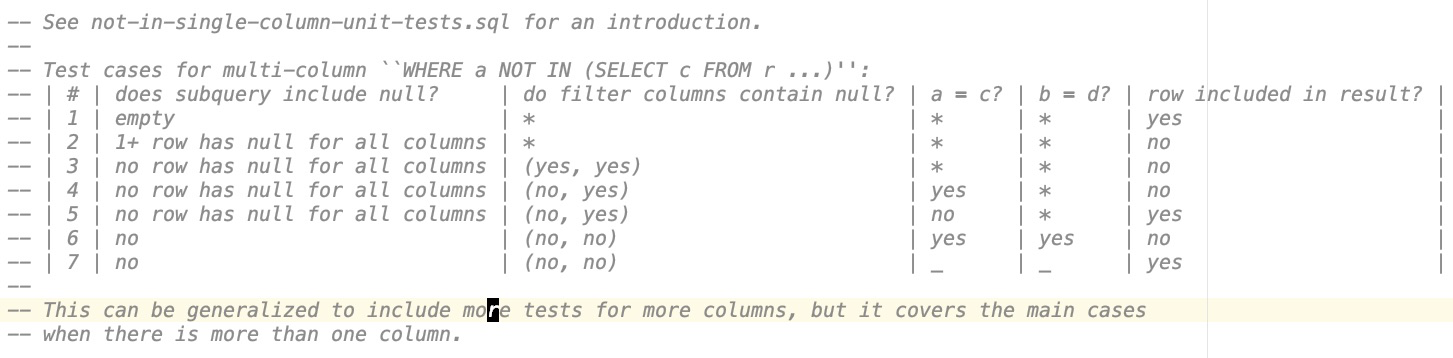
basically, if there is any null columns in probe side keys, it means ignoring the null keys values, and using the rest non-null column to try match in corresponding columns in buildSide. since in streamedSide rows, in can be all kinds of null position combination existing, i can not pre-build according to any single combination, so i have to expand to all kinds of combination with null padding . |

|
@leanken ... let me chew on your response. I will get back to you. In the meanwhile I am wondering if you can rerun the performance of the original TPCH q16 (single key not-in) with this multi-key PR and without it. I have a feeling we might have regressed the performance of the (much more common) single key case and it may make sense to retain that as a special case. Can you double check that please. |
Sure, I will do Q16 Test again. Though i have strong confident that it will not cause perf regression, because in single key not in case, it will not cause any data expansion. |
because 2^1 - 1 = 1 |
Let's consider for both steps 2 and 3 of section 6.2 in the NAAJ separately:
|
| // All predicate must match pattern condition: Or(EqualTo(a=b), IsNull(EqualTo(a=b))) | ||
| val allMatch = predicates.forall { | ||
| case Or(e @ EqualTo(leftExpr: Expression, rightExpr: Expression), | ||
| IsNull(e2 @ EqualTo(_, _))) if e.semanticEquals(e2) => |
There was a problem hiding this comment.
IIUC this pattern matching depends on the RewritePredicateSubquery code:
This is okay now, but I'm a little worried that it does not work well if the RewritePredicateSubquery code will be updated; for example, if both attributes are non-nullable in a join condition, we might be able to remove IsNull(c) for optimization in the RewritePredicateSubquery rule.
There was a problem hiding this comment.
yes. the IsNull being removed case is considered, we only do NAAJ optimize with the Or condition still exists.
Basically, the NAAJ Optimize switch triggered at SparkStrategies, which I think optimizer is done its job. it's save to put this pattern check in physical plan state
// negative hand-written left anti join
      // testData.key nullable false
      // testData2.a nullable false
      // isnull(key = a) isnull(key+1=a) will be optimized to true literal and removed
      joinExec = assertJoin((
        "SELECT * FROM testData LEFT ANTI JOIN testData3 ON (key = a OR ISNULL(key = a)) " +
          "AND (key + 1 = a OR ISNULL(key + 1 = a))",
        classOf[BroadcastHashJoinExec]))
      assert(!joinExec.asInstanceOf[BroadcastHashJoinExec].isNullAwareAntiJoin)
There was a problem hiding this comment.
in JoinSuite Line 1209. FYI.
After we expand data in BuildSide it's a bit tricky, but to sum up. After the expansion, I need to find exact same match include null column from streamedSide in HashedRelation, which is counted as a Match. Just see how it is probed in Code. |
Above, when I mean "match" -- I mean that the left side would match the build row and WON'T be returned. Whereas with non match I mean that the left side would not match the build side and thus WILL be returned. We have different meanings for the words 'match' and 'not-match'. So please read my 'match' == 'NAAJ should not return the left row', and conversely for non-match. I would really really really encourage you to:
This is really tricky and I don't think the current implementation you have of expanding the hash table with a simple lookup on the stream side would suffice. I will also try to play around with your PR locally and run them as tests to convince myself. I hope I am wrong ;-). |
Yes, I do understand of the Paper 6.2. Basically the paper describe the algorithm in the perspective of StreamedSide. But the expansion state the perspective of BuildSide. Let's just do revert inferencing of the following case. if buildSide exist a row (1,2,3), what data in StreamedSide will evaluated as TRUE OR UNKNOWN and dropped. Only in above combination, streamedSide row will be dropped besides non-all-null case, right? I suppose this solution is working because it's passing all the not in cases in SQLQueryTestSuite. |
|
I just found out a negative case for it and we should do something on streamedSide too, if we want this hash lookup to apply correctly. |
|
@agrawaldevesh I am finally understand the complexity of multi column support, thanks to your remind again and again, feel sorry about my naive. Do you think it still worth to carry on to support multi column? sincerely ask for your suggestion. |
as for how to support it, i think it might be
when probe doing on streamedSide
|
First let me make sure I understand the current approach in this PR: We take a row and add possible null padded combinations of it to the hash table. And then there is almost no change to the streaming side: We look for an exact match in the hash table. The only other tiny change to the streaming side is the change from anyNull to allNull, which becomes pertinent with multiple keys. Is that right ? So with this consider what happens when there is a build row of (1, null, 3). We expect the row (1, 2, 3) to NOT be returned (or 'matched' in my parlance). Lets see what would happen with this PR: We will expand (1, null, 3) into the following rows in the HT: (1, null, 3), (null, null, 3), (1, null, null), (null, null, null). (Btw, should (null, null, null) be even added here ?). Unfortunately the row (1, 2, 3) does not match and is RETURNED. Similarly the left side row (1, 3, null) should also match and not be RETURNED but this PR would return it. (Please consider adding them as tests and you will see that the BNLJ implementation passes them but this PR would fail them.) The PR currently will pass the negative tests I mentioned above: build row (1, 5, 3) will not match probe row (1, 2, 3) and nor will the build row (1, 5, null) match the probe row (1, 5, 7). That is, the PR will correctly NOT return the probe rows (1, 2, 3) nor (1, 5, 7). As for why the PR may be passing SubquerySuite: I am not sure how strong the coverage for SubquerySuite's multi-key not-in is. The BNLJ approach didn't have a special algorithm for multiple keys and thus it may not have needed as much attention. My guess is that we cannot just do simple HT probing on the stream side. We have to do something different. The original NAAJ paper calls for creating multiple HT's with different key combinations (depending on what's null or not).
Don't feel sorry. I admire you being bold and persevering with this !! This is how engineering proceeds, we learn when we hit brick walls. I have actually tried to (unsuccessfully !) implement this optimization before using a variety of these naive ways but shied away from implementing the multiple index approach because it seemed too much work. You have come very far with this and I would totally encourage you to please think how to support this for the common cases of just 2 and 3 keys. I think creating new additional indices "on-demand" (as mentioned in step 3) when we encounter a particular row-type on the probe side is probably not going to work (it would lead to unpredictable memory behavior). As for whether we should do this or not ... it totally depends on the approach. If its not too much work to support it for the special case of 2 keys (lets even forget three keys), we can consider it. Its a tradeoff: Customers can always rewrite their query from NOT-IN to NOT-EXISTS if they are not happy with the BNLJ performance. How about this approach (mirroring the steps 1, 2, and 3 in the paper): Step 1 is for the exact match. For step 2, Instead of exploding the HT (ie inserting the null combinations there) -- just search for different null variants as mentioned in step 2 of the paper. ie do the different null-aware padding lookups instead of storing those lookups. Whereas if you encounter a left side row with a null key then we would be forced to do the BNLJ style "scanning" of the HT to search for all matching combinations (ie, if we decide to not build additional indices). This approach would still be more efficient than plain BNLJ since the NLJ penalty is only paid for left rows having a null key. As a diversion, I wonder if it makes sense instead to support the single key case but for distributed scenario (shuffle hash join and like) if this multi-key stuff is really hard. I think the single-key distributed case would be more common. Thanks for working on this !! |
| .doc("The maximum number of keys that will be supported to use NAAJ optimize. " + | ||
| "While with NAAJ optimize, buildSide data would be expanded to (2^numKeys - 1) times, " + | ||
| "it might cause Driver OOM if NAAJ numKeys increased, since it is exponential growth.") | ||
| .intConf |

In SPARK-32290, We only support Single Column NAAJ, and because of the complexity of Multi Column support, See. http://www.vldb.org/pvldb/vol2/vldb09-423.pdf Section 6. In this PR, proposed a trade-off that can also support multi column to perform hash lookup in buildSide, but required buildSide with extra duplicate data, the duplication would be (2^numKeys - 1) times, for example, if we are to support NAAJ with 3 column join key, the buildSide would be expanded into (2^3 - 1) times, 7X.

For example, if there is a UnsafeRow key (1,2,3)
In NullAware Mode, it should be expanded into 7 keys with extra C(3,1), C(3,2) combinations, within the combinations, we duplicated these record with null padding as following.

Original record

(1,2,3)

Extra record to be appended into HashedRelation

(null, 2, 3) (1, null, 3) (1, 2, null)
(null, null, 3) (null, 2, null) (1, null, null))

with the expanded data we can extract a common pattern for both single and multi column. allNull refer to a unsafeRow which has all null columns.

* buildSide is empty input => return all rows
* allNullColumnKey Exists In buildSide input => reject all rows
* if streamedSideRow.allNull is true => drop the row
* if streamedSideRow.allNull is false & findMatch in NullAwareHashedRelation => drop the row
* if streamedSideRow.allNull is false & notFindMatch in NullAwareHashedRelation => return the row

Considered that NAAJ in real production usage, the numKeys should not be that big, normally 1~3 keys, I think it's still worth to do such trade-off.

No.

1. SQLQueryTestSuite with NOT IN keyword SQL, add CONFIG_DIM with spark.sql.optimizeNullAwareAntiJoin on and off
2. added case in org.apache.spark.sql.JoinSuite.
3. added case in org.apache.spark.sql.SubquerySuite.
4. added case in org.apache.spark.sql.execution.joins.HashedRelationSuite to make sure the data expand logical.
5. config combination against e2e test (both single and multi column cases) with following

```
Map(
  "spark.sql.optimizeNullAwareAntiJoin" -> "true",
  "spark.sql.adaptive.enabled" -> "false",
  "spark.sql.codegen.wholeStage" -> "false"
),
Map(
  "sspark.sql.optimizeNullAwareAntiJoin" -> "true",
  "spark.sql.adaptive.enabled" -> "false",
  "spark.sql.codegen.wholeStage" -> "true"
),
Map(
  "spark.sql.optimizeNullAwareAntiJoin" -> "true",
  "spark.sql.adaptive.enabled" -> "true",
  "spark.sql.codegen.wholeStage" -> "false"
),
Map(
  "spark.sql.optimizeNullAwareAntiJoin" -> "true",
  "spark.sql.adaptive.enabled" -> "true",
  "spark.sql.codegen.wholeStage" -> "true"
)
```

Change-Id: I8c4ffeb7e5d27bff7db269f414f2f702ceb3612f
Change-Id: I506224fdbefd9c4f1f24a8f62fecf65636f23f20
Change-Id: I58066c5c0285860f0c3bbc0b6bfbe82a888baa40
Change-Id: I2ab6b1d87b467386ebf9a2faa7947e46450de173
…iJoinKeys.

2. update SQLConf doc.
3. comments and code style refined.
4. SQL Keyword to upper case in JoinSuite and SubquerySuite.

Change-Id: I83eca23bde4476e2864e081372cbcc490d39f7b0
Change-Id: I6c59ca05232c42617e3c1e93b2043b258ad515b8
leanken-zz
force-pushed
the
leanken-SPARK-32494
branch
from
1153513 to
054581a
Compare
|
@agrawaldevesh already pushed the InvertedIndex version POC. and gather some test result on TPCH 1TB Q16 Since for the following reason, I think I might need to temporary seal the PR, and maybe looking back in some future time.
But, we are still come up with a neat algorithm to fix the complicated issue, that should count for something. Let's just considered this PR as a Discussion and Memo, and maybe some day when it's ready to support multi-column, the conversation and test result in the PR might be helpful. @agrawaldevesh @viirya @maropu sorry for waste your time, and as @cloud-fan suggested, I will move on to support single column ShuffleHashJoinExec. hashedRelation implSingleColumnE2E time: 33.6s InvertedIndex implSingleColumnE2E time: 40.5s TwoColumnE2E time: 59.2s |
|
Test build #127068 has finished for PR 29304 at commit
|
|
@leanken ... this was a GREAT GREAT attempt and I certainly learned a ton from it :-P. I am curious if you ran profiled it while running the Q16 and have a sense of where the low hanging fruits might be ? We can also consider the hybrid approach we discussed where we double the memory and keep the original HashedRelation for step 1 and 2 of the paper but use the inverted indices only for the step 3. That might help with the inverted index caused regression for the single key case. In any case, I am totally with @cloud-fan that supporting shuffled hash join single key is more important. (As I also noted in my previous comment):
|
| if (isNullAwareAntiJoin) { | ||
| val (broadcastRelation, relationTerm) = prepareBroadcast(ctx) | ||
| val (keyEv, anyNull) = genStreamSideJoinKey(ctx, input) | ||
| val (keyEv, anyNull) = genStreamSideJoinKey(ctx, input, true) |
There was a problem hiding this comment.
HI @leanken ... I am curious why we force unsafe for NAAJ ? Is that for efficiency or is the implementation assume unsafe row ?
There was a problem hiding this comment.
because if it's a single Long key, keyEv will be codegen as java long, but not UnsafeRow. In InvertedIndexHashedRelation, it only takes UnsafeRow as input to lookup in buildSide.
5 participants


What changes were proposed in this pull request?
In this PR, proposed a trade-off that can also support multi column to perform hash lookup in buildSide, but required buildSide with extra duplicate data, the duplication would be 2^numKeys - 1, for example, if we are to support NAAJ with 3 column join key, the buildSide would be expanded into (2^3 - 1) times, 7X.
For example, if there is a UnsafeRow key (1,2,3)
In NullAware Mode, it should be expanded into 7 keys with extra C(3,1), C(3,2) combinations, within the combinations, we duplicated these record with null padding as following.
Original record
(1,2,3)
Extra record to be appended into HashedRelation
(null, 2, 3) (1, null, 3) (1, 2, null)
(null, null, 3) (null, 2, null) (1, null, null))
with the expanded data we can extract a common pattern for both single and multi column. allNull refer to a unsafeRow which has all null columns.
Why are the changes needed?
Considered that NAAJ in real production usage, the numKeys should not be that big, normally 1~3 keys, I think it's still worth to do such trade-off.
Does this PR introduce any user-facing change?
No.
How was this patch tested?