[SPARK-28810][DOC][SQL] Document SHOW TABLES in SQL Reference. #25561
There are no files selected for viewing
| Original file line number | Diff line number | Diff line change |
|---|---|---|
|
|
@@ -18,5 +18,83 @@ license: | | |
| See the License for the specific language governing permissions and | ||
| limitations under the License. | ||
| --- | ||
| ### Description | ||
|
|
||
| List all the `tables` from the database with `database-name` and `is temporary table`. | ||
|
|
||
| ### Syntax | ||
| {% highlight sql %} | ||
| SHOW TABLES [{FROM|IN} database_name] [LIKE 'regex_pattern'] | ||
| {% endhighlight %} | ||
|
|
||
| ### Parameters | ||
| <dl> | ||
| <dt><code><em>{FROM|IN} database_name</em></code></dt> | ||
| <dd> | ||
| Specifies the `database` name from which tables are listed. | ||
| </dd> | ||
| <dt><code><em>LIKE 'regex_pattern'</em></code></dt> | ||
| <dd> | ||
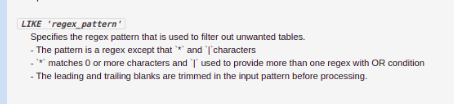
| Specifies the regex pattern that is used to filter out unwanted tables. | ||
| <br> - Only `*` and `|` are allowed as wildcard pattern. | ||
|
Contributor
There was a problem hiding this comment. @shivusondur Can you please include the example with output using the 'I' as wildcard ? From the code its not clear to me if this is supported.
Member
There was a problem hiding this comment.
Contributor
There was a problem hiding this comment. @srowen Thats a very good point Sean. How about we name the pattern 'identifier_with_wildcards' (and describe as such) as mentioned in
Member
There was a problem hiding this comment. Is it a SQL-like pattern that supports wildcards like
Contributor
There was a problem hiding this comment. @srowen I quickly tried in my env. It does not support SQL-like pattern like
@shivusondur Can you please confirm ?
Contributor
Author
There was a problem hiding this comment. @dilipbiswal @srowen
Member
There was a problem hiding this comment. OK, your comment is consistent with the docs then. Hm, but isn't it more accurate to say that
Contributor
Author
There was a problem hiding this comment. @srowen @dilipbiswal I updated according to your suggestion and screenshot also I updated. |
||
| <br> - Excluding `*` and `|` the remaining pattern follows the regex semantics. | ||
| <br> - The leading and trailing blanks are trimmed in the input pattern before processing. | ||
| </dd> | ||
| </dl> | ||
|
|
||
| ### Example | ||
| {% highlight sql %} | ||
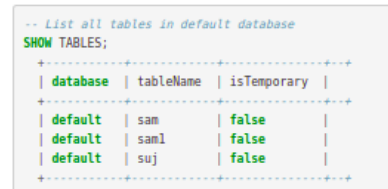
| -- List all tables in default database | ||
| SHOW TABLES; | ||
| +-----------+------------+--------------+--+ | ||
|
Contributor
There was a problem hiding this comment. Please lets fix the formatting. Did we construct this output by hand ? Can we paste the
Contributor
Author
There was a problem hiding this comment. @dilipbiswal In the UI it looks like below, i think it is normal Only in the git file editor, it shows inconsistent. |
||
| | database | tableName | isTemporary | | ||
| +-----------+------------+--------------+--+ | ||
| | default | sam | false | | ||
| | default | sam1 | false | | ||
| | default | suj | false | | ||
| +-----------+------------+--------------+--+ | ||
|
|
||
| -- List all tables from userdb database | ||
| SHOW TABLES FROM userdb; | ||
| +-----------+------------+--------------+--+ | ||
| | database | tableName | isTemporary | | ||
| +-----------+------------+--------------+--+ | ||
| | userdb | user1 | false | | ||
| | userdb | user2 | false | | ||
| +-----------+------------+--------------+--+ | ||
|
|
||
| -- List all tables in userdb database | ||
| SHOW TABLES IN userdb; | ||
| +-----------+------------+--------------+--+ | ||
| | database | tableName | isTemporary | | ||
| +-----------+------------+--------------+--+ | ||
| | userdb | user1 | false | | ||
| | userdb | user2 | false | | ||
| +-----------+------------+--------------+--+ | ||
|
|
||
| -- List all tables from default database matching the pattern `sam*` | ||
| SHOW TABLES FROM default LIKE 'sam*'; | ||
| +-----------+------------+--------------+--+ | ||
| | database | tableName | isTemporary | | ||
| +-----------+------------+--------------+--+ | ||
| | default | sam | false | | ||
| | default | sam1 | false | | ||
| +-----------+------------+--------------+--+ | ||
|
|
||
| -- List all tables matching the pattern `sam*|suj` | ||
|
Contributor
There was a problem hiding this comment. Nit: can we have a line between previous test and this one.
Contributor
Author
There was a problem hiding this comment. @dilipbiswal |
||
| SHOW TABLES LIKE 'sam*|suj'; | ||
| +-----------+------------+--------------+--+ | ||
| | database | tableName | isTemporary | | ||
| +-----------+------------+--------------+--+ | ||
| | default | sam | false | | ||
| | default | sam1 | false | | ||
| | default | suj | false | | ||
| +-----------+------------+--------------+--+ | ||
|
|
||
| {% endhighlight %} | ||
|
shivusondur marked this conversation as resolved.
Outdated
|
||
|
|
||
| ### Related statements | ||
| - [CREATE TABLE](sql-ref-syntax-ddl-create-table.html) | ||
| - [DROP TABLE](sql-ref-syntax-ddl-drop-table.html) | ||
| - [CREATE DATABASE](sql-ref-syntax-ddl-create-database.html) | ||
| - [DROP DATABASE](sql-ref-syntax-ddl-drop-database.html) | ||



There was a problem hiding this comment.
Choose a reason for hiding this comment
The reason will be displayed to describe this comment to others. Learn more.
@shivusondur Sorry.. re-reading this one last time :-)
SHOW TABLESstatement returns all the tables for an optionally specified database. Additionally, the outputof this statement may be filtered via an optional matching pattern. If no database is specified then the tables
are returned from the current database.
There was a problem hiding this comment.
Choose a reason for hiding this comment
The reason will be displayed to describe this comment to others. Learn more.
DOne