Skip to content
Closed
Show file tree
Hide file tree
Changes from all commits
Commits
File filter

Filter by extension

Filter by extension

Conversations
Failed to load comments.
Loading
Jump to
Jump to file
Failed to load files.
Loading
Diff view
Diff view
Original file line number Diff line number Diff line change
Expand Up @@ -274,6 +274,7 @@ object FunctionRegistry {
expression[Tan]("tan"),
expression[Cot]("cot"),
expression[Tanh]("tanh"),
expression[WidthBucket]("width_bucket"),

expression[Add]("+"),
expression[Subtract]("-"),
Expand Down
Original file line number Diff line number Diff line change
Expand Up @@ -25,7 +25,7 @@ import org.apache.spark.sql.catalyst.analysis.{FunctionRegistry, TypeCheckResult
import org.apache.spark.sql.catalyst.analysis.TypeCheckResult.{TypeCheckFailure, TypeCheckSuccess}
import org.apache.spark.sql.catalyst.expressions.codegen._
import org.apache.spark.sql.catalyst.expressions.codegen.Block._
import org.apache.spark.sql.catalyst.util.NumberConverter
import org.apache.spark.sql.catalyst.util.{MathUtils, NumberConverter}
import org.apache.spark.sql.types._
import org.apache.spark.unsafe.types.UTF8String

Expand Down Expand Up @@ -1319,3 +1319,123 @@ case class BRound(child: Expression, scale: Expression)
with Serializable with ImplicitCastInputTypes {
def this(child: Expression) = this(child, Literal(0))
}

/**
* Returns the bucket number into which
* the value of this expression would fall after being evaluated.
Copy link
Member

@maropu maropu May 29, 2020

Choose a reason for hiding this comment

The reason will be displayed to describe this comment to others. Learn more.

nit: how about the format and the rephrasing below?

/**
 * Returns the bucket number into which the value of this expression would fall
 * after being evaluated.
 *
 * @param expr is the expression to compute a bucket number in the histogram
 * @param minValue is the minimum value of the histogram
 * @param maxValue is the maximum value of the histogram
 * @param numBucket is the number of buckets
 */

*
* @param expr is the expression for which the histogram is being created
Copy link
Member

Choose a reason for hiding this comment

The reason will be displayed to describe this comment to others. Learn more.

is this comment correct? How about "the expression for which the bucket number in the histogram would return"?

Copy link
Member Author

Choose a reason for hiding this comment

The reason will be displayed to describe this comment to others. Learn more.

* @param minValue is an expression that resolves
* to the minimum end point of the acceptable range for expr
* @param maxValue is an expression that resolves
* to the maximum end point of the acceptable range for expr
* @param numBucket is an expression that resolves to
* a constant indicating the number of buckets
*/
// scalastyle:off line.size.limit
@ExpressionDescription(
usage = "_FUNC_(expr, min_value, max_value, num_bucket) - Returns the `bucket` to which operand would be assigned in an equidepth histogram with `num_bucket` buckets, in the range `min_value` to `max_value`.",
extended = """
Copy link
Member

Choose a reason for hiding this comment

The reason will be displayed to describe this comment to others. Learn more.

extended -> examples. Also, plz add a since tag.

Examples:
> SELECT _FUNC_(5.35, 0.024, 10.06, 5);
3
""")
// scalastyle:on line.size.limit
case class WidthBucket(
expr: Expression,
minValue: Expression,
maxValue: Expression,
numBucket: Expression) extends Expression with ImplicitCastInputTypes {
Copy link
Member

Choose a reason for hiding this comment

The reason will be displayed to describe this comment to others. Learn more.

Cloud we do WidthBucket (...) extends QuaternaryExpression with ImplicitCastInputTypes with CodegenFallback for simplicity? If we need the codegen support, I think its okay to do so in follow-up.


override def children: Seq[Expression] = Seq(expr, minValue, maxValue, numBucket)
override def foldable: Boolean = children.drop(1).forall(_.foldable)
override def inputTypes: Seq[AbstractDataType] = Seq(DoubleType, DoubleType, DoubleType, LongType)
override def dataType: DataType = LongType
override def nullable: Boolean = true

private lazy val _minValue: Any = minValue.eval()
private lazy val minValueV = _minValue.asInstanceOf[Double]
Copy link
Member Author

Choose a reason for hiding this comment

The reason will be displayed to describe this comment to others. Learn more.

if minValue.eval(EmptyRow) == null,
minValue.eval(EmptyRow).asInstanceOf[Double] will be 0.0,
So keep both of them here.


private lazy val _maxValue: Any = maxValue.eval()
private lazy val maxValueV = _maxValue.asInstanceOf[Double]

private lazy val _numBucket: Any = numBucket.eval()
private lazy val numBucketV = _numBucket.asInstanceOf[Long]

private val errMsg = "The argument [%d] of WIDTH_BUCKET function is NULL or invalid."

override def eval(input: InternalRow): Any = {
Copy link
Member

Choose a reason for hiding this comment

The reason will be displayed to describe this comment to others. Learn more.

Why you create QuaternaryExpression with default nullSafeEval but didn't use it? If you want do so, you don't need QuaternaryExpression, simply let WidthBucket extend Expression.


if (foldable) {
if (_minValue == null) {
throw new RuntimeException(errMsg.format(2))
} else if (_maxValue == null) {
throw new RuntimeException(errMsg.format(3))
} else if (_numBucket == null || numBucketV <= 0) {
throw new RuntimeException(errMsg.format(4))
Copy link
Member

@viirya viirya Jul 28, 2017

Choose a reason for hiding this comment

The reason will be displayed to describe this comment to others. Learn more.

Is the above handling for null valid? Except for null-intolerant expressions, usually any input of an expression is null, it returns null.

Copy link
Member Author

Choose a reason for hiding this comment

The reason will be displayed to describe this comment to others. Learn more.

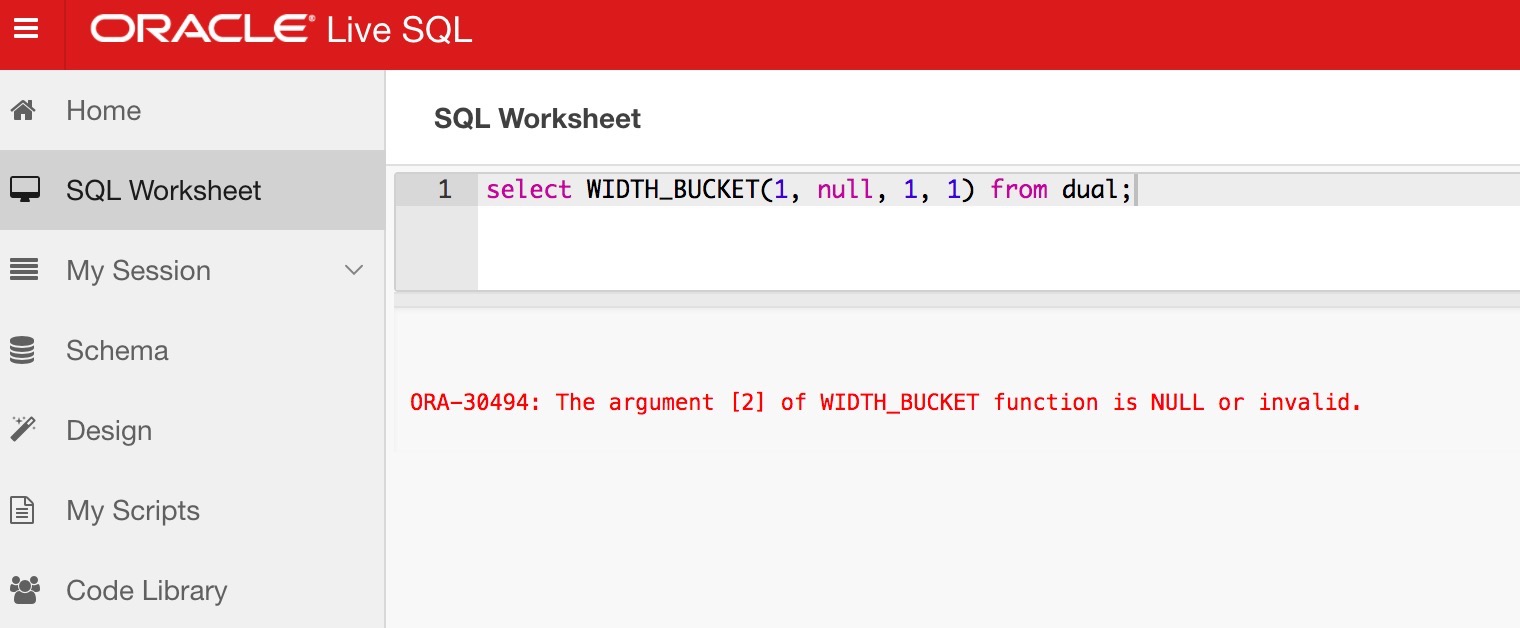
To be consistent with oracle:
oracle-width_bucket

} else {
val exprV = expr.eval(input)
if (exprV == null) {
null
} else {
MathUtils.widthBucket(exprV.asInstanceOf[Double], minValueV, maxValueV, numBucketV)
}
}
} else {
val evals = children.map(_.eval(input))
val invalid = evals.zipWithIndex.filter { case (e, i) =>
(i > 0 && e == null) || (i == 3 && e.asInstanceOf[Long] <= 0)
}
if (invalid.nonEmpty) {
invalid.foreach(l => throw new RuntimeException(errMsg.format(l._2 + 1)))
} else if (evals(0) == null) {
null
} else {
MathUtils.widthBucket(
Copy link
Member

Choose a reason for hiding this comment

The reason will be displayed to describe this comment to others. Learn more.

MathUtils.widthBucket is used only for this new expr now? If so, could we move the method to this expr?

evals(0).asInstanceOf[Double],
evals(1).asInstanceOf[Double],
evals(2).asInstanceOf[Double],
evals(3).asInstanceOf[Long])
}
}
}

override def doGenCode(ctx: CodegenContext, ev: ExprCode): ExprCode = {
Copy link
Member

Choose a reason for hiding this comment

The reason will be displayed to describe this comment to others. Learn more.

ditto. As you override doGenCode, I don't see the reason why you create QuaternaryExpression for this expr.

val mathUtils = MathUtils.getClass.getName.stripSuffix("$")
if (foldable) {
val exprV = expr.genCode(ctx)
ev.copy(code = code"""
if (${_minValue == null}) {
throw new RuntimeException(String.format("$errMsg", 2));
} else if (${_maxValue == null}) {
throw new RuntimeException(String.format("$errMsg", 3));
} else if (${_numBucket == null || numBucketV <= 0}) {
throw new RuntimeException(String.format("$errMsg", 4));
}
${exprV.code}
boolean ${ev.isNull} = ${exprV.isNull};
long ${ev.value} = ${CodeGenerator.defaultValue(dataType)};
if (!${ev.isNull}) {
${ev.value} = $mathUtils.widthBucket(${exprV.value}, $minValueV, $maxValueV, $numBucketV);
}""")
} else {
val evals = children.map(_.genCode(ctx))
val invalid = evals.zipWithIndex.map { case (e, i) =>
s"""
if (($i > 0 && ${e.isNull}) || ($i == 3 && ${e.value} < 0)) {
throw new RuntimeException(String.format("$errMsg", $i + 1));
}
"""}

ev.copy(code = code"""
${invalid.map(_.stripMargin).mkString("\n")}
boolean ${ev.isNull} = ${evals(0).isNull};
long ${ev.value} = ${CodeGenerator.defaultValue(dataType)};
if (!${evals(0).isNull}) {
${ev.value} = $mathUtils.widthBucket(
${evals(0).value}, ${evals(1).value}, ${evals(2).value}, ${evals(3).value});
}
""")
}
}
}
Original file line number Diff line number Diff line change
@@ -0,0 +1,52 @@
/*
* Licensed to the Apache Software Foundation (ASF) under one or more
* contributor license agreements. See the NOTICE file distributed with
* this work for additional information regarding copyright ownership.
* The ASF licenses this file to You under the Apache License, Version 2.0
* (the "License"); you may not use this file except in compliance with
* the License. You may obtain a copy of the License at
*
* http://www.apache.org/licenses/LICENSE-2.0
*
* Unless required by applicable law or agreed to in writing, software
* distributed under the License is distributed on an "AS IS" BASIS,
* WITHOUT WARRANTIES OR CONDITIONS OF ANY KIND, either express or implied.
* See the License for the specific language governing permissions and
* limitations under the License.
*/

package org.apache.spark.sql.catalyst.util

import org.apache.spark.sql.AnalysisException

object MathUtils {

/**
* Returns the bucket number into which
* the value of this expression would fall after being evaluated.
*
* @param expr is the expression for which the histogram is being created
* @param minValue is an expression that resolves
* to the minimum end point of the acceptable range for expr
* @param maxValue is an expression that resolves
* to the maximum end point of the acceptable range for expr
* @param numBucket is an expression that resolves to
* a constant indicating the number of buckets
* @return Returns an long between 0 and numBucket+1 by mapping the expr into buckets defined by
* the range [minValue, maxValue].
*/
def widthBucket(expr: Double, minValue: Double, maxValue: Double, numBucket: Long): Long = {
val lower: Double = Math.min(minValue, maxValue)
val upper: Double = Math.max(minValue, maxValue)
Copy link
Contributor

@wzhfy wzhfy Jun 22, 2017

Choose a reason for hiding this comment

The reason will be displayed to describe this comment to others. Learn more.

Does other databases allow max value to appear first? i.e. widthBucket(3.14, 4, 0, 3)

Copy link
Member Author

@wangyum wangyum Jun 23, 2017

Choose a reason for hiding this comment

The reason will be displayed to describe this comment to others. Learn more.

Yes, Oracle support it.


val result: Long = if (expr < lower) {
Copy link
Member

@gatorsmile gatorsmile Jul 16, 2017

Choose a reason for hiding this comment

The reason will be displayed to describe this comment to others. Learn more.

// an underflow bucket numbered 0

Copy link
Member Author

Choose a reason for hiding this comment

The reason will be displayed to describe this comment to others. Learn more.

0
} else if (expr >= upper) {
numBucket + 1L
Copy link
Member

Choose a reason for hiding this comment

The reason will be displayed to describe this comment to others. Learn more.

// an overflow bucket numbered num_buckets+1

Copy link
Member Author

Choose a reason for hiding this comment

The reason will be displayed to describe this comment to others. Learn more.

} else {
(numBucket.toDouble * (expr - lower) / (upper - lower) + 1).toLong
Copy link
Contributor

Choose a reason for hiding this comment

The reason will be displayed to describe this comment to others. Learn more.

what if upper == lower?

}

if (minValue > maxValue) (numBucket - result) + 1 else result
}
}
Original file line number Diff line number Diff line change
Expand Up @@ -677,4 +677,68 @@ class MathExpressionsSuite extends SparkFunSuite with ExpressionEvalHelper {
checkEvaluation(BRound(-0.35, 1), -0.4)
checkEvaluation(BRound(-35, -1), -40)
}

test("width_bucket") {
def test(
expr: Double,
minValue: Double,
maxValue: Double,
numBucket: Long,
expected: Long): Unit = {
checkEvaluation(WidthBucket(Literal.create(expr, DoubleType),
Literal.create(minValue, DoubleType),
Literal.create(maxValue, DoubleType),
Literal.create(numBucket, LongType)),
expected)
}

test(5.35, 0.024, 10.06, 5, 3)

test(3.14, 0, 4, 3, 3)
test(2, 0, 4, 3, 2)

test(3.14, 4, 0, 3, 1)
test(2, 4, 0, 3, 2)

// an underflow bucket numbered 0
test(-1, 0, 3.2, 4, 0)
test(1, 2, 3, 4, 0)

// an overflow bucket numbered num_buckets + 1
test(-1, 3.2, 0, 4, 5)
test(3, 2, 3, 2, 3)

// invalid argument
val e1 = intercept[RuntimeException] {
WidthBucket(Literal.create(1.0, DoubleType),
Literal.create(null, DoubleType),
Literal.create(2.0, DoubleType),
Literal.create(5L, LongType)).eval(EmptyRow)
}
assert(e1.getMessage.contains("The argument [2] of WIDTH_BUCKET function is NULL or invalid."))

val e2 = intercept[RuntimeException] {
WidthBucket(Literal.create(1.0, DoubleType),
Literal.create(1.0, DoubleType),
Literal.create(null, DoubleType),
Literal.create(5L, LongType)).eval(EmptyRow)
}
assert(e2.getMessage.contains("The argument [3] of WIDTH_BUCKET function is NULL or invalid."))

val e3 = intercept[RuntimeException] {
WidthBucket(Literal.create(1.0, DoubleType),
Literal.create(1.0, DoubleType),
Literal.create(2.0, DoubleType),
Literal.create(null, LongType)).eval(EmptyRow)
}
assert(e3.getMessage.contains("The argument [4] of WIDTH_BUCKET function is NULL or invalid."))

val e4 = intercept[RuntimeException] {
WidthBucket(Literal.create(1.0, DoubleType),
Literal.create(1.0, DoubleType),
Literal.create(2.0, DoubleType),
Literal.create(-1L, LongType)).eval(EmptyRow)
}
assert(e4.getMessage.contains("The argument [4] of WIDTH_BUCKET function is NULL or invalid."))
}
}
Original file line number Diff line number Diff line change
@@ -0,0 +1,46 @@
/*
* Licensed to the Apache Software Foundation (ASF) under one or more
* contributor license agreements. See the NOTICE file distributed with
* this work for additional information regarding copyright ownership.
* The ASF licenses this file to You under the Apache License, Version 2.0
* (the "License"); you may not use this file except in compliance with
* the License. You may obtain a copy of the License at
*
* http://www.apache.org/licenses/LICENSE-2.0
*
* Unless required by applicable law or agreed to in writing, software
* distributed under the License is distributed on an "AS IS" BASIS,
* WITHOUT WARRANTIES OR CONDITIONS OF ANY KIND, either express or implied.
* See the License for the specific language governing permissions and
* limitations under the License.
*/

package org.apache.spark.sql.catalyst.util

import org.apache.spark.SparkFunSuite
import org.apache.spark.sql.AnalysisException
import org.apache.spark.sql.catalyst.util.MathUtils._

class MathUtilsSuite extends SparkFunSuite {

test("widthBucket") {
assert(widthBucket(5.35, 0.024, 10.06, 5) === 3)
assert(widthBucket(0, 1, 1, 1) === 0)
assert(widthBucket(20, 1, 1, 1) === 2)

// Test https://docs.oracle.com/cd/B28359_01/olap.111/b28126/dml_functions_2137.htm#OLADM717
// WIDTH_BUCKET(credit_limit, 100, 5000, 10)
assert(widthBucket(500, 100, 5000, 10) === 1)
assert(widthBucket(2300, 100, 5000, 10) === 5)
assert(widthBucket(3500, 100, 5000, 10) === 7)
assert(widthBucket(1200, 100, 5000, 10) === 3)
assert(widthBucket(1400, 100, 5000, 10) === 3)
assert(widthBucket(700, 100, 5000, 10) === 2)
assert(widthBucket(5000, 100, 5000, 10) === 11)
assert(widthBucket(1800, 100, 5000, 10) === 4)
assert(widthBucket(400, 100, 5000, 10) === 1)

// minValue == maxValue
assert(widthBucket(10, 4, 4, 15) === 16)
Copy link
Contributor

Choose a reason for hiding this comment

The reason will be displayed to describe this comment to others. Learn more.

Is this behavior consistent with other databases? If so, then I'm fine with this and please ignore my previous comment.

Copy link
Member Author

Choose a reason for hiding this comment

The reason will be displayed to describe this comment to others. Learn more.

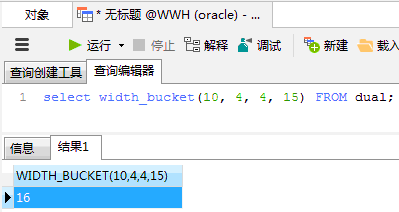
Yes, This is Oracle's behavior:
oracle-width_bucket

Copy link
Contributor

Choose a reason for hiding this comment

The reason will be displayed to describe this comment to others. Learn more.

Thanks!

}
}
Original file line number Diff line number Diff line change
@@ -1,8 +1,8 @@
<!-- Automatically generated byExpressionsSchemaSuite -->
## Summary
- Number of queries: 333
- Number of expressions that missing example: 34
- Expressions missing examples: and,string,tinyint,double,smallint,date,decimal,boolean,float,binary,bigint,int,timestamp,cume_dist,dense_rank,input_file_block_length,input_file_block_start,input_file_name,lag,lead,monotonically_increasing_id,ntile,struct,!,not,or,percent_rank,rank,row_number,spark_partition_id,version,window,positive,count_min_sketch
- Number of queries: 334
- Number of expressions that missing example: 35
- Expressions missing examples: and,string,tinyint,double,smallint,date,decimal,boolean,float,binary,bigint,int,timestamp,cume_dist,dense_rank,input_file_block_length,input_file_block_start,input_file_name,lag,lead,monotonically_increasing_id,ntile,struct,!,not,or,percent_rank,rank,row_number,spark_partition_id,version,window,positive,width_bucket,count_min_sketch
## Schema of Built-in Functions
| Class name | Function name or alias | Query example | Output schema |
| ---------- | ---------------------- | ------------- | ------------- |
Expand Down Expand Up @@ -287,6 +287,7 @@
| org.apache.spark.sql.catalyst.expressions.Uuid | uuid | SELECT uuid() | struct<uuid():string> |
| org.apache.spark.sql.catalyst.expressions.WeekDay | weekday | SELECT weekday('2009-07-30') | struct<weekday(CAST(2009-07-30 AS DATE)):int> |
| org.apache.spark.sql.catalyst.expressions.WeekOfYear | weekofyear | SELECT weekofyear('2008-02-20') | struct<weekofyear(CAST(2008-02-20 AS DATE)):int> |
| org.apache.spark.sql.catalyst.expressions.WidthBucket | width_bucket | N/A | N/A |
| org.apache.spark.sql.catalyst.expressions.XxHash64 | xxhash64 | SELECT xxhash64('Spark', array(123), 2) | struct<xxhash64(Spark, array(123), 2):bigint> |
| org.apache.spark.sql.catalyst.expressions.Year | year | SELECT year('2016-07-30') | struct<year(CAST(2016-07-30 AS DATE)):int> |
| org.apache.spark.sql.catalyst.expressions.ZipWith | zip_with | SELECT zip_with(array(1, 2, 3), array('a', 'b', 'c'), (x, y) -> (y, x)) | struct<zip_with(array(1, 2, 3), array(a, b, c), lambdafunction(named_struct(y, namedlambdavariable(), x, namedlambdavariable()), namedlambdavariable(), namedlambdavariable())):array<struct<y:string,x:int>>> |
Expand Down
12 changes: 12 additions & 0 deletions sql/core/src/test/resources/sql-tests/inputs/operators.sql
Original file line number Diff line number Diff line change
Expand Up @@ -81,3 +81,15 @@ select positive('-1.11'), positive(-1.11), negative('-1.11'), negative(-1.11);
-- pmod
select pmod(-7, 2), pmod(0, 2), pmod(7, 0), pmod(7, null), pmod(null, 2), pmod(null, null);
select pmod(cast(3.13 as decimal), cast(0 as decimal)), pmod(cast(2 as smallint), cast(0 as smallint));

-- width_bucket
Copy link
Contributor

Choose a reason for hiding this comment

The reason will be displayed to describe this comment to others. Learn more.

Do we need end-to-end tests here? I think we already cover these cases in other test suites.

Copy link
Contributor

Choose a reason for hiding this comment

The reason will be displayed to describe this comment to others. Learn more.

Instead, we need to add a test for sql queries using this function.

select width_bucket(5.35, 0.024, 10.06, 5);
select width_bucket(5.35, 0.024, 10.06, 3 + 2);
select width_bucket('5.35', '0.024', '10.06', '5');
select width_bucket(5.35, 0.024, 10.06, 2.5);
select width_bucket(5.35, 0.024, 10.06, 0.5);
select width_bucket(null, 0.024, 10.06, 5);
select width_bucket(5.35, null, 10.06, 5);
select width_bucket(5.35, 0.024, null, -5);
select width_bucket(5.35, 0.024, 10.06, null);
select width_bucket(5.35, 0.024, 10.06, -5);
Loading