Spark: Add read.locality.enabled to TableProperties to support disabl… #2577
Conversation


 jshmchenxi
force-pushed
the
spark-locality
branch
from
jshmchenxi
force-pushed
the
spark-locality
branch
from
e4d5813 to
9c05dbb
Compare

|
I think that this can be configured via |
|
Also, if we introduced this, would we be removing the possibility of all of the different locality levels that are provided by Yarn? https://spark.apache.org/docs/latest/tuning.html#data-locality From the scheduling configs, you can see that the options provided by spark are much more complex: spark.locality.wait.node I think that the 30s upper limit you are seeing is potentially being derived from So I'm guessing that is where the 30s thing came into play (before spark started scheduling tasks). Can you try setting spark.locallity.wait.rack or .node and see if that helps? I've only tried this on S3, so I'm not 100% sure if this will help you. |
…e locality for spark-sql
jshmchenxi
force-pushed
the
spark-locality
branch
from
9c05dbb to
f1317fc
Compare

|
@kbendick Hi! Thank you for your kind suggestion! |
…eaded ReadTask initialize
jshmchenxi
force-pushed
the
spark-locality
branch
from
f1317fc to
d0447af
Compare
Ah ok. That makes sense re: the current spark.locality.wait.* entries. I will try to take a look at this later today, but I might not be the best person to be reviewing this portion of the code. Will give it a look though. |

| List<CombinedScanTask> scanTasks = tasks(); | ||
| for (int i = 0; i < scanTasks.size(); i++) { | ||
| final int curIndex = i; | ||
| futures.add(pool.submit(() -> new ReadTask<>(scanTasks.get(curIndex), tableBroadcast, | ||
| expectedSchemaString, caseSensitive, true, supplier.get()))); | ||
| } |

There was a problem hiding this comment.
You might be able to use org.apache.iceberg.util.ParallelIterable here to help simplify some of this code that takes care of submitting tasks.
There was a problem hiding this comment.
Thanks! I will try to use iceberg utils in another PR and this will focus on adding the ability to disable locality.
| final ExecutorService pool = Executors.newFixedThreadPool( | ||
| taskInitThreads, | ||
| new ThreadFactoryBuilder() | ||
| .setDaemon(true) | ||
| .setNameFormat("Init-ReadTask-%d") | ||
| .build()); |
There was a problem hiding this comment.
Have a look at org.apache.iceberg.util.ThreadPools, which can help handle this for you. It would also allow for the pool size to be set as a system property (as well as providing space for a default).
I'm not too sure how I feel about the default coming as a table level property though. Seems to me like how parallel and whether or not you want to wait for locality would be specific to the cluster that the job is running on. But I don't have a strong opinion on that.
There was a problem hiding this comment.
Seems to me like how parallel and whether or not you want to wait for locality would be specific to the cluster that the job is running on.
I aggre with that. And this property is useful only with spark. Maybe it's better we define it as a user-defined spark configuration that can be set per session?

| public static final boolean ORC_VECTORIZATION_ENABLED_DEFAULT = false; | ||
|
|
||
| public static final String LOCALITY_ENABLED = "read.locality.enabled"; | ||
| public static final String LOCALITY_ENABLED_DEFAULT = null; |

There was a problem hiding this comment.
What is the current default? Is that inconsistent across uses and that's why this is null?
There was a problem hiding this comment.
Is that inconsistent across uses and that's why this is null?
Yes. The current default comes from LOCALITY_WHITELIST_FS.contains(scheme), which is true on hdfs and false otherwise.
| public static final String VECTORIZATION_BATCH_SIZE = "batch-size"; | ||
|
|
||
| // Overrides the table's read.locality.enabled | ||
| public static final String LOCALITY_ENABLED = "locality"; |
There was a problem hiding this comment.
What about locality-enabled?
There was a problem hiding this comment.
The locality was passed by spark read option "locality". Maybe someone is already using it?
There was a problem hiding this comment.
Okay, this was an existing setting? If so we don't need to rename it.
| String tableLocalityProp = PropertyUtil.propertyAsString(tableProperties, TableProperties.LOCALITY_ENABLED, | ||
| TableProperties.LOCALITY_ENABLED_DEFAULT); | ||
| return tableLocalityProp == null ? LOCALITY_WHITELIST_FS.contains(fsScheme) : | ||
| Boolean.parseBoolean(tableLocalityProp); |
There was a problem hiding this comment.
I think that locality should be enabled by default, but only relevant if the file system is white-listed. That would make the logic here localityEnabled && LOCALITY_WHITELIST_FS.contains(fsScheme). That's a bit simpler than using the table property to override and we don't want to check locality for file systems that don't support it.
There was a problem hiding this comment.
OK. I am using spark-sql and didn't find a way to set locality as a spark read option. I will try to add it as a user-defined spark configuration so that it can be set per session.
There was a problem hiding this comment.
We should add the ability to set read options in hints via Spark extensions. Being able to use hints would be great because we could use it for this and a few other things, like time travel in SQL. (@RussellSpitzer, what do you think?)
There was a problem hiding this comment.
I'm a big fan of hints (not that I was asked). But they're a great SQL first solution to a number of problems.
Assuming you mean like
select /* read.locality.enabled=false */ a, b, c from table iceberg_table t
We have encountered a few situations internally where updating spark.sql.partitions would make a job unreasonably slow (due to possibly a large filter prior to the write), so a COALESCE hint would be really helpful in helping with file sizes (which I assume is naturally supported from spark 3.x hints, unless Iceberg operations get in the way, e.g maybe anything to do with merging or deletes). But I have admittedly not tried it.
There was a problem hiding this comment.
I think hints could solve a number of problems that people want to create table level properties for, for which table level properties are likely not the most appropriate as they're dependent on seasonal changes in dataset size and also cluster resources when the job is started.
There was a problem hiding this comment.
Yeah, I'm not a fan either, but the read and write options probably won't be possible through SQL otherwise. Maybe that's not what we want to do for things that would ideally have SQL clauses (like AS OF TIMESTAMP or AS OF VERSION) but hints like locality=true seem like a reasonable path to me. We may even be able to get that in upstream Spark.
There was a problem hiding this comment.
Lastly, I think hints are much easier to explain to end users and have them remember, as there are A LOT of spark configurations (by necessity - not even including iceberg spark properties which are much fewer) and even people who are very well acquainted with spark can get them mixed up.... which leads to support requests etc.
If the hint gets placed in the query (SQL file, notebook), developers are much more likely to remember what needs to be updated to change it to suit their current needs.

There was a problem hiding this comment.
I thought for time travel and such I'm a bigger fan of just adding more special table naming, just so we have less reliance on catalyst. That said I have no problem with doing some more hints for things like locality
|
|
||
| List<Future<ReadTask<T>>> futures = new ArrayList<>(); | ||
|
|
||
| final ExecutorService pool = Executors.newFixedThreadPool( |
There was a problem hiding this comment.
Let's remove these changes and consider them in a separate PR.
There was a problem hiding this comment.
Thanks! I will open another PR for this feature.
| public static final String LOCALITY_ENABLED_DEFAULT = null; | ||
|
|
||
| public static final String LOCALITY_TASK_INITIALIZE_THREADS = "read.locality.task.initialize.threads"; | ||
| public static final int LOCALITY_TASK_INITIALIZE_THREADS_DEFAULT = 1; |
There was a problem hiding this comment.
If this PR is adding the ability to disable locality, I think it should remain focused on that task and should not include a separate feature.

|
Since this hasn't been updated recently, I'm going to go ahead and close it. Feel free to reopen if you have the time to update it! |

|
Sure, thanks Ryan! |

4 participants


…e locality for spark-sql
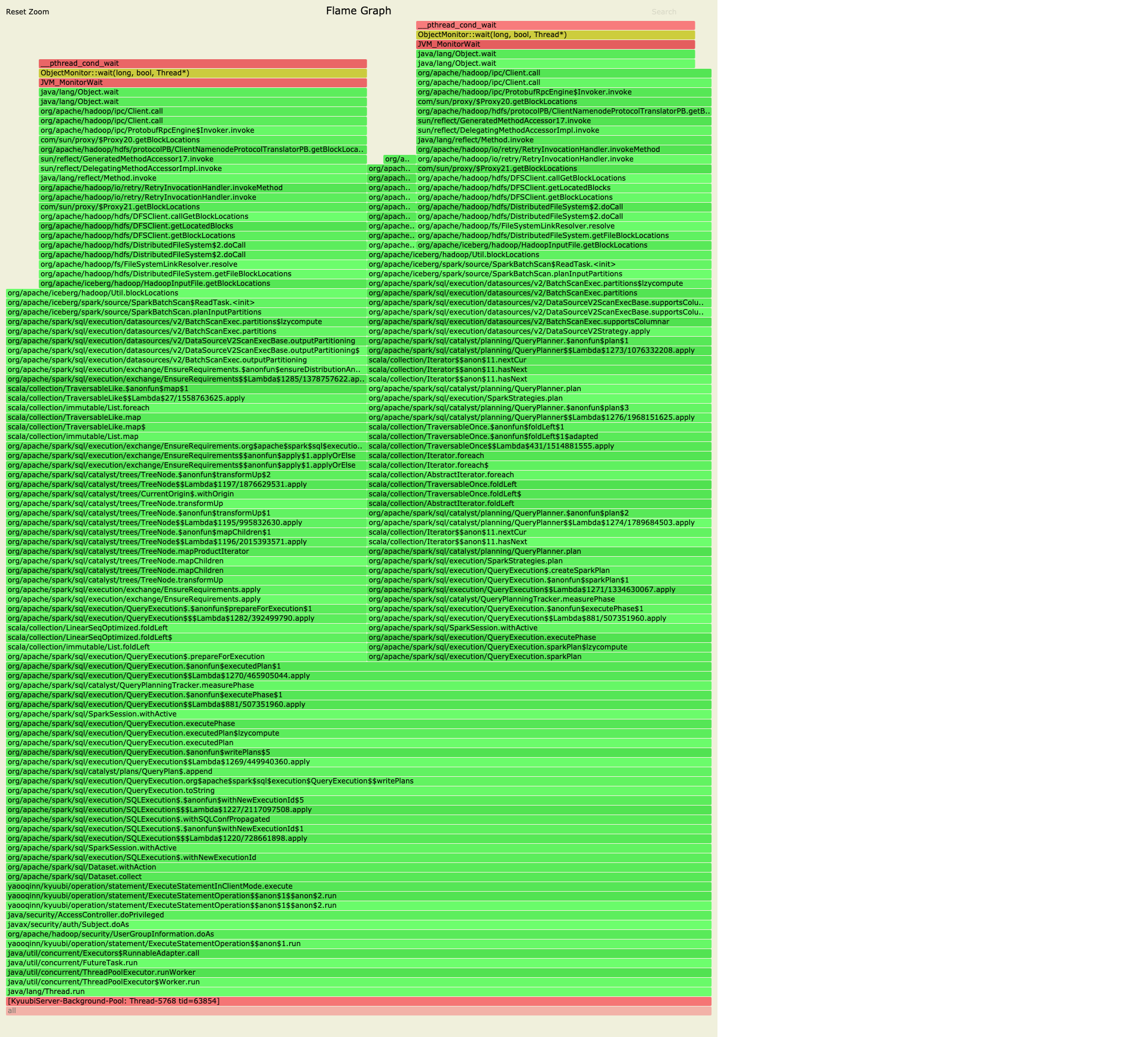
When reading an Iceberg table by spark-sql, I couldn't find a way to disable locality as it is defined as a Spark read option. In our busy cluster, a table of about 8k files took about 15s to get block locations from NN. Both QueryExecution$.prepareForExecution() and QueryExecution.sparkPlan() will get block locations and that's 30 seconds... However, the spark job of my sql only runs about 10 seconds...
So I try to add locality as a table property that it can be disable for spark-sql.
Maybe there is a way to disable locality in spark-sql session? Please inform me, thanks!
I also found it not so elegant to set these runtime read-options as table properties. However, I'm using spark-sql and what could be a better way to apply to this problem?
I've dumped the wallclock time profiling. We can see the problem lies in SparkBatchScan.planInputPartitions()