Conversation


|
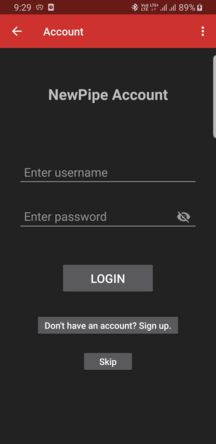
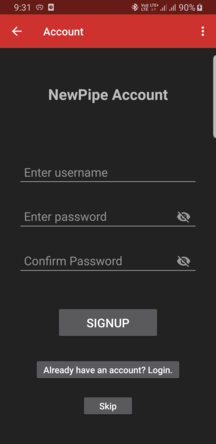
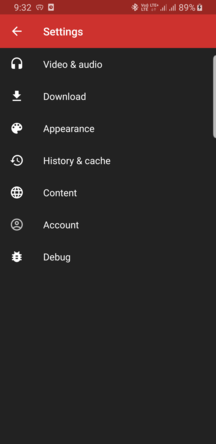
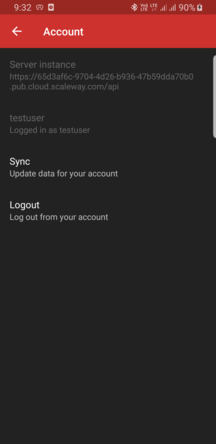
Screenshots
|

|
Hey @yausername, |
 TobiGr
added
deep review required
TobiGr
added
deep review required

|
Wasn't the idea behind NewPipe always to not implement any form of authentication, whatever kind of? We have to discuss if we want such a thing first of all, then how it should be hosted and then what privacy and data protection implications it will have. |
|
I see that there's some form of user data encryption. If we make this encryption part of our privacy policy (i.e., "we encrypt your data with your passphrase", ...), we'll have to carefully review this in order to be on the safe side. Implementing crypto is always a delicate task. We're also not legal entity. Liability is a topic that needs to be discussed as well. Spoiler: not a fan of this. Just because we can doesn't imply we should... |
Yes, makes sense. Currently you can skip the initial login screen, change instance from
The schema is similar to that of newpipe internal sqllite db. But since data is encrypted, other services will need to decrypt it before consuming. |
That's not how this kind of encryption works. @yausername already pointed out in the initial post that the data is lost when the passwort is lost, i.e., there's no passphrase reset (which IMO is not so great, but perhaps we can find a possibility to implement this somehow later). As said, this is a really delicate kind of service to implement and host in accordance to the laws. I appreciate the suggestion to provide a self-hosting option. By the way, do we really need custom service? Perhaps this can be integrated with existing services like {Own,Next}Cloud in some way? |
Data can be decrypted with the same username, password combination by other clients like FreeTube, etc. So cross sync is still possible. |
Sync across devices using flat files is not straightforward I think. |

Generally you would create a master key that is actually used for encryption. The master can then be encrypted with the password to generate K1 and a random recovery passphrase to generate K2. You can extend this to generate K3, K4, etc. As always with these things I would recommend finding some other resource that provides some more explanation. In case you haven't already seen it the OWASP cheatsheet should be useful, as well as this answer on SO. |

|
Why create a new account system if you can use Invidious? I think at least having the option to use that would be useful. |
|
Thanks @omarroth, highly appreciated. Of course the solution is a (or multiple) recovery passphrases, although that decreases the overall security again. It's logical that if you want multiple passphrases for a (symmetrically) encrypted storage, you need some sort of intermediate passphrase that is then encrypted with the real passphrases. This method is used widely e.g., by LUKS, which IIRC call that intermediate passphrase the master key (they have 8 slots for passphrases IIRC). Right now I'm not primarily interested into (web) security, but legal implications (and the need for proper security is a consequence from that). @poperigby does Invidious provide sufficient functionality? I had a glance at their privacy policy, I think it'd need some additional love to be in accordance with EU laws (mainly GDPR related, it lacks some information regarding storage and treatment of data and also requires a few standard texts about users' rights), but we could fix that then and refer to them from our privacy policy. |
|
I am using client-side encryption (correct me if this is not a good choice). The encryption key is derived from the username (salt), password (passphrase) combination. Here is the code for that. public SecretKey generateKey(char[] passphraseOrPin, byte[] salt) throws NoSuchAlgorithmException, InvalidKeySpecException {
final int iterations = 1000;
final int outputKeyLength = 512;
SecretKeyFactory secretKeyFactory = SecretKeyFactory.getInstance("PBKDF2WithHmacSHA1");
KeySpec keySpec = new PBEKeySpec(passphraseOrPin, salt, iterations, outputKeyLength);
SecretKey secretKey = secretKeyFactory.generateSecret(keySpec);
return secretKey;
}A username, password combination will generate the same key every time. As @omarroth suggested we can generate a random master key and use that for encryption instead of directly using the password derived key. In this case we can have multiple encrypted versions of keys with different passphrases. |
I haven't explored that option but my main reason to create a new service was client side data encryption. |
@omarroth do you need to do any GDPR stuff to make this work? |

It hasn't to be a specific server, there should be a possibility to specify any server. |
As far as I'm aware all code should be GDPR-compliant, changes would only be required for the privacy policy. If there are any resources you'd recommend on this I'd be happy to take a look. |
|
I can't give legal advice, sorry. Key points I'm missing that you should add/revise are, as mentioned already, users' rights (you have to inform so-called "data subjects" (people using your service) that they can have their data corrected, deleted, ..., as long as you collected it via informed consent; with your service I doubt you have to collect anything (except for the server logs maybe, depending on your jurisdiction, I don't know where you live nor where the server is hosted), just make sure you make it sound like "you have a right to have it deleted/corrected as per GDPR Art. 16/17"), if you make backups refer to them as well, and, really important, to be GDPR compliant, you must provide information about who is responsible about the data collection and how they can be reached. I as a user cannot enforce any of my rights if I don't know who to talk to about. I know that's annoying, but like I can't have deleted what I don't know is collected I cannot send a GDPR Art. 17 deletion request if I don't know who to send it to. Oh, and you support some Google authentication, right? I'm missing a link to Google's privacy policy for the service. Wouldn't hurt to refer to their privacy policy anyway as the videos are coming from YouTube as well. Other than that, your privacy notice is pretty complete already. I like it. It's better than what I see most of the time. But it's not quite up to being GDPR compliant. And being compliant isn't too hard. |

|
@omarroth Wouldn't syncing with invidious directly be "cleaner"? |
|
It appears to me that there's a need for an "inter-app/service video service preference protocol". Standardization ftw! |

|
This sounds wonderful! |
I think so, as I mentioned in #1163 probably the only thing lacking from the API would be proper support for playlists. I'm in the IRC as well if you'd like to chat there about anything that would need to be added/modified for something like sync. Since this PR already exists though I think it makes sense to move forward with the proposed design if possible.
It would be quite a bit of work as it is currently. For syncing between two web services (newpipe-sync-server and an Invidious instance), it looks like it would be necessary to make calls fairly often (e.g. when viewing preferences, playlists, etc.) to the other service to ensure everything is up-to-date (this is what Invidious does for syncing Google accounts) which can carry a bit of overhead. From a UI perspective, a user would have two different accounts, potentially depending on how they are registered with newpipe-sync-server (e.g. using same user and pass as Invidious). From a look through the code, my understanding is that Invidious would have to store the session token for newpipe-sync-server, and (potentially) a URL if using a custom instance, although I'm not sure if you're currently looking into this as a possibility. Hopefully from the above comments I've made it clear I am not opposed to this design. It'll be the for the NewPipe team to decide what works best, and I will look into supporting it. |
Also hard to realize under the GDPR, since we'd have to create contracts between each other (German Vertrag zur Auftragsdatenverarbeitung, in English probably a contract for commissioned data processing). It's easier (and cheaper (less code, less inter-service interactions, easier to keep stuff e2e encrypted)) to just have the client device push to/pull from multiple services and resolve conflicts. Again, my main issue is that I'm not sure whether we want to offer a centralized sync server instance. Hosting a website with comments section is easy. This is a whole lot more complex, legally. We're not a public entity. If we were, we'd be safer on the legal side, since then there's the German Vereinsrecht that handles all the bits and makes sure only random private persons can be held liable. Also we can take donations and provide Spendenquittungen (which, to German donors, private as well as legal entities, is really important!) and we can be more transparent about what happens to your donations, fund meetings or help developers attend conferences, ...
I think I'm going to open another issue about this. You can write your opinion about it there then. Let's please not bloat this one with off-topic discussions about these plans. |


I get where you are coming from and a lot of this sounds challenging from a legal perspective to say the least. Two things have to be kept in mind: a syncing service and a data format needs to be developed. |
|
If you just use Nextcloud, you can't sync playlists, history, etc. with Invidious, which I think is something that's very useful. For example, people want to start a video on their desktop, and finish it on their phone. |

|
A better implementation would be to use WebDAV, see #1163. |
|
I webDAV along with being able to sign in with Invidious would be a good idea. |

|
Great work, I subscribe :) |

|
Would like to suggest adding invidio.us account suppprt in NewPipe. |
|
What made you close the pull request? |
|
I don't think this as a good idea any more. Storing user data, encrypted or not should be avoided as much as possible. An implementation using owncloud/nextcloud can be considered though. |

|
Im so sad to see this pull request closed as I was really looking forward to this feature. With the sync server being self hostable, I don't think this would have compromised user security any more than an implementation of owncloud or nextcloud. In any case, I believe it should be up to the user where their data is stored, and this pull request gives the that option. |
Can you add an optional feature to login to one or more invidious instance which can sync your subscriptions, video feed and playlists? I use invidio.us on my desktop instead of YouTube and it will be cool to be able to access my invidious account in NewPipe. Again this will be optional, not mandatory. |

13 participants


This PR adds an option to create newpipe account on server and sync subscriptions, playlists, etc.
Backend code - https://github.com/yausername/newpipe-sync-server
BookmarkFragment, SubscriptionFragment, LocalPlaylistFragment, StatisticsPlaylistFragmentDisclaimer: This is a draft implementation. This is expected to be buggy and might contain some security/crypto related bugs as well. Your local data (of debug app) will be erased if you choose to login.