Merged
Conversation


directly rematerialize for loop with the right values, instead of
replacing unpipelined load uses a posteriori
…#1584)

This is a pre-requisist for efficient mixed-precision matmul

To avoid puzzling segment fault problems caused by multiprocessing, this
PR:

- Uses "spawn" instead of "fork".
- Define the `instance_descriptor` namedtuple globally.
- Make the `kernel_sub` JITFunction defined by the child process only.

… used for load/store ops. (triton-lang#1587)
…riton-lang#1568)

# Introducing the `noinline` Parameter for Triton JIT Decorator

We're excited to introduce a new parameter, `noinline`, that can be
added to the `jit` decorator in Triton. This parameter allows developers
to specify that a particular Triton function should not be inlined into
its callers. In this post, we'll dive into the syntax, purpose, and
implementation details of this new feature.

## Syntax

To use the `noinline` parameter, simply add `noinline=True` to the `jit`
decorator for the function that you don't want to be inlined. Here's an
example:

```python
@triton.jit(noinline=True)
def device_fn(x, y, Z):
    z = x + y
    tl.store(Z, z)

def test_noinline():
    @triton.jit
    def kernel(X, Y, Z):
        x = tl.load(X)
        y = tl.load(Y)
        device_fn(x, y, Z)
```

In this example, the `device_fn` function is decorated with
`@triton.jit(noinline=True)`, indicating that it should not be inlined
into its caller, `kernel`.

## Purpose

The `noinline` parameter serves several key purposes:

- Reducing code size: By preventing inlining, we can reduce the size of
the compiled code.
- Facilitating debugging: Keeping functions separate can make it easier
to debug the code.
- Avoiding common subexpression elimination (CSE) in certain cases: CSE
can sometimes be avoided by using the `noinline` parameter to reduce
register pressure.
- Enabling dynamic linking: This parameter makes it possible to
dynamically link Triton functions.

## Implementation

The implementation of the `noinline` parameter involves significant
changes to three analysis modules in Triton: *Allocation*, *Membar*, and
*AxisInfo*. Prior to this update, these modules assumed that all Triton
functions had been inlined into the root kernel function. With the
introduction of non-inlined functions, we've had to rework these
assumptions and make corresponding changes to the analyses.

### Call Graph and Limitations

<div style="text-align: center;">
<img
src="https://user-images.githubusercontent.com/2306281/234663904-12864247-3412-4405-987b-6991cdf053bb.png"
alt="figure 1" width="200" height="auto">
</div>

To address the changes, we build a call graph and perform all the
analyses on the call graph instead of a single function. The call graph
is constructed by traversing the call edges and storing them in an edge
map. Roots are extracted by checking nodes with no incoming edges.

The call graph has certain limitations:

- It does not support recursive function calls, although this could be
implemented in the future.
- It does not support dynamic function calls, where the function name is
unknown at compilation time.

### Allocation

<div style="text-align: center;">
<img
src="https://user-images.githubusercontent.com/2306281/234665110-bf6a2660-06fb-4648-85dc-16429439e72d.png"
alt="figure 2" width="400" height="auto">
</div>

In Triton, shared memory allocation is achieved through two operations:
`triton_gpu.convert_layout` and `triton_gpu.alloc_tensor`. The
`convert_layout` operation allocates an internal tensor, which we refer
to as a *scratch* buffer, while the `alloc_tensor` operation returns an
allocated tensor and is thus known as an *explicit* buffer.

To accommodate the introduction of function calls, we are introducing a
third type of buffer called a *virtual* buffer. Similar to scratch
buffers, virtual buffers are allocated internally within the scope of a
function call, and the buffers allocated by the called functions remain
invisible to subsequent operations in the calling function. However,
virtual buffers are distinct from scratch buffers in that the call
operation itself does not allocate memory—instead, it specifies the
total amount of memory required by all the child functions being called.
The actual allocation of buffers is performed by individual operations
within these child functions. For example, when invoking edge e1, no
memory is allocated, but the total amount of memory needed by function B
is reserved. Notably, the amount of shared memory used by function B
remains fixed across its call sites due to the consideration of dynamic
control flows within each function.

An additional challenge to address is the calculation of shared memory
offsets for functions within a call graph. While we can assume a shared
memory offset starting at 0 for a single root function, this is not the
case with a call graph, where we must determine each function's starting
offset based on the call path. Although each function has a fixed memory
consumption, the starting offset may vary. For instance, in Figure 2,
the starting offset of function C through edges e1->e2 differs from that
through edges e2->e4. To handle this, we accumulate the starting offset
at each call site and pass it as an argument to the called function.
Additionally, we amend both the function declaration and call sites by
appending an offset variable.

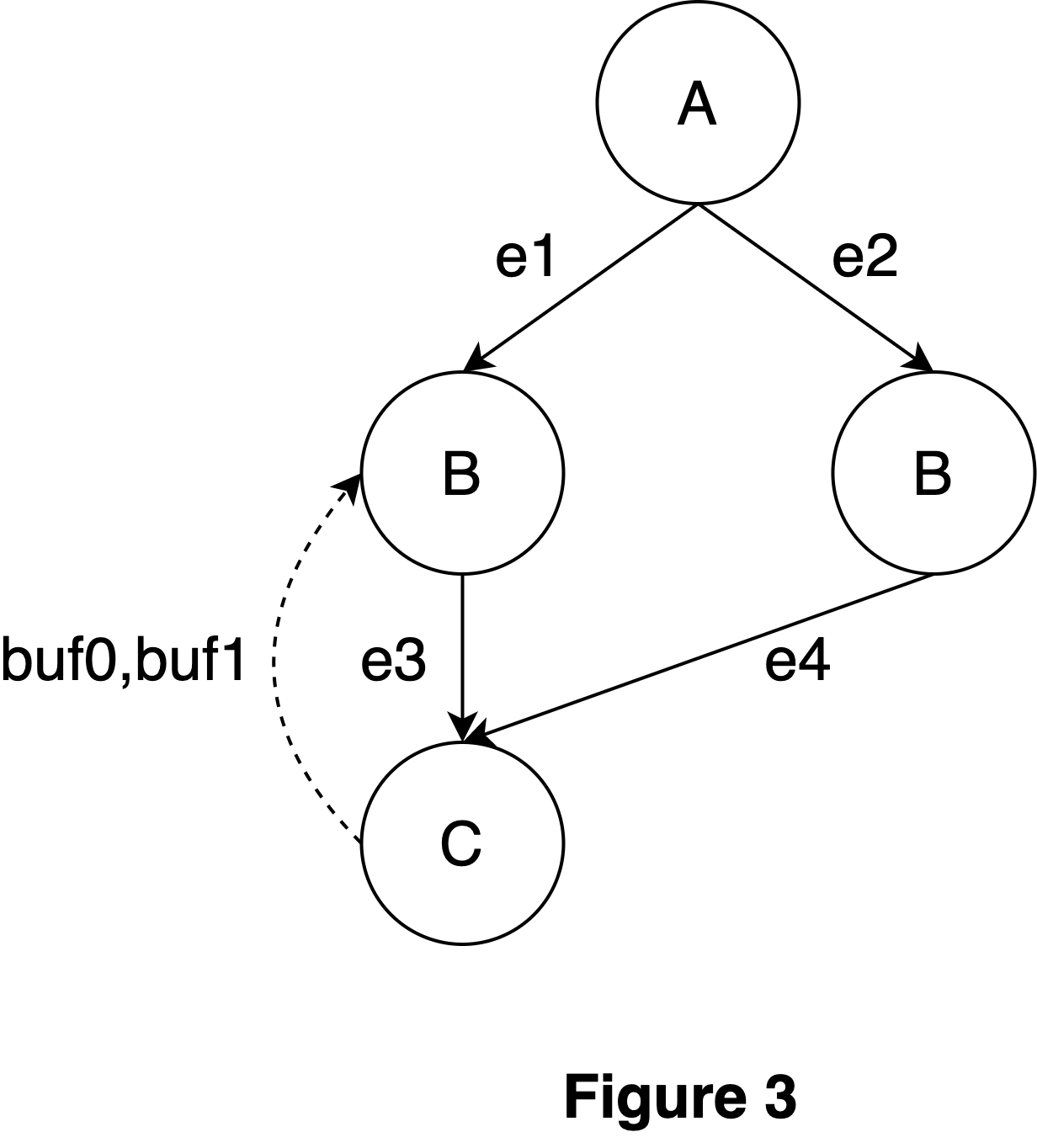
### Membar

<div style="text-align: center;">
<img
src="https://user-images.githubusercontent.com/2306281/234665157-844dd66f-5028-4ef3-bca2-4ca74b8f969d.png"
alt="figure 3" width="300" height="auto">
</div>

The membar pass is dependent on the allocation analysis. Once the offset
and size of each buffer are known, we conduct a post-order traversal of
the call graph and analyze each function on an individual basis. Unlike
previous analyses, we now return buffers that remain unsynchronized at
the end of functions, allowing the calling function to perform
synchronization in cases of overlap.

### AxisInfo

<div style="text-align: center;">
<img
src="https://user-images.githubusercontent.com/2306281/234665183-790a11ac-0ba1-47e1-98b1-e356220405a3.png"
alt="figure 4" width="400" height="auto">
</div>

The AxisInfo analysis operates differently from both membar and
allocation, as it traverses the call graph in topological order. This is
necessary because function arguments may contain axis information that
will be utilized by callee functions. As we do not implement
optimizations like function cloning, each function has a single code
base, and the axis information for an argument is determined as a
conservative result of all axis information passed by the calling
functions.

---------

Co-authored-by: Philippe Tillet <phil@openai.com>

…oad (triton-lang#1593)

Closes triton-lang#1556
triton-lang#1512

The current hash used for caching the cubin does not include the
architecture. This leads to the following error when compiling against
one arch and running against another (with no code changes to trigger a
recompilation).
```
RuntimeError: Triton Error [CUDA]: device kernel image is invalid
```
Was not sure what unit tests would be appropriate here (if any)

Co-authored-by: davidma <davidma@speechmatics.com>
… statement (triton-lang#1597)

If `node.func` is an `ast.Attribute`, it won't cause an early return.
(Not sure if I interpret it correctly)

triton-lang#1591
…n ldmatrix and mma.sync (triton-lang#1595)

…ubin binding (triton-lang#1583)

Formatting of the diff is not the best. I only indented the whole
function, moved the creation of the py::bytes and the return out of the
scope and declared and assigned the cubin variable appropriately.
Everything else is unchanged.

Today it triggers the following error on CPython debug build:
```
Fatal Python error: _PyMem_DebugMalloc: Python memory allocator called without holding the GIL
Python runtime state: initialized

```

---------

Co-authored-by: Keren Zhou <kerenzhou@openai.com>
Co-authored-by: Philippe Tillet <phil@openai.com>

[BACKEND] Enable slice layout support for reduce op


make torch optional to fix circular dependency issue
triton-lang#1608)

ConvertLayoutOp can be folded in other ConvertLayoutOp

This exposes `semantic.expand_dims` in the public API and builds upon it
with support for expanding multiple dimensions at once. e.g.
```python
tl.expand_dims(tl.arange(0, N), (0, -1))  # shape = [1, N, 1]
```

Compared to indexing with `None`, this API is useful because the
dimensions can be constexpr values rather than hard-coded into the
source. As a basic example
```python
@triton.jit
def max_keepdim(value, dim):
    res = tl.max(value, dim)
    return tl.expand_dims(res, dim)
```

…ome code (triton-lang#1629)

Co-authored-by: Philippe Tillet <phil@openai.com>
circular dependency is causing troubles now that our interpreter depends
on torch 2.0 ...

Simple mechanism to run Triton kernels on PyTorch for debugging purpose
(upstream from Kernl).

Todo:
- random grid iteration
- support of atomic ops
- more unit tests
- cover new APIs?

Ideally you would also build source distributions so that it is in
principle possible to build `triton` on other platforms, but building
`musllinux` wheels would at least help with openai/whisper#1328.

I suspect you will also get people showing up at some point asking for
`aarch64` wheels as well. It might be worth taking a look at the
[`cibuildwheel` output
matrix](https://cibuildwheel.readthedocs.io/en/stable/#what-does-it-do)
to see what you are comfortable with shipping (particularly if you
aren't shipping source distributions).
- Case 1: Return after static control flow is taken. Peel off
instructions after the first `return` for each basic block.

```python
if static_condition:
    tl.store(...)
    return
return
```

- Case 2: Return exists in both `if` and `else` branches of an inlined
`JITFunction` function

```python
def foo():
    if dynamic_condition:
        return a
    else:
        return b
```

- Case 3: Return exists in a `JITFunction` from another module

```python
import module
if cond:
    a = module.func()
```

- Case 4: A chain of calls through undefined local variables

```python
import module
if cond:
    a = x
    a = a.to(tl.int32).to(tl.int32)
```

- Case 5: Call a function `func` without returning variables. `func` is
recognized as an `Expr` first instead of a `Call`.

```python
if cond:
    foo()
else:
    bar()
```

- Case 6: Call a `noinline` function. We don't need to check if the
function contains any return op.

…on-lang#1641)

This sometimes happens in TorchInductor. See
pytorch/pytorch#100880.
More generally, it's useful to be able to write `tl.device_assert(False,
msg)`.

Co-authored-by: Keren Zhou <kerenzhou@openai.com>
`noinline` can be None, False, or True, so we have to check the callee
in the first two cases.

… runtime (triton-lang#1663)

Triton runtime currently relies on KeyError to check whether a kernel
has been compiled. This results in somewhat confusing backtraces when
running the kernel crashes, as the stack traces includes not only the
actual crash, but also the stack trace for the original KeyError which
was caught.


…triton-lang#1668)

This depends on a [pending LLVM
release](ptillet/triton-llvm-releases#10).

* Implement setCalleeFromCallable in CallOp.
* Cast type to ShapedType for various getters.
* Improve TritonDialect::materializeConstant due to breaking change in
constructor of arith::ConstantOp.
* Add OpaqueProperties argument in inferReturnTypes.

Co-authored-by: Philippe Tillet <phil@openai.com>
…rTile[1] = 1` (triton-lang#1675)

this fixes fused attention with D_HEAD=128

…ly with WIN32 API (triton-lang#1674)

Co-authored-by: Philippe Tillet <phil@openai.com>
Remove unused variables, fix member initializer list order.
…-lang#1678)

`bool` is a subclass of `int`, so `isinstance(bool_var, int) == True`,
and a `bool` constant will be converted to an `int` constant.

In triton specifically, if a bool var is treated as an integer, it
prevents us using the `logical_and` operator which requires both
operands have the same bit length.

> Cannot bitcast data-type of size 32 to data-type of size 1

By differentiating int and bool, it allows us to make the syntax more
close to native python. We can now use `if bool_var and condition` to
check the truthiness, and `if bool_var is True` to check identity.
This avoids `ctad-maybe-unsupported` warning.

Conflicts:
	lib/Conversion/TritonGPUToLLVM/TritonGPUToLLVMPass.cpp
	lib/Target/LLVMIR/LLVMIRTranslation.cpp
	python/test/unit/language/assert_helper.py
	python/triton/third_party/cuda/bin/ptxas
	test/Conversion/tritongpu_to_llvm.mlir

 It looks like you may be committing a merge.
 If this is not correct, please remove the file
	.git/MERGE_HEAD
 and try again.

 jayfurmanek
force-pushed
the
IFU-230517
branch
3 times, most recently
from
jayfurmanek
force-pushed
the
IFU-230517
branch
3 times, most recently
from
1401cca to
4630016
Compare
jayfurmanek
requested review from
alefimov-amd,
micmelesse,
weihanmines and
zhanglx13

zhanglx13
requested changes
May 22, 2023


guacamoleo
pushed a commit
that referenced
this pull request
Dec 10, 2025



* Fix lds size

* Switch to switch
This file contains hidden or bidirectional Unicode text that may be interpreted or compiled differently than what appears below. To review, open the file in an editor that reveals hidden Unicode characters.
Learn more about bidirectional Unicode characters
Sign up for free
to join this conversation on GitHub.
Already have an account?
Sign in to comment
20 participants


Add this suggestion to a batch that can be applied as a single commit.This suggestion is invalid because no changes were made to the code.Suggestions cannot be applied while the pull request is closed.Suggestions cannot be applied while viewing a subset of changes.Only one suggestion per line can be applied in a batch.Add this suggestion to a batch that can be applied as a single commit.Applying suggestions on deleted lines is not supported.You must change the existing code in this line in order to create a valid suggestion.Outdated suggestions cannot be applied.This suggestion has been applied or marked resolved.Suggestions cannot be applied from pending reviews.Suggestions cannot be applied on multi-line comments.Suggestions cannot be applied while the pull request is queued to merge.Suggestion cannot be applied right now. Please check back later.
https://github.com/ROCmSoftwarePlatform/frameworks-internal/issues/4377