feat(workflows): add an orchestration policy layer to the Workflow tool description - #8694
Conversation


…ol description

The description was an accurate technical specification that said nothing
about when to orchestrate, which shape to use, or how to trust what comes
back. With only the API in view, the naive shape wins every time: fan
everything out through one barrier and take the first answer at face value.

Adds the decision layer on top of the existing runtime facts — purpose
framing, pipeline-by-default with an explicit test for when a barrier is
genuinely required, scout-then-orchestrate, reusable shapes, adversarial
and perspective-diverse verification, the deduplicate-against-seen rule
that keeps discovery loops terminating, and honest reporting of bounded
coverage.

Prompt text only: no runtime, sandbox, or schema change.

Closes QwenLM#8690

Co-Authored-By: Claude Opus 5 <noreply@anthropic.com>

 github-actions
Bot
added
the
review/self-reported
github-actions
Bot
added
the
review/self-reported


|
Thanks for the PR! Template looks good ✓ Problem: real, with a linked issue (#8690, already triaged as Direction: aligned. The workflow runtime is already shipped and capable; the missing decision layer is what makes it usable well. The area is active upstream too — no direct reference to a policy-layer description, but clearly relevant. Size: core path touched ( Approach: minimal — the description moves into a Risk: no elevated risk signals — none of the changed files match the high-risk paths from the revert analysis. Moving on to code review. 🔍 中文说明感谢贡献! 模板完整 ✓ 问题:真实存在,有关联 issue(#8690,已被 triage 标为 方向:对齐。workflow 运行时已落地且能力完整,缺的正是让它被用好的决策层。上游在该领域也持续活跃——虽无直接对应的描述,但该领域明显相关。 规模:触及核心路径( 方案:最小化——描述移入携带策略层的 风险:无升级风险信号——改动文件均未命中 revert 分析中的高风险路径。 进入代码审查。🔍 — Qwen Code · qwen3.8-max Reviewed at |
Code reviewClean pass — no blocking findings, and this round re-verified the diff against the runtime end to end. The shape is exactly what the issue asked for: the description moves out of the constructor into Every capability fact in the new text was checked against the implementation:
Nothing outside CI test evidenceThe previous blocker is resolved: the branch now carries
The three skips are by design, not a gap: the macOS/Windows test legs and the CLI integration suite are Not verified: live measurement of how model-authored scripts change under the new text — the PR declares that out of scope, and the merge-relevant claim (the description carries both the runtime facts and the policy) is exactly what the pinned tests substantiate. The maintainer's round-2/3 verification comments in this thread report live model script-authoring runs; that is the maintainer's own evidence and is recorded here as such. 中文说明代码审查干净通过——无阻塞项,本轮已将 diff 与运行时端到端重新核对。 形态正是 issue 所要的:描述从构造函数移入 新文本中的每条能力事实都对照实现核实过:
CI 测试证据此前的阻塞已解除:分支已带上 三个 skipped 项是设计使然而非缺口:macOS/Windows 测试与 CLI 集成套件在 未验证:新文本对模型实际产出脚本影响的在线测量——PR 已声明超出范围;与合并相关的论断(描述同时携带运行时事实与策略)正是锚定测试所证实的内容。maintainer 在本帖 round-2/3 验证评论中报告了在线模型脚本编写运行,那是 maintainer 自己的证据,此处如实标注。 — Qwen Code · qwen3.8-max Reviewed at |
|
Confidence: 5/5 — clean across every stage; the only earlier reservation (CI never ran the suite on the old head) is resolved by the main merge, and the suite is green on this commit. Stepping back: this is what a good prompt-text PR looks like. The motivation reads straight off the current description, the scope is exactly the issue's six points and nothing else, every runtime fact in the new prose was re-checked against the code this round and holds, and the pinning tests guard the one realistic regression — a future edit quietly shrinking the description back to a capability list. Interpolating the caps from the orchestrator's exported constants rather than hard-coding them is the right call: it removes the hand-sync failure mode for everything except the one literal that cannot be exported, and that one is documented on both sides. The author is upfront about the two tradeoffs — the longer description costs context on every workflow-enabled turn, and the effect on model-authored scripts is unmeasured by this PR. Both are fair to accept knowingly: the context cost is the price of the policy layer the issue asked for, and the maintainer's verification rounds in this thread (including live model script-authoring runs) cover the behavioral side. No outstanding questions from this side. Approving, pinned to the reviewed commit. Thanks @qqqys — nice work seeing the branch staleness through. ✅ 中文说明置信度:5/5 —— 各阶段全部干净;此前唯一的保留意见(旧头部上 CI 从未跑到单测)已随合入 main 解除,套件在本提交上全绿。 退一步看:这是一份标准的提示词类 PR。动机在现有描述里一眼可见;范围恰好是 issue 的六点、别无其他;本轮已将新文本里每条运行时事实重新对照代码核实;锚定测试也恰好防住唯一现实的回归——日后某次编辑把描述悄悄退回成能力清单。上限从 orchestrator 导出的常量插值而非硬编码是正确做法:除唯一无法导出的字面量外,手工同步这一失败模式被彻底消除,而那个例外在两侧都有注明。 作者坦承两个取舍——更长的描述在每个启用 workflow 的轮次消耗上下文、本 PR 未测量对模型产出脚本的影响。两者都可以在知情前提下接受:上下文成本正是 issue 所要求策略层的代价,本帖中 maintainer 的多轮验证(含在线模型脚本编写运行)已覆盖行为面。 本侧无未决问题。批准,锚定在被审查的提交上。感谢 @qqqys 把分支过期问题一路跟到底。✅ — Qwen Code · qwen3.8-max Reviewed at |
The branch forked from 8fd0162, before 732f4d8 added the `check:voice-guard-sync` package.json script and its CI step. Because ci.yml checks out refs/pull/N/head while taking the workflow YAML from the merge ref, the step ran but the script did not exist, so Test (ubuntu-latest) failed with `npm error Missing script` and the unit suite never ran on this commit.

Merging current main brings the script in. No PR code changes: the diff against main is still only workflow.ts and workflow.test.ts.

Verified: npm run check:voice-guard-sync (passes), npm run build, npm run typecheck, and packages/core src/tools/workflow/workflow.test.ts (40/40).
 qwen-code-ci-bot
left a comment
qwen-code-ci-bot
left a comment
qwen-code-ci-bot
left a comment
There was a problem hiding this comment.
Reviewed — no blockers. Suggestions are inline. Test Plan (not a blocker): 40 passed — this review observed 1092, 18154, 1464, 475, 2868, 444 passed.
中文说明
已审查——无阻断问题。 建议见行内评论。 Test Plan(非阻断):40 passed — this review observed 1092, 18154, 1464, 475, 2868, 444 passed。
— qwen3.8-max via Qwen Code /review (v0.21.7)
| it('description carries both the runtime facts and the orchestration policy', () => { | ||
| const { description } = new WorkflowTool(fakeConfig()); |
There was a problem hiding this comment.
[Suggestion] R1-1: The pinning test's anchors leave policy sections unguarded. The test exists — per its own comment — to catch "A refactor that drops the policy prose", but deleting the "What a workflow is for" or "Scout first, then orchestrate" section (including "Common single-phase shapes") from WORKFLOW_TOOL_DESCRIPTION keeps all 10 assertions green (verified by mutation probe). The linked issue's six-item scope includes purpose framing, hybrid scouting, and reusable shapes — none of them is anchored. — Failure scenario: a future refactor deletes those policy paragraphs → every anchor stays intact and the suite passes green, shipping exactly the regression class this test claims to catch for three of the issue's six content areas.
Add one anchor per uncovered section:
expect(description).toMatch(/Parallelism on its own is not a reason/);
expect(description).toMatch(/only before the orchestration step/);
expect(description).toMatch(/Common single-phase shapes/);
中文说明
[Suggestion] 锚定测试的锚点没有覆盖全部策略段落。该测试按其自身注释的说法,是为了捕获"删掉策略 prose 的重构",但经变异探针验证:从 WORKFLOW_TOOL_DESCRIPTION 中删除 "What a workflow is for" 或 "Scout first, then orchestrate"(含 "Common single-phase shapes")段落后,全部 10 条断言仍然为绿。关联 issue 的六点范围包含目的定位、混合侦察与可复用形状——这三项均未被锚定。失败场景:未来某次重构删掉这些策略段落 → 所有锚点原样存活、测试套件全绿,恰好把该测试声称要捕获的回归类型放行(涉及 issue 六点中的三点)。
— qwen3.8-max via Qwen Code /review (v0.21.7)
|
|
||
| Reach for one to be comprehensive (decompose the work and cover every part in parallel), to be confident (independent perspectives and adversarial checks before an answer is committed to), or to take on scale a single context cannot hold — migrations, audits, broad sweeps. The script is where that structure is encoded: what fans out, what verifies, what synthesizes. Parallelism on its own is not a reason; work that is already one short sequence of edits belongs in the main loop. | ||
|
|
||
| **Runtime** — see the \`script\` parameter for the detailed authoring contract. |
There was a problem hiding this comment.
[Suggestion] R1-2: The description newly advertises the workflow(nameOrRef, args?) and budget globals while pointing at the script parameter for "the detailed authoring contract" — but that contract documents neither global. The hard single-level nesting limit (the sandbox throws "workflow() nesting is limited to a single level") and budget's total/spent()/remaining() semantics appear nowhere model-visible. — Failure scenario: an author composing two levels of workflow() nesting — the natural reading of an advertised primitive — discovers the throwing stub only at runtime → the run has already burned agents/tokens on everything before the failing call.
For example, add to the Runtime paragraph: "workflow(nameOrRef, args?) runs a saved workflow sharing this run's caps; nesting is single-level (a workflow invoked via workflow() cannot call workflow() itself)", and/or document both globals in the script parameter description.
中文说明
[Suggestion] 描述新近宣传了 workflow(nameOrRef, args?) 与 budget 全局,并指向 script 参数的"详细编写契约"——但该契约对这两个全局只字未提:单层嵌套的硬性上限(沙箱会抛出 "workflow() nesting is limited to a single level")以及 budget 的 total/spent()/remaining() 语义在任何模型可见的文本中都不存在。失败场景:作者组合两层 workflow() 嵌套——对被宣传原语的自然读法——只在运行时才撞到 throwing stub → 此时本次运行已在失败调用之前烧掉了 agents/tokens。
— qwen3.8-max via Qwen Code /review (v0.21.7)
| * `script`'s own description carries the exact authoring contract (error | ||
| * strings, serialization rules, env overrides) and is not duplicated here. |
There was a problem hiding this comment.
[Suggestion] R1-3: The unconditional 30-minute wall-clock cap per run (DEFAULT_MAX_WALL_CLOCK_MS; override QWEN_CODE_MAX_WORKFLOW_SECONDS) appears nowhere in the model-visible surface, while this description encourages runs that can exceed it ("up to 1000 agents total", migrations/audits/broad sweeps) — and this comment claims the script contract carries the env overrides, while only two of the three workflow knobs are enumerated in the Runtime sentence. The sandbox's own source comment computes that a legitimate 1000-agent fan-out already exceeds 30 minutes. — Failure scenario: a model-authored migration workflow legitimately needing more than 30 minutes → aborted mid-run by the wall-clock watchdog, in-flight subagents cancelled, partial result failed as execution_failed; recovery is an env var the model cannot set, discoverable only from the timeout error text after the run already died. (Mitigating: that error text does name the override.)
For example, extend the Runtime limits sentence: "…up to 1000 agents total (QWEN_CODE_MAX_WORKFLOW_CONCURRENCY / QWEN_CODE_MAX_WORKFLOW_AGENTS), under a 30-minute wall-clock cap per run (QWEN_CODE_MAX_WORKFLOW_SECONDS)".
中文说明
[Suggestion] 每次运行无条件 30 分钟的墙钟上限(DEFAULT_MAX_WALL_CLOCK_MS;覆盖变量 QWEN_CODE_MAX_WORKFLOW_SECONDS)在任何模型可见文本中都不存在,而本描述恰恰鼓励可能超过它的运行("最多 1000 个 agent"、迁移/审计/大面积排查)——且本注释声称 script 契约包含 env 覆盖,而 Runtime 句子里实际只列出了三个 workflow 旋钮中的两个。沙箱自身的源码注释已经算出:一次合理的 1000-agent 扇出就会超过 30 分钟。失败场景:模型编写的迁移 workflow 合理需要超过 30 分钟 → 被墙钟看门狗中途终止,在途 subagent 被取消,部分结果以 execution_failed 失败;恢复手段是一个模型无法设置的 env 变量,只能在运行死后从超时错误文本中发现。(缓解项:该错误文本确实写明了覆盖变量。)
— qwen3.8-max via Qwen Code /review (v0.21.7)
| for (const anchor of [ | ||
| 'min(16, cpus-2)', | ||
| 'QWEN_CODE_MAX_WORKFLOW_AGENTS', |
There was a problem hiding this comment.
[Suggestion] R1-4: The anchor list pins only one of the two env-var names the Runtime paragraph advertises — QWEN_CODE_MAX_WORKFLOW_AGENTS is protected, but its sibling QWEN_CODE_MAX_WORKFLOW_CONCURRENCY appears exactly once in the description and is unprotected by any assertion (probe-verified: renaming the description occurrence escaped this test). — Failure scenario: a future edit corrupts or renames QWEN_CODE_MAX_WORKFLOW_CONCURRENCY in the description → all assertions stay green; the model instructs users to set a misspelled env var; the runtime reads MAX_WORKFLOW_CONCURRENCY_ENV correctly, so the override silently never applies and users conclude the concurrency knob is broken.
| for (const anchor of [ | |
| 'min(16, cpus-2)', | |
| 'QWEN_CODE_MAX_WORKFLOW_AGENTS', | |
| for (const anchor of [ | |
| 'min(16, cpus-2)', | |
| 'QWEN_CODE_MAX_WORKFLOW_AGENTS', | |
| 'QWEN_CODE_MAX_WORKFLOW_CONCURRENCY', |
中文说明
[Suggestion] 锚点列表只钉住了 Runtime 段落宣传的两个环境变量名之一——QWEN_CODE_MAX_WORKFLOW_AGENTS 有保护,而其姊妹 QWEN_CODE_MAX_WORKFLOW_CONCURRENCY 在描述中恰好只出现一次且无任何断言保护(探针验证:重命名描述中的该变量可以逃过本测试)。失败场景:未来某次编辑损坏或重命名描述中的 QWEN_CODE_MAX_WORKFLOW_CONCURRENCY → 所有断言保持绿色;模型指导用户设置拼错的环境变量;运行时读取的是正确常量,覆盖静默失效,用户会以为并发旋钮坏了。
— qwen3.8-max via Qwen Code /review (v0.21.7)
| * `script`'s own description carries the exact authoring contract (error | ||
| * strings, serialization rules, env overrides) and is not duplicated here. |
There was a problem hiding this comment.
[Suggestion] R1-5: This comment asserts the authoring contract "is not duplicated here", but the description below duplicates contract content verbatim — both env-override names, the max(1, min(16, cpus-2)) default and the 1000-agent cap, the per-call agent({…}) opts, resumeFromRunId cache semantics, and run_in_background behavior all appear both here and in the script/param descriptions. — Failure scenario: a future change to one of the duplicated facts (bumping DEFAULT_MAX_AGENTS_PER_RUN, renaming the concurrency env var) is applied to the runtime and the script param description but skips the tool description, because this comment tells the editor it carries no contract content → the drift ships silently for every duplicated fact the pinning test does not anchor, leaving the model-visible description contradicting the param contract.
| * `script`'s own description carries the exact authoring contract (error | |
| * strings, serialization rules, env overrides) and is not duplicated here. | |
| * `script`'s own description carries the detailed authoring contract (error | |
| * strings, serialization rules); the limits and env knobs restated above are | |
| * a summary — keep both in sync when they change. |
中文说明
[Suggestion] 本注释断言编写契约"不会在此重复",但下方描述逐字重复了契约内容——两个 env 覆盖变量名、max(1, min(16, cpus-2)) 默认值与 1000-agent 上限、按调用的 agent({…}) 选项、resumeFromRunId 缓存语义、run_in_background 行为,在此处与 script/参数描述中均出现。失败场景:未来对某个重复事实的修改(如提高 DEFAULT_MAX_AGENTS_PER_RUN、重命名并发环境变量)应用到了运行时与 script 参数描述,却跳过了工具描述——因为本注释明确告诉编辑此处不含契约内容 → 对锚定测试未钉住的每一个重复事实,漂移都会静默上线,模型可见的描述将与参数契约相互矛盾。
— qwen3.8-max via Qwen Code /review (v0.21.7)
|
|
||
| **Runtime** — see the \`script\` parameter for the detailed authoring contract. | ||
|
|
||
| \`phase(title)\`, \`log(msg)\`, \`agent(prompt, opts?)\`, \`parallel(thunks)\`, \`pipeline(items, ...stages)\`, \`workflow(nameOrRef, args?)\`, plus the \`args\` and \`budget\` globals. Default \`max(1, min(16, cpus-2))\` agents in flight per run, up to 1000 agents total (\`QWEN_CODE_MAX_WORKFLOW_CONCURRENCY\` / \`QWEN_CODE_MAX_WORKFLOW_AGENTS\`). Per-call \`agent({ schema, agentType, model, isolation: 'worktree' })\` covers structured-output contracts, declarative-agent selection, model override, and git-worktree-isolated subagents. \`resumeFromRunId\` resumes a prior run — agent() calls whose rolling prefix-hash matches the journal are served from cache for the longest unchanged prefix. Runs appear in the background-tasks view and the \`/workflows\` dialog (live phase tree, token usage, cancel); \`run_in_background: true\` returns a run handle immediately in the interactive TUI and delivers completion through the conversation. Scripts run in a node:vm sandbox with no filesystem or shell access — all I/O happens through the spawned agents. |
There was a problem hiding this comment.
[Suggestion] R1-6: The per-run output-token cap QWEN_CODE_MAX_TOKENS_PER_WORKFLOW — which gates every agent() dispatch (countedDispatch throws WorkflowBudgetExceededError, cancelling in-flight agents and failing the run) — appears in neither model-visible half, even though this description newly advertises the budget global. It is the one cap operators are actively prompted to set (the first-success usage banner says exactly that), its error message deliberately names no knob (see the P5 R2 comment in workflow-budget.ts), and the banner is user-visible returnDisplay only. — Failure scenario: an operator follows the banner and sets a token cap; the model, primed by this description for large fan-outs ("migrations, audits, broad sweeps", "up to 1000 agents total"), never probes budget.total (whose null/cap semantics appear nowhere model-visible) → a mid-run budget-exceeded error cancels in-flight agents and fails the run with partial results; the first capped run dies un-warned.
Intent-compatible with the P5 R2 rationale (which deliberately keeps the env-var name out of model-reachable error text), add a probe clause rather than the knob name — e.g. "a per-run output-token cap may be in effect; read budget.total (null = uncapped) before large fan-outs" — to the Runtime paragraph and/or the script contract.
中文说明
[Suggestion] 每运行的输出 token 上限 QWEN_CODE_MAX_TOKENS_PER_WORKFLOW——它把关每一次 agent() 派发(countedDispatch 抛出 WorkflowBudgetExceededError,取消在途 agent 并使运行失败)——在两个模型可见 half 中均不存在,尽管本描述新近宣传了 budget 全局。它是产品主动提示操作者去设置的唯一上限(首次成功的 usage banner 原文如此),其错误消息刻意不写任何旋钮(见 workflow-budget.ts 的 P5 R2 注释),而 banner 仅存在于用户可见的 returnDisplay。失败场景:操作者照 banner 设置了 token 上限;模型被本描述鼓动去做大型扇出("迁移、审计、大面积排查"、"最多 1000 个 agent"),又从不探测 budget.total(其 null/上限语义在任何模型可见处都不存在)→ 运行中途的预算超限错误取消在途 agent、以部分结果使运行失败;第一次受限的运行毫无预警地死去。
与 P5 R2 的理由兼容(该理由刻意让 env 变量名远离模型可达的错误文本):添加探测子句而非旋钮名——例如 "a per-run output-token cap may be in effect; read budget.total (null = uncapped) before large fan-outs"——加到 Runtime 段落和/或 script 契约中。
— qwen3.8-max via Qwen Code /review (v0.21.7)
…icy section

Addresses the round-1 review on QwenLM#8694 (R1-1 through R1-6).

The description now names the three limits a model has to plan around
rather than discover from a mid-run failure: `workflow()` nests one level
only, the 30-minute wall-clock cap per run
(`QWEN_CODE_MAX_WORKFLOW_SECONDS`), and the per-run output-token cap —
surfaced as a `budget.total` probe rather than a knob name, keeping the
P5 R2 rule that the env var stays out of model-reachable text.

The pinning test grew anchors for the three policy sections a mutation
probe could delete while it stayed green, and for
`QWEN_CODE_MAX_WORKFLOW_CONCURRENCY`, which the description advertised
with nothing asserting its spelling.

The JSDoc claim that the authoring contract "is not duplicated here" was
false — the limits and env knobs appear in both halves — so it now says
they are a summary to keep in sync.

|
Local deep verification (maintainer round) — verdict: ✅ merge-ready · 68/68 scripted assertions passed · verified head 中文摘要(Chinese summary)结论:merge-ready(可以合并)。68/68 项脚本化断言通过,验证 head
1. Central claim & A/B (mutation matrix)Central claim: the description now carries both the runtime facts and an orchestration policy layer, and the new test pins both halves.
Both mutations failed on the intended assertion (quoted expected-vs-received, not an import/compile error), and the restored tree went green with 0 dirty entries — the test is load-bearing and pins the policy prose, not just the env-knob spellings.
2. Fact-check: description ↔ real runtime (60/60)Every capability claim in the new description was cross-checked against the runtime constants that read it (built
3. Context cost (acknowledged tradeoff, measured)
Paid on every turn with workflows enabled. The PR discloses this deliberately; the number is confirmed, not larger than stated. 4. Findings (non-blocking)
5. Not covered
6. MethodologyScratch git worktree at the PR head (
|


qwen-code-ci-bot
left a comment
qwen-code-ci-bot
left a comment
There was a problem hiding this comment.
Reviewed — no blockers. Suggestions are inline. Test Plan (not a blocker): 40 passed — this review observed 19287, 1092, 18157, 1464, 475, 2868, 444 passed.
中文说明
已审查——无阻断问题。 建议见行内评论。 Test Plan(非阻断):40 passed — this review observed 19287, 1092, 18157, 1464, 475, 2868, 444 passed。
— qwen3.8-max via Qwen Code /review (v0.21.7)
| 'QWEN_CODE_MAX_WORKFLOW_AGENTS', | ||
| 'QWEN_CODE_MAX_WORKFLOW_CONCURRENCY', | ||
| 'QWEN_CODE_MAX_WORKFLOW_SECONDS', |
There was a problem hiding this comment.
[Suggestion] R2-1: The env-knob anchors are hardcoded string literals instead of the runtime's exported constants (MAX_WORKFLOW_AGENTS_ENV, MAX_WORKFLOW_CONCURRENCY_ENV in workflow-orchestrator.ts), so the guard only catches description-side typos — a rename on the runtime side drifts past it. — Failure scenario: a future PR renames MAX_WORKFLOW_AGENTS_ENV (or its string value) and updates workflow-orchestrator.test.ts's hardcoded literals, but misses WORKFLOW_TOOL_DESCRIPTION → this test stays green while the model tells users to set a variable nothing reads. Probe-verified at the reviewed commit: mutating the constant's value leaves all 40 tests green; anchoring through the imported constant makes the same mutation fail. (QWEN_CODE_MAX_WORKFLOW_SECONDS has no exported constant — workflow-sandbox.ts reads it inline — so that anchor stays a literal unless one is exported.)
| 'QWEN_CODE_MAX_WORKFLOW_AGENTS', | |
| 'QWEN_CODE_MAX_WORKFLOW_CONCURRENCY', | |
| 'QWEN_CODE_MAX_WORKFLOW_SECONDS', | |
| MAX_WORKFLOW_AGENTS_ENV, | |
| MAX_WORKFLOW_CONCURRENCY_ENV, | |
| 'QWEN_CODE_MAX_WORKFLOW_SECONDS', |
plus the import: import { MAX_WORKFLOW_AGENTS_ENV, MAX_WORKFLOW_CONCURRENCY_ENV } from '../../agents/runtime/workflow-orchestrator.js';
中文说明
[Suggestion] env 旋钮锚点是硬编码字符串字面量,而非运行时导出的常量(workflow-orchestrator.ts 中的 MAX_WORKFLOW_AGENTS_ENV、MAX_WORKFLOW_CONCURRENCY_ENV),因此该守卫只能捕获描述侧的拼写错误——运行时侧的重命名会从它眼皮底下溜过。失败场景:未来某个 PR 重命名 MAX_WORKFLOW_AGENTS_ENV(或其字符串值)并更新了 workflow-orchestrator.test.ts 中的硬编码字面量,却漏掉 WORKFLOW_TOOL_DESCRIPTION → 本测试保持绿色,而模型会指导用户设置一个没有任何代码读取的变量。已在被审 commit 上用探针验证:改变常量值后全部 40 个测试仍绿;把锚点换成导入的常量后,同样的变异会使测试失败。(QWEN_CODE_MAX_WORKFLOW_SECONDS 没有导出的常量——workflow-sandbox.ts 以行内方式读取——因此除非导出一个常量,该锚点保持字面量。)
— qwen3.8-max via Qwen Code /review (v0.21.7)
| // Limits the model has to plan around rather than discover from a | ||
| // mid-run failure. | ||
| expect(description).toMatch(/nests one level only/); |
There was a problem hiding this comment.
[Suggestion] R2-2: The numeric caps the model plans around — "up to 1000 agents total" and the "30-minute wall-clock cap" — are not anchored by any assertion, even though this comment names exactly those planning limits and the sibling min(16, cpus-2) formula IS anchored. — Failure scenario: a future PR raises DEFAULT_MAX_AGENTS_PER_RUN or DEFAULT_MAX_WALL_CLOCK_MS and forgets WORKFLOW_TOOL_DESCRIPTION → all 17 anchors stay green while the model sizes fan-outs against stale caps, discovering the real one from a mid-run rejection. Probe-verified: mutating the description's 1000→500 and 30-minute→15-minute leaves the test green; adding the two anchors below flips the same mutation red.
| // Limits the model has to plan around rather than discover from a | |
| // mid-run failure. | |
| expect(description).toMatch(/nests one level only/); | |
| // Limits the model has to plan around rather than discover from a | |
| // mid-run failure. | |
| expect(description).toMatch(/up to 1000 agents total/); | |
| expect(description).toMatch(/30-minute wall-clock cap/); | |
| expect(description).toMatch(/nests one level only/); |
中文说明
[Suggestion] 模型制定计划所依据的数值上限——"最多 1000 个 agent"与"30 分钟墙钟上限"——没有任何断言锚定,尽管这段注释指名的正是这些规划限制,且同段的 min(16, cpus-2) 公式已被锚定。失败场景:未来某个 PR 提高 DEFAULT_MAX_AGENTS_PER_RUN 或 DEFAULT_MAX_WALL_CLOCK_MS 却忘记更新 WORKFLOW_TOOL_DESCRIPTION → 所有 17 个锚点保持绿色,而模型按过时的上限规划扇出,直到运行中途被拒绝才发现真实上限。探针验证:将描述中的 1000→500、30-minute→15-minute 变异后测试仍绿;加入上面两个锚点后同一变异即转红。
— qwen3.8-max via Qwen Code /review (v0.21.7)
| * `script`'s own description carries the exact authoring contract (error | ||
| * strings, serialization rules); the limits and env knobs restated below | ||
| * are a summary of it, not a separate source of truth — when one of them | ||
| * changes, change both. |
There was a problem hiding this comment.
[Suggestion] R2-3: The sync claim in this comment is only partially true: the concurrency window / agent cap and their two env knobs do restate the script parameter description, but the wall-clock cap (QWEN_CODE_MAX_WORKFLOW_SECONDS), the budget.total semantics, and the one-level workflow() nesting limit appear ONLY in this tool description — the script description's globals list is phase/log/agent/args. — Failure scenario: a maintainer changes DEFAULT_MAX_WALL_CLOCK_MS and follows "change both" → looks for the cap in the script description (the declared source of truth), finds nothing, and since this text is declared "not a separate source of truth", the 30-minute sentence and its test anchor go stale silently — exactly the drift this PR's test exists to catch, and it then stays green (probe-verified, see R2-2).
| * `script`'s own description carries the exact authoring contract (error | |
| * strings, serialization rules); the limits and env knobs restated below | |
| * are a summary of it, not a separate source of truth — when one of them | |
| * changes, change both. | |
| * `script`'s own description carries the exact authoring contract (error | |
| * strings, serialization rules). The concurrency window, agent cap, and | |
| * their two env knobs restate it — when one of them changes, change both. | |
| * The wall-clock cap, output-token budget, and `workflow()` nesting limit | |
| * live only in this description — keep it in sync with the runtime | |
| * constants (e.g. `DEFAULT_MAX_WALL_CLOCK_MS`, `DEFAULT_MAX_AGENTS_PER_RUN`). |
中文说明
[Suggestion] 本注释的同步声明只部分为真:并发窗口/agent 上限及其两个 env 旋钮确实是 script 参数描述的复述,但墙钟上限(QWEN_CODE_MAX_WORKFLOW_SECONDS)、budget.total 语义与单层 workflow() 嵌套限制只出现在本工具描述中——script 描述的全局清单是 phase/log/agent/args。失败场景:维护者修改 DEFAULT_MAX_WALL_CLOCK_MS 后按"两处一起改"去找 script 描述(声明的权威来源),什么也找不到;而本段又被声明为"不是独立的权威来源",于是 30 分钟那句话及其测试锚点悄悄过期——这正是本 PR 的测试要捕获的漂移,而该测试届时保持绿色(探针验证见 R2-2)。
— qwen3.8-max via Qwen Code /review (v0.21.7)
… its limit

Round-2 review (R2-1/R2-2/R2-3) plus the two non-blocking suggestions from
the maintainer verification round.

- R2-1: anchor the two env knobs through the orchestrator's exported
  MAX_WORKFLOW_AGENTS_ENV / MAX_WORKFLOW_CONCURRENCY_ENV instead of
  hardcoded literals, so a rename on the runtime side fails the guard too.
  QWEN_CODE_MAX_WORKFLOW_SECONDS has no exported constant
  (workflow-sandbox.ts reads it inline), so it stays a literal.
- R2-2: pin the numbers the model plans around — "up to 1000 agents total"
  and the "30-minute wall-clock cap" — not just the knob names.
- R2-3: the sync note claimed the whole limits block restates the `script`
  contract; the wall-clock cap, token budget and one-level workflow()
  nesting limit live only in the tool description. Say which is which.
- W-1: budget exhaustion refuses each further agent() call; a bare
  sequential await sees the rejection, while parallel()/pipeline() turn the
  refused slot into null and keep running (errors-as-data, settleToNullArray).
- W-2: pair each env knob with the quantity it overrides — the shared
  parenthetical read as if both knobs covered the total.

Mutation-probed: 1000->500, 30-minute->15-minute, and renaming
MAX_WORKFLOW_AGENTS_ENV's value each turn the suite red on the intended
assertion; restored tree is 40/40 green.
|
Follow-up maintainer verification: current head + live model script-authoring A/B Recommendation: merge-ready from the verification side. The current check suite is green; GitHub still reports Current PR head This follows the earlier 68/68 deterministic verification, which explicitly left live model behavior unmeasured. 1. Current-head deterministic verification
2. Strategy-aligned script-authoring A/BI ran A zero-dependency MCP probe recorded the authored Workflow scripts and never executed their subagent fleets. Therefore the claims below concern authored orchestration structure, not final workflow output, runtime convergence, or end-to-end finding quality. Static adjudication was not blinded. The full rubric and per-sample evidence are preserved in The behavior samples use parent head
Review scenarioAll three base scripts waited for every initial file review before one global verification stage. All three policy-description scripts used a per-file pipeline and retained explicit verification. One authored workflow required two independent verifiers to support the same finding before retaining it. This is the clearest observed behavior change: pipeline structure improved without weakening the false-positive gate. Cross-package scenarioAll six authored scripts retained the genuinely necessary full-set barrier: inspect packages, build a complete semantic catalog, globally cluster/deduplicate, then launch expensive analysis only for distinct candidates. The policy description did not mechanically remove the barrier. Two of three policy-description scripts explicitly instructed an agent to try to refute the duplicate hypothesis; none of the base scripts used equally explicit refutation wording. Open-ended audit scenarioBase sample 1 authored a reusable methodology instead of repository-directed audit stages; the other two base scripts satisfied the static rubric. All three policy-description scripts authored discovery stages, a permanent all-seen ledger including dismissed/rediscovered candidates, consecutive-zero-new stopping logic, independent refutation, closing gap challenges, and confidence downgrades at caps or unresolved gaps. This 3. Paired request calibration and context costFor the 21 recorded pairs (12 explicit positive-control pairs and 9 strategy-aligned pairs), the request that first carried the complete deferred Workflow declaration was compared after normalizing:
The remaining harness-controlled fields were identical in 21/21 pairs: model, user prompt, cwd semantics, tool set, tool parameters/schema, Provider-reported token usage was measured on the nine paired requests at parent head
4. Interpretation and limitations
5. RecommendationNo local correctness, compatibility, or authored-orchestration blocker was found. The current head passes the deterministic gates and current-main synthetic merge. The parent-head A/B, whose policy text is unchanged in the current head, provides directional evidence that the description:
The material tradeoff is context cost: approximately 中文报告(Chinese report)建议:从验证角度看已 merge-ready。当前 check suite 已全绿;GitHub 仍显示 当前 PR head 为 当前 head 的确定性门禁
真实模型 authored-script A/B使用 MCP probe 只记录模型写出的 Workflow script,不执行其中的 subagent fleet。因此以下结论评价的是模型编排出的脚本结构,不是最终业务输出、实际运行收敛或 finding 正确率。人工静态裁决未盲化,完整 rubric 和逐样本证据已保存。
Wire 校准与成本21 对样本中,选取首次携带完整 deferred Workflow schema 的请求。归一化受控变量 Workflow description、arm-specific 隔离路径、随机 tool-call ID、以及模型在前一轮生成的随机前言/思考后,剩余 harness-controlled 字段 21/21 一致:模型、用户 prompt、cwd 语义、工具集合/schema、 provider token 成本测量来自父提交
限制与结论
综合当前 head 的确定性验证,以及策略段未变的父提交 authored-script A/B:本地未发现 correctness、compatibility 或 orchestration blocker。主要取舍是 deferred schema 请求中实测约 |


|
@qwen-code /resolve |
Resolves the conflict in packages/core/src/tools/workflow/workflow.ts.
main's QwenLM#8320 edited the inline constructor description this branch is
replacing, so the two sides touched the same argument:

- Kept this branch's `WORKFLOW_TOOL_DESCRIPTION` constant — extracting
  that description is the whole point of the PR.
- Ported QwenLM#8320's fact into the constant. The extracted text still listed
  the `/workflows` dialog controls as "live phase tree, token usage,
  cancel"; taking our side verbatim would have dropped cooperative
  pause/resume from the description the model actually reads.
- Pinned that capability list in the existing description test. Nothing
  else asserted it, so the same silent drop could recur on the next base
  merge.

Verified: npm run build, npm run typecheck, eslint on both changed files,
and packages/core src/tools/workflow/workflow.test.ts (40 passed).

|
Merge conflict resolved and pushed as Why it conflicted. #8320 landed in How I resolved it. Kept this branch's constant (that extraction is the point of the PR), then ported #8320's fact into it: the extracted text still described the Scope against Verification
Two things worth flagging, @wenshao:
合并冲突已解决并推送为 冲突原因:#8320 合入 解决方式:保留本分支的常量(这正是本 PR 的目的),并把 #8320 的信息补进常量 —— 抽出的文本仍把 另外两点:① 你在 05:06:09Z 发的 |
|
@qwen-code /review |

| _Qwen Code review request accepted. Review is queued in [workflow run](https://github.com/QwenLM/qwen-code/actions/runs/31266125026)._ |
|
Qwen Code review timed out. Qwen review timed out after 10800 seconds (of the 180-minute budget). For large PRs, retry with a longer timeout by commenting: |
|
@qwen-code /review |
qwen-code-ci-bot
left a comment
qwen-code-ci-bot
left a comment
There was a problem hiding this comment.
Reviewed. Suggestions are inline. Not reviewed: reverse audit — stopped before round 3 by the review time budget. Test Plan (not a blocker): 40 passed — this review observed 19434, 1101, 18427, 1466, 481, 2941, 454 passed.
中文说明
已审查。 建议见行内评论。 未审查:反向审计——评审时间预算不足,未能开始第 3 轮。 Test Plan(非阻断):40 passed — this review observed 19434, 1101, 18427, 1466, 481, 2941, 454 passed。
— qwen3.8-max via Qwen Code /review (v0.21.7)
| expect(description).toMatch(/up to 1000 agents total/); | ||
| expect(description).toMatch(/30-minute wall-clock cap/); |
There was a problem hiding this comment.
[Suggestion] R3-1: The numeric-cap anchors pin description-side literals, so the drift the adjacent comment claims to catch — raising a runtime constant without updating the description — runs green; the guard is one level shallower than the problem it describes. — Failure scenario: a maintainer raises DEFAULT_MAX_AGENTS_PER_RUN (exported, workflow-orchestrator.ts) from 1000 to 2000 and leaves the description untouched → /up to 1000 agents total/ still matches the unchanged text, the suite stays green, and the model sizes fan-outs against a stale cap. Probe-verified at this commit: the mutation leaves all 40 tests green; anchoring through the imported constant turns the same mutation red. DEFAULT_MAX_WALL_CLOCK_MS vs /30-minute wall-clock cap/ is the same shape, but that constant is module-private in workflow-sandbox.ts — either export it and derive the expected minutes, or narrow the comment's claim to what the literals actually catch.
| expect(description).toMatch(/up to 1000 agents total/); | |
| expect(description).toMatch(/30-minute wall-clock cap/); | |
| expect(description).toContain(`up to ${DEFAULT_MAX_AGENTS_PER_RUN} agents total`); | |
| expect(description).toMatch(/30-minute wall-clock cap/); |
(add DEFAULT_MAX_AGENTS_PER_RUN to the existing workflow-orchestrator.js import)
中文说明
[Suggestion] R3-1:数值上限锚点锚定的是描述侧的字面量,因此相邻注释声称要捕获的漂移——提高运行时常量而不更新描述——会原样保持绿色;守卫比它描述的问题浅了一层。失败场景:维护者把 DEFAULT_MAX_AGENTS_PER_RUN(已导出,workflow-orchestrator.ts)从 1000 提到 2000 而不动描述 → /up to 1000 agents total/ 仍然匹配未变化的文本,整套测试保持绿色,模型却按过时的上限规划扇出。已在被审 commit 上用探针验证:该变异下全部 40 个测试仍绿;把锚点换成导入的常量后,同一变异转红。DEFAULT_MAX_WALL_CLOCK_MS 与 /30-minute wall-clock cap/ 同形,但该常量在 workflow-sandbox.ts 中是模块私有的——要么导出它并按其推导分钟数,要么把注释的声明收窄到字面量实际能捕获的范围。(建议块替换被锚定的两行;导入需另行添加。)
— qwen3.8-max via Qwen Code /review (v0.21.7)
| * strings, serialization rules). The concurrency window, the agent cap, and | ||
| * their two env knobs restate it — when one of those changes, change both. |
There was a problem hiding this comment.
[Suggestion] R3-2: The description restates three values that already exist as exported constants this file can import — DEFAULT_MAX_AGENTS_PER_RUN (workflow-orchestrator.ts), MAX_WORKFLOW_AGENTS_ENV, and MAX_WORKFLOW_CONCURRENCY_ENV — instead of interpolating them into the template literal. — Concrete cost: a permanent multi-site sync obligation the doc comment itself concedes ("change both", "keep it in sync"), with the pinning test's /up to 1000 agents total/ literal a third copy of the same value — any change to one of those constants requires a synchronized prose edit that only fails at test time. workflow.ts already imports from the runtime module, and buildUsageBanner already interpolates MAX_TOKENS_PER_WORKFLOW_ENV into model-visible prose in this same file, so the duplication is removable at zero structural cost:
up to ${DEFAULT_MAX_AGENTS_PER_RUN} agents total (`${MAX_WORKFLOW_AGENTS_ENV}`) ... (`${MAX_WORKFLOW_CONCURRENCY_ENV}`)The 30-minute wall-clock cap and the max(1, min(16, cpus-2)) formula have no importable constant (module-private / computed inline) and correctly stay literals.
中文说明
[Suggestion] R3-2:描述复述了三个本文件可以直接导入的已导出常量——DEFAULT_MAX_AGENTS_PER_RUN(workflow-orchestrator.ts)、MAX_WORKFLOW_AGENTS_ENV、MAX_WORKFLOW_CONCURRENCY_ENV——而没有把它们插值进模板字面量。具体代价:一份永久的多站点同步义务,文档注释自己也承认("两处一起改"、"保持同步"),而钉定测试里的 /up to 1000 agents total/ 字面量是同一数值的第三份拷贝——任何一个常量的变化都需要同步的文案编辑,且只在测试时才暴露。workflow.ts 已经从该运行时模块导入,且同文件的 buildUsageBanner 已经把 MAX_TOKENS_PER_WORKFLOW_ENV 插值进模型可见文案,因此这份重复可以零结构成本地消除(见上代码片段)。30 分钟墙钟上限与 max(1, min(16, cpus-2)) 公式没有可导入的常量(模块私有/行内计算),保持字面量是正确的。
— qwen3.8-max via Qwen Code /review (v0.21.7)
| // so raising a runtime constant without updating the description here | ||
| // turns this red instead of leaving the model sizing fan-outs against | ||
| // a stale cap. | ||
| expect(description).toMatch(/up to 1000 agents total/); |
There was a problem hiding this comment.
[Suggestion] R3-3: The cap numbers are hardcoded a second time in the script parameter description (workflow.ts — max(1, min(16, cpus-2)) and At most 1000 agent() calls per run), which nothing pins — this new test anchors only the tool description. — Failure scenario: a maintainer raises DEFAULT_MAX_AGENTS_PER_RUN to 2000 → this test goes red → they edit the tool-description constant, the test goes green, and they stop. The script parameter description still tells the model "At most 1000 agent() calls per run", so the model reads two contradictory caps from one tool call and under-sizes fan-outs against the stale one — exactly the "model sizing fan-outs against a stale cap" failure this test's own comment says it exists to prevent, and the red test actively directs the fixer to only one of the two sites. Suggested fix — extend the pinning to the parameter side via the schema accessor this file already uses:
const schema = tool.schema.parametersJsonSchema;
expect(schema.properties.script.description).toContain('At most 1000 agent() calls');
expect(schema.properties.script.description).toContain('max(1, min(16, cpus-2))');
中文说明
[Suggestion] R3-3:上限数值在 script 参数描述中被第二次硬编码(workflow.ts——max(1, min(16, cpus-2)) 与 At most 1000 agent() calls per run),而没有任何断言钉定它们——新增测试只锚定了工具描述。失败场景:维护者把 DEFAULT_MAX_AGENTS_PER_RUN 提到 2000 → 本测试转红 → 他们更新工具描述常量,测试转绿,随即停手。script 参数描述仍然告诉模型"At most 1000 agent() calls per run",于是模型从同一次工具调用里读到两个互相矛盾的上限,并按过时的哪一个缩小扇出——正是本测试注释声称要防止的"模型按过时上限规划扇出",而且变红的测试还会主动把修复者引向两处中的一处。建议修复——用本文件已在使用的 schema 访问器把钉定扩展到参数侧(见上代码片段)。
— qwen3.8-max via Qwen Code /review (v0.21.7)
|
|
||
| **Runtime** — see the \`script\` parameter for the detailed authoring contract. | ||
|
|
||
| \`phase(title)\`, \`log(msg)\`, \`agent(prompt, opts?)\`, \`parallel(thunks)\`, \`pipeline(items, ...stages)\`, \`workflow(nameOrRef, args?)\`, plus the \`args\` and \`budget\` globals. \`workflow()\` runs a saved workflow inline under this run's caps and nests one level only — a workflow reached through \`workflow()\` cannot call \`workflow()\` itself, and doing so throws. Default \`max(1, min(16, cpus-2))\` agents in flight per run (\`QWEN_CODE_MAX_WORKFLOW_CONCURRENCY\`), up to 1000 agents total (\`QWEN_CODE_MAX_WORKFLOW_AGENTS\`), under a 30-minute wall-clock cap per run (\`QWEN_CODE_MAX_WORKFLOW_SECONDS\`) — a fan-out near the agent cap will not fit inside the default cap. A per-run output-token cap may also be in effect: read \`budget.total\` (\`null\` = uncapped) before committing to a large fan-out, because once the cap is reached every further \`agent()\` call is refused — a bare sequential \`await agent()\` sees the rejection, while inside \`parallel()\`/\`pipeline()\` the refused slot becomes \`null\` and the script keeps running on partial results. Per-call \`agent({ schema, agentType, model, isolation: 'worktree' })\` covers structured-output contracts, declarative-agent selection, model override, and git-worktree-isolated subagents. \`resumeFromRunId\` resumes a prior run — agent() calls whose rolling prefix-hash matches the journal are served from cache for the longest unchanged prefix. Runs appear in the background-tasks view and the \`/workflows\` dialog (live phase tree, token usage, cooperative pause/resume, cancel); \`run_in_background: true\` returns a run handle immediately in the interactive TUI and delivers completion through the conversation. Scripts run in a node:vm sandbox with no filesystem or shell access — all I/O happens through the spawned agents. |
There was a problem hiding this comment.
[Suggestion] R3-4: The description never says where saved workflows live — issue #8690 explicitly asks the text to use this project's own vocabulary (".qwen/ paths, QWEN_CODE_* env overrides, the workflow keyword trigger, and the /workflows view"), and the new text carries the env knobs and /workflows but zero .qwen/ paths. — Failure scenario: a user says "run my saved triage workflow" → the model's only surfaces are "runs a saved workflow" (no location) and scriptPath (needs an absolute path it has no way to construct), so it guesses workflow('<name>') blindly or abandons reuse and authors a fresh inline script, leaving the save/reuse feature invisible from the model side. The adjacent script parameter description already uses this vocabulary for agent resolution (.qwen/agents/<name>.md, project then user then built-in), and workflow-saved.ts/storage.ts confirm names resolve against .qwen/workflows/ (project) / ~/.qwen/workflows/ (user). Suggested fix: name the location where saved workflows are introduced — e.g. "workflow() runs a saved workflow (.qwen/workflows/<name>.js, project or user) inline under this run's caps..." — and add a .qwen/workflows anchor to the pinning test.
中文说明
[Suggestion] R3-4:描述从未说明已保存的 workflow 存放在哪里——issue #8690 明确要求文本使用本项目自己的词汇(".qwen/ 路径、QWEN_CODE_* 环境覆盖、workflow 关键词触发,以及 /workflows 视图"),而新文本带了环境旋钮与 /workflows,却没有一处 .qwen/ 路径。失败场景:用户说"运行我保存的 triage workflow" → 模型仅有的两个表面是"runs a saved workflow"(没有位置信息)与 scriptPath(需要一个它无从构造的绝对路径),于是它要么盲目猜测 workflow('<name>'),要么放弃复用、重新现写一段内联脚本,令保存/复用特性在模型侧不可见。相邻的 script 参数描述已经在 agent 解析上使用了这一词汇(.qwen/agents/<name>.md,先项目后用户再内置),且 workflow-saved.ts/storage.ts 确认名称解析基于 .qwen/workflows/(项目)/~/.qwen/workflows/(用户)。建议修复:在引入 saved workflow 的位置写明路径——例如 "workflow() runs a saved workflow (.qwen/workflows/<name>.js, project or user) inline under this run's caps..."——并在钉定测试中加入 .qwen/workflows 锚点。
— qwen3.8-max via Qwen Code /review (v0.21.7)
Addresses the four Suggestions from review round 3 on QwenLM#8694.

R3-2 / R3-3: the agent cap and the two env-knob names were prose
literals in both model-visible halves — the tool description and the
`script` parameter description — a third copy sitting in the pinning
test. Interpolate `DEFAULT_MAX_AGENTS_PER_RUN`, `MAX_WORKFLOW_AGENTS_ENV`
and `MAX_WORKFLOW_CONCURRENCY_ENV` from `workflow-orchestrator.ts` into
both halves instead, so raising a cap moves every copy at once and the
model can no longer read two contradictory caps from one tool call.
`DEFAULT_MAX_WALL_CLOCK_MS` stays a literal: it is private to
`workflow-sandbox.ts`. The doc comment now says which values still need
hand-syncing rather than claiming all of them do.

R3-1: the numeric anchor pinned the description's own literal, so it
could not catch the drift its comment claimed to catch. Anchor it
through the exported constant, and add a test pinning the `script`
parameter description's copy of the same caps — nothing asserted it
before, so a maintainer could raise a cap, get the tool-description
test green again, and leave `script` advertising the old number.

R3-4: issue QwenLM#8690 asked the text to use this project's vocabulary. The
description advertised `workflow('<name>')` without ever saying where
saved workflows live, leaving the model to guess a name blindly or
construct an absolute `scriptPath` it has no way to know. Name both
scopes and their precedence.

Verification: npm run build, npm run typecheck, eslint on both changed
files, and vitest on workflow.test.ts + workflow-orchestrator.test.ts
(174 passed). Probed the new anchors both ways with the cap temporarily
raised to 2000: the suite stays green (the description tracks the
constant), and pasting the literal `1000` back into the description
turns both assertions red.
qwen-code-ci-bot
left a comment
qwen-code-ci-bot
left a comment
There was a problem hiding this comment.
Reviewed — no blockers. Suggestions are inline. Test Plan (not a blocker): 40 passed — this review observed 19435, 1101, 18430, 1466, 481, 2941, 454 passed.
中文说明
已审查——无阻断问题。 建议见行内评论。 Test Plan(非阻断):40 passed — this review observed 19435, 1101, 18430, 1466, 481, 2941, 454 passed。
— qwen3.8-max via Qwen Code /review (v0.21.8)
|
|
||
| **Runtime** — see the \`script\` parameter for the detailed authoring contract. | ||
|
|
||
| \`phase(title)\`, \`log(msg)\`, \`agent(prompt, opts?)\`, \`parallel(thunks)\`, \`pipeline(items, ...stages)\`, \`workflow(nameOrRef, args?)\`, plus the \`args\` and \`budget\` globals. \`workflow()\` runs a saved workflow inline under this run's caps and nests one level only — a workflow reached through \`workflow()\` cannot call \`workflow()\` itself, and doing so throws. Saved workflows are \`<name>.js\` files under \`<projectRoot>/.qwen/workflows\` (project scope, also surfaced as \`/<name>\` slash commands) or \`~/.qwen/workflows\` (user scope, lower precedence when both define the same name); \`workflow('<name>')\` resolves against those two directories, while \`scriptPath\` takes an absolute path to a script anywhere. Default \`max(1, min(16, cpus-2))\` agents in flight per run (\`${MAX_WORKFLOW_CONCURRENCY_ENV}\`), up to ${DEFAULT_MAX_AGENTS_PER_RUN} agents total (\`${MAX_WORKFLOW_AGENTS_ENV}\`), under a 30-minute wall-clock cap per run (\`QWEN_CODE_MAX_WORKFLOW_SECONDS\`) — a fan-out near the agent cap will not fit inside the default cap. A per-run output-token cap may also be in effect: read \`budget.total\` (\`null\` = uncapped) before committing to a large fan-out, because once the cap is reached every further \`agent()\` call is refused — a bare sequential \`await agent()\` sees the rejection, while inside \`parallel()\`/\`pipeline()\` the refused slot becomes \`null\` and the script keeps running on partial results. Per-call \`agent({ schema, agentType, model, isolation: 'worktree' })\` covers structured-output contracts, declarative-agent selection, model override, and git-worktree-isolated subagents. \`resumeFromRunId\` resumes a prior run — agent() calls whose rolling prefix-hash matches the journal are served from cache for the longest unchanged prefix. Runs appear in the background-tasks view and the \`/workflows\` dialog (live phase tree, token usage, cooperative pause/resume, cancel); \`run_in_background: true\` returns a run handle immediately in the interactive TUI and delivers completion through the conversation. Scripts run in a node:vm sandbox with no filesystem or shell access — all I/O happens through the spawned agents. |
There was a problem hiding this comment.
[Suggestion] The description states that scriptPath "takes an absolute path to a script anywhere", but the runtime refuses any scriptPath outside the two saved-workflow directories (<projectRoot>/.qwen/workflows and ~/.qwen/workflows). Probe-verified at this commit through the real tool path: a scriptPath pointing at a file elsewhere throws refusing to load a workflow file outside the saved-workflow directories (the realpath boundary check in workflow-saved.ts). Enforcement is stricter than advertised — fail-safe direction, so this is a description defect, not a missing guard — but the clause also contradicts the scriptPath parameter's own schema description ("Absolute path to a saved workflow .js file"), so the model reads two incompatible statements in one tool declaration. — Failure scenario: a model trusts the description and passes a path like ~/scratch/my-flow.js as scriptPath → the call fails every time, in a way the description says cannot happen → the model retries or improvises instead of telling the user to place the file under one of the two directories or inline it via script.
// in WORKFLOW_TOOL_DESCRIPTION (Runtime paragraph):
- while `scriptPath` takes an absolute path to a script anywhere.
+ while `scriptPath` takes an absolute path to a saved-workflow file
+ inside one of them (paths outside are refused).
(the matching new test comment in workflow.test.ts — "scriptPath wants an absolute path it cannot construct" — wants the same adjustment)
中文说明
描述声称 scriptPath "接受指向任意脚本的绝对路径",但运行时拒绝任何位于两个 saved-workflow 目录(<projectRoot>/.qwen/workflows 与 ~/.qwen/workflows)之外的 scriptPath。已在被审 commit 上通过真实工具路径用探针验证:指向其他位置的 scriptPath 会抛出 refusing to load a workflow file outside the saved-workflow directories(workflow-saved.ts 中的 realpath 边界检查)。实际执行比描述更严格——方向是 fail-safe 的,因此这是描述缺陷而非缺少防护——但该子句同时与 scriptPath 参数自身的 schema 描述("Absolute path to a saved workflow .js file")矛盾,模型会在同一次工具声明里读到两种互不相容的说法。失败场景:模型相信描述,把 ~/scratch/my-flow.js 这类路径作为 scriptPath 传入 → 调用每次都按描述声称"不可能发生"的方式失败 → 模型反复重试或改走野路子,而不是告诉用户把文件放到上述两个目录之一、或用 script 内联。(workflow.test.ts 中新增的那句注释——"scriptPath wants an absolute path it cannot construct"——也建议一并调整。)
— qwen3.8-max via Qwen Code /review (v0.21.8)
| * every model-visible copy at once — there is no prose to hand-sync. | ||
| * The wall-clock cap is the one exception: `DEFAULT_MAX_WALL_CLOCK_MS` is |
There was a problem hiding this comment.
[Suggestion] The "there is no prose to hand-sync … the wall-clock cap is the one exception" claim is inaccurate: the default concurrency window max(1, min(16, cpus-2)) is also hand-synced prose in BOTH model-visible descriptions — resolveConcurrencyLimit computes it inline (workflow-orchestrator.ts) and no constant is exported, so the tool description and the script parameter description each carry the formula as prose. — Failure scenario: a maintainer widens the default window (16 → 32) → both descriptions keep advertising min(16, cpus-2) and nothing bridges the runtime to either description: the 'min(16, cpus-2)' anchor in the pinning test only trips if the tool-description prose is edited, and the parity test anchors the agent cap and env knobs in the script description but not the formula — while this comment actively assures the reader that the wall-clock literal is the only one needing a companion edit.
| * every model-visible copy at once — there is no prose to hand-sync. | |
| * The wall-clock cap is the one exception: `DEFAULT_MAX_WALL_CLOCK_MS` is | |
| * every model-visible copy at once — there is no prose to hand-sync. | |
| * The wall-clock cap and the `max(1, min(16, cpus-2))` default window are the exceptions: `DEFAULT_MAX_WALL_CLOCK_MS` is |
中文说明
"无需手工同步的文案……墙钟上限是唯一的例外"这一说法不准确:默认并发窗口 max(1, min(16, cpus-2)) 同样是两份模型可见描述中的手工同步文案——resolveConcurrencyLimit 行内计算该值(workflow-orchestrator.ts),没有导出常量,因此工具描述与 script 参数描述各自以文案形式携带该公式。失败场景:维护者把默认窗口放宽(16 → 32)→ 两份描述继续宣称 min(16, cpus-2),且没有任何东西把运行时与这两份描述关联起来:钉定测试里的 'min(16, cpus-2)' 锚点只在工具描述文案被编辑时才会转红,而对等测试只钉定了 script 描述里的 agent 上限与环境旋钮、没有钉定该公式——而这条注释却在主动向读者保证墙钟字面量是唯一需要配套修改的地方。
— qwen3.8-max via Qwen Code /review (v0.21.8)
|
|
||
| **Runtime** — see the \`script\` parameter for the detailed authoring contract. | ||
|
|
||
| \`phase(title)\`, \`log(msg)\`, \`agent(prompt, opts?)\`, \`parallel(thunks)\`, \`pipeline(items, ...stages)\`, \`workflow(nameOrRef, args?)\`, plus the \`args\` and \`budget\` globals. \`workflow()\` runs a saved workflow inline under this run's caps and nests one level only — a workflow reached through \`workflow()\` cannot call \`workflow()\` itself, and doing so throws. Saved workflows are \`<name>.js\` files under \`<projectRoot>/.qwen/workflows\` (project scope, also surfaced as \`/<name>\` slash commands) or \`~/.qwen/workflows\` (user scope, lower precedence when both define the same name); \`workflow('<name>')\` resolves against those two directories, while \`scriptPath\` takes an absolute path to a script anywhere. Default \`max(1, min(16, cpus-2))\` agents in flight per run (\`${MAX_WORKFLOW_CONCURRENCY_ENV}\`), up to ${DEFAULT_MAX_AGENTS_PER_RUN} agents total (\`${MAX_WORKFLOW_AGENTS_ENV}\`), under a 30-minute wall-clock cap per run (\`QWEN_CODE_MAX_WORKFLOW_SECONDS\`) — a fan-out near the agent cap will not fit inside the default cap. A per-run output-token cap may also be in effect: read \`budget.total\` (\`null\` = uncapped) before committing to a large fan-out, because once the cap is reached every further \`agent()\` call is refused — a bare sequential \`await agent()\` sees the rejection, while inside \`parallel()\`/\`pipeline()\` the refused slot becomes \`null\` and the script keeps running on partial results. Per-call \`agent({ schema, agentType, model, isolation: 'worktree' })\` covers structured-output contracts, declarative-agent selection, model override, and git-worktree-isolated subagents. \`resumeFromRunId\` resumes a prior run — agent() calls whose rolling prefix-hash matches the journal are served from cache for the longest unchanged prefix. Runs appear in the background-tasks view and the \`/workflows\` dialog (live phase tree, token usage, cooperative pause/resume, cancel); \`run_in_background: true\` returns a run handle immediately in the interactive TUI and delivers completion through the conversation. Scripts run in a node:vm sandbox with no filesystem or shell access — all I/O happens through the spawned agents. |
There was a problem hiding this comment.
[Suggestion] The parenthetical pins slash-command surfacing to project scope only — "(project scope, also surfaced as /<name> slash commands)" — but user-scope saved workflows are surfaced as /<name> slash commands too: SavedWorkflowLoader.loadCommands maps every entry from listSavedWorkflows (both scopes, project shadowing same-named user entries) to a command with no scope filter, and its own test feeds a user-scope entry and asserts it becomes a command. — Failure scenario: a model reading this description concludes a user-scope workflow is not reachable as /<name> → it avoids recommending that path, or tells the user their user-scope workflow has no slash command when it does. Impact is bounded because workflow('<name>') resolution against both directories is documented in the same sentence.
// in WORKFLOW_TOOL_DESCRIPTION (Runtime paragraph):
- `<projectRoot>/.qwen/workflows` (project scope, also surfaced as
- `/<name>` slash commands) or `~/.qwen/workflows` (user scope, ...)
+ `<projectRoot>/.qwen/workflows` (project scope) or `~/.qwen/workflows`
+ (user scope, lower precedence when both define the same name); both
+ are surfaced as `/<name>` slash commands
中文说明
这个括号注释把斜杠命令的暴露限定在了项目作用域——"(project scope, also surfaced as /<name> slash commands)"——但用户作用域的 saved workflow 同样会暴露为 /<name> 斜杠命令:SavedWorkflowLoader.loadCommands 会把 listSavedWorkflows(两个作用域,项目侧遮蔽同名的用户侧条目)返回的每个条目都映射为命令,没有任何作用域过滤,它自己的测试就喂入过一个用户作用域条目并断言其成为命令。失败场景:模型读到这段描述后断定用户作用域的 workflow 无法通过 /<name> 触达 → 于是避免推荐这条路径,或者在用户的 user-scope workflow 明明有斜杠命令时告诉他没有。影响有限,因为同一句话里也写了 workflow('<name>') 会在这两个目录里解析。
— qwen3.8-max via Qwen Code /review (v0.21.8)
| // dialog while this branch was moving the description into a constant, | ||
| // and the base merge conflicted exactly here. Nothing else asserts the | ||
| // control set, so dropping one on the next merge would be silent. | ||
| expect(description).toMatch(/cooperative pause\/resume/); |
There was a problem hiding this comment.
[Suggestion] The /workflows dialog capability list is under-anchored in two probe-proven shapes: (1) the loop anchor toContain('/workflows') above is permanently masked by the saved-workflow path strings — both <projectRoot>/.qwen/workflows and ~/.qwen/workflows contain /workflows — and (2) of the four advertised capabilities, "(live phase tree, token usage, cooperative pause/resume, cancel)", only cooperative pause/resume is anchored. — Failure scenario: probed at this commit — deleting only the /workflows dialog reference from the sentence leaves 41/41 green (the path strings satisfy the masked anchor), and deleting , cancel from the parenthetical also leaves 41/41 green. Either silent drop removes the model's only description-side pointer to the dialog or its controls — exactly the #8320-style merge drop the comment above says this anchor exists to catch.
| expect(description).toMatch(/cooperative pause\/resume/); | |
| expect(description).toMatch(/the `\/workflows` dialog \(live phase tree, token usage, cooperative pause\/resume, cancel\)/); |
(one unit anchor pins the dialog reference plus all four capabilities; the masked '/workflows' loop entry can then be dropped)
中文说明
/workflows 对话框能力清单的锚定不足,且两种形态都已用探针证实:(1) 上面循环里的 toContain('/workflows') 锚点被 saved-workflow 路径字符串永久遮蔽——<projectRoot>/.qwen/workflows 和 ~/.qwen/workflows 都包含 /workflows 子串;(2) 描述宣称的四项能力 "(live phase tree, token usage, cooperative pause/resume, cancel)" 中只有 cooperative pause/resume 被锚定。失败场景:已在被审 commit 上用探针验证——只删掉句中的 /workflows 对话框引用,41/41 依旧全绿(路径字符串能满足被遮蔽的锚点);删掉括号里的 , cancel 同样全绿。任何一种静默删除都会抹掉模型在描述侧指向该对话框或其控件的唯一线索——正是上方注释声称这个锚点要拦截的 #8320 式合并丢失。(建议块用一条整体锚点同时钉住对话框引用与全部四项能力;之后可以删掉被遮蔽的 '/workflows' 循环项。)
— qwen3.8-max via Qwen Code /review (v0.21.8)
| // a location, "runs a saved workflow" leaves the model no way to reach | ||
| // one: `workflow('<name>')` is a blind guess and `scriptPath` wants an | ||
| // absolute path it cannot construct. | ||
| expect(description).toContain('.qwen/workflows'); |
There was a problem hiding this comment.
[Suggestion] This anchor is masked by the user-scope path: ~/.qwen/workflows contains the substring .qwen/workflows, so dropping or rewriting the project-scope clause <projectRoot>/.qwen/workflows while the user path remains leaves the anchor green — losing exactly the project-scope placement the comment above (issue #8690's "speak this project's own vocabulary" ask) says this anchor defends. — Failure scenario: a maintainer or the next base merge drops the project-scope mention while ~/.qwen/workflows remains → toContain('.qwen/workflows') still matches → the model loses the project-scope location (the primary one — project scope shadows user scope and is surfaced in the slash-command list first) and no test turns red.
| expect(description).toContain('.qwen/workflows'); | |
| expect(description).toContain('<projectRoot>/.qwen/workflows'); | |
| expect(description).toContain('~/.qwen/workflows'); |
(the ~ form also pins the tilde, which .qwen/workflows never checks)
中文说明
这个锚点被用户作用域路径遮蔽:~/.qwen/workflows 本身就包含 .qwen/workflows 子串,因此只要用户侧路径还在,删掉或改写项目作用域的 <projectRoot>/.qwen/workflows 子句,锚点依旧为绿——丢掉的恰恰是上方注释(issue #8690 "使用本项目自己的词汇"的要求)声称这个锚点要守护的项目作用域位置。失败场景:维护者或下一次 base 合并删掉了项目作用域的提及而 ~/.qwen/workflows 仍在 → toContain('.qwen/workflows') 仍然匹配 → 模型失去项目作用域的位置信息(那是主要位置——项目作用域遮蔽用户作用域,且在斜杠命令列表中最先呈现),同时没有任何测试转红。(~ 的写法同时还钉住了波浪号,.qwen/workflows 永远检查不到它。)
— qwen3.8-max via Qwen Code /review (v0.21.8)
|
Maintainer verification, round 3 — head Earlier rounds (68/68 deterministic, then the live-model follow-up) checked the description against the runtime constants. Since then the branch merged Base for the diff is the merge-base 中文摘要(Chinese summary)结论:从验证角度看可以合并(merge-ready),验证 head 前两轮是拿描述去比对运行时常量。此后分支合了
1 · What actually reaches the model, and what it costsThe workflow tool is opt-in (
The byte-identical
2 · Every factual claim in the new text, executed (14/14)Each row is a tool result read off the wire after a probe workflow ran inside the real CLI. The runtime was never mocked — only the model was.
Every capability fact the old one-paragraph description stated survives in the new Runtime section, which additionally states the saved-workflow location, the nesting limit, the wall-clock cap and the output-token budget — none of which the old text mentioned.
3 · Tests and mutations
4 · What
|


| arm | runtime cap | tool description says | script param says |
tests |
|---|---|---|---|---|
e4913243 (previous head) |
777 | 1000 | 1000 | 40/40 green |
5a466444 (this head) |
777 | 777 | 777 | 41/41 green |
Before this commit, raising a cap would have left the model sizing fan-outs against a stale number with every test still passing. That is a real, silent failure mode, and it is now closed on both model-visible copies.

5 · Gates
prettier --checkandeslintclean on both changed files.- Trial merge into current
origin/main(1cbf2e8f; the PR is 14 commits behind) is conflict-free, and in the merged treeworkflow.tsandworkflow.test.tsare byte-identical to the PR head. - No other test, doc, or snapshot consumes the old description string.
6 · Findings (all non-blocking, wording only)
- The slash-command parenthetical sits on the wrong side. The text reads
<projectRoot>/.qwen/workflows(project scope, also surfaced as/<name>slash commands) or~/.qwen/workflows(user scope, …), which reads as if only project-scope workflows become slash commands. Both scopes do —saved-workflow-loader.ts:9loads.qwen/workflows/**and**~/.qwen/workflows/"and exposes each as a/`". Moving the parenthetical after the semicolon would cover both. <projectRoot>is really<targetDir>.Storage.getProjectWorkflowsDir()joinsgetQwenDir(), i.e. the directory the CLI was launched in, not the git root. Harmless shorthand, but the model may construct paths from it.- PR body test count is stale — it says 40 passed locally; head is at 41.
7 · Not covered
- No live-model behavioural sampling this round. The model gateway used for the previous round's authored-script A/B is not reachable from this machine right now. Those samples were taken on parent head
0ecc3160;5a466444changed only the cap interpolation, the saved-workflow location sentence and the pause/resume wording, leaving every policy section the A/B relied on untouched — so that evidence still applies, but it was not re-collected here. - macOS and Windows CI lanes remain skipped for this fork PR. This round is a macOS datapoint (darwin 25.6, Node v24.18.1).
- The repo-wide suite was not re-run locally; only the workflow surfaces above.
8 · Methodology
Two scratch worktrees (base = merge-base fd76d4dd, head = 5a466444), each npm ci + npm run bundle, driven as node dist/cli.js --yolo -p … with QWEN_HOME, workspace, and saved-workflow fixtures isolated per case. The provider is a ~130-line recording OpenAI-compatible SSE server that writes every request body to disk, scripts the assistant's replies (so the "model" deterministically emits the probe workflow), reports usage so the output-token budget actually accrues, and can hold responses open so in-flight overlap is measurable — that last part is how the default concurrency window was measured rather than asserted. Harnesses, raw request logs, timelines and ANSI captures live under tmp/pr8694-verify/.
|
@qwen-code /triage |

|
Sandboxed verification: The verification run did not complete, so the phases below may be partial or missing entirely. Advisory evidence for human reviewers — not a review, an approval, or a CI check. 中文 — 判定:
|

|
@qwen-code /triage |
|
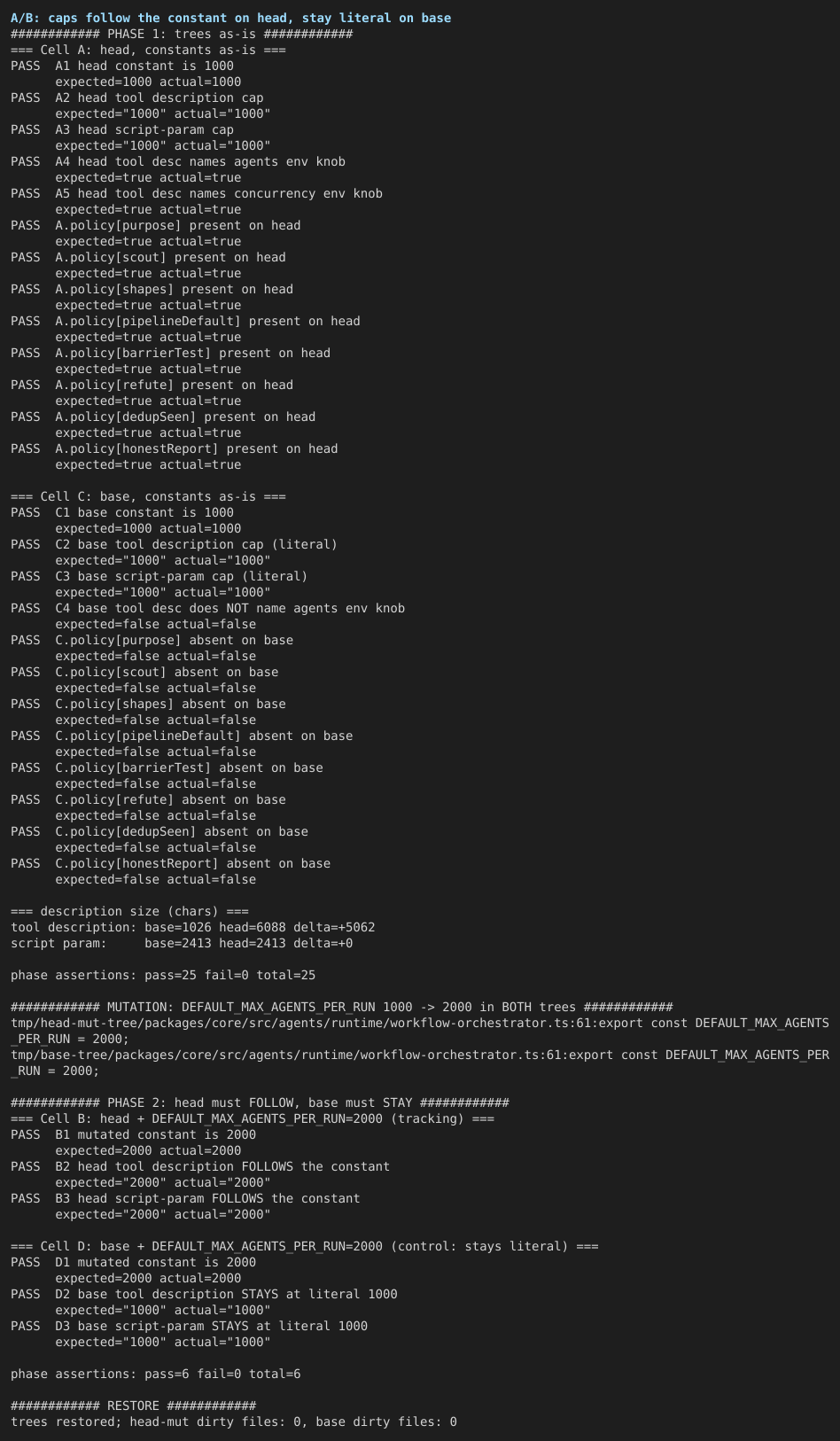
Sandboxed verification: ✅ passed — merge-ready (agent verdict) - workflow run Ran the PR in an isolated, token-free container: A/B against the base build, mock-free harness assertions, targeted gates. Advisory evidence for human reviewers — not a review, an approval, or a CI check. Scripted assertions: 260 passed · 0 failed · 260 total 中文 — 判定:✅ 通过 · 可合入(agent 判定)沙箱验证在隔离、无凭证的容器中执行了该 PR 的代码(与 base 构建 A/B 对照、无 mock harness 断言、定向门禁)。仅作为评审证据,不构成评审、批准或 CI 检查。 脚本断言:260 通过 · 0 失败 · 260 总计 Verification reportVerify PR #8694 — feat(workflows): add an orchestration policy layer to the Workflow tool descriptionVerdict: 中文摘要
Central claim + A/BCentral claim: the tool description now carries an orchestration policy layer on top of the runtime facts, and the model-visible caps/env-knobs in both description halves are derived from the orchestrator's exported constants, so raising a cap moves every copy at once (no hand-synced prose). The load-bearing proof is the tracking flip: raise
Flip: 2 cells change from stale-literal (base) to tracking (head). 31/31 A/B assertions passed. The same harness also measured the accepted tradeoff: tool description 1026 → 6088 chars (+5062 ≈ 1.3k tokens at ~4 chars/token); the Capability preservation (reviewer test plan). Symmetric census of 12 phrasing-robust capability facts (parallel/pipeline signatures, concurrency formula, agent cap, per-call options, resume/journal cache, background-tasks + Corrections
FindingsNo blocking findings. Two observations, both accepted/pinned by the PR itself:
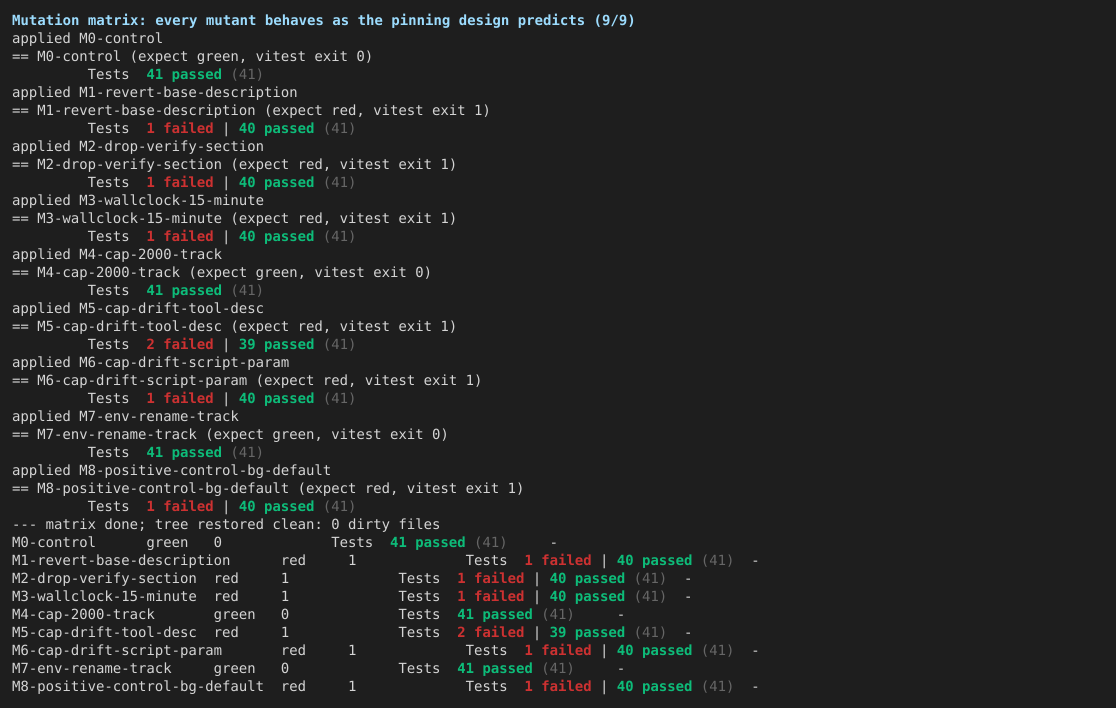
Mutation matrix + vacuity (9/9 as predicted)Witness:
M1 reached the intended assertion (expected-vs-actual quoted above), satisfying the vacuity rule; M8 proves the harness can red an unrelated pre-existing test. No survivor went unclassified. Description accuracy (15/15)Every hand-synced literal and named knob checked against the real runtime source: cap=1000, both env knobs read by Not covered
MethodologyEnvironment: CI Evidence images
Harness scripts and raw logs are in the workflow run artifacts (7-day retention). — Qwen Code · sandboxed verification |

qwen-code-ci-bot
left a comment
qwen-code-ci-bot
left a comment
There was a problem hiding this comment.
LGTM, looks ready to ship. ✅
Resolves the one conflict, packages/core/src/tools/workflow/workflow.test.ts,
by keeping both sides: main's QwenLM#8694 description/policy anchors and this
branch's manifest-seeded preflight-cancellation test.
|
Released in v0.21.9. |
3 participants


What this PR does
Rewrites the
Workflowtool description so it carries an orchestration policy layer on top of the runtime facts it already stated. Every capability fact from the previous text is preserved — concurrency window, agent ceiling, per-call options, resume semantics, the background-tasks and/workflowssurfaces, the sandbox boundary — and the environment variables that override the limits are now named inline. On top of that the description explains what a workflow is actually for, tells the model to scout the work list in the main loop before orchestrating over it, makes staggered per-item pipelining the default while spelling out the narrow cases where a synchronizing barrier is genuinely required, describes how to verify a subagent's answer instead of believing it, gives the deduplication rule that keeps unknown-size discovery loops terminating, and asks for honest reporting when a run bounds its own coverage.This is prompt text only. No runtime, sandbox, orchestrator, or schema behavior changes.
Why it's needed
The runtime is already capable, but a model that is only handed the API reliably picks the naive shape: fan everything out through a single barrier, take the first answer at face value, and stop. That pays barrier latency on stages that never needed synchronizing, and lets plausible-but-wrong subagent findings through unchallenged. Nothing in the description previously pushed against either failure, so the quality of an orchestration depended entirely on whatever the model happened to improvise.
A test pins the load-bearing claims so a future edit cannot quietly reduce the description back to a capability list — there is no other signal that would catch it.
Reviewer Test Plan
How to verify
Read the new description as if you were the model deciding how to structure a fan-out: it should tell you when not to orchestrate at all, why per-item pipelining beats a barrier by default, and what to do with a finding before reporting it. Then confirm nothing regressed on the capability side — the concurrency default, the 1000-agent ceiling, the per-call options,
resumeFromRunId,run_in_background, and the sandbox statement should all still be present and unchanged in meaning.Unit tests for the tool:
cd packages/core && npx vitest run src/tools/workflow/workflow.test.ts— 40 passed locally, including the new description test.Evidence (Before & After)
N/A — not user-visible; the description is read by the model, not rendered in the TUI.
Tested on
Environment (optional)
Unit tests only.
Risk & Scope
Linked Issues
Closes #8690
中文说明
这个 PR 做了什么
重写
Workflow工具描述,在原有的运行时事实之上补齐编排策略层。此前文本中的每一条能力事实都被保留——并发窗口、agent 上限、按调用的选项、恢复语义、后台任务视图与/workflows界面、沙箱边界——并且把覆盖这些上限的环境变量就地写明。在此之上,描述还解释了 workflow 究竟是为什么而存在,要求模型先在主循环里侦察出工作清单再对其编排,把逐项错峰的 pipeline 定为默认并写清哪些情形才真正需要同步 barrier,说明如何验证子 agent 的答案而不是直接采信,给出让未知规模的发现循环得以终止的去重规则,并要求在一趟扫描自我设限时如实汇报。纯提示词改动。运行时、沙箱、orchestrator、schema 的行为均无变化。
为什么需要
运行时本身已经够用,但只拿到 API 的模型必然选最朴素的形状:一个 barrier 一把梭,直接采信第一个答案,然后收工。这既在根本不需要同步的阶段上付出 barrier 延迟,也让"看着合理其实是错的"子 agent 结论毫无阻拦地通过。此前的描述对这两种失败模式都没有任何约束,一次编排的质量完全取决于模型临场发挥。
新增的测试锚定了几条承重论断,避免日后的编辑把描述悄悄退回成一份能力清单——除此之外没有任何信号能发现这种退化。
评审验证计划
如何验证
以"模型正在决定如何组织扇出"的视角读一遍新描述:它应当告诉你什么时候根本不该编排、为什么默认逐项 pipeline 优于 barrier、以及一条发现在上报之前该做什么。然后确认能力侧没有退化——并发默认值、1000 agent 上限、按调用的选项、
resumeFromRunId、run_in_background以及沙箱声明都应仍然存在且语义不变。工具单测:
cd packages/core && npx vitest run src/tools/workflow/workflow.test.ts——本地 40 项通过,含新增的描述测试。证据(前后对比)
N/A——非用户可见;该描述由模型读取,不在 TUI 中渲染。
测试环境
运行环境(可选)
仅单元测试。
风险与范围
关联 Issue
Closes #8690