fix(security): honor explicit distrust over inherited trust - #8628
Conversation


 qwen-code-ci-bot
left a comment
qwen-code-ci-bot
left a comment
qwen-code-ci-bot
left a comment
There was a problem hiding this comment.
Thanks for the PR, @daleselaji-dev! We can't take this into review yet: the description doesn't follow the pull request template — none of the required headings are present.
What's missing:
## What this PR doesand## Why it's needed## Reviewer Test Planwith### How to verify,### Evidence (Before & After), and the### Tested onOS table## Risk & Scope## Linked Issues- The Chinese
<details>translation of the description
Your current description (Problem / Solution / Testing / ...) already covers similar ground, so this is mostly reorganizing content you have: port it into the template, fill the Tested-on table with the environments you actually ran, and keep the note that ESLint/typecheck could not run locally. Then push again (or a maintainer can re-run triage with @qwen-code /triage) and the review continues from there.
中文说明
感谢提交 PR,@daleselaji-dev!目前还无法进入评审:PR 描述未遵循 PR 模板——全部必需标题均缺失。
缺失内容:
## What this PR does与## Why it's needed## Reviewer Test Plan,含### How to verify、### Evidence (Before & After)及### Tested on操作系统表格## Risk & Scope## Linked Issues- 描述内容的中文
<details>翻译
现有描述(Problem / Solution / Testing 等)已涵盖类似内容,主要是把已有内容按模板重新组织:请填入模板,在 Tested-on 表格中标注实际测试过的环境,并保留"本地未能运行 ESLint/typecheck"的说明。完成后重新推送(或请维护者使用 @qwen-code /triage 重新运行分诊),评审将继续进行。
— Qwen Code · qwen3.8-max
qwen-code-ci-bot
left a comment
qwen-code-ci-bot
left a comment
There was a problem hiding this comment.
Not reviewed: build-and-test — tmux-testing was skipped in CI and its suite did not run locally.
Not reviewed: build-and-test — verify was skipped in CI and its suite did not run locally.
Not reviewed: reverse audit — stopped before round 3 by the review time budget.
— qwen3.8-max via Qwen Code /review (v0.21.6)
| for (const trustedPath of trustedPaths) { | ||
| for (const locationVariant of locationVariants) { | ||
| for (const trustedVariant of getPathComparisonVariants(trustedPath)) { |
There was a problem hiding this comment.
[Critical] This fix only wins for a DO_NOT_TRUST rule on the exact workspace path. Any workspace inside a distrusted folder is still evaluated as trusted via the ancestor TRUST_FOLDER rule, because the distrust check matches only by exact variant equality (unchanged here and in isPathTrustedFastPath) — so the vulnerability reported in the linked issue remains reachable one directory deeper. Verified end-to-end with a live probe: with rules TRUST_FOLDER /projects + DO_NOT_TRUST /projects/evil-repo, isPathTrusted('/projects/evil-repo/packages/app') returns true, and bootstrapServeFastPathEnvironment run from that descendant workspace loads the distrusted repo's .env and adopts QWEN_SERVER_TOKEN (the exact distrusted path itself is correctly denied). The issue's stated principle is "most-specific rule wins", and the issue thread's containment argument (distrust must match by containment — a prerequisite, not a follow-up) is unrebutted. The PR description scopes the change to exact-workspace distrust, which documents the limitation but does not remove the traced harm. — Failure scenario: rules TRUST_FOLDER on /projects and DO_NOT_TRUST on /projects/evil-repo; user runs qwen serve from /projects/evil-repo/packages/app (a common monorepo shape) → the exact-equality distrust check misses, this ancestor-trust loop matches via isWithinRoot, the repo-controlled .env is loaded and QWEN_SERVER_TOKEN is injected — the exact outcome the issue describes.
Suggested fix: match DO_NOT_TRUST by containment (or resolve by most-specific/deepest matching rule) in isPathTrusted, isPathTrustedFastPath, and getExplicitTrustLevel together, with regression tests for a descendant workspace both with and without a covering ancestor trust rule. If exact-path-only semantics are the deliberate maintainer decision, please state that in the PR and the issue thread, since it contradicts the thread's prerequisite analysis.
— qwen3.8-max via Qwen Code /review (v0.21.6)
| const locationVariants = getPathComparisonVariants(location); | ||
| for (const rule of rules) { | ||
| if (rule.level !== 'trusted') continue; | ||
| if (rule.level !== 'untrusted') continue; |
There was a problem hiding this comment.
[Suggestion] The trust precedence policy is hand-encoded as loop order in three places — isPathTrustedFastPath here, LoadedTrustedFolders.isPathTrusted, and getExplicitTrustLevel — so this precedence change had to be hand-repeated in each, and every future policy change must be too. This PR is evidence the policy does change (the old order was a security bug). — Concrete cost: a future precedence change applied to trustedFolders.ts but missed in this file (whose name advertises settings plumbing, not trust evaluation) means qwen serve decides whether to load a workspace's .env and settings.json under a different policy than the interactive CLI reports — loading environment from a workspace the updated rules consider untrusted. The duplicated scenario tests in fast-path.test.ts catch a one-site miss today; the standing cost is the repetition plus relying on remembering the second site exists.
Suggested fix: extract the pure decision procedure into one dependency-light function beside path-comparison.ts (both files already import from there, so the fast path keeps its cheap startup), or at minimum add a parity test that runs both resolvers over a shared table of precedence scenarios so drift fails mechanically rather than by convention.
— qwen3.8-max via Qwen Code /review (v0.21.6)
| trustLevel === TrustLevel.DO_NOT_TRUST && | ||
| arePathsEquivalent(workspaceCwd, rulePath) |
There was a problem hiding this comment.
[Suggestion] This precedence flip makes the source === 'file' branch of the "This folder is still trusted because a parent folder is trusted." warning in useTrustModify.updateTrustLevel (packages/cli/src/ui/hooks/useTrustModify.ts:86-89) unreachable, and its test (useTrustModify.test.ts, 'still trusted by parent') now passes only by mocking { isTrusted: true, source: 'file' } — a state the implementation can no longer produce. Probe-verified: a file-source preview with [cwd]: DO_NOT_TRUST can now only return untrusted; isTrusted: true is reachable only with source: 'ide' or source: undefined. — Concrete cost: a maintainer reading the hook or its test concludes an exact DO_NOT_TRUST can be overridden by an ancestor's trust — the opposite of the security semantics this PR establishes; under a future parent-grant-priority regression this stale branch and test would mask the bug instead of catching it.
Suggested fix: drop the if (source === 'file') override (the IDE message is the only remaining reachable case) and update/remove the 'still trusted by parent' test to assert the new behavior (no warning; pending change + restart).
— qwen3.8-max via Qwen Code /review (v0.21.6)
| for (const trustedPath of trustedPaths) { | ||
| for (const locationVariant of locationVariants) { | ||
| for (const trustedVariant of getPathComparisonVariants(trustedPath)) { |
There was a problem hiding this comment.
[Suggestion] The diff also changes the DO_NOT_TRUST-vs-TRUST_PARENT precedence winner (here, in getExplicitTrustLevel, and in the fast path), but no test pins that combination — only the DO_NOT_TRUST-vs-TRUST_FOLDER shape is tested. Verified empirically: a mutant restoring parent-grant priority passes all 126 trust-related tests while isPathTrusted('/a/b') with rules {'/a/b': DO_NOT_TRUST, '/a/b/sub': TRUST_PARENT} flips from false to true. — Failure scenario: such a regression sails through the whole suite green, and on the qwen serve fast path it loads the .env/settings of the explicitly distrusted workspace into the server process — the exposure this PR fixes.
Suggested fix: add one case per implementation, e.g. in trustedFolders.test.ts: mockRules['/home/user/projectA'] = TrustLevel.DO_NOT_TRUST; mockRules['/home/user/projectA/child/marker'] = TrustLevel.TRUST_PARENT; with mockCwd = '/home/user/projectA' → expect {isTrusted: false, source: 'file'}; mirror in fast-path.test.ts by adding a TRUST_PARENT rule pointing inside the distrusted nested workspace and keeping the QWEN_SERVER_TOKEN undefined expectation.
— qwen3.8-max via Qwen Code /review (v0.21.6)
| trustLevel === TrustLevel.DO_NOT_TRUST && | ||
| arePathsEquivalent(workspaceCwd, rulePath) |
There was a problem hiding this comment.
[Suggestion] The /trust dialog's inherited-trust note (packages/cli/src/ui/components/TrustDialog.tsx:88-95) still asserts the precedence this PR removes: it tells the user the folder "will remain trusted even if you set a different trust level here" and to modify the parent instead — no longer true for the "Don't trust" choice. A/B probe-verified against the merge base: pre-PR the note's claim held (a DO_NOT_TRUST preview stayed trusted); on this PR the same preview returns untrusted while the note still renders and contradicts the shipped behavior. (The IDE variant of the note remains accurate — IDE trust still overrides file rules.) — Failure scenario: with TRUST_FOLDER on /home/user/projects, a user opens /home/user/projects/myapp and runs /trust wanting to distrust only myapp; the note says that is impossible, so they set the parent to DO_NOT_TRUST — stripping trust from every sibling project — or give up, even though selecting "Don't trust" in the dialog would in fact work under the new precedence.
Suggested fix: reword the parent-inheritance note to carve out the new behavior, e.g. "This folder behaves as trusted because a parent folder is trusted. Setting 'Don't trust' here overrides that for this folder only; other trust levels keep inheriting from the parent."
— qwen3.8-max via Qwen Code /review (v0.21.6)


|
Thanks for picking this up, @daleselaji-dev — the direction is exactly what #8627 asked for, and splitting The gapThe PR reorders the checks but doesn't change how they match. Distrust still matches by exact path equality ( Real repos have subdirectories, and users it('POC: subdir of an explicitly untrusted workspace still loads its env', async () => {
delete process.env['QWEN_SERVER_TOKEN'];
const qwenHome = useTempQwenHome();
tempWorkspace = realpathSync(
mkdtempSync(join(os.tmpdir(), 'qws-fast-path-trust-poc-')),
);
const evilRepo = join(tempWorkspace, 'evil-repo');
const subDir = join(evilRepo, 'packages', 'foo');
mkdirSync(subDir, { recursive: true });
writeFileSync(
join(qwenHome, 'settings.json'),
JSON.stringify({ security: { folderTrust: { enabled: true } } }),
);
process.env['QWEN_CODE_TRUSTED_FOLDERS_PATH'] = join(
qwenHome,
'trustedFolders.json',
);
writeFileSync(
process.env['QWEN_CODE_TRUSTED_FOLDERS_PATH'],
JSON.stringify({
[tempWorkspace]: TrustLevel.TRUST_FOLDER,
[evilRepo]: TrustLevel.DO_NOT_TRUST,
}),
);
writeFileSync(join(evilRepo, '.env'), 'QWEN_SERVER_TOKEN=attacker\n');
await bootstrapServeFastPathEnvironment(subDir);
expect(process.env['QWEN_SERVER_TOKEN']).toBeUndefined();
});With this PR applied:
The PR description names this ("broader descendant containment is outside this PR") — I just don't think that line can be drawn here, because descendant containment is the vulnerability. Please don't just widen distrust to
|
🩺 serve daemon A/BBuilt the PR base vs this PR head ✅ No response changes against the PR base across 4 scenario(s). — Qwen Code · serve A/B |

|
Following up on my earlier review with a concrete proposal, @daleselaji-dev — I prototyped the "most-specific rule wins" direction locally to check it actually holds up before asking you to build it. I'm deliberately not opening a competing PR: this is yours, and I'd rather you fold whatever is useful into it than have two PRs racing. Sketch below, take or leave any of it. The shape that workedOne resolver, in a new leaf module export type TrustRuleLevel = 'trusted' | 'untrusted';
export interface TrustPrecedenceRule<TPayload = undefined> {
readonly level: TrustRuleLevel;
readonly variants: ReadonlySet<string>; // pre-computed by getPathComparisonVariants
readonly payload?: TPayload; // e.g. the original TrustLevel
}
export function resolveTrustRule<TPayload>(
rules: Iterable<TrustPrecedenceRule<TPayload>>,
locationVariants: ReadonlySet<string>,
): TrustPrecedenceRule<TPayload> | undefined;
export function resolveTrustDecision(
rules: Iterable<TrustPrecedenceRule<unknown>>,
locationVariants: ReadonlySet<string>,
): boolean | undefined;Of every rule whose path contains the location, the deepest one decides; distrust wins exact ties. Two details that turned out to matter:
Four call sites delegate to it: The consequence to decide on deliberatelyDescendants of a It does mean two existing tests need updating, and they're worth updating with a comment rather than quietly:
It also changes UX: Note that Tests worth pinningBoth directions, so nobody later "simplifies" this back into a one-directional fix:
Where I got toLocally: 135/135 on 中文接着之前的评审补充一个具体方案,@daleselaji-dev —— 我在本地把"最具体规则优先"的方向做了原型验证,确认可行后再来请你实现。我特意没有另开一个竞争性的 PR:这个 PR 是你的,我更希望你把其中有用的部分吸收进去,而不是两个 PR 并行。以下是草案,采纳与否随你。 可行的形态一个统一的解析器,放在新的叶子模块 在所有路径包含该 location 的规则中,最深的那条决定结果;精确相等时不信任优先。 有两个细节事后证明很关键:
有四处调用点委托给它: 需要明确决策的一个后果
这意味着有两个现有测试需要更新,并且值得加注释说明,而不是悄悄改掉:
它同时也改变了交互行为: 另外 值得固化的测试覆盖两个方向,以免日后有人把它"简化"回单向修复:
我这边的进展本地结果: |


 qqqys
left a comment
qqqys
left a comment
qqqys
left a comment
There was a problem hiding this comment.
本 PR 引入的 CI 失败:Test (ubuntu-latest, Node 22.x) 红,阻塞合并。
位置
packages/cli/src/ui/components/TrustDialog.tsx:88-95—— 本 PR 把isInheritedTrustFromParent分支的提示文案整段改写为「Note: This folder currently inherits trust from a parent folder. A more-specific trust rule here can override that decision.」packages/cli/src/ui/components/TrustDialog.test.tsx:96—— 该断言仍是旧文案「Note: This folder behaves as a trusted folder because one of the parent folders is trusted.」,本 PR 未改到这个文件(gh pr diff 8628 --name-only里没有它)。
触发条件
TrustDialog.test.tsx > should display the inherited trust note from parent 渲染对话框后 waitFor 断言 lastFrame() 包含旧文案,实际渲染出的是新文案,waitFor 超时后失败。
影响
Test (ubuntu-latest, Node 22.x) 失败,阻塞合并。不是既有失败也不是偶发:
FAIL  src/ui/components/TrustDialog.test.tsx > TrustDialog > should display the inherited trust note from parent
AssertionError: expected '╭───…' to contain 'Note: This folder behaves as a truste…'
Tests  1 failed | 18357 passed | 22 skipped (18380)
当前 head 49e4095 的 run 31236322379 里全仓库仅此一个失败用例;main 上 TrustDialog.tsx:91-95 仍是旧文案,与该断言一致,所以这个失败只来自本 PR。
修复方向
把 TrustDialog.test.tsx:96 的断言同步成新文案(建议只断言稳定片段,例如 'currently inherits trust from a parent folder',避免 Ink 换行把整句拆开导致 toContain 再次误伤)。同一文件第 118 行的 IDE 分支断言不受影响,isInheritedTrustFromIde 的文案本 PR 没改,不用动。

|
@qwen-code /review |

| _Qwen Code review request accepted. Review is queued in [workflow run](https://github.com/QwenLM/qwen-code/actions/runs/31246158860)._ |

 yiliang114
left a comment
yiliang114
left a comment
yiliang114
left a comment
There was a problem hiding this comment.
Re-reviewed the current head (49e4095). The original Critical is fixed: the regular resolver, serve fast path, daemon effective decision, and daemon explicitTrustLevel now share the same deepest-rule policy; descendant DO_NOT_TRUST stays untrusted, while a more-specific trusted child can opt back in. I did not find another reachable code-path blocker in this revision.
The remaining merge blocker is the TrustDialog assertion mismatch already reported by @qqqys: CI is red with 18,357 passed / 1 failed / 22 skipped. One additional cleanup before merge: the PR body is now stale—it still describes an exact-workspace-only fix and says descendant containment is out of scope, while the current head deliberately changes descendant semantics, centralizes the policy, updates daemon reporting, and changes the /trust copy. Could you update the description and test evidence when fixing that assertion? #8643 remains a separate issue.
|
@qwen-code /review |

…ording

This PR changed the isInheritedTrustFromParent note in TrustDialog.tsx
but the test still asserted the old copy, failing Test (ubuntu-latest,
Node 22.x). Assert the stable fragment instead of the full sentence so
Ink line wrapping cannot break toContain.

Suggested-by: @qqqys in QwenLM#8628 (review)
yiliang114
left a comment
yiliang114
left a comment
There was a problem hiding this comment.
LGTM. I verified at 49e4095 that the original critical is fixed: the regular resolver, the serve fast path, the daemon's effective decision, and the daemon's explicitTrustLevel all share the same deepest-rule policy — a descendant DO_NOT_TRUST stays untrusted, while a more-specific trusted child can opt back in, and I found no other reachable code-path blocker. The only merge blocker left was the TrustDialog assertion still expecting the old wording; f20816b syncs it — that one is a maintainer commit I pushed (branch allows maintainer edits) following @qqqys's suggestion to assert the stable fragment, since the branch had been quiet for days. This run is green. Nothing blocks merge.

原问题已在 f20816b 修复:packages/cli/src/ui/components/TrustDialog.test.tsx:96 的断言已由整句旧文案改为稳定片段 'currently inherits trust from a parent folder',与 TrustDialog.tsx:88-95 的新文案一致;当前 head 上 Test (ubuntu-latest, Node 22.x) 已为 SUCCESS。解除本条 CHANGES_REQUESTED,不代表对本 PR 的整体批准。
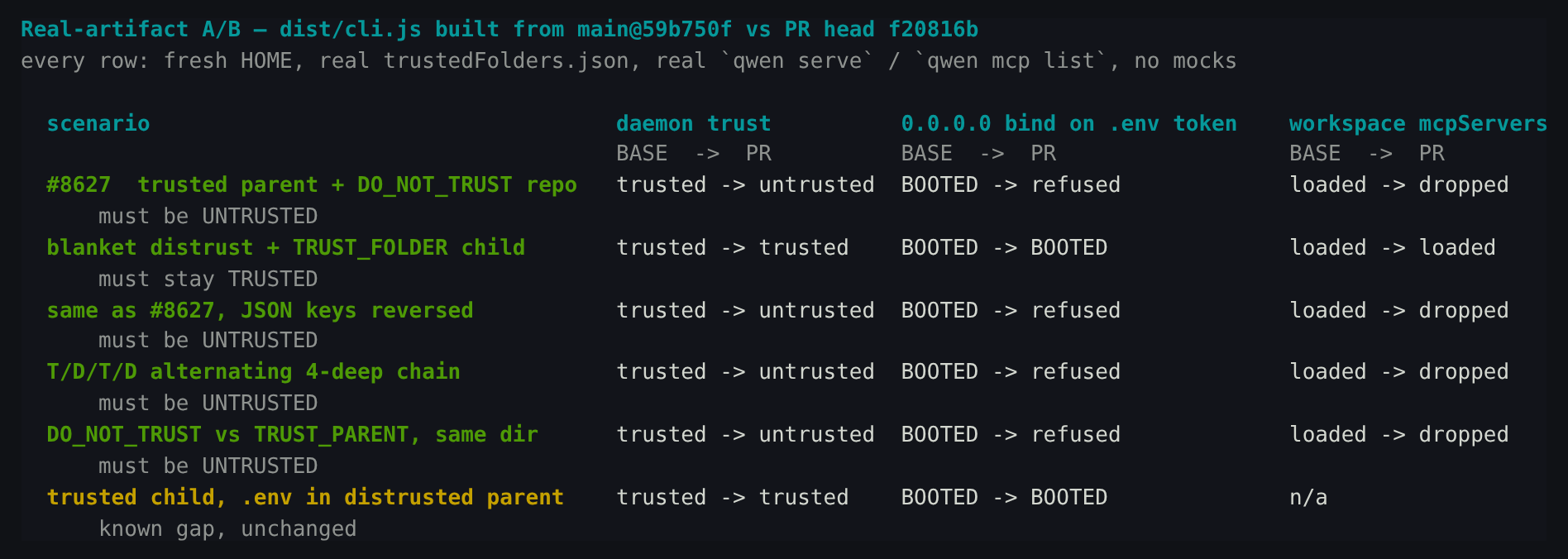
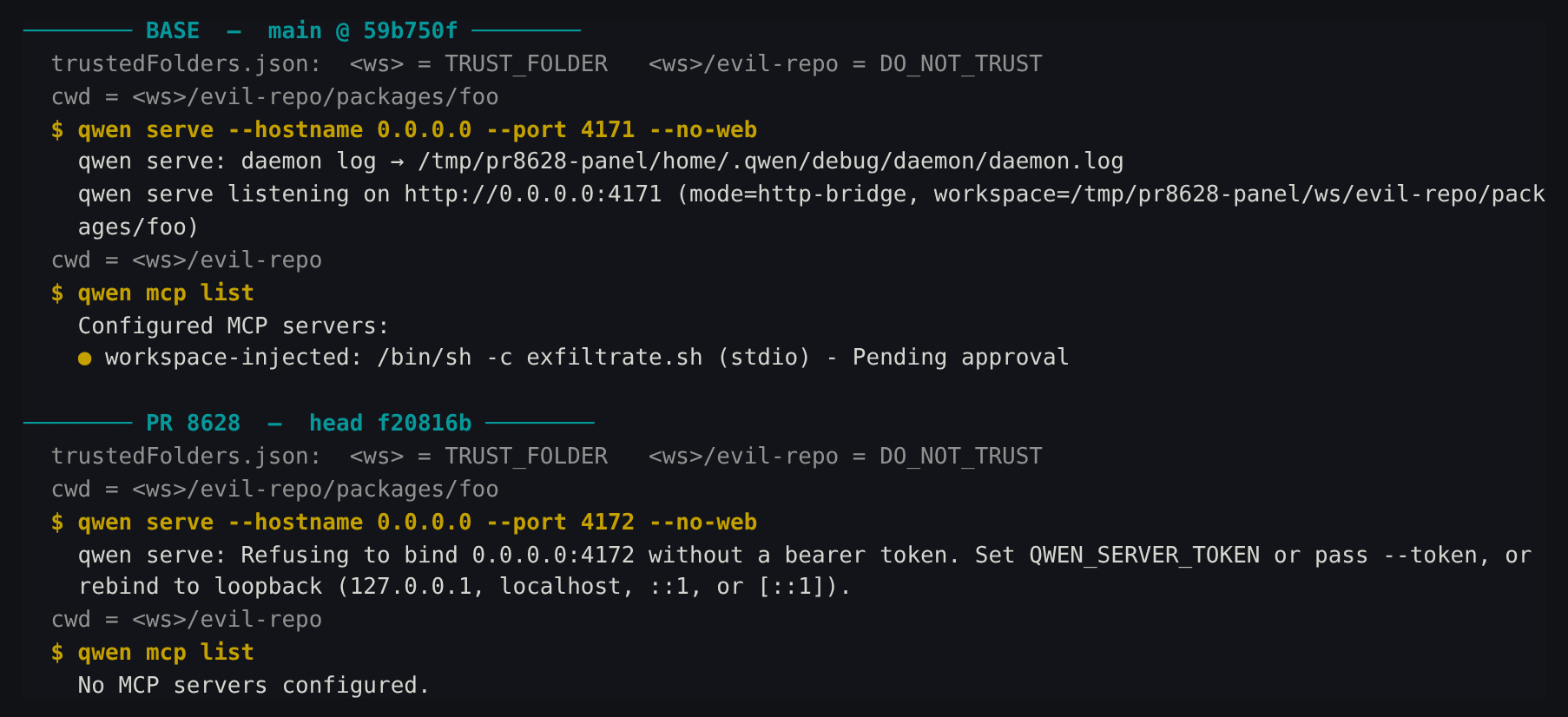
Verification report — built and ran this locally, real artifacts, no mocksVerdict: the fix does what it claims, in both directions, on real binaries. I found nothing that blocks the merge. Three things below are worth a deliberate reviewer decision rather than discovery-after-merge, and one follow-up needs its scope widened by one file. I built Artifact-level sanity check that the two builds really differ as intended: What I confirmed
S2 is the one that matters most for "don't just widen distrust to The #8627 bypass, before and after
Two independent consequences, both on real binaries:
The daemon agrees with both loaders: The
|
| # | 布局 | 期望 | 结果 |
|---|---|---|---|
| S1 | <ws> TRUST_FOLDER + <ws>/evil-repo DO_NOT_TRUST,从 evil-repo/packages/foo 启动 |
不可信 | ✅ trusted → untrusted |
| S2 | <ws> DO_NOT_TRUST + <ws>/good-repo TRUST_FOLDER |
保持可信 | ✅ trusted → trusted |
| S3 | 与 S1 相同,但 trustedFolders.json 键顺序反转 |
不可信 | ✅ trusted → untrusted |
| S4 | 4 层深度上 T/D/T/D 交替 |
不可信 | ✅ trusted → untrusted |
| S5 | DO_NOT_TRUST 对上解析到同一目录的 TRUST_PARENT |
不可信(平局时不信任优先) | ✅ trusted → untrusted |
S2 是"不要简单把不信任改成 isWithinRoot"这一点上最关键的场景:整体不信任 + 局部显式放行仍然可用,且在 base 与 PR 上表现完全一致,因此它确实是一个无回归护栏,而不是行为变更。
#8627 绕过:修复前后
两个相互独立的后果,均在真实二进制上验证:
- 非 loopback 启动守卫。 磁盘上唯一的
QWEN_SERVER_TOKEN就是不可信仓库.env里的那一个。base 会采用它并顺利绑定0.0.0.0;此后守护进程只认攻击者的 token —— 我必须发送Authorization: Bearer attacker-supplied-token才能从GET /workspace/trust拿到 200,这一点本身就是证据。PR 上守护进程拒绝启动。 - 工作区
mcpServers。qwen mcp list在 base 上加载了仓库提供的 MCP server,在 PR 上被丢弃。这走的是完整的loadSettings()路径而非 fast path ——settings.ts:1048是isWorkspaceTrusted(...).isTrusted ?? true,所以旧的undefined判定等价于可信。这个?? true正说明undefined → false是修复本身,而不是副作用。
守护进程与两个加载器的判定一致:PR 上 GET /workspace/trust 在 evil-repo 和 evil-repo/packages/foo 都返回 effective.state: untrusted, source: file,base 上返回 trusted。这说明第四份策略副本(daemon-trust-policy.ts)现在与另外三处得出了相同答案。
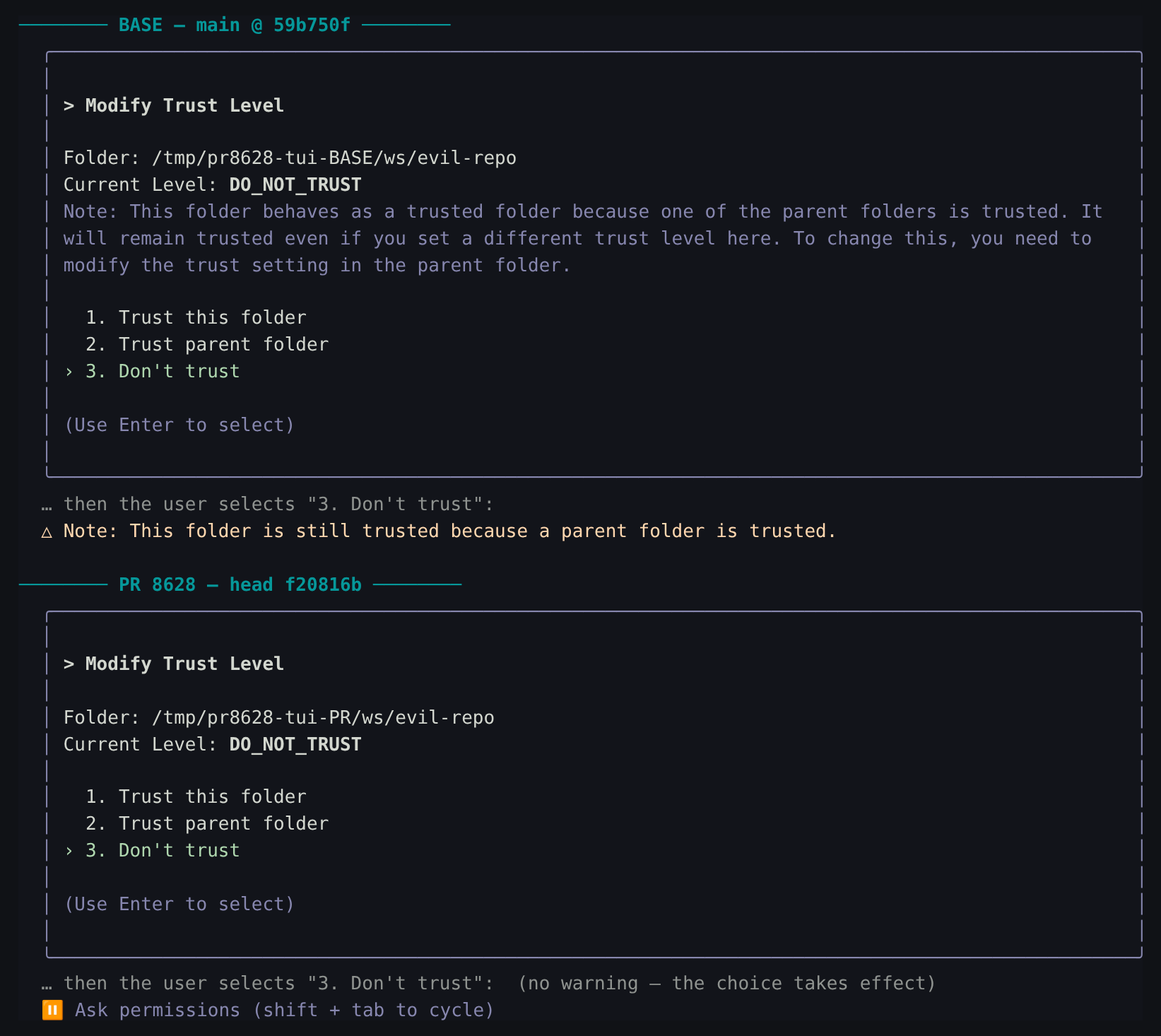
真实 TUI 中的 TrustDialog 文案
通过 tmux 在 <ws>/evil-repo 驱动真实 TUI。base 告诉用户他的 DO_NOT_TRUST 设置无效,并且随即证明了这一点 —— 选择"Don't trust"后弹出 Note: This folder is still trusted because a parent folder is trusted.,会话仍停留在 Auto mode。PR 上该提示消失,选择静默生效,底栏变为 ⏸ Ask permissions。useTrustModify 按原始 key 读取 folders.user.config[cwd],因此两侧的 Current Level: DO_NOT_TRUST 都正确未变。
PR 描述中标注为未验证的检查项
描述里说作者的 sparse checkout 无法运行 ESLint 与 CLI typecheck。我在完整 npm ci 的 head 检出上跑了:
npm run typecheck --workspace=packages/cli(tsc --noEmit)—— 通过- 对全部 6 个改动源文件执行
npx eslint—— 通过 npm run check:serve-fast-path-bundle—— "Startup bundle closure checks passed." 这是我最想看到的一项:trust-precedence.ts现在是fast-path-settings.ts的静态导入,该守卫确认它没有把任何新东西拖进 pre-listen 闭包。叶子模块的约束成立。- head 上的定向测试套件:
trust-precedence+trustedFolders+daemon-trust-policy+fast-path+TrustDialog+useTrustModify+useFolderTrust= 169/169 通过。 - 同样这些测试文件跑在 base 源码上:3 个套件共 8 个失败。说明新增测试确实钉住了新行为。值得一提的是
allows a trusted child rule to override an untrusted parent在 base 上也通过 —— 这是对的,它是护栏而非变更。 - 500 条规则的极端
trustedFolders.json下的启动开销(解析器不再在首个可信匹配处提前返回):base 321 ms vs PR 328 ms,5 次qwen mcp list的均值。属于噪声。
我还验证了深度度量最可能出错的场景:可信子树内的一个符号链接指向被显式不信任的仓库(<ws>/sub/deep 在深度 3 可信,<ws>/evil 在深度 1 不可信,<ws>/sub/deep/x → <ws>/evil,从符号链接进入)。PR 判定为不可信,因为两个 env 加载器都会先对起始目录做 realpathSync,字面符号链接路径根本到不了深度比较那一步。base 判定为可信。结果是好的,但它依赖的是上游那次 realpathSync 而非解析器本身 —— 建议在 trust-precedence.ts 里加一句注释,以免日后被人移除。
发现的问题
1. 被推迟的 .env 漏洞存在于两个文件中,后续 issue 需要覆盖两处
@yiliang114 的评审指出 findEnvFilesFastPath 只针对起始目录计算一次 isTrusted,然后把这个布尔值应用到向上遍历中找到的每个候选(fast-path-settings.ts:152 → :162 的 canUseEnvFile),并正确地把它排除在本 PR 之外。完整加载器里存在形状完全相同的代码: environment.ts:215 → :225 的 canUseEnvFile。只修 fast path 会让交互式 CLI 继续暴露。
在真实二进制上复现,base 与 PR 表现完全一致(因此属于既有问题,不是回归,也不阻塞合并):
<ws>            DO_NOT_TRUST
<ws>/good-repo  TRUST_FOLDER
<ws>/.env       QWEN_SERVER_TOKEN=...   OPENAI_MODEL=model-from-DISTRUSTED-parent
cwd = <ws>/good-repo/src
- fast path:
qwen serve --hostname 0.0.0.0成功启动,采用了不可信父目录的 token —— base 与 PR 相同。 - 完整加载器:TUI 头部渲染出
API Key | model-from-DISTRUSTED-parent—— base 与 PR 相同。
值得指出的是,本 PR 让这个形状变得更常见而非更少见:S2(DO_NOT_TRUST 父目录 + TRUST_FOLDER 子目录)现在是有专门测试的一等支持配置,而这恰恰就是该漏洞会命中的配置。
2. DO_NOT_TRUST 目录的后代不再弹窗询问 —— 建议明确签署这一点
useFolderTrust.ts:31 是在 trusted === undefined 时打开信任对话框。后代现在解析为 false,因此这些目录不再询问,而是被静默按不可信处理。@yiliang114 已经论证过这是正确的("用户已经说了不信任这个仓库"),我同意 —— 我提出来只是因为它对用户可见,日后很容易被当成 bug 报上来。我验证了实际行为确实如此,并且没有任何规则命中的目录仍然返回 undefined、仍然会弹窗。
3. explicitTrustLevel 现在会报告继承来的级别(低优先级,仅命名/文档)
getExplicitTrustLevel 返回胜出规则的 payload,而它可能来自祖先目录。在 <ws>/evil-repo/packages/foo(本身没有任何规则)上,守护进程现在报告 explicitTrustLevel: "DO_NOT_TRUST"。这并非新引入的错误:base 在同一路径上就已经泄漏祖先规则,报告的是 "TRUST_FOLDER",因为旧的可信轮次本来就是包含匹配。本 PR 让它变得对称,是个改进。但这个字段名叫 explicit,而且是公开接口(GET /workspace/trust、v2 状态里的 configured.explicitTrustLevel、以及 packages/sdk-typescript 中的 DaemonWorkspaceTrustLevel),UI 完全可能把它理解成"这个目录上有一条规则"。给 getExplicitTrustLevel 加一段文档注释,或改名为 decidingTrustLevel 之类,就能堵住这个歧义。TUI 不受影响:useTrustModify 读的是原始配置 key。
复现方式
git fetch origin pull/8628/head:pr-8628 && git worktree add wt-8628 pr-8628
cd wt-8628 && npm ci && npm run build && npm run bundle   # PR 构建 -> dist/

mkdir -p /tmp/h/.qwen /tmp/ws/evil-repo/packages/foo
echo '{"security":{"folderTrust":{"enabled":true}}}' > /tmp/h/.qwen/settings.json
cat > /tmp/h/.qwen/trustedFolders.json <<'JSON'
{ "/tmp/ws": "TRUST_FOLDER", "/tmp/ws/evil-repo": "DO_NOT_TRUST" }
JSON
echo 'QWEN_SERVER_TOKEN=attacker-supplied-token' > /tmp/ws/evil-repo/.env

cd /tmp/ws/evil-repo/packages/foo
HOME=/tmp/h node <wt>/dist/cli.js serve --hostname 0.0.0.0 --port 4171 --no-web
# base: "listening on http://0.0.0.0:4171"   PR: "Refusing to bind 0.0.0.0:4171 ..."
base 一侧把这 10 个文件回退到 59b750f 后重新构建即可 —— 树里其他内容保持完全一致,这正是 A/B 可信的原因。
给复现者两个 harness 提示:一旦守护进程采用了工作区 .env 里的 token,未认证的 GET /workspace/trust 会返回 401;如果只轮询 res.ok,看起来就像"守护进程没起来" —— 应该带上预埋的 token 重试,而它接受哪个 token 本身就是证据。另外,工作区设置是从 <cwd>/.qwen/settings.json 读取的、不向上查找,而 .env 发现会向上遍历 —— 所以设置探针和 env 探针必须从不同目录运行,才能分别覆盖精确路径与后代路径。
总体评价
这次重构达成了评审的要求:一个解析器、四处调用点、双向覆盖、与顺序无关,误导性的对话框文案也修好了。它在 fast path、完整设置加载器、守护进程 HTTP 接口和 TUI 上都经受住了真实二进制的检验。上面三点分别是后续 issue 的范围提示、一个值得记录的 UX 决策,以及一个命名建议 —— 都不构成阻拦本 PR 的理由。

Dismissed: the PR body has carried all required template headings (What this PR does / Why it is needed / Reviewer Test Plan) since the same morning; verified on current head f20816b.

|
Released in v0.21.8. |
5 participants


What this PR does
This PR makes an explicitly distrusted workspace take precedence over an inherited trusted parent when Qwen Code decides whether to load workspace settings or environment files. The same rule is applied in the regular trusted-folder path and the fast-path settings path.
Why it's needed
Problem
When a parent directory is trusted but a nested workspace is explicitly marked
DO_NOT_TRUST, the nested workspace can still be treated as trusted. That can allow workspace-provided settings or environment values to be loaded unexpectedly.Root Cause
Both trust-resolution paths checked ancestor containment before checking the exact workspace's explicit distrust marker. The exact
DO_NOT_TRUSTrule therefore lost to inherited trust.Reviewer Test Plan
How to verify
DO_NOT_TRUST.Evidence (Before & After)
N/A — this is a non-UI security behavior change. Before the patch, the nested-workspace regression test expected inherited trust; after the patch, the same scenario returns no trust and does not load the environment file. The focused config suite passed 56 tests; the risk-matched config/daemon/fast-path run passed 129 tests with one Windows symlink
EPERMenvironment failure in an existing canonical-path test.Tested on
EPERMEnvironment (optional)
Windows PowerShell, blobless sparse checkout, Node/npm workspace tests. ESLint and the CLI workspace typecheck were not verified because the sparse environment lacks required generated SDK/channel/template artifacts and an ESLint plugin.
Solution
Check the exact
DO_NOT_TRUSTmarker before ancestor containment trust in both trusted-folder resolution and fast-path settings resolution.Changes
trustedFolders.tsandfast-path-settings.tsto apply exact distrust first.Testing
npm test --workspace=packages/cli -- src/config/trustedFolders.test.ts src/config/daemon-trust-policy.test.ts --run— 55 passed.EPERM).npx prettier --checkandgit diff --checkpassed.npm run build --workspace=packages/channels/basepassed.npm run typecheck --workspace=packages/cliwere not verified for the environment limitations stated above.Risk & Scope
The change is intentionally limited to exact-workspace distrust precedence; broader descendant containment is outside this PR.
Compatibility/Risk
This is a narrow security precedence fix. Explicitly untrusted nested workspaces stop inheriting trust from a trusted parent; ordinary explicit trust and unrelated descendant policy remain unchanged. A broader distrust-by-containment rule may be considered separately, but is intentionally outside this PR.
Notes for Reviewer
Please review the two resolution paths together: the regular trusted-folder path and the fast-path settings path must agree on the exact-workspace precedence rule. The Windows symlink failure is an environment limitation in an existing test, not a changed assertion. GitHub prechecks passed; repository triage/review checks are the remaining external gates.
Linked Issues
Linked Issue
Fixes #8627
中文说明
本 PR 做了什么
当 Qwen Code 判断是否加载工作区设置或环境文件时,如果嵌套工作区被明确标记为
DO_NOT_TRUST,本 PR 让该明确不信任规则优先于父目录继承的信任状态。普通可信目录路径和快速设置路径使用相同规则。为什么需要它
问题
当父目录可信、但嵌套工作区明确标记为
DO_NOT_TRUST时,嵌套工作区仍可能被当作可信目录,从而意外加载工作区提供的设置或环境值。根因
两条信任解析路径都先检查祖先目录包含关系,再检查当前工作区的明确不信任标记,因此精确的
DO_NOT_TRUST规则被继承的信任状态覆盖。评审测试计划
如何验证
DO_NOT_TRUST。前后证据
这是非 UI 的安全行为变更,因此不适用截图。修改前嵌套工作区回归测试预期继承父目录信任;修改后同一场景返回不可信且不加载环境文件。配置聚焦测试通过 56 项;配置、守护进程和快速路径风险匹配测试通过 129 项,另有一个既有规范路径测试因 Windows 无法创建目录符号链接而出现
EPERM环境失败。测试平台
Windows 本地测试通过;macOS 和 Linux 未在本地运行。Windows 的既有符号链接测试受
EPERM环境限制。环境
Windows PowerShell、blobless sparse checkout 和 Node/npm workspace 测试。由于缺少生成的 SDK、channel、模板产物和 ESLint 插件,ESLint 与 CLI workspace typecheck 未验证。
解决方案
在可信目录解析和快速设置解析中,都先检查当前工作区的精确
DO_NOT_TRUST标记,再检查祖先目录的包含式信任。修改内容
trustedFolders.ts和fast-path-settings.ts,让精确不信任优先。测试
已运行配置基线 55 项、修改后配置 56 项、快速路径回归 1 项,以及风险匹配测试 129 项;Prettier 检查、diff check 和 base channel build 通过。ESLint 与 CLI typecheck 因环境限制未验证。
兼容性/风险
这是范围很小的安全优先级修复。明确不可信的嵌套工作区不再从可信父目录继承信任;普通明确可信行为和无关的后代目录策略保持不变。更广泛的“按包含关系不信任”策略可另行讨论,本 PR 有意不扩大范围。
给评审者的说明
请同时检查普通可信目录路径和快速设置路径,确认两者对当前工作区的精确优先级规则一致。Windows 符号链接失败是既有测试的环境限制,不是断言变化。GitHub 预检查已通过,剩余是仓库分诊和评审外部门禁。
关联 Issue
Fixes #8627