feat(web-shell): render streaming charts with markdown-chart - #7916
Conversation


🖼️ web-shell visual previewRendered against a mock daemon (no real backend): the PR base vs this PR head Screenshots · before / afterℹ️ No screenshot changed against the PR base — but this PR edits 7 render-shaping files:
Either the change has no visual effect (logic, plumbing, a state the scenarios never reach), or no scenario renders this UI — in which case the preview cannot see it, and an empty result is a coverage gap rather than a clean bill of health. To make it visible, add a scenario to Full-resolution recordings (.webm) are attached to the workflow run. — Qwen Code · web-shell visuals |

Maintainer verification report — local build + live end-to-endVerdict: I'd merge this. Every number in the Reviewer Test Plan reproduces exactly on a clean checkout of head How this was verifiedAn isolated The live run deliberately avoids the mock harness. It is a real 1. The four gates from the Reviewer Test Plan
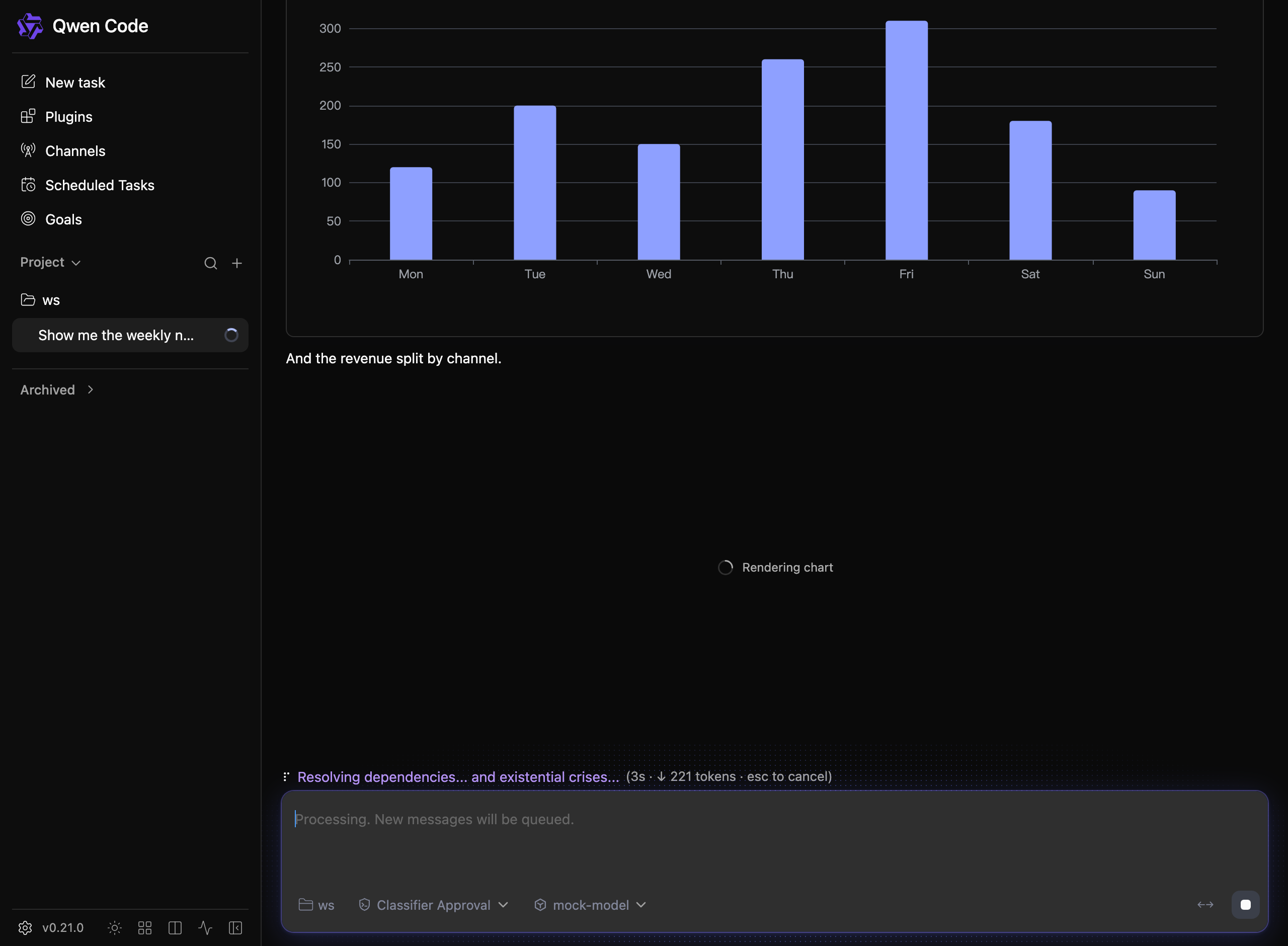
Two repo-level gates that the new dependencies touch also pass: 2. The streaming boundary — the behaviour this PR exists forSampling the DOM every 120 ms from the moment the prompt was submitted:
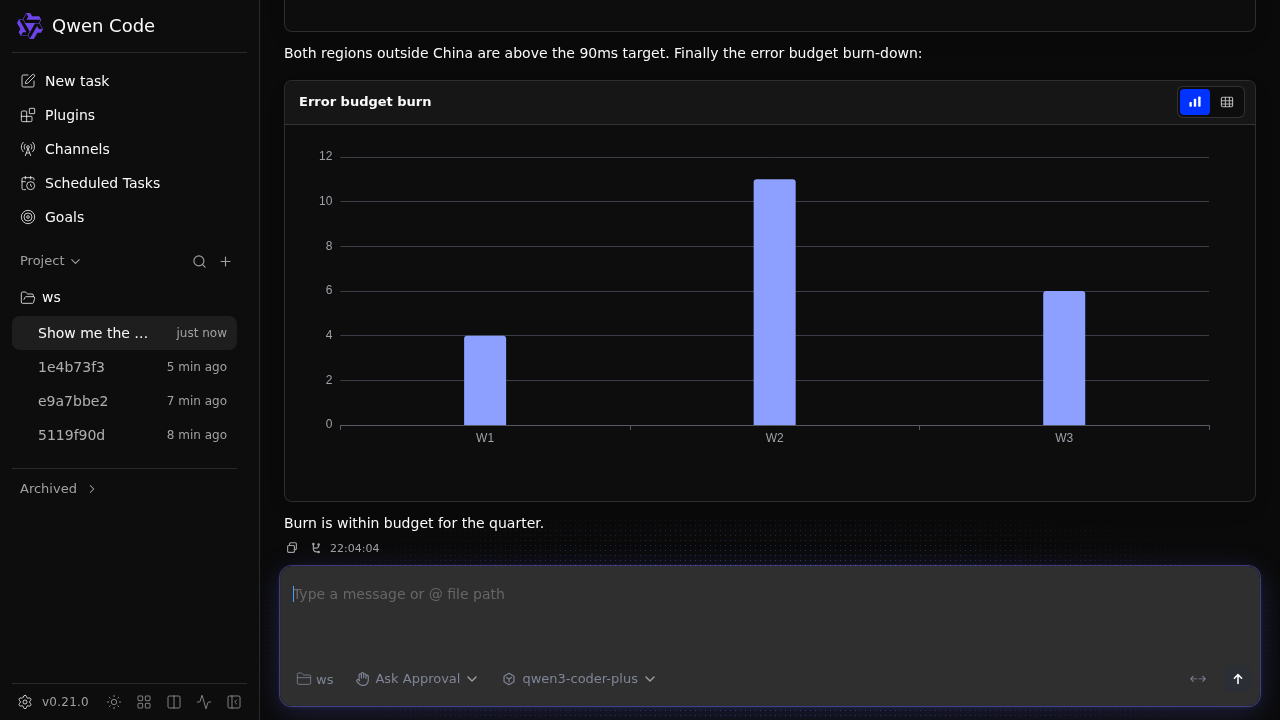
The 2,691 ms row is the claim in the PR description, observed in the running product: the first chart is already a painted canvas while the second fence is still arriving and correctly shows the loading state. The canvas count never goes 1 → 0 → 1, so a completed chart is not being torn down and rebuilt as later text streams in.
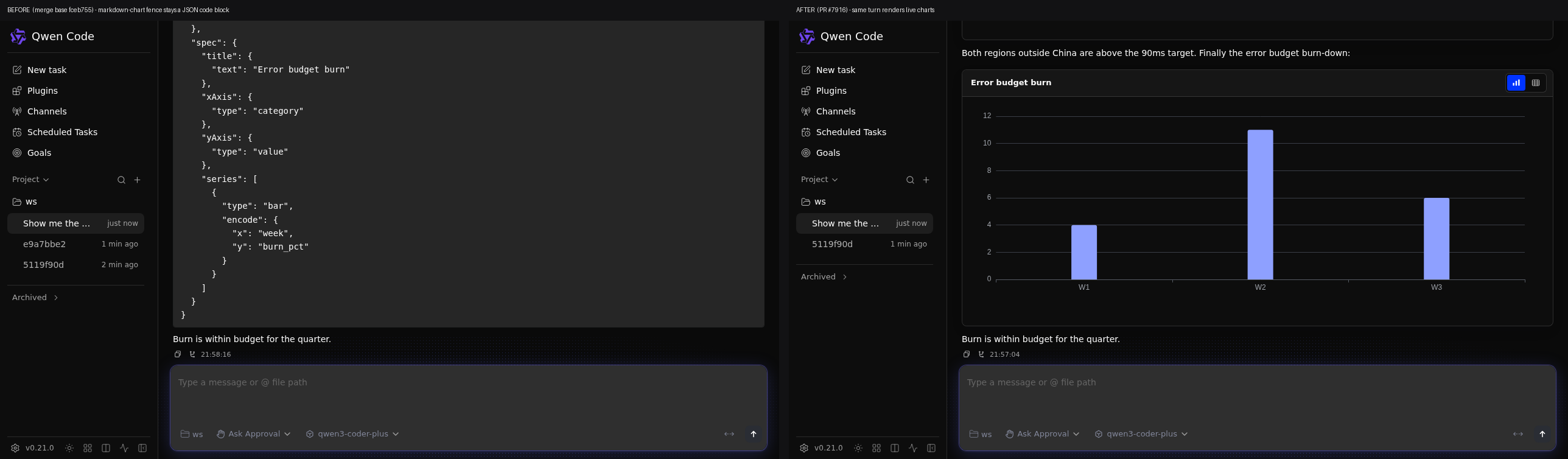
3. Before / after, with one variable changedIdentical daemon binary, identical scripted model, identical prompt. The only thing that differs is which
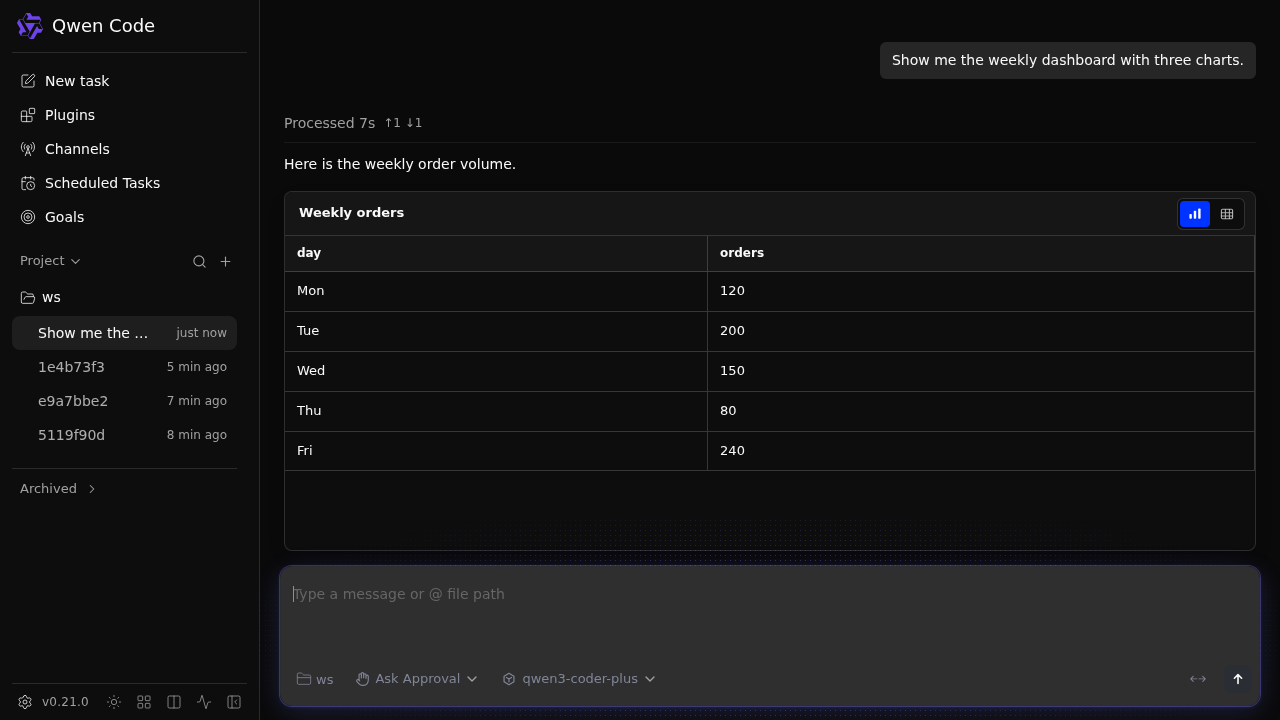
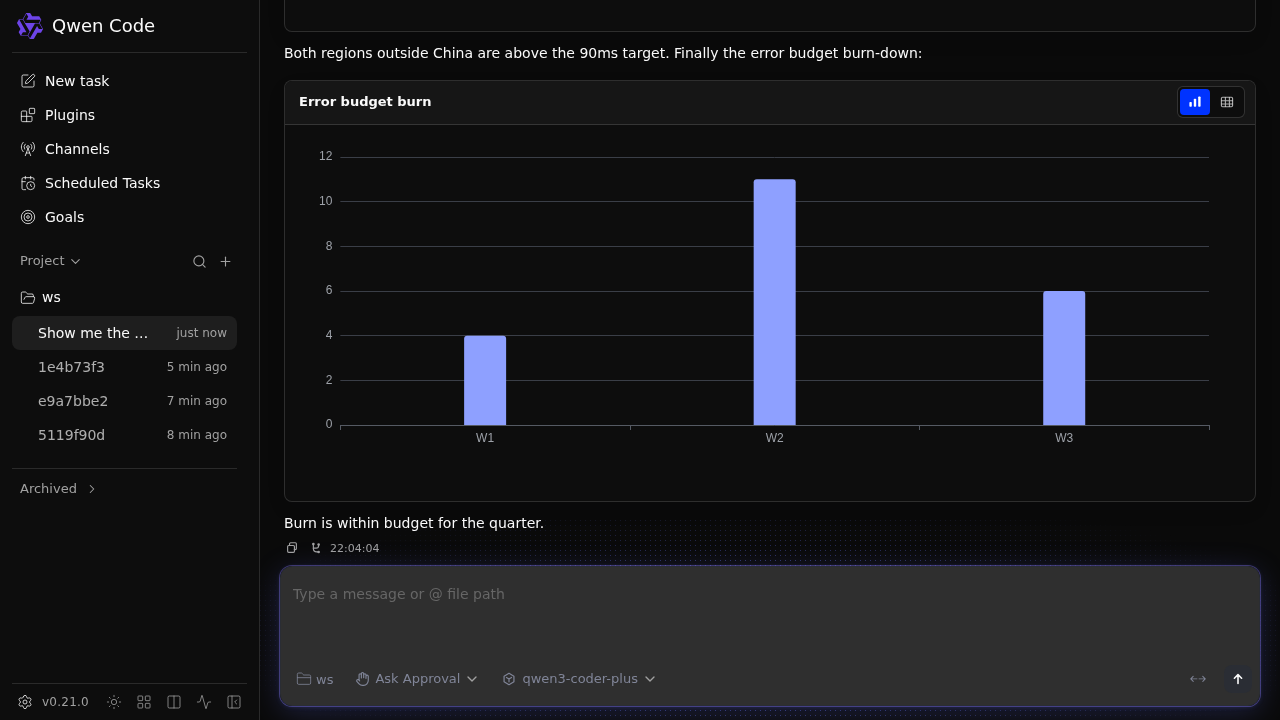
The "after" image is taken after a full page reload, so it doubles as the persistence check: both charts come back from the stored transcript with live canvases and zero raw chart fences. 4. Chart / Data view, and the browser consoleThe Chart/Data toggle works per card and renders the inline dataset as a table (2 tables, 13 rows total across the two charts). Note in the screenshot that chart 1 is in Data mode while chart 2 is still in Chart mode — the view state is per chart, not global.
Across the whole session — page load, streaming, toggling, reload — the browser reported 0 console errors, 0 uncaught page errors, and 0 failed HTTP requests. One thing worth flagging for anyone reproducing this: my first attempt showed a 5. Are the new tests real? (mutation testing)The 13 new tests all drive a fake ECharts runtime, so I checked whether they actually constrain the production code. Three source mutations, three precise kills:
The second one matters most: it is the test that pins the anti-remount guarantee, and it genuinely catches a regression in it. These tests are not vacuous. 6. Bundle cost — the "ECharts stays lazily loaded" claim holds
ECharts 6 lands in its own 1.1 MB chunk that The library bundle got smaller, because the 1,889-line in-tree implementation is gone and the three Findings — all non-blockingF1 — In a Chinese UI, the chart chrome is now English. Should fix, but as a follow-up. The PR removes 10
The deleted component used all 11 F2 — A closed chart fence inside a blockquote sits in "Rendering chart" until the turn ends. Nit. Only blockquotes are affected — the
This reproduces on both the default registry path and the legacy F3 — Two deletions are not mentioned in the PR description. Nit. Checked and found fine
One note rather than a finding: 中文版本维护者验证报告 —— 本地构建 + 真实端到端结论:我认为可以合并。 Reviewer Test Plan 中的每一个数字都在 head 验证方式使用独立的 实测部分刻意没有使用 mock 测试环境:真实的 1. Reviewer Test Plan 的四道门禁
另外两道与新依赖相关的仓库级门禁也通过: 2. 流式边界 —— 本 PR 的核心行为从提交 prompt 起,每 120 ms 采样一次 DOM:
2,691 ms 这一行正是 PR 描述中的论断,在真实产品中被观测到:第一个图表已经是绘制完成的 canvas,而第二个 fence 仍在传输并正确显示 loading 状态。canvas 数量全程没有出现 1 → 0 → 1 的变化,说明已完成的图表不会因为后续文本继续流式输出而被卸载重建。 3. 单变量前后对比守护进程二进制、脚本化模型、prompt 完全相同,唯一变量是守护进程服务的
"After" 截图是在整页刷新之后拍摄的,因此同时也验证了持久化:两个图表都能从存储的会话记录中恢复出真实 canvas,且没有残留任何未升级的图表 fence。 4. Chart / Data 视图与浏览器控制台Chart/Data 切换按卡片独立生效,并把内联数据渲染成表格(两个图表共 2 张表、13 行)。截图中图表 1 处于 Data 模式而图表 2 仍在 Chart 模式 —— 视图状态是每个图表独立的,不是全局的。 整个会话过程中(页面加载、流式输出、视图切换、刷新),浏览器报告 0 个 console error、0 个未捕获页面异常、0 个失败的 HTTP 请求。 有一点供后续复现者参考:我第一次尝试时出现过 5. 新增测试是否有效?(变异测试)13 个新测试都使用假的 ECharts 运行时,因此我验证了它们是否真正约束了生产代码。三次源码变异,三次精准命中:
第二条最关键:它正是钉住"不重新挂载"这一保证的测试,并且确实能捕获该保证的回归。这些测试不是空测试。 6. 包体积成本 —— "ECharts 仍然延迟加载"的说法成立
ECharts 6 被拆分到独立的 1.1 MB chunk, Library bundle 反而变小了,因为 1,889 行的仓库内实现被移除,并且三个 发现的问题 —— 均不阻塞合并F1 —— 中文界面下图表外壳变成英文。建议修复,但可作为后续项。 本 PR 从两个语言包中删除了 10 个 被删除的组件用到了全部 11 个 F2 —— 位于引用块(blockquote)内的已闭合图表 fence 会一直停留在 "Rendering chart",直到本轮结束。小问题。 只有 blockquote 受影响 —— 续行的
该现象在默认 registry 路径和旧版 F3 —— 两处删除未在 PR 描述中说明。小问题。 已检查且确认无问题的部分
最后一点属于提示而非问题: |
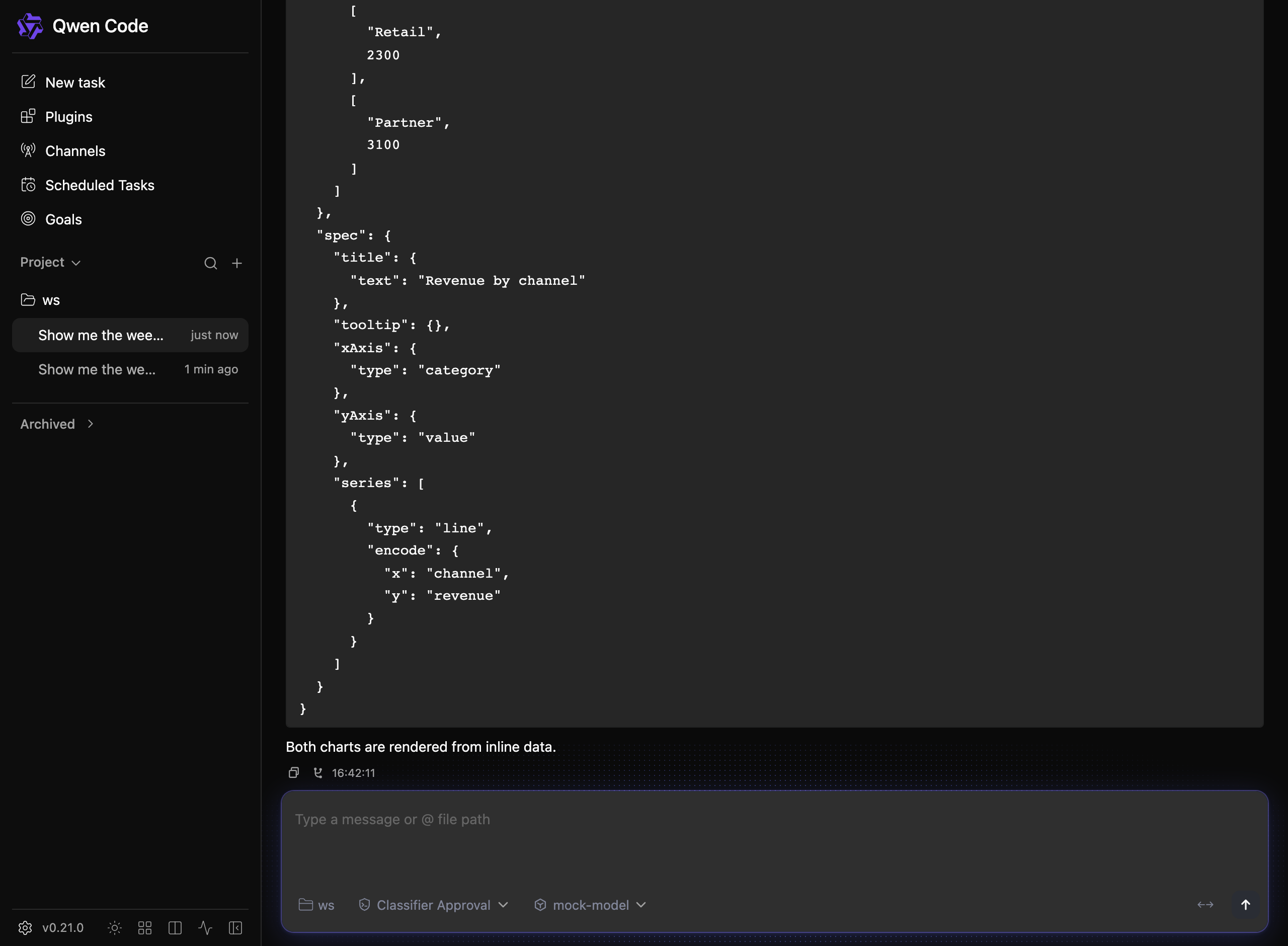
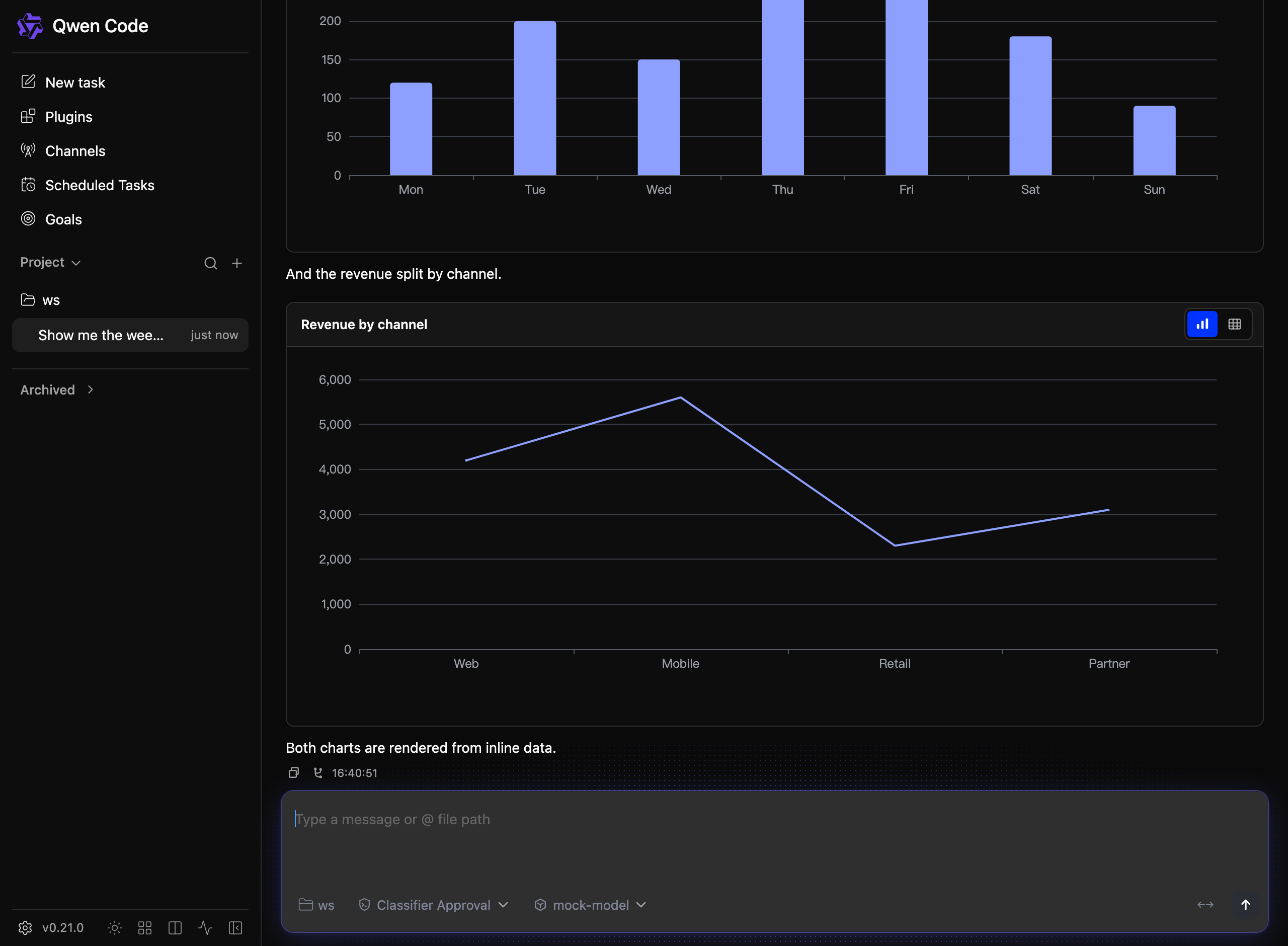
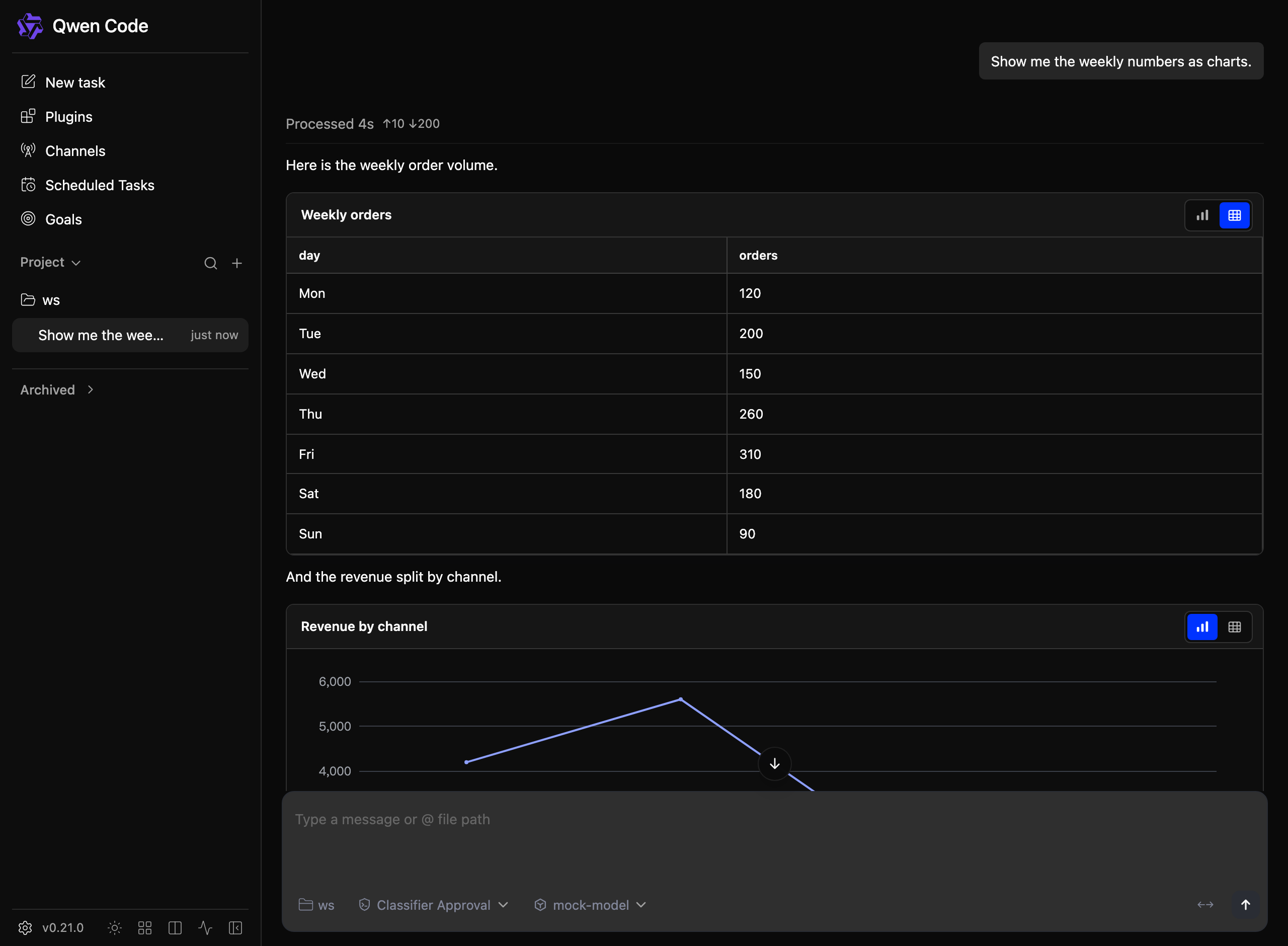
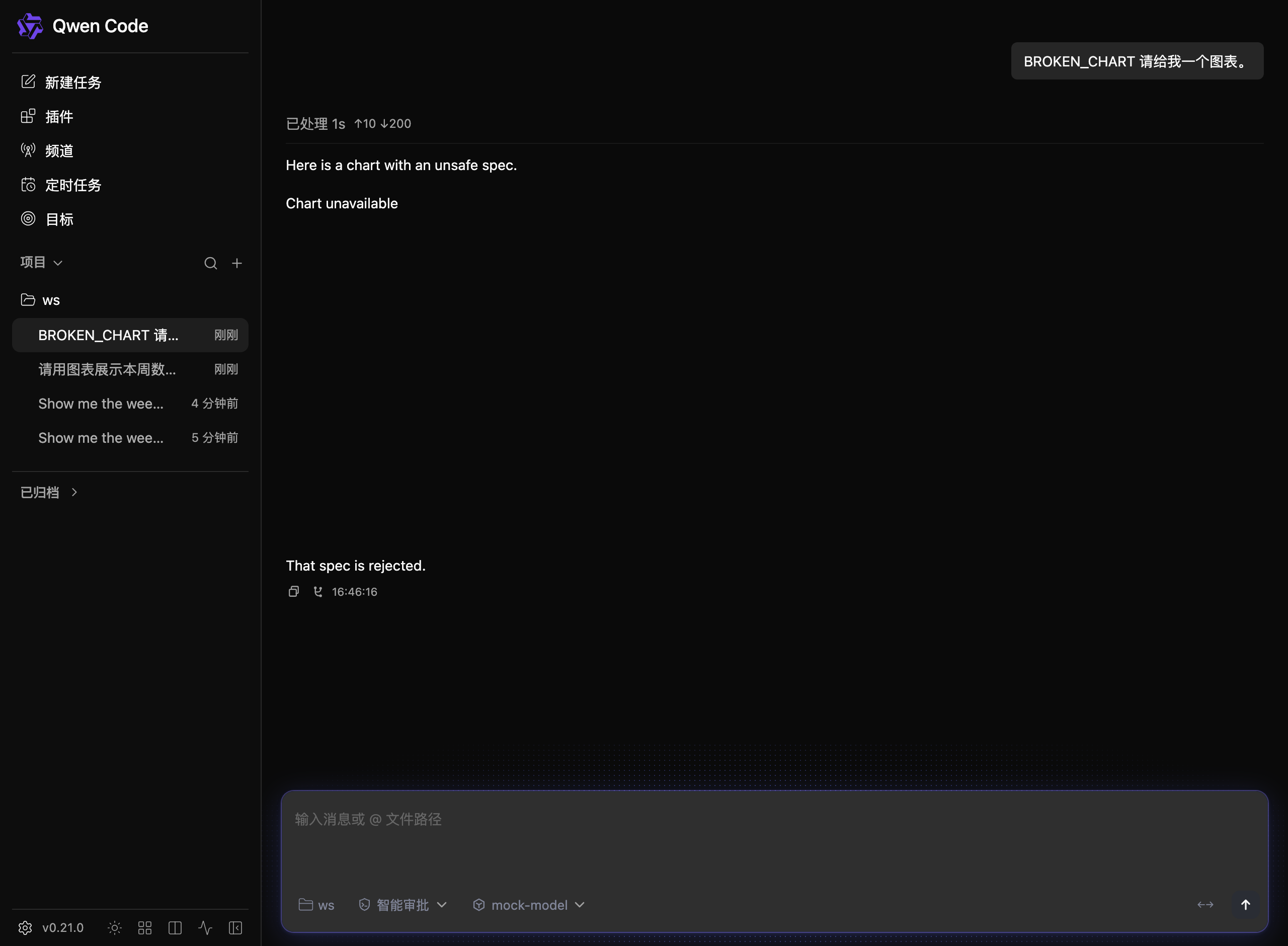
Follow-up: the deprecated-API compatibility surfaceAfter posting the report above I went back over the surface the PR describes as preserved. Everything in that report still stands — the zero-config default path works end-to-end exactly as claimed, and all the measurements reproduce. But this part of the description is not accurate for hosts on the deprecated API:
Five concrete divergences below. All are verified first-hand against the PR source and the published C1. The default registry claims
|
| Surface | Suggested one-line mutation that should fail a test |
|---|---|
parseError — a public prop of EchartsFullDataBlock |
delete the if (parseError && !isStreaming) block at :395-397 |
withTimeout — the 30 s bound |
return promise; as the first line of :217 |
| Theme plumbing | hardcode theme={'light'} at :162 |
Not a regression — flagging so nobody over-corrects
The object-identity footgun from the report above (a host passing a fresh markdown.chart literal per render remounts its charts) looks alarming and the PR's README does show that exact shape at README.md:306. But the base README showed the same inline shape for renderCodeBlock, and I measured identical remount counts on both paths on this build. It is long-standing WebShellCustomizationProvider behaviour, not something to hold this PR for. Tightening the useMemo to key on chart.registry / chartClassName / chartStyle would be a cheap improvement, and the docstring at customization.tsx:70 should say the whole chart object must be stable, not just the registry.
Revised bottom line
I would still merge this — the feature is well built, the default path is solid under real end-to-end load, and the new tests are not vacuous. But I would ask for two small things first, because both are cheap and both are currently mis-stated in the description:
- Correct the "no breaking changes" claim, and say plainly that
echarts-fulldata(C1) now renders by default and thatresolveDataRefreceives an unnormalized ref (C3) — or restore normalization, which is a three-line change. - Note the zh-CN string regression (F1 in the report above) as a known follow-up with an upstream issue, so it does not get lost.
Everything else here is a nit or a coverage suggestion and can land afterwards.
中文版本
补充:已废弃 API 的兼容性面
在发布上面的报告之后,我又重新审视了本 PR 声称"保持兼容"的那部分接口。上面报告中的结论依然成立 —— 零配置默认路径的端到端行为完全符合声明,所有测量数据也都可复现。但对于仍在使用已废弃 API 的宿主来说,描述中的这段话并不准确:
已有宿主提供的
createEchartsFullDataRenderer接入继续保持原有优先级和回调行为。[…] 预期没有 breaking change。
以下五处具体差异,全部是我基于 PR 源码和从 registry 单独安装的 @datafe-open/markdown-chart-echarts@0.1.10 产物第一手验证得出,并非推断。
C1. 默认 registry 会接管 echarts-fulldata(以及两种厂商专用语言),宿主无需也无法选择退出 · 建议补充说明
只要宿主没有覆盖 code/pre/renderCodeBlock,Markdown.tsx 就会为每一条助手消息安装 DEFAULT_WEB_SHELL_MARKDOWN_CHART。而该 registry 的 ECharts renderer 匹配的不止一种语言:
markdown-chart
echarts-fulldata
/^echarts-chatbi_query_(\d+)-(\d+)$/
/^echarts-chatbi_sandbox_filepath_(\S+)$/i
在本 PR 之前,echarts-fulldata 只有在宿主显式接入 renderCodeBlock: createEchartsFullDataRenderer({ loadEcharts }) 时才会渲染成图表,否则显示为普通代码块。现在它开箱即用地渲染为图表。两个 echarts-chatbi_* 模式是 Web Shell 从未接管过的第三方遗留格式;助手若输出这类 fence,现在会得到图表卡片或 Chart unavailable 提示,而不是可读的代码。
这可能是有意为之,但它确实是发布产品中的行为变更,且未写入 PR 描述。
C2. 有意不提供 loadEcharts 的遗留宿主现在会静默使用内置 ECharts · 建议修复或说明
当 options.loadEcharts 为假值时,adaptLegacyRuntimeLoader 返回 undefined(MarkdownChartRenderer.tsx:232-234),随后库会回落到自己的默认实现:
// @datafe-open/markdown-chart-echarts/dist/index.js:1820
const loadECharts = options.loadECharts ?? (async () => await import("echarts"));旧组件在这种情况下会渲染 echartsChart.runtimeUnavailable("图表运行时不可用。")。把不提供 loader 当作开关来禁用图表的宿主,现在会照常渲染出图表。
C3. resolveDataRef 现在收到的是原始 ref,而不是归一化后的 ref · 建议修复
旧的 normalizeDataRef 既做校验也做规范化,返回 `${prefix}${segments.join('/')}`(scheme 小写、路径百分号解码),并把该值交给宿主 resolver。替代它的 isSupportedLegacyDataRef(MarkdownChartRenderer.tsx:182-215)是纯布尔谓词,库随后原样转发 envelope 中的值:
// @datafe-open/markdown-chart-echarts/dist/index.js:1822-1830
if (options.validateDataRef && !options.validateDataRef(data.ref)) { … }
resolvedDataset = await options.resolveDataRef(data.ref, { format, dimensions, signal });因此对于输入 ARTIFACT://charts/%6Frders.csv(它能通过谓词,因为谓词在校验时会小写 scheme 并解码路径),宿主 resolver 此前收到的是 artifact://charts/orders.csv,现在收到的是原始字符串。这不是安全漏洞(路径穿越、..、盘符、查询串、双重编码仍然会在调用 resolver 之前被拒绝,我已确认这部分仍然有效),但它是对一个有文档的回调输入契约的静默变更。PR 自带的测试只回环了一个本就规范的 ref,因此无法发现这一点。
C4. EchartsFullDataBlock 的 parseError 渲染结构发生变化 · 小问题
旧实现:错误信息渲染在卡片内部,带 toolbar 和标题,使用没有 ARIA role 的普通 <div>。新实现(MarkdownChartRenderer.tsx:395-397):一个没有卡片外壳的裸 <div role="alert">。新增 role="alert" 是无障碍方面的改进,但 DOM 结构以及依赖它的宿主 CSS 都会改变。在 isStreaming 为 true 时两者实际等价(都显示加载状态),因此只有结束态存在差异。
相关:data-testid="echarts-fulldata-{rendered,chart,table}" 这些钩子已被移除,依赖它们的宿主 e2e 会失效。
C5. 30 秒超时只存在于已废弃路径上 · 值得留意
withTimeout(MarkdownChartRenderer.tsx:217-227)只通过 adaptLegacyRuntimeLoader / adaptLegacyDataResolver 生效。DEFAULT_WEB_SHELL_MARKDOWN_CHART 两者都不传,而库自身也没有超时 —— 它只传递了 AbortSignal(因此卸载会取消),但没有任何定时器。所以主路径上如果 resolveDataRef 卡死,会一直挂着而不是在 30 秒时失败。讽刺的是,受保护更好的反而是已废弃路径。
关于测试覆盖 —— 对我自己报告的一处更正
在上面的报告中我把"isIncompleteTailFence 恒返回 false"这条变异列为被杀死。这没错,但我当时读得不够细:它只被 Markdown.test.ts:534 杀死,而 13 个 MarkdownChartRenderer 测试全部保持绿色。原因是结构性的 —— 共享的 pre 组件直接渲染 MarkdownChartBlock 而从不渲染 children,因此对图表 fence 而言 MarkdownCode 根本不会被调用,isIncompleteTailFence 也就永远不会执行。它只服务于遗留的 renderCodeBlock 路径;默认路径使用的是库自己的等价尾部检测逻辑。
所以 renders a closed chart immediately while later Markdown is streaming 和 loads only after the active tail fence closes 是对内置库的良好集成冒烟测试,但不应被理解为对 web-shell 新增流式逻辑的覆盖。真正钉住该逻辑的只有 Markdown.test.ts 中那一个用例 —— 而根据上面的 F2,它并未覆盖嵌套在容器中的 fence。
有三处有文档的接口完全没有测试,我认为这是最值得补投入的地方:
| 接口 | 建议的单行变异(应当导致测试失败) |
|---|---|
parseError —— EchartsFullDataBlock 的公开 prop |
删除 :395-397 处的 if (parseError && !isStreaming) 块 |
withTimeout —— 30 秒上限 |
在 :217 的第一行加 return promise; |
| 主题传递 | 在 :162 硬编码 theme={'light'} |
这一条不是回归 —— 特此说明以免过度修正
上面报告中提到的对象标识陷阱(宿主每次渲染传入新的 markdown.chart 字面量会导致图表重新挂载)看起来很吓人,而且 PR 的 README 在 README.md:306 正好展示了这种写法。但 base 版 README 对 renderCodeBlock 展示的是同样的内联写法,而且我在同一构建上测得两条路径的重新挂载次数完全一致。这是 WebShellCustomizationProvider 的既有行为,不足以阻塞本 PR。把 useMemo 的依赖收紧为 chart.registry / chartClassName / chartStyle 是一处成本很低的改进;同时 customization.tsx:70 的文档注释应改为"整个 chart 对象必须保持稳定",而不只是 registry。
修订后的结论
我依然认为可以合并 —— 功能实现质量不错,默认路径在真实端到端压力下表现稳定,新增测试也不是空测试。但我建议在合并前补两件成本很低、且目前在描述中被表述错误的事:
- 修正"没有 breaking change"的说法,明确写出
echarts-fulldata现在会默认渲染(C1),以及resolveDataRef收到的是未归一化的 ref(C3)—— 或者直接恢复归一化,这只是三行改动。 - 把 zh-CN 文案回退(上面报告的 F1)记为已知后续项并附上游 issue,以免遗漏。
其余各条都属于小问题或测试补充建议,可以后续再处理。
 qwen-code-ci-bot
left a comment
qwen-code-ci-bot
left a comment
qwen-code-ci-bot
left a comment
There was a problem hiding this comment.
Reviewed — no blockers. Suggestions are inline.
中文说明
已审查——无阻断问题。 建议见行内评论。
— qwen3.7-max via Qwen Code /review

|
Implemented the review follow-ups in
Validation on the current head:
The PR description has been updated with the compatibility notes, upstream links, and current evidence. |

 doudouOUC
left a comment
doudouOUC
left a comment
doudouOUC
left a comment
There was a problem hiding this comment.
Reviewed. Suggestions are inline.
中文说明
已审查。 建议见行内评论。
— qwen3.7-max via Qwen Code /review
qwen-code-ci-bot
left a comment
qwen-code-ci-bot
left a comment
There was a problem hiding this comment.
Reviewed — no blockers. Suggestions are inline.
中文说明
已审查——无阻断问题。 建议见行内评论。
— qwen3.7-max via Qwen Code /review
|
Addressed the latest review round in
Current validation: lockfile check passed; focused 87/87; full WebShell 145 files / 2,344 tests; typecheck, lint, production/library/declaration build all passed. All five new review threads have been replied to and resolved. |
|
Qwen Code review did not complete successfully. Run review failed. See workflow logs for details. A transient error is retried automatically; if you are seeing this, retry with |
doudouOUC
left a comment
doudouOUC
left a comment
There was a problem hiding this comment.
Reviewed — no blockers. Suggestions are inline.
中文说明
已审查——无阻断问题。 建议见行内评论。
— qwen3.7-max via Qwen Code /review
qwen-code-ci-bot
left a comment
qwen-code-ci-bot
left a comment
There was a problem hiding this comment.
Reviewed — no blockers. Suggestions are inline.
中文说明
已审查——无阻断问题。 建议见行内评论。
— qwen3.7-max via Qwen Code /review
Local verification against a real stack (Linux)I ran this PR locally on the head commit Stack: scripted OpenAI-compatible SSE model → real 1. Repo gates, on a clean PR-head tree
2. One real streaming turnThe model streamed: text → closed chart fence → text → closed chart fence → text → a chart fence held unterminated across several chunks → close → trailing text.
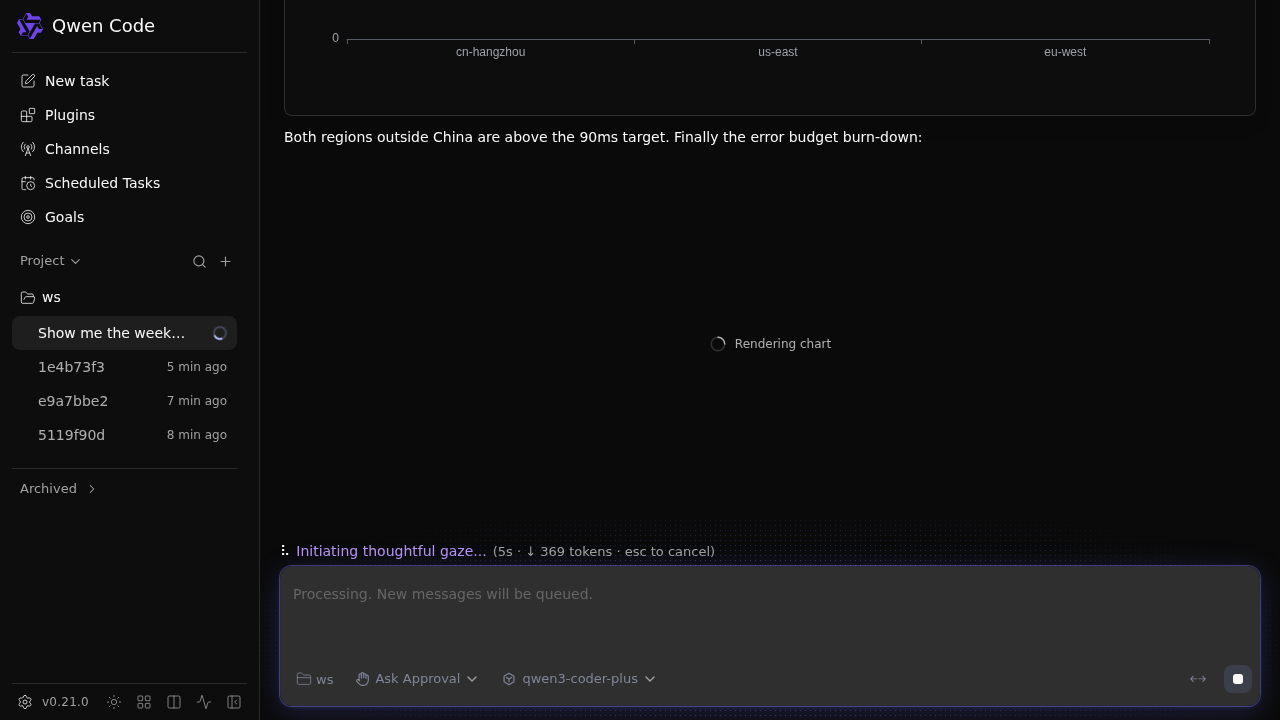
The streaming-boundary claim is the interesting one, and it holds — chart #2 is fully mounted and interactive while the tail fence below it still shows Rendering chart and the turn is still streaming:
Settled turn, Data view, and after reload
3. Before / after on the identical turnSame daemon, same scripted model output, same workspace — only
4. Host
|
| Ref | Reached host resolver | Rendered |
|---|---|---|
artifact://sales/2026-q1.json |
✅ yes (normalized, with format + dimensions) |
chart |
session-file://reports/rows.json |
✅ yes | chart |
https://evil.example.com/data.json |
❌ no | error state |
file:///etc/passwd |
❌ no | error state |
artifact://../../etc/passwd |
❌ no | error state |
artifact://a%2F..%2F..%2Fetc%2Fpasswd |
❌ no | error state |
artifact://a\..\..\etc\passwd |
❌ no | error state |
artifact://C:/Windows/win.ini |
❌ no | error state |
artifact://sales/ 2026.json |
❌ no | error state |
artifact://sales/rows.json?token=abc |
❌ no | error state |
/etc/passwd |
❌ no | error state |
To make sure that pass was not vacuous, I ran a positive control: neutering normalizeSupportedDataRef to return every ref unchanged. 7 of the 9 hostile refs immediately leaked to the resolver and the test failed — so the assertion is live. (Interesting side note: https:// and file:// stayed rejected even with the control patch, i.e. the shared package's own scheme check is a second layer behind WebShell's normalizer.)
Data-ref harness screenshot
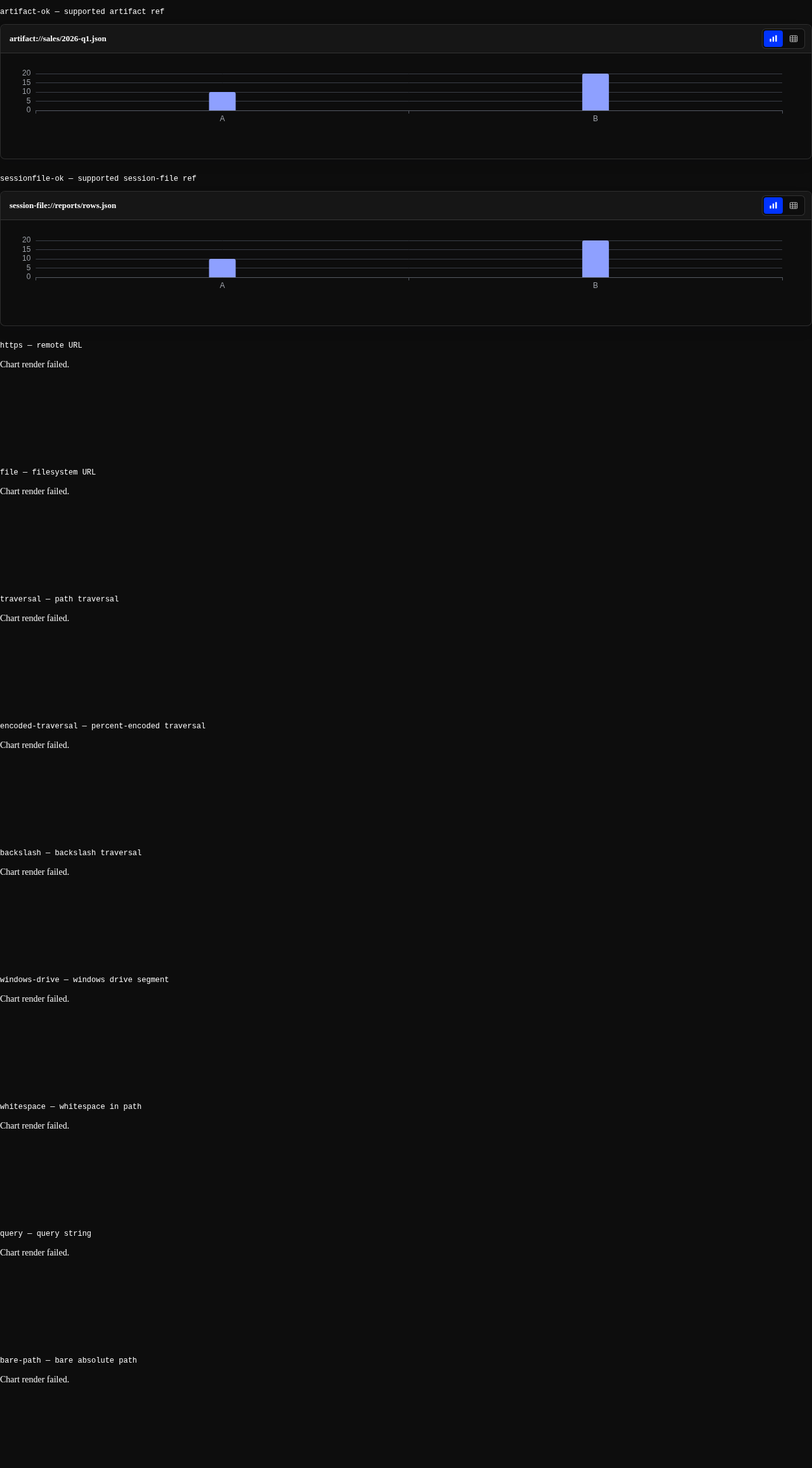
5. Integration contract probes
| Probe | Expected | Measured |
|---|---|---|
| canonical fence, zero host chart config | renders | 1 canvas |
echarts-fulldata alias, no host opt-in |
renders (the PR's documented breaking change) | 1 canvas |
same fence under source="thinking" |
must not become a chart surface | 0 canvases, stays a code block |
host renderCodeBlock present |
host keeps precedence, built-in registry suppressed | host node rendered, 0 canvases |
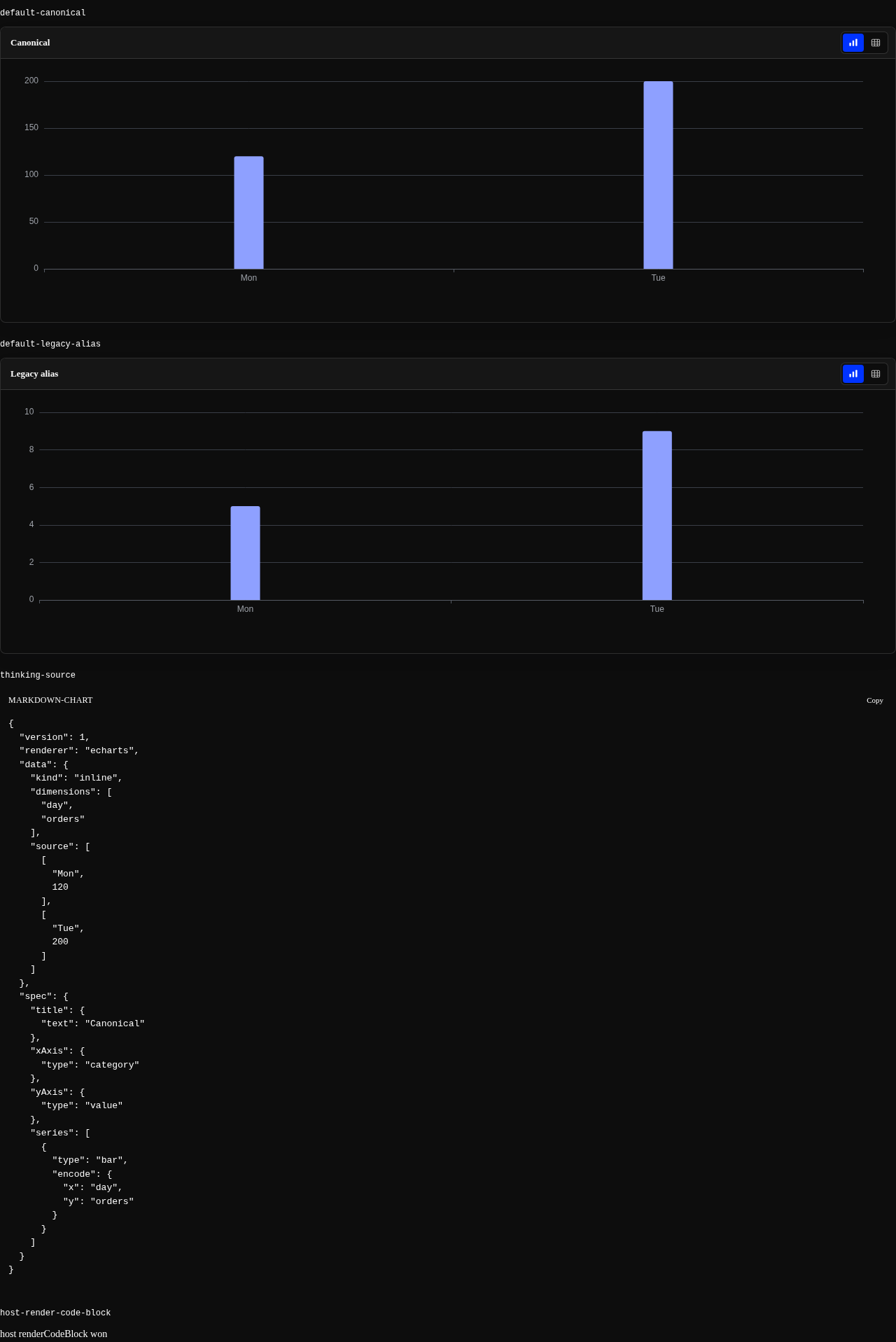
The breaking change described in the PR body is real and behaves exactly as documented: an unconfigured WebShell that previously showed echarts-fulldata fences as code will now render them as charts.
6. Bundle impact (production app build, uncompressed)
| Metric | before | after | delta |
|---|---|---|---|
| eager entry chunk | 2,952,682 B | 3,026,962 B | +72.5 KiB |
| total JS across all chunks | 15,000,096 B | 16,203,228 B | +1.15 MiB |
| chunk count | 326 | 327 | +1 |
The +1 chunk is ECharts/zrender and it is reached through import("./index-C2GE3DAF.js") with no modulepreload in index.html — so the "ECharts remains lazily loaded" claim holds; only ~72 KiB of markdown-chart core lands in the eager path. The library build keeps echarts and all three @datafe-open/* packages external, so embedders still own the runtime.
One thing I specifically checked because the lockfile looks alarming: @datafe-open/markdown-chart-react pins its own react-markdown@10.1.0 next to WebShell's 9.1.0, and its dist/index.js does import ReactMarkdown from "react-markdown". It is tree-shaken out — react-markdown pipeline markers are byte-for-byte identical in count between the two builds (3 and 4), and the chart chunk contains zero react-markdown references. No duplicate markdown pipeline ships.
7. Streaming re-render cost
Markdown.tsx now does per-code-node offset slicing plus a fence-closed check on every render, so I measured it: a 156 KB assistant document with 40 code fences plus an unterminated tail, re-rendered 30 times, 3 runs per arm.
| Arm | median ms / re-render |
|---|---|
| before | 32.74 |
| after | 33.46 |
Run ranges overlap (before 32.2–35.5, after 33.3–36.3). The added work is in the noise.
Caveats on my run
- The lockfile itself is not independently validated by me. The box had under 1 GB free, so instead of
npm ciI hardlink-copied amain-basednode_modulesand installed the four new packages from the registry at exactly the locked versions and paths. Resolution and versions match the lockfile entries, but CI'snpm ciremains the authority there. - Harness noise, unrelated to this PR and identical in both arms: my scripted model id is not in the CLI's
openaimodel registry, soPOST /session/:id/modelreturns 500 and the shell shows a Set model failed toast. I hid the toast host for the screenshots only; chart errors were still asserted through[role="alert"]and the console listeners. - Still unvalidated by anyone: Windows, and macOS beyond your own run.
- Worth a maintainer decision independent of correctness: this makes
@qwen-code/web-shelldepend at runtime on a third-party npm scope (@datafe-open/*) plusecharts. Versions are pinned exact, which is the right call.
LGTM from my side.
中文说明
本地真实环境验证(Linux)
我在本地对本 PR 的 head commit 44029db 做了完整验证:既跑了仓库自身的各项检查,也用真实 qwen serve daemon + 真实浏览器做了端到端验证,并以 merge base fceb755 作为对照组做了 before/after 对比。Reviewer 测试计划中的每一项都能复现,包括流式边界、引用数据边界和向后兼容行为。没有发现阻塞性问题。 下面是数据和截图,后续 reviewer 不用再重做一遍。
验证链路: 脚本化的 OpenAI 兼容 SSE 模型 → 真实 qwen serve v0.21.0(--workspace,独立 QWEN_HOME)→ 用本分支源码启动的 web-shell vite dev server → Chromium(Playwright)。WebShell 完全没有任何图表相关配置 —— 没有 loadEcharts,没有 registry,也没有 renderCodeBlock。
环境: Debian 13、Linux 6.12.63、Node v22.22.2。Linux 正是 PR 的 OS 表格中未测试的那一行。
1. 仓库检查(干净的 PR head 工作树)
| 检查项 | 结果 |
|---|---|
vitest run(packages/web-shell) |
145 个文件 / 2344 个测试通过 —— 与 PR 声称的数字完全一致 |
MarkdownChartRenderer.test.tsx + Markdown.test.ts |
87 个通过(22 + 65,与声称一致) |
tsc -p tsconfig.json --noEmit |
通过 |
eslint packages/web-shell --max-warnings 0 |
通过 |
npm run build(应用 + library bundle + tsc -p tsconfig.lib.json) |
exit 0,三个产物均构建成功 |
prettier --check packages/web-shell |
2 个 warning —— client/index.html 和 components/GitModePopover.module.css,这两个文件本 PR 未改动,且与 main 完全一致。属于既有问题,与本 PR 无关。 |
2. 一次真实的流式回答
模型依次输出:文本 → 已闭合图表 fence → 文本 → 已闭合图表 fence → 文本 → 跨多个 chunk 保持未闭合的图表 fence → 闭合 → 收尾文本。
| 观测项 | 实测 |
|---|---|
| 尾部 fence 仍处于 loading 时已挂载的 ECharts canvas 数 | 2 |
| 回答结束后的 card / canvas 数 | 3 / 3,canvas 像素尺寸均非零 |
结束后 [data-markdown-chart-loading] |
0 |
结束后 [role="alert"] |
0 |
| 第 1 个图表的 Chart→Data→Chart 切换 | 双向均正常 |
| 整页刷新后(持久化 transcript) | 3 个 card、3 个 canvas、0 loading、0 alert |
| 图表相关 console error / warning / page error | 0 / 0 / 0 |
流式边界这一条是最关键的,结论成立 —— 下方尾部 fence 还显示 Rendering chart、整个回答仍在流式输出时,图表 #2 已经完全挂载并可交互:
结束状态、Data 视图、刷新后
3. 同一次回答的 before / after 对比
相同 daemon、相同脚本化模型输出、相同 workspace —— 只把 packages/web-shell/client 在 merge base 和本分支之间切换。
| 分支 | 图表 card | canvas | 原始 envelope 代码块 |
|---|---|---|---|
before(fceb755) |
0 | 0 | 3 |
| after(本 PR) | 3 | 3 | 0 |
4. 宿主 resolveDataRef 边界 —— 以及一次正向对照
我写了一个 harness,接入真实的 createMarkdownChartRegistry({ resolveDataRef }),记录 renderer 交给宿主的每一个 ref,然后喂了 11 个 data.kind="ref" envelope。
| Ref | 是否到达宿主 resolver | 渲染结果 |
|---|---|---|
artifact://sales/2026-q1.json |
✅ 是(已规范化,带 format + dimensions) |
图表 |
session-file://reports/rows.json |
✅ 是 | 图表 |
https://evil.example.com/data.json |
❌ 否 | 错误态 |
file:///etc/passwd |
❌ 否 | 错误态 |
artifact://../../etc/passwd |
❌ 否 | 错误态 |
artifact://a%2F..%2F..%2Fetc%2Fpasswd |
❌ 否 | 错误态 |
artifact://a\..\..\etc\passwd |
❌ 否 | 错误态 |
artifact://C:/Windows/win.ini |
❌ 否 | 错误态 |
artifact://sales/ 2026.json |
❌ 否 | 错误态 |
artifact://sales/rows.json?token=abc |
❌ 否 | 错误态 |
/etc/passwd |
❌ 否 | 错误态 |
为了确认这个"通过"不是空转,我做了一次正向对照:把 normalizeSupportedDataRef 改成原样返回所有 ref。9 个恶意 ref 中立刻有 7 个泄漏到 resolver,测试随即失败 —— 说明这个断言是真实生效的。(一个有意思的细节:即使打了对照补丁,https:// 和 file:// 依然被拒绝,也就是说共享包自身的 scheme 校验是 WebShell 规范化之后的第二道防线。)
数据引用 harness 截图
5. 接入契约验证
| 验证项 | 预期 | 实测 |
|---|---|---|
| canonical fence,零宿主图表配置 | 渲染 | 1 个 canvas |
echarts-fulldata alias,宿主未 opt-in |
渲染(PR 中记录的 breaking change) | 1 个 canvas |
同样的 fence 在 source="thinking" 下 |
不得成为图表渲染面 | 0 个 canvas,仍是代码块 |
宿主提供了 renderCodeBlock |
宿主优先,内置 registry 被抑制 | 渲染宿主节点,0 个 canvas |
PR 描述中的 breaking change 真实存在,且行为与文档完全一致:此前把 echarts-fulldata fence 当作代码显示的未配置 WebShell,现在会直接渲染成图表。
6. 打包体积影响(生产应用构建,未压缩)
| 指标 | before | after | 增量 |
|---|---|---|---|
| 首屏 entry chunk | 2,952,682 B | 3,026,962 B | +72.5 KiB |
| 全部 chunk 的 JS 总量 | 15,000,096 B | 16,203,228 B | +1.15 MiB |
| chunk 数量 | 326 | 327 | +1 |
新增的那个 chunk 就是 ECharts/zrender,它是通过 import("./index-C2GE3DAF.js") 加载的,index.html 中没有 modulepreload —— 所以"ECharts 仍然延迟加载"的说法成立,首屏路径只多了约 72 KiB 的 markdown-chart 核心。Library 构建把 echarts 和三个 @datafe-open/* 都保持为 external,嵌入方仍然掌握运行时。
还有一点我特意查了,因为 lockfile 看上去有点吓人:@datafe-open/markdown-chart-react 自带了 react-markdown@10.1.0,与 WebShell 的 9.1.0 并存,而且它的 dist/index.js 确实有 import ReactMarkdown from "react-markdown"。这段被 tree-shaking 掉了 —— 两次构建中 react-markdown pipeline 的特征标记数量完全相同(3 和 4),图表 chunk 里没有任何 react-markdown 引用。不会打进第二套 markdown 流水线。
7. 流式重渲染开销
Markdown.tsx 现在每次渲染都会对每个 code node 做 offset 切片和 fence 闭合判断,所以我实测了一下:156 KB 的 assistant 文档、40 个代码 fence 加一个未闭合尾部,重渲染 30 次,每个分支跑 3 轮。
| 分支 | 每次重渲染中位数(ms) |
|---|---|
| before | 32.74 |
| after | 33.46 |
两组区间是重叠的(before 32.2–35.5,after 33.3–36.3)。新增开销在噪声范围内。
关于本次验证的说明
- lockfile 本身没有被我独立验证。 机器可用空间不足 1 GB,所以我没有跑
npm ci,而是用硬链接复制了一份基于main的node_modules,再按 lockfile 中完全一致的版本和路径从 registry 安装了这 4 个新包。解析结果和版本与 lockfile 条目一致,但这一项仍应以 CI 的npm ci为准。 - 与本 PR 无关、且两个分支表现一致的 harness 噪声:我脚本化的模型 id 不在 CLI 的
openai模型注册表中,因此POST /session/:id/model返回 500,界面会弹出 Set model failed toast。我只在截图时隐藏了 toast 容器;图表错误仍然通过[role="alert"]和 console 监听独立断言。 - 目前仍未被任何人验证的:Windows;macOS 除你自己那次之外也没有第二次验证。
- 与正确性无关、但值得维护者单独判断的一点:这会让
@qwen-code/web-shell在运行时依赖第三方 npm scope(@datafe-open/*)以及echarts。版本都做了精确 pin,这个处理是对的。
我这边 LGTM。
Verified locally with Claude Code (Claude Opus 5, 1M context).
|
Addressed the latest review round in
Validation completed locally:
|

qwen-code-ci-bot
left a comment
qwen-code-ci-bot
left a comment
There was a problem hiding this comment.
Reviewed — no blockers. Suggestions are inline. 1 Suggestion-level finding(s) could not be anchored to a changed line and were dropped; nothing further to act on here.
中文说明
已审查——无阻断问题。 建议见行内评论。 1 条建议级发现无法锚定到改动行,已丢弃;此处无需进一步处理。
— qwen3.7-max via Qwen Code /review
|
Addressed the latest review suggestions in
Local validation on the current head:
Both inline threads have been replied to and resolved. |

qwen-code-ci-bot
left a comment
qwen-code-ci-bot
left a comment
There was a problem hiding this comment.
No issues found. LGTM! ✅
中文说明
未发现问题。LGTM!✅
— qwen3.7-max via Qwen Code /review

 yiliang114
left a comment
yiliang114
left a comment
yiliang114
left a comment
There was a problem hiding this comment.
LGTM — clean migration from duplicated EchartsFullDataBlock to shared @datafe-open/markdown-chart renderer. Net -4278 lines, deletion is complete with no orphaned imports/CSS/i18n keys. Security is solid (data ref validation defense-in-depth, no dangerouslySetInnerHTML, 30s timeout guards). Streaming fence detection correct.
Non-blocking suggestions for follow-up:
- Memoize
chartvariable or document referential stability requirement to avoid streaming re-renders - Consider
^6.0.0for echarts (peer range is>=5.5 <7) or comment the exact-pin policy - Add resize and multi-chart-in-one-message tests
- Document chart vs renderCodeBlock precedence in CodeBlockRenderer type

|
Released in v0.21.2. |
5 participants


What this PR does
Replaces WebShell's duplicated
echarts-fulldataimplementation with the shared@datafe-open/markdown-chart*0.1.12 renderer stack. WebShell now includes the default ECharts runtime and registry, so canonicalmarkdown-chartblocks render without host-side ECharts wiring. Hosts only need to install the canonicalmarkdown-chartskill, and only hosts usingdata.kind="ref"need to provideresolveDataRef. The host resolver receives a validated, normalized ref and is bounded by the existing 30-second deadline. Shared chart controls and error states follow WebShell's language, while hosts can override individual labels.The existing
createEchartsFullDataRenderer,EchartsFullDataBlock, andmarkdown.renderCodeBlockintegration surfaces remain compatible and delegate to the shared renderer. The React Markdown integration now distinguishes a closed chart fence from the active incomplete tail fence, so completed charts render immediately and stay mounted while later text continues streaming.The obsolete
skill-required-capabilitiesproposal and the WebShell-ownedqwencode-vizskill template are removed. New integrations use the canonical skill maintained by themarkdown-chartproject instead of a second WebShell-specific model contract.Why it's needed
Maintaining a separate parser, sanitizer, data resolver, Chart/Data view, and ECharts lifecycle inside WebShell duplicates the public Markdown Chart implementation and allows the two implementations to drift. Moving WebShell to the shared renderer centralizes protocol validation, safety behavior, streaming boundaries, and lifecycle fixes while preserving existing integrations.
Reviewer Test Plan
How to verify
npm ci.npm run test --workspace=packages/web-shell; expect 147 test files and 2,383 tests to pass, including the 25MarkdownChartRenderertests and 65 Markdown tests.npm run typecheck --workspace=packages/web-shellandnpm run lint --workspace=packages/web-shell.npm run build --workspace=packages/web-shell; confirm the production app, library bundle, and declarations build.markdown-chartskill in a fresh Qwen workspace, startqwen serve, and ask the model for canonical inline charts. Confirm closed fences render immediately, the active unclosed tail shows the loading state, Chart/Data switching works, and persisted charts restore after a reload.createMarkdownChartRegistry({ resolveDataRef })and confirm a controlledartifact://orsession-file://ref is resolved only through the host callback.Evidence (Before & After)
Before: WebShell used its own
EchartsFullDataBlockimplementation and new hosts had to supply ECharts explicitly.After: a real
qwen servev0.21.0 session with the project-levelmarkdown-chartskill restored three canonical charts after reload; all three chart canvases were present with no loading or alert state and no chart-related console warnings or errors. A new model turn produced a fourth chart through the built-in runtime. The session also verified the incomplete-tail loading state, localized controls, and Chart/Data switching. Closed charts inside streaming blockquotes are covered by the renderer integration suite because the current canonical skill explicitly asks models not to nest chart fences in Markdown containers.Tested on
Environment (optional)
macOS, Node.js 22.23.1, Qwen Code/WebShell 0.21.0, local
qwen serve, fresh workspace sandbox with the canonicalmarkdown-chartskill.Risk & Scope
echarts-fulldataand the twoecharts-chatbi_*families) even without host opt-in, where an unconfigured WebShell previously showed those fences as code. Existing host-providedcreateEchartsFullDataRendererintegrations keep their precedence, missing-runtime behavior, normalized ref callback input, 30-second callback deadline, resolved-ref reuse across streaming-state changes, and direct-component loader identity stability. The deprecated direct component now uses shared chart DOM, so private legacydata-testidhooks are not preserved. New integrations should install only the canonicalmarkdown-chartskill and provideresolveDataRefonly when referenced data is required.Linked Issues
中文说明
本 PR 做了什么
使用共享的
@datafe-open/markdown-chart*0.1.12 renderer 体系替换 WebShell 内重复维护的echarts-fulldata实现。WebShell 现在内置默认 ECharts 运行时和 registry,因此无需宿主接入 ECharts 即可渲染 canonicalmarkdown-chartblock。宿主只需要安装标准markdown-chartskill;只有使用data.kind="ref"的宿主需要提供resolveDataRef。宿主 resolver 收到经过校验和规范化的 ref,并继续受既有的 30 秒超时保护。共享图表控件和错误提示会跟随 WebShell 语言,宿主也可以覆盖个别文案。现有
createEchartsFullDataRenderer、EchartsFullDataBlock和markdown.renderCodeBlock接入接口继续保持兼容,并委托给共享 renderer。React Markdown 接入现在可以区分已经闭合的图表 fence 和尾部仍未闭合的活动 fence,因此已完成的图表会立即渲染,并在后续文本继续流式输出时保持挂载。同时删除已过时的
skill-required-capabilities提案和 WebShell 自己维护的qwencode-vizskill 模板。新接入统一使用markdown-chart项目维护的标准 skill,不再维护第二套 WebShell 专用模型输出契约。为什么需要
WebShell 内单独维护 parser、sanitizer、数据解析、Chart/Data 视图和 ECharts 生命周期,既重复了公共 Markdown Chart 实现,也可能导致两个实现逐渐产生差异。迁移到共享 renderer 后,协议校验、安全行为、流式边界和生命周期修复都集中在一处,同时保留已有接入方式。
Reviewer 测试计划
如何验证
npm ci安装依赖。npm run test --workspace=packages/web-shell;应有 147 个测试文件、2,383 个测试通过,其中包括 25 个MarkdownChartRenderer测试和 65 个 Markdown 测试。npm run typecheck --workspace=packages/web-shell和npm run lint --workspace=packages/web-shell。npm run build --workspace=packages/web-shell;确认生产应用、library bundle 和声明文件均构建成功。markdown-chartskill,启动qwen serve,并让模型生成 canonical inline 图表。确认已闭合 fence 会立即渲染、尾部活动未闭合 fence 会显示 loading、Chart/Data 切换正常,并且刷新后可以恢复持久化图表。createMarkdownChartRegistry({ resolveDataRef }),确认受控的artifact://或session-file://ref 只会通过宿主回调解析。前后证据
改动前:WebShell 使用自己维护的
EchartsFullDataBlock实现,新宿主需要显式提供 ECharts。改动后:真实
qwen servev0.21.0 会话搭配项目级markdown-chartskill,刷新后成功恢复三个 canonical 图表;三个图表 canvas 均存在,不再有 loading 或 alert 状态,也没有图表相关的控制台 warning/error。新的模型轮次继续通过内置 runtime 生成了第四个图表。同一个会话还验证了未闭合尾部 loading 状态、本地化控件和 Chart/Data 切换。由于当前标准 skill 明确要求模型不要把图表 fence 嵌入 Markdown 容器,流式 blockquote 内已闭合图表由 renderer 集成测试覆盖。测试平台
环境(可选)
macOS、Node.js 22.23.1、Qwen Code/WebShell 0.21.0、本地
qwen serve,以及安装了标准markdown-chartskill 的全新 workspace sandbox。风险与范围
echarts-fulldata和两类echarts-chatbi_*),而未配置 renderer 的旧 WebShell 会将这些 fence 显示为代码。已有宿主提供的createEchartsFullDataRenderer接入继续保持原有优先级、缺少 runtime 时的错误行为、规范化后的 ref 回调输入、30 秒回调超时、流式状态切换时对已解析 ref 的复用,以及直接组件在 loader 回调身份变化时保持图表挂载。已废弃的直接组件现在使用共享图表 DOM,因此不保留私有的旧data-testid。新接入只需安装标准markdown-chartskill,仅在需要引用数据时提供resolveDataRef。关联 Issue