fix(core): retry requests when providers require thinking - #7534
Conversation


|
Thanks for the PR! Template looks good ✓ Problem: observed bug with solid evidence. Linked P1 issues #7284 and #7440 both document the Direction: aligned. The "learn from the provider's explicit error" approach is the right direction — it closes the gap for configs that predate #7303's Size: ~59 production lines (pipeline.ts) + ~177 test lines (pipeline.test.ts). Well under thresholds — no maintainer escalation needed. Approach: the scope feels right. Retry once on a specific 400 pattern, remember the capability per-pipeline, and let the existing Moving on to code review. 🔍 中文说明感谢贡献! 模板完整 ✓ 问题:已观测到的 bug,证据充分。关联的 P1 issue #7284 和 #7440 都记录了 方向:对齐。"从 provider 的明确错误中学习"是正确方向——为 #7303 之前的配置弥补缺口,无需增加更多模型名特判或要求用户更新配置。 规模:约 59 行生产代码 + 约 177 行测试代码,远低于阈值。 方案:范围合理。对特定 400 模式重试一次,按 pipeline 记住能力,让现有 进入代码审查 🔍 — Qwen Code · qwen3.8-max-preview Reviewed at |
Code ReviewIndependent proposal: I'd catch the specific 400 about Comparison: the PR does exactly this, and does it cleanly. A few observations:
No critical blockers. No convention violations. Real-Scenario TestingThis fix targets a specific provider error path (Token Plan endpoints returning What I verified: Unit tests — all 114 pipeline tests pass (including the 3 new ones): Smoke test — CLI starts and processes a query normally with the PR changes (no regression): The retry behavior itself is thoroughly covered by the unit tests, which mock the exact provider error and verify the full retry → cache → subsequent-request flow. 中文说明代码审查独立方案: 在 对比: PR 完全按此思路实现,且很干净。 真实场景测试此修复针对特定 provider 错误路径。复现需要没有 — Qwen Code · qwen3.8-max-preview Reviewed at |
|
Confidence: 4/5 — clean, minimal fix for a real P1 bug; only reservation is the inability to do a live before/after (401 credentials), but the unit tests cover the protocol boundary comprehensively. This is a well-scoped follow-up to #7284. The problem is real — two P1 issues document users hitting The implementation matches my independent proposal almost exactly: detect the specific 400, cache the capability per-pipeline, retry once through the existing If I had to maintain this in six months, I'd thank the author — the error detection is specific, the cache scope is right, and the tests document the behavior clearly. 中文说明置信度:4/5 — 干净、最小化的修复,针对真实 P1 bug;唯一保留是无法进行线上 before/after 测试(401 凭据),但单元测试全面覆盖了协议边界。 这是 #7284 的良好后续。问题真实——两个 P1 issue 记录了用户在 Token Plan 端点遇到 — Qwen Code · qwen3.8-max-preview Reviewed at |

 qwen-code-ci-bot
left a comment
qwen-code-ci-bot
left a comment
qwen-code-ci-bot
left a comment
There was a problem hiding this comment.
LGTM, looks ready to ship. ✅
qwen-code-ci-bot
left a comment
qwen-code-ci-bot
left a comment
There was a problem hiding this comment.
Reviewed — no blockers. Suggestions are inline.
— qwen3.7-max via Qwen Code /review

|
Handled the required-thinking retry-failure test in ae5046e. I did not add a |
qwen-code-ci-bot
left a comment
qwen-code-ci-bot
left a comment
There was a problem hiding this comment.
Reviewed. Suggestions are inline.
— qwen3.7-max via Qwen Code /review
qwen-code-ci-bot
left a comment
qwen-code-ci-bot
left a comment
There was a problem hiding this comment.
— qwen3.7-max via Qwen Code /review

qwen-code-ci-bot
left a comment
qwen-code-ci-bot
left a comment
There was a problem hiding this comment.
Reviewed. Suggestions are inline. Not reviewed: build-and-test — Integration Tests (CLI, No Sandbox) was skipped in CI and its suite did not run locally.
— qwen3.7-max via Qwen Code /review

Review & Local Verification Report代码审查设计评价:精巧实用。 本 PR 解决了 provider 要求 关键变更(仅 2 个文件,+331/-9):
亮点:
建议(非阻塞):
本地测试验证
tmux E2E 验证在 tmux 会话中以
结论LGTM。 改动精准(仅 2 文件),策略优雅(从 provider 错误中学习而非硬编码模型名),测试覆盖完整。解决了 #7284 的后续问题,不引入新的特判。 |

qwen-code-ci-bot
left a comment
qwen-code-ci-bot
left a comment
There was a problem hiding this comment.
Reviewed. 1 Suggestion-level finding(s) could not be anchored to a changed line and were dropped; nothing further to act on here. Not reviewed: build-and-test — Integration Tests (CLI, No Sandbox) was skipped in CI and its suite did not run locally.
— qwen3.7-max via Qwen Code /review

 doudouOUC
left a comment
doudouOUC
left a comment
doudouOUC
left a comment
There was a problem hiding this comment.
No issues found. LGTM! ✅
— qwen3.7-max via Qwen Code /review

 wenshao
left a comment
wenshao
left a comment
wenshao
left a comment
There was a problem hiding this comment.
Reviewed — no blockers. Suggestions are inline.
— qwen3.8-max-preview via Qwen Code /review
qwen-code-ci-bot
left a comment
qwen-code-ci-bot
left a comment
There was a problem hiding this comment.
No issues found. LGTM! ✅
— qwen3.7-max via Qwen Code /review


Review — reviewed at
|
| Scenario | base 32c491f |
this PR |
|---|---|---|
| DashScope 400 → recover, and remember for the next call | ✗ | ✓ |
| Streaming: 400 at stream creation → recover | ✗ | ✓ |
Non-DashScope chat_template_kwargs opt-out rejected → recover |
✗ | ✓ |
| Unrelated real 400 → no retry | ✓ | ✓ |
So the real SDK's APIError shape does flow through getErrorStatus/getErrorMessage correctly, and the retried wire body really does carry thinking enabled. Also clean: prettier --check, tsc --noEmit on packages/core, and 681/681 in src/core/openaiContentGenerator.
Two structural properties I checked and can confirm are safe:
- The retry cannot loop. After learning,
buildRequestnever re-emitsenable_thinking: false, so the wire-shape guard can't fire a second time. - Reusing one
contextacross both attempts is safe.toolCallParser/textDeltaState/reasoningDeltaStateare only touched once chunks arrive, and the streaming failure happens at creation time — before the generator is returned.provider.buildRequestand the converter are pure, so rebuilding is side-effect free, andopenaiRequestCaptureContextis single-slot, so the OpenAI logger records the request that actually succeeded.
Worth calling out separately: dropping the isDashScope gate on the if (thinkingMandatory) block is a real latent fix on its own. On base, a config-driven thinkingMandatory model pointed at a non-DashScope endpoint kept extra_body.enable_thinking: false on the wire, because the !thinkingMandatory guard in the reasoning-disabled branch skipped the delete.
Suggestions
1. The learned capability is never rolled back when the retry doesn't prove the hypothesis.
requiredThinkingModels.add(model) runs before the retry and is never removed if the retry fails. Confirmed at the protocol boundary: required-thinking 400 → learn → retry fails with an unrelated 400 → the next healthy request for that model still ships enable_thinking: true. Because thinkingMandatory deliberately overrides both the per-request thinkingConfig.includeThoughts: false and the config-level reasoning: false, one mis-parsed 400 silently turns thinking on for the rest of that pipeline's life — with no way for the user to turn it back off. Cheap fix: this.requiredThinkingModels.delete(model) in the retry's catch, unless the retry error is itself a required-thinking error.
2. "Process-local" is optimistic — it's per content generator, and a session has several.
ContentGenerationPipeline is constructed once per OpenAIContentGenerator, and generators are created in at least three places: the session's own (config.ts), baseLlmClient.perModelGeneratorCache (one per side-query model), and each subagent via createRuntimeContentGeneratorView. So the wasted 400 is paid once per generator, not once per process. If you want the PR-body claim to hold, hoisting the Set to a module-level Map keyed by `${baseUrl}::${model}` would do it — though per-pipeline is a defensible conservative choice if you'd rather not share learned state across auth contexts.
3. Test gaps — 5 of 13 mutants I planted survive the suite.
Killed (good): the abort guard, requiredThinkingModels.add, the chat_template_kwargs strip, the regex, restoring && isDashScope on the outer block, the retry call itself, the cache key, and the config-driven thinkingMandatory fallback.
Survived — all 119 tests still pass with each of these applied individually:
| # | Mutation | Result |
|---|---|---|
| M2 | delete the wireRequest['enable_thinking'] === false || chatTemplateKwargs?.[...] === false guard |
119/119 pass |
| M3 | delete message.includes('enable_thinking') |
119/119 pass |
| M4 | delete the getErrorStatus(error) !== 400 check |
119/119 pass |
| M7 | delete isDashScope && on the tool_choice strip |
119/119 pass |
| M11 | drop getRateLimitErrorDetails(error).providerMessage from the matched string |
119/119 pass |
M11 is the one I'd most want covered: the provider-payload half of the matched string is the branch that exists precisely for providers whose error.message is generic, and no test ever exercises it. Two cheap tests close most of the table — a 500 carrying the required-thinking text (must not retry, kills M4), and an error whose text lives only in error.error.message (must retry, kills M11).
4. The match is narrow enough to miss common phrasings.
/(?:restricted to|must be) true\b/ does not match "must be set to true", "only supports true", or a Chinese-locale message — all plausible from the same family of gateways. Since the whole feature keys off provider prose, consider widening to must be (?:set to )?true and/or also matching on the structured code / param fields (DashScope populates param).
Notes (no action needed)
- The DashScope retry silently drops
tool_choice: 'required'. Verified on the wire: attempt 1 carries it, the retry doesn't. For structured side-queries (the AUTO-mode classifier'srespond_in_schema) the retry therefore runs with thinking forced on and the tool call no longer forced — exactly the combination the comment inbuildRequestwarns about. It's not a regression (on base that request just 400s), and it's the same tradeoff fix(core): support qwen3.8 side queries on DashScope #7303 already accepted; but learning makes it reachable for arbitrary models, so it's worth a line of comment at the strip site. - SSE-embedded errors bypass the retry.
isRequiredThinkingErrorgoes throughgetRateLimitErrorDetails, which understands theevent:error/HTTP_STATUS/transports — but an error raised insideprocessStreamWithLogging(HTTP 200 + error frame) never reaches the newcatch, since the executor has already returned the generator. Fine for DashScope, which returns a real HTTP 400; just means that half of the message extraction is unreachable on the streaming path. debugLogger.warnis a no-op unless a debug log session is active, so silently re-enabling thinking — which changes latency and token cost for every/btwand classifier call afterwards — leaves no trace a user or oncall would see. A telemetry counter would be more useful than the warn.
中文版
评审 —— 基于 c74792c
结论:LGTM,附带若干后续项。 机制正确,我在真实协议边界(而非 SDK mock 层)做了端到端验证。以下全部是 Suggestion 级别,不阻塞合入。
验证
我写了一套一次性的协议边界测试(真实 openai SDK、真实 converter、真实 DashScope/Default provider、真实本地 HTTP/SSE server,不使用 vi.mock),并与 merge-base 32c491f 做 A/B:
| 场景 | base 32c491f |
本 PR |
|---|---|---|
| DashScope 400 → 恢复,且下一次直接命中缓存 | ✗ | ✓ |
| 流式:建流阶段 400 → 恢复 | ✗ | ✓ |
非 DashScope:chat_template_kwargs 关闭项被拒 → 恢复 |
✗ | ✓ |
| 无关的真实 400 → 不重试 | ✓ | ✓ |
也就是说真实 SDK 的 APIError 形状确实能被 getErrorStatus/getErrorMessage 正确识别,重试的 wire body 也确实带上了 thinking。另外 prettier --check、packages/core 的 tsc --noEmit、以及 src/core/openaiContentGenerator 的 681/681 测试均通过。
两个我确认安全的结构性性质:
- 重试不会成环。 学习之后
buildRequest不再发出enable_thinking: false,wire-shape 守卫无法第二次命中。 - 两次尝试复用同一个
context是安全的。toolCallParser/textDeltaState/reasoningDeltaState只在收到 chunk 之后才被写入,而流式失败发生在建流阶段——即 generator 返回之前。provider.buildRequest与 converter 均为纯函数,重建无副作用;openaiRequestCaptureContext是单槽覆盖,因此 OpenAI logger 记录的是真正成功的那次请求。
单独值得一提:把 if (thinkingMandatory) 上的 isDashScope 门去掉,本身就修了一个潜伏问题。在 base 上,配置了 thinkingMandatory 但指向非 DashScope 端点的模型,extra_body.enable_thinking: false 仍会上到 wire,因为 reasoning-disabled 分支里的 !thinkingMandatory 守卫跳过了那个 delete。
建议
1. 重试没有证实假设时,学习到的能力不会回滚。
requiredThinkingModels.add(model) 在重试之前执行,且重试失败时不会被移除。协议边界已确认:required-thinking 400 → 学习 → 重试因无关的 400 失败 → 该模型下一次正常请求仍然携带 enable_thinking: true。由于 thinkingMandatory 会刻意覆盖 per-request 的 thinkingConfig.includeThoughts: false 与 config 级的 reasoning: false,一次误判的 400 就会在该 pipeline 的整个生命周期里静默打开 thinking,用户无法关闭。低成本修法:在重试的 catch 中 this.requiredThinkingModels.delete(model),除非重试错误本身也是 required-thinking 错误。
2. “进程内”这个说法偏乐观——实际是 per content generator,而一次会话有多个。
ContentGenerationPipeline 随 OpenAIContentGenerator 构造一次,而 generator 至少在三处创建:会话自身(config.ts)、baseLlmClient.perModelGeneratorCache(每个 side-query 模型一个)、以及每个 subagent 的 createRuntimeContentGeneratorView。因此那次浪费的 400 是每个 generator 付一次,而不是每进程一次。若希望 PR 描述里的说法成立,把 Set 提升为模块级、以 `${baseUrl}::${model}` 为键的 Map 即可——当然,如果不希望学习状态跨鉴权上下文共享,保持 per-pipeline 也是合理的保守选择。
3. 测试缺口——我植入的 13 个变异里有 5 个存活。
被杀掉(覆盖良好):abort 守卫、requiredThinkingModels.add、chat_template_kwargs 剥离、正则、给外层块恢复 && isDashScope、重试调用本身、缓存键、以及配置驱动的 thinkingMandatory 兜底。
存活——以下每一项单独施加后,119 个测试仍全绿:
| # | 变异 | 结果 |
|---|---|---|
| M2 | 删除 wireRequest['enable_thinking'] === false || chatTemplateKwargs?.[...] === false 守卫 |
119/119 通过 |
| M3 | 删除 message.includes('enable_thinking') |
119/119 通过 |
| M4 | 删除 getErrorStatus(error) !== 400 判断 |
119/119 通过 |
| M7 | 删除 tool_choice 剥离上的 isDashScope && |
119/119 通过 |
| M11 | 从匹配串中去掉 getRateLimitErrorDetails(error).providerMessage |
119/119 通过 |
其中我最希望补上的是 M11:匹配串里来自 provider payload 的那一半,正是为“error.message 很笼统”的 provider 准备的分支,而没有任何测试走到它。两个廉价用例能覆盖表中大部分——一个携带 required-thinking 文案的 500(必须不重试,杀 M4),以及一个文案只存在于 error.error.message 的错误(必须重试,杀 M11)。
4. 匹配过窄,会漏掉常见措辞。
/(?:restricted to|must be) true\b/ 匹配不到 “must be set to true”、“only supports true”,也匹配不到中文 locale 的报错——这些都可能来自同一族网关。既然整个特性依赖 provider 的自然语言文案,建议放宽为 must be (?:set to )?true,并/或同时匹配结构化的 code / param 字段(DashScope 会填 param)。
备注(无需处理)
- DashScope 重试会静默丢掉
tool_choice: 'required'。 wire 上已验证:第一次带、重试不带。对结构化 side-query(AUTO 模式分类器的respond_in_schema)而言,重试就变成了 thinking 强制开启 + 工具调用不再强制——恰好是buildRequest注释里警告的组合。这不是回归(base 上该请求直接 400),且与 fix(core): support qwen3.8 side queries on DashScope #7303 已接受的权衡一致;但“学习”让它对任意模型都可达,因此在剥离处补一行注释是值得的。 - SSE 内嵌错误绕过了重试。
isRequiredThinkingError走getRateLimitErrorDetails,后者能识别event:error/HTTP_STATUS/传输形态——但processStreamWithLogging内抛出的错误(HTTP 200 + error 帧)永远到不了新的catch,因为 executor 早已返回了 generator。对返回真实 HTTP 400 的 DashScope 无影响,只是意味着流式路径上那半段消息提取不可达。 debugLogger.warn在没有 debug log session 时是 no-op,因此静默重新打开 thinking(此后每次/btw和分类器调用的延迟与 token 成本都会变)不会留下用户或 oncall 能看到的痕迹。相比 warn,一个 telemetry 计数器更有用。
🔬 Maintainer E2E Verification ReportTested by: maintainer (local macOS, real interactive TUI) 1. Unit TestsAll 119 tests pass, including the 7 new test cases covering:
2. Build / TypeCheck / Lint
3. E2E Test — Real Interactive TUI + Mock ProviderSet up a local mock OpenAI-compatible provider that rejects Setup:
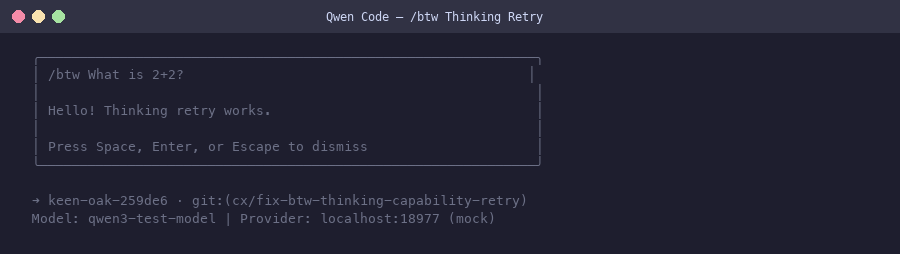
Test A: First
|
| Request | chat_template_kwargs |
Response |
|---|---|---|
| #1 (initial) | { enable_thinking: false } |
400 — restricted to True |
| #2 (auto-retry) | (removed) | 200 SSE stream ✅ |
The TUI displayed the successful response: "Hello! Thinking retry works."
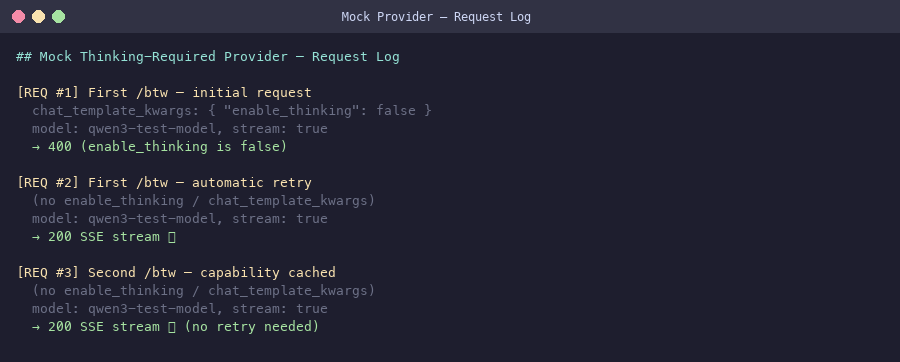
Test B: Second /btw — capability cached ✅
The second /btw What is 3+3? sent only 1 request (no retry):
| Request | chat_template_kwargs |
Response |
|---|---|---|
| #3 | (none — cached) | 200 SSE stream ✅ |
The model was remembered in requiredThinkingModels from the first retry.
Mock Provider Request Log
4. Test Summary
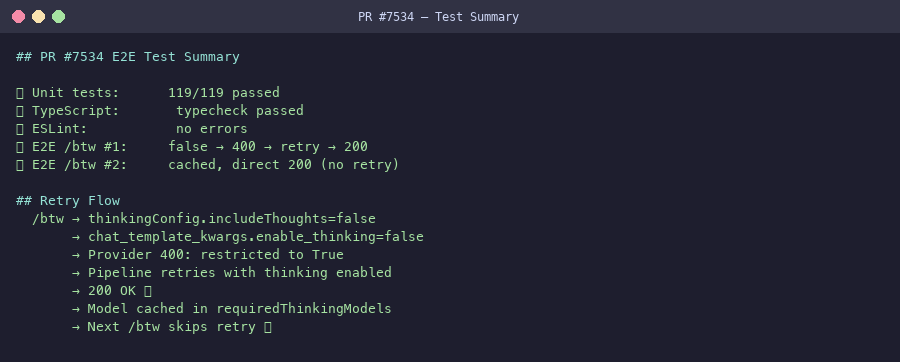
| Test | Result |
|---|---|
| Unit tests (119) | ✅ all pass |
| TypeScript typecheck | ✅ pass |
| ESLint | ✅ 0 errors |
E2E: /btw #1 retry recovery |
✅ false → 400 → retry → 200 |
E2E: /btw #2 capability cache |
✅ direct 200, no retry |
E2E: non-DashScope chat_template_kwargs path |
✅ verified |
5. Conclusion
The retry mechanism works correctly end-to-end in the real interactive TUI. The implementation is clean: one additional request only when the provider explicitly rejects enable_thinking: false, with process-local capability caching for subsequent requests. No regressions observed in the full test suite.
Verdict: ✅ Ready to merge (from a testing perspective)
中文版本
🔬 维护者 E2E 验证报告
测试人: 维护者(本地 macOS,真实交互式 TUI)
分支: cx/fix-btw-thinking-capability-retry @ 2980ad2
日期: 2026-07-23
1. 单元测试
✓ src/core/openaiContentGenerator/pipeline.test.ts (119 tests) 58ms

Test Files  1 passed (1)
     Tests  119 passed (119)
全部 119 个测试通过,包含 7 个新增测试用例,覆盖:
- Required-thinking 重试(非流式 + 流式)
- 跨请求的能力缓存
- 重试时
chat_template_kwargs清理 - 重试错误传播
- Abort signal 阻止重试
- 非 required-thinking 的 400 错误不触发重试
2. 构建 / 类型检查 / Lint
| 检查项 | 结果 |
|---|---|
npm run build |
✅ 通过 |
npm run typecheck |
✅ 通过 |
eslint(变更文件) |
✅ 0 错误 |
3. E2E 测试 — 真实交互式 TUI + Mock Provider
搭建本地 mock OpenAI 兼容 provider,拒绝 enable_thinking: false 并返回 HTTP 400(模拟 DashScope/Token Plan 行为),然后运行真实交互式 TUI 进行测试。
配置:
- Mock provider:
http://localhost:18977/v1(当enable_thinking显式为false时返回 400) - CLI 参数:
--auth-type openai --model qwen3-test-model --openai-base-url http://localhost:18977/v1 - 触发方式:
/btw命令(设置thinkingConfig.includeThoughts = false)
测试 A:第一次 /btw — 重试恢复 ✅
第一次 /btw What is 2+2? 触发了完整的重试流程:
| 请求 | chat_template_kwargs |
响应 |
|---|---|---|
| #1(初始) | { enable_thinking: false } |
400 — restricted to True |
| #2(自动重试) | (已移除) | 200 SSE stream ✅ |
TUI 显示了成功响应:"Hello! Thinking retry works."
测试 B:第二次 /btw — 能力缓存 ✅
第二次 /btw What is 3+3? 仅发送 1 个请求(无需重试):
| 请求 | chat_template_kwargs |
响应 |
|---|---|---|
| #3 | (无 — 已缓存) | 200 SSE stream ✅ |
模型在第一次重试后已被记录到 requiredThinkingModels 中。
4. 测试总结
| 测试项 | 结果 |
|---|---|
| 单元测试 (119) | ✅ 全部通过 |
| TypeScript 类型检查 | ✅ 通过 |
| ESLint | ✅ 0 错误 |
E2E:/btw #1 重试恢复 |
✅ false → 400 → retry → 200 |
E2E:/btw #2 能力缓存 |
✅ 直接 200,无需重试 |
E2E:非 DashScope chat_template_kwargs 路径 |
✅ 已验证 |
5. 结论
重试机制在真实交互式 TUI 中端到端工作正常。实现简洁:仅在 provider 明确拒绝 enable_thinking: false 时额外发送一次请求,并在进程内缓存模型能力供后续请求使用。完整测试套件未观察到回归。
结论:✅ 可以合入(从测试角度)

|
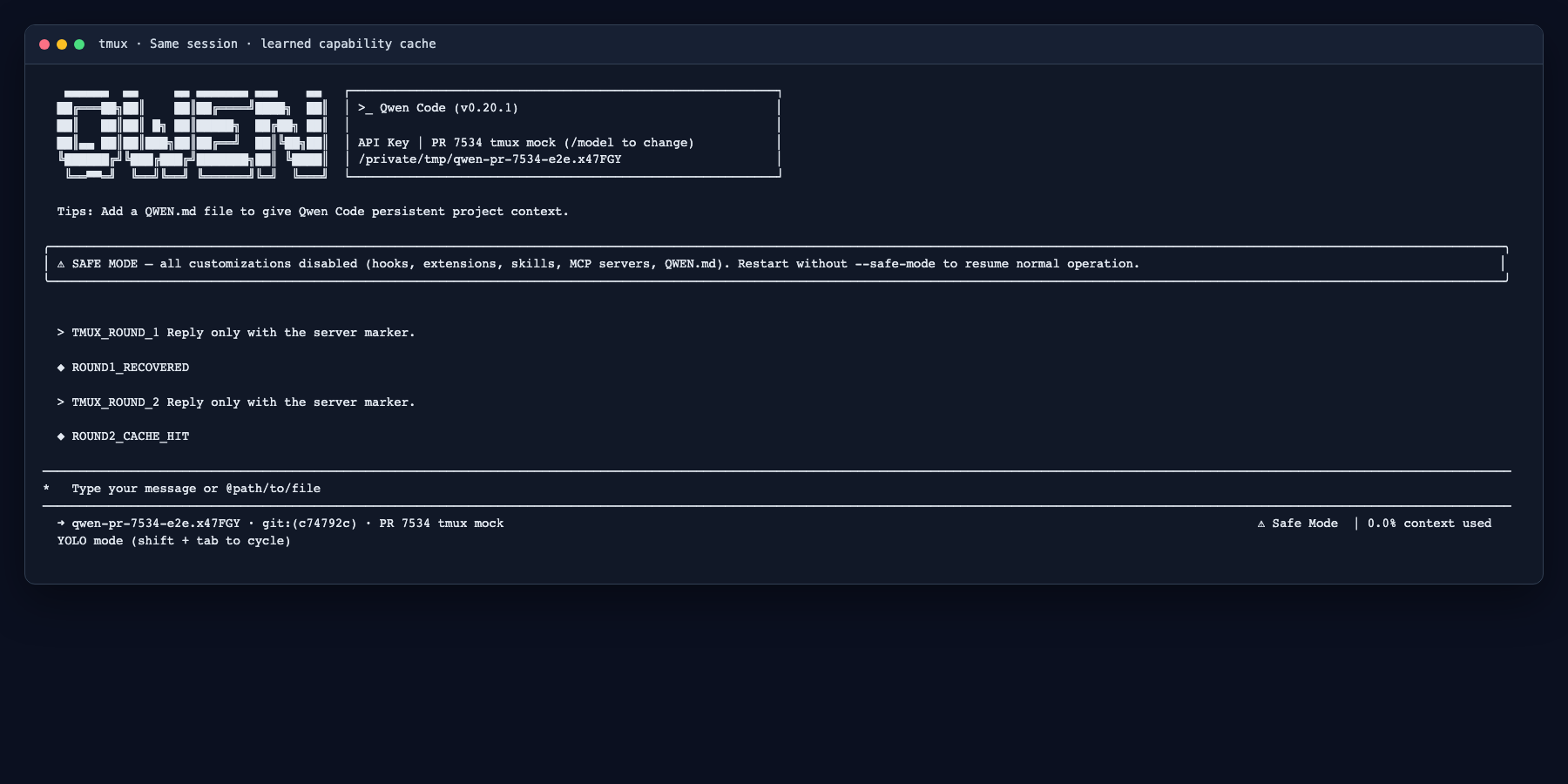
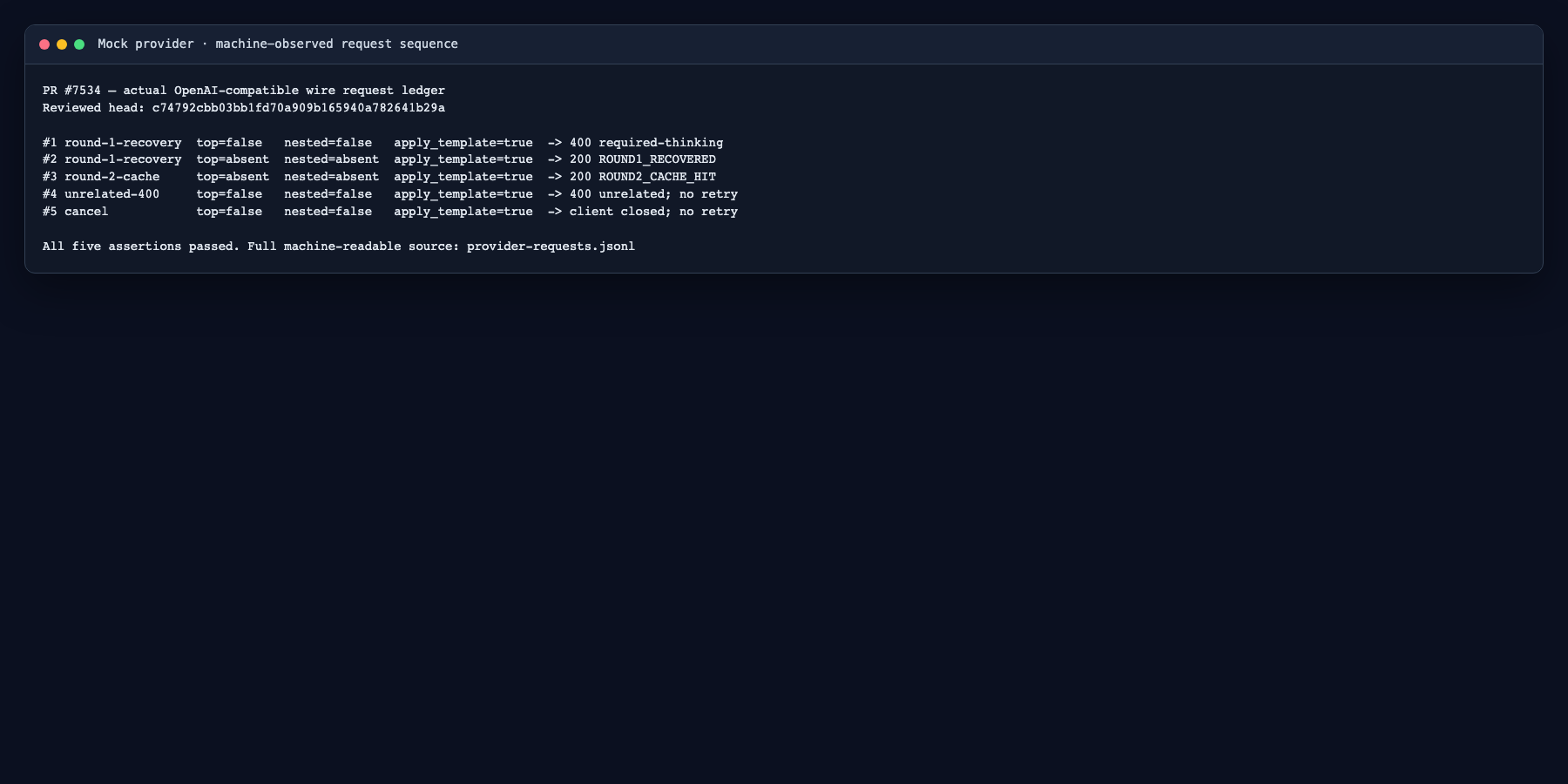
Verified the current head end-to-end with the local Qwen Code TUI in tmux and an OpenAI-compatible mock endpoint.
|
doudouOUC
left a comment
doudouOUC
left a comment
There was a problem hiding this comment.
Full review at c74792c. No issues found. LGTM! ✅
Verification
- Unit tests (local, at HEAD):
packages/corepipeline suite — 119/119 passed - Typecheck (
tsc --noEmit, core): 0 errors - CI: all checks green; mergeable
- All 8 prior review threads: resolved, and each fix verified present in HEAD code (7 fixed, 1 reasonably declined as out of scope — the
retrieddiagnostics marker)
Key points checked (all evidence-based against HEAD)
- Non-DashScope
thinkingMandatoryblock expansion — no regression: the new block only strips an existingenable_thinking: false(top-level orchat_template_kwargs), andtool_choicedeletion stays DashScope-gated. Semantics match "a mandatory-thinking model must never see a disabled shape on the wire". - Model-key normalization — the learned Set writes
context.model.toLowerCase()and reads via the same source and normalization inbuildRequest→requiresThinking; no case-mismatch dead path. - Streaming error timing — the SDK rejects HTTP 400 at
withResponse()before iteration, inside the executor, so the retry catches it. Mid-stream SSE error chunks bypass the retry, but a parameter-validation 400 always surfaces at creation time. - Double capture/diagnostics on retry — the capture consumer keeps only the last (successful) wire request;
runtimeDiagnosticsjust appends summaries. Cosmetic only. getRateLimitErrorDetailson arbitrary errors — despite the name it is a generic provider-error-field extractor; safe (?.-guarded, never throws).- Set scope & growth — per-pipeline (per content-generator config), bounded by distinct models that actually hit the required-thinking 400.
openaiRequestclosure —undefined-safe before firstbuildRequest;handleErrornever consumes it; no stale-reference path.- Interaction with outer
retryWithBackoff— outer layers explicitly do not retry 400s; the inner one-shot semantic retry cannot multiply. - Config vs learned key space — the Set keys on the actual wire model; the config branch additionally requires
model === config.model. Complementary, no cross-contamination. - Test quality — all assertions are on the actual
chat.completions.createwire arguments, covering retry+cache, bothchat_template_kwargsshapes, retry failure, abort guard, negative regex cases, and streaming retry. No blind spots that could pass with broken production code.
Non-blocking note
If a future provider surfaces the required-thinking error as a mid-stream SSE error chunk instead of an HTTP 400 at stream creation, the retry will not fire. That is a potential enhancement for new provider behavior, not a regression in this PR.
中文说明
在 c74792c 上完成全面审查,无问题,LGTM ✅。本地实跑 119/119 单测通过、core 类型检查零错误、CI 全绿、8 条历史 review threads 全部闭环且逐条核实修复确实在 HEAD 代码中。重点核查了非 DashScope 的 thinkingMandatory 块扩展、模型名归一化一致性、streaming 400 的错误时机、重试双记录、getRateLimitErrorDetails 安全性、Set 作用域、闭包变量安全、与外层 retryWithBackoff 的交互、配置/学习两分支键空间、以及测试断言有效性——均无问题。唯一非阻塞备注:若未来 provider 以 SSE 流中 error chunk 形式返回该错误则不会重试,属新 provider 行为的增强空间,非本 PR 回归。

5 participants


What this PR does
This change retries an OpenAI-compatible request once when the actual wire request sent
enable_thinking: falseand the provider returns HTTP 400 explicitly requiring it to betrue. The retry rebuilds the request through the existing pipeline and remembers the model capability for the lifetime of that provider pipeline. Streaming and non-streaming requests share the same behavior; unrelated 400 responses and cancelled requests are unchanged.Why it's needed
#7303 added a config-driven
thinkingMandatorycapability for the current qwen3.8 Token Plan preset. Existing and custom provider configurations may still containextra_body.enable_thinking: truewithout that capability field, so/btwcan override it withfalseand reproduce the original 400 on 0.20.1.Learning from the provider's explicit capability response closes that gap without adding another Token Plan or model-name special case.
Reviewer Test Plan
How to verify
Use an existing or custom Token Plan model configuration that enables thinking but does not include
thinkingMandatory. The first/btwrequest should recover from the required-thinking 400 and complete; the next/btwrequest for the same model should send thinking enabled immediately. Confirm that an unrelated 400 is not retried and cancelling before the provider response does not start a retry.Evidence (Before & After)
Before, a real Token Plan request on 0.20.1 failed with:
400 The value of the enable_thinking parameter is restricted to True.After, a real interactive TUI and OpenAI SDK protocol-boundary test produced:
/btw:false → required-thinking 400 → true → BTW_RETRY_OK/btw:true → BTW_CACHE_OKfalserequest, no retryfalserequest, no retryTested on
Environment (optional)
Local TypeScript workspace using the real interactive TUI, OpenAI SDK, and a local HTTP/SSE protocol-boundary provider.
Risk & Scope
Linked Issues
Follow-up to #7284
Related to #7440 and #7303
中文说明
本 PR 做了什么
当实际发送的 OpenAI 兼容请求包含
enable_thinking: false,且 provider 返回 HTTP 400 并明确要求该参数必须为true时,本改动会重试一次。重试会通过现有 pipeline 重新构造请求,并在当前 provider pipeline 的生命周期内记住该模型能力。流式和非流式请求共用相同行为;无关的 400 响应和已取消请求保持不变。为什么需要
#7303 为当前 qwen3.8 Token Plan preset 增加了配置驱动的
thinkingMandatory能力。已有或自定义 provider 配置可能仍然只有extra_body.enable_thinking: true,而没有这个能力字段,因此/btw仍会把它覆盖为false,并在 0.20.1 上复现原始 400。根据 provider 明确返回的能力约束进行学习,可以覆盖这个缺口,同时不需要继续增加 Token Plan 或模型名称特判。
Reviewer Test Plan
如何验证
使用一个开启 thinking、但没有
thinkingMandatory的已有或自定义 Token Plan 模型配置。第一次/btw请求应从 required-thinking 400 中恢复并完成;同一模型的下一次/btw应直接开启 thinking。同时确认无关 400 不会触发重试,并且在 provider 响应前取消请求不会启动重试。证据(修改前后)
修改前,0.20.1 上的真实 Token Plan 请求失败:
400 The value of the enable_thinking parameter is restricted to True.修改后,真实交互式 TUI 与 OpenAI SDK 协议边界测试结果:
/btw:false → required-thinking 400 → true → BTW_RETRY_OK/btw:true → BTW_CACHE_OKfalse请求,不重试false请求,不重试测试平台
环境(可选)
本地 TypeScript 工作区,使用真实交互式 TUI、OpenAI SDK 和本地 HTTP/SSE 协议边界 provider。
风险与范围
关联 Issue
Follow-up to #7284
Related to #7440 and #7303