feat(web-shell): add git mode selector for new session creation - #7471
Conversation


Support three git workflows when creating a new session:
1. Current branch (default, unchanged behavior)
2. New branch — daemon runs git checkout -b before spawning
3. Worktree isolation (existing, now unified into the same UI)

The mode selector lives in the composer's git chip as a popover,
replacing the previous worktree-only toggle in the welcome header.

API: POST /session accepts branch: { name } (mutually exclusive
with worktree). Server validates branch name, checks dirty tree,
creates branch, and rolls back on spawn failure.

Design doc: docs/design/2026-07-22-webshell-session-git-mode.md

|
Re-run at Template: Core sections present and well-filled — What this PR does, Why it's needed, Reviewer Test Plan with step-by-step verification and Playwright screenshots. Missing the Tested on / Risk & Scope / Linked Issues sections from the template, but the body is thorough enough that this is a minor gap, not a blocker. Problem: Real workflow gap, not theoretical. Users who want to "start a new branch for this task" currently have to manually Direction: Aligned. This extends the existing worktree session infrastructure with a third, lighter-weight git workflow. CHANGELOG shows Claude Code has been investing in worktree and git-related features (worktree-isolated subagents, worktree symlink fixes, etc.), so the area is actively relevant. The unified popover replacing the worktree-only toggle is a clean UX consolidation. Size: Cross-package change spanning Approach: The implementation mirrors the existing Moving on to code review. 🔍 中文说明在 模板: 核心章节齐全且内容充实——PR 做了什么、为什么需要、评审者测试计划(含逐步验证步骤和 Playwright 截图)。缺少模板中的 测试环境 / 风险与范围 / 关联 Issue 章节,但 PR 描述已足够详尽,这只是小瑕疵,不构成阻塞。 问题: 真实的工作流缺口,非理论性问题。用户想"开个新分支做这个任务"时,目前只能手动 方向: 对齐。这是在现有 worktree 会话基础设施上扩展第三种更轻量的 git 工作流。CHANGELOG 显示 Claude Code 一直在投资 worktree 和 git 相关功能,该领域持续活跃。用统一 popover 替代仅 worktree 的开关是干净的 UX 整合。 规模: 跨包变更,涉及 方案: 实现几乎逐行镜像现有 进入代码审查 🔍 — Qwen Code · qwen3.8-max-preview Reviewed at |
Code reviewRe-run at No critical blockers found. Specific observations:
sequenceDiagram
    participant P1 as Web Shell composer
    participant P2 as Daemon POST session
    participant P3 as git
    participant P4 as Session bridge
    P1->>P2: createSession with branch name
    P2->>P2: validate name, reject if worktree also set
    P2->>P3: rev-parse, status porcelain (exists, dirty)
    P2->>P2: check inFlight and activeBranchSessions guards
    P2->>P3: checkout -b name
    P2->>P4: spawnOrAttach with branch meta
    P4-->>P2: session
    P2->>P2: activeBranchSessions.set, clear inFlight
    P2-->>P1: 200 with branch name and baseBranch
    Note over P2,P3: on spawn failure, checkout baseBranch then branch -D name
Files changed (35 total, key files shown)
Real-scenario testingRan the actual daemon from this PR's code ( Unit tests (all pass on this head):
中文说明代码审查在 未发现关键阻塞项。 具体观察:
真实场景测试从本 PR 代码( 单元测试(在此 head 上全部通过):
— Qwen Code · qwen3.8-max-preview Reviewed at |
|
Confidence: 4/5 — clean, well-tested implementation that does exactly what it promises; the design mirrors existing patterns, the security surface is tight, and real-scenario testing confirms every path works. Capped at 4 (not 5) because the cross-package scope is wide and the Stepping back: this PR solves a real, everyday friction — "I want to start a new branch for this task" shouldn't require a manual The one thing a maintainer should consciously accept: "new branch" mode mutates the shared workspace HEAD. That's the point of the feature, but it's a different safety model from worktree isolation. The dirty-tree check and the one-branch-session-per-workspace guard mitigate the obvious footguns, but a user with two browser tabs and no attached client in one could still be surprised. The design doc acknowledges this ("不做会话结束时自动切回原分支") and the tradeoff is reasonable for v1. After seeing it run, the results match what the PR promised. Every error path returns the right code and message; the happy path creates the branch, switches HEAD, and returns the metadata. 245 unit tests pass across all touched packages. If I had to maintain this in six months, I'd thank the author — the code reads like the worktree flow's sibling, not a bolt-on. Approving. ✅ 中文说明置信度:4/5 —— 干净、测试充分的实现,完全兑现了承诺;设计镜像现有模式,安全面收紧,真实场景测试确认每条路径均正常工作。给 4 而非 5,是因为跨包范围较广,且 退一步看:这个 PR 解决了一个真实的日常摩擦——"我想为这个任务开个新分支"不应该需要手动 维护者应有意识接受的一点:"新建分支"模式会改变共享 workspace 的 HEAD。这是功能的设计目的,但与 worktree 隔离是不同的安全模型。脏树检查和每 workspace 单分支会话守卫缓解了明显的误操作,但用户若开了两个浏览器标签且其中一个无已连接客户端,仍可能感到意外。设计文档承认了这一点("不做会话结束时自动切回原分支"),对 v1 而言权衡合理。 运行结果与 PR 承诺一致。每条错误路径返回正确的代码和消息;正常路径创建分支、切换 HEAD、返回元数据。245 个单元测试在所有触及的包中通过。如果六个月后我要维护这段代码,我会感谢作者——代码读起来像 worktree 流程的兄弟,而非外挂。 批准。✅ — Qwen Code · qwen3.8-max-preview Reviewed at |
The portal container used by Web Shell's Popover primitive is not
recognized by Radix's DismissableLayer, causing the popover to close
on any interaction. Add onInteractOutside prevention so the popover
only closes via explicit selection.

Also replace prototype screenshots with real Playwright captures and
add e2e test + screenshot capture script.
…ader

The composer git chip popover now fully covers worktree selection,
making the welcome header toggle/badge redundant. Remove the toggle
UI, its state (worktreeToggleEligible, refs, handlers, focus effect),
and all associated tests (unit + e2e + visuals).
- Add missing setSessionBranch(undefined) in loadSidebarSession,
  createNewSession, and session switch effect (!sid path)
- Add setSessionBranch(summary.branch) in session status restore
- Add branch rollback in client disconnect (!res.writable) path
- Fix onInteractOutside: use containment check instead of
  unconditional prevention so genuine outside clicks close popover
- Hoist promisify(execFile) to module level
- Narrow reserved branch name check to only HEAD (FETCH_HEAD etc.
  are valid branch names)

|
@qwen-code /takeover |
 qwen-code-dev-bot
added
the
autofix/takeover
qwen-code-dev-bot
added
the
autofix/takeover


|
🤝 Takeover engaged: the autofix loop now manages this PR — it will address new review feedback and resolve base conflicts until the label is removed or the round cap is reached. Remove the 中文说明🤝 已接管:autofix 循环现在管理此 PR —— 将持续处理新的评审反馈与 base 冲突,直到移除标签或达到轮次上限。移除 |

…564e

# Conflicts:
#	packages/web-shell/client/App.test.tsx
#	packages/web-shell/client/App.tsx
|
🤖 Addressed the latest review feedback (round 1/100). What changed, and what I pushed back on: Review feedback addressedConflict resolutionMerged
Feedback points
Verification
中文说明已处理的评审反馈冲突解决将
反馈要点
验证结果
Base-conflict check: conflicted with main — resolved in this push. Re-review when you have a moment. After round 100 this bot stops and leaves the PR for a human. 🧠 Handled by Qwen Code · model/模型 |
🖼️ web-shell visual previewRendered against a mock daemon (no real backend): the PR base vs this PR head Screenshots · before / after
Full-resolution recordings (.webm) are attached to the workflow run. — Qwen Code · web-shell visuals |
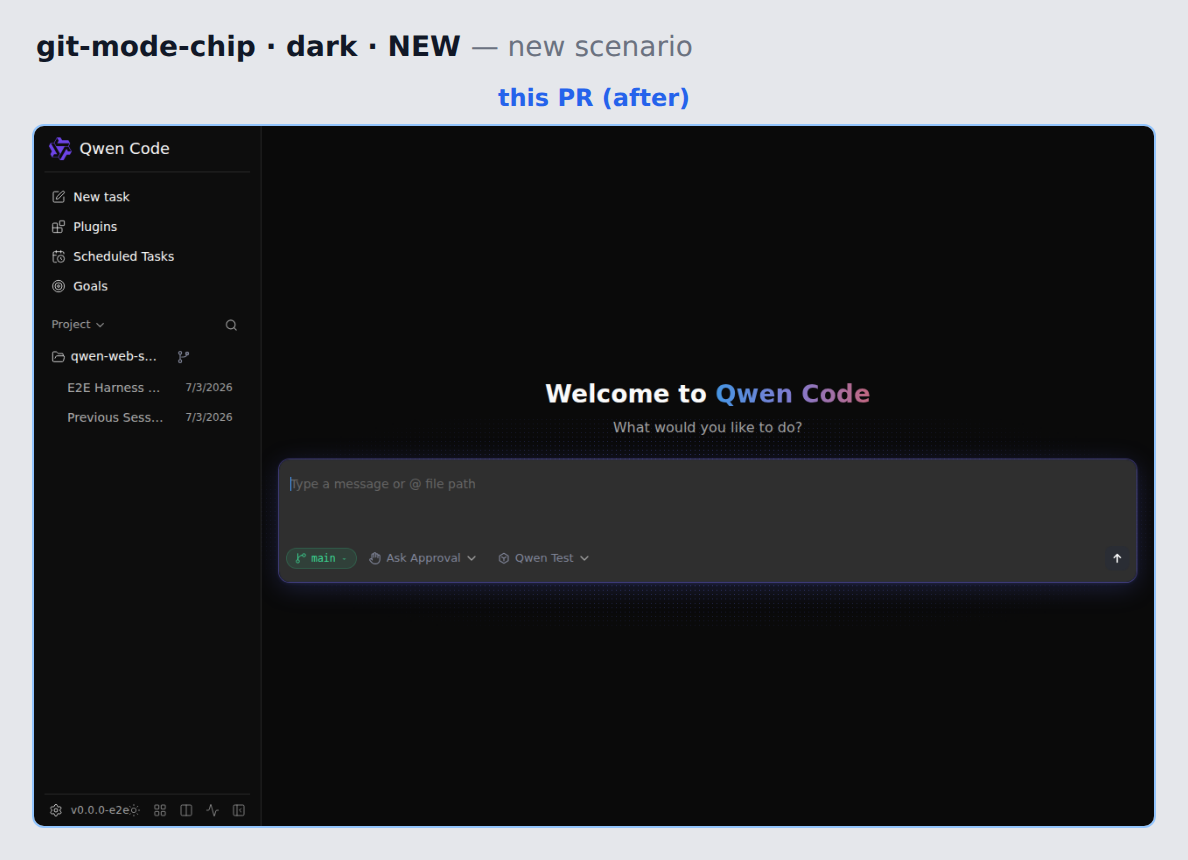
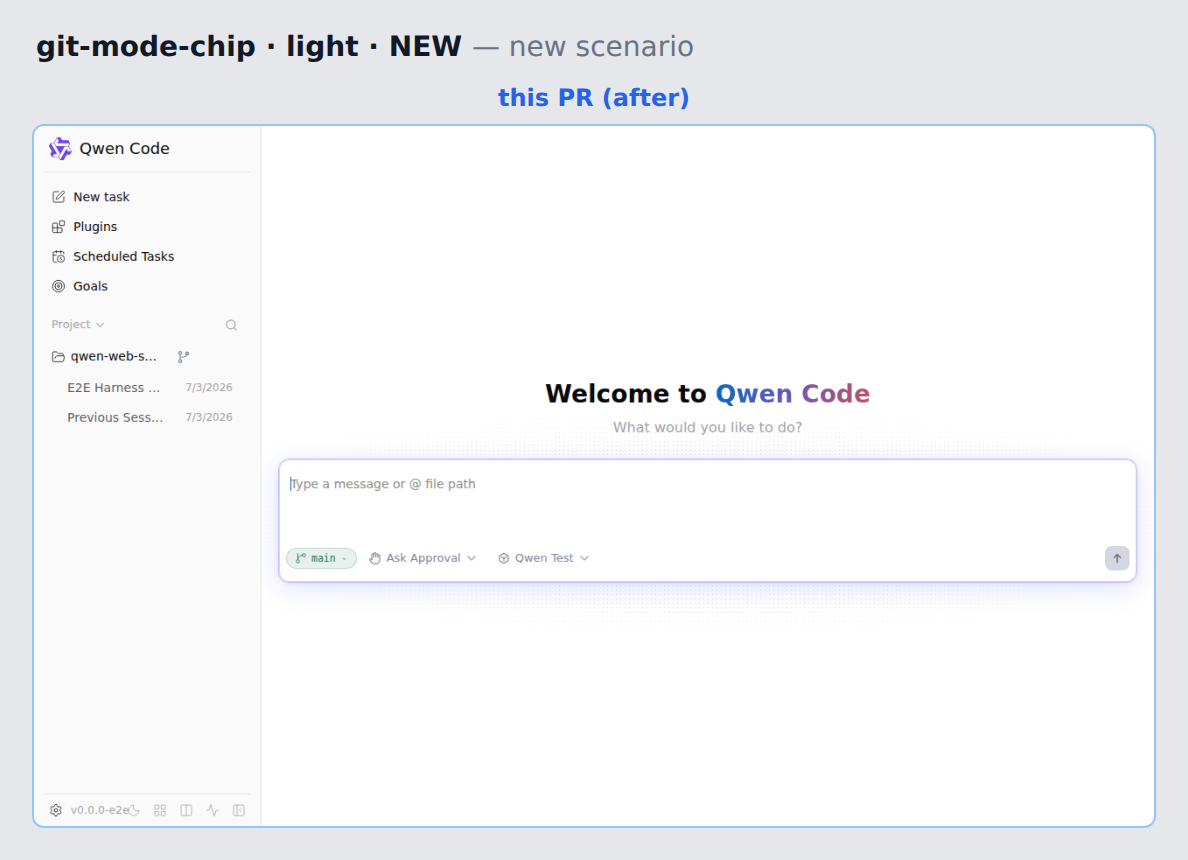
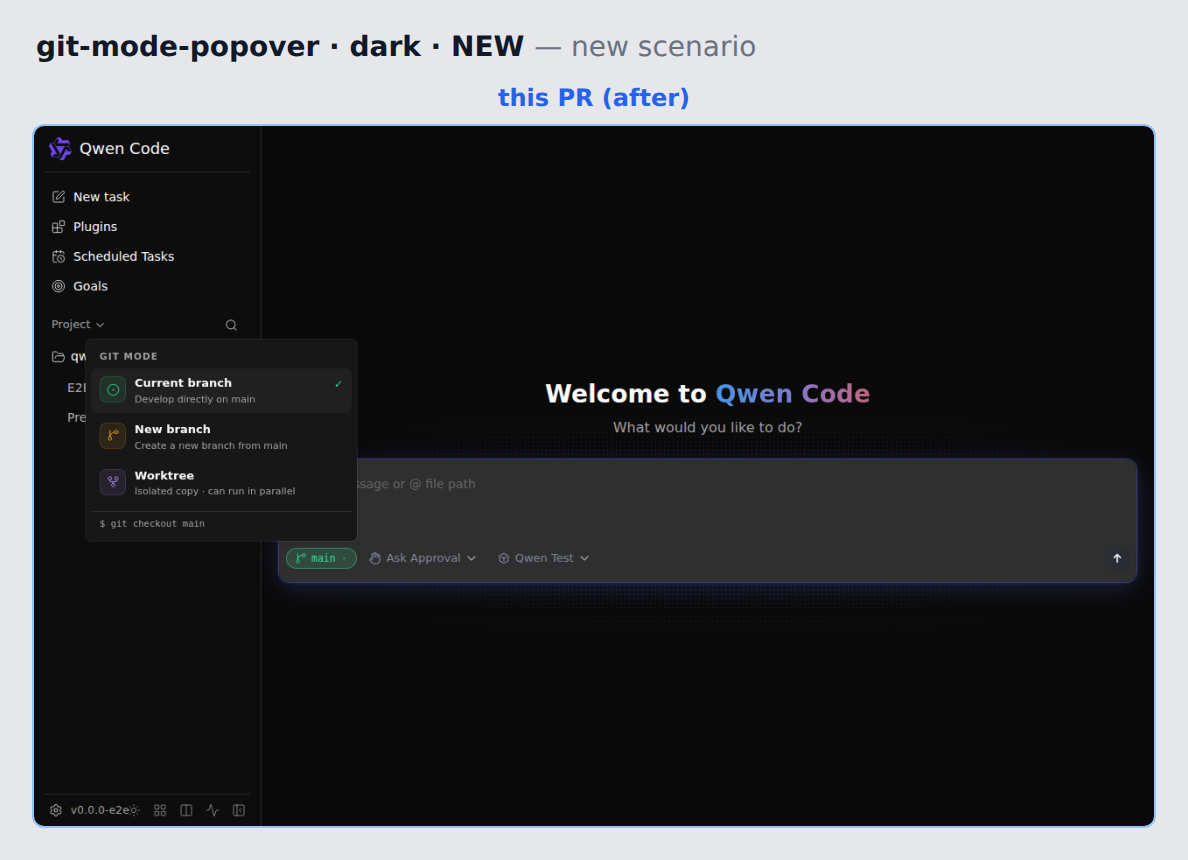
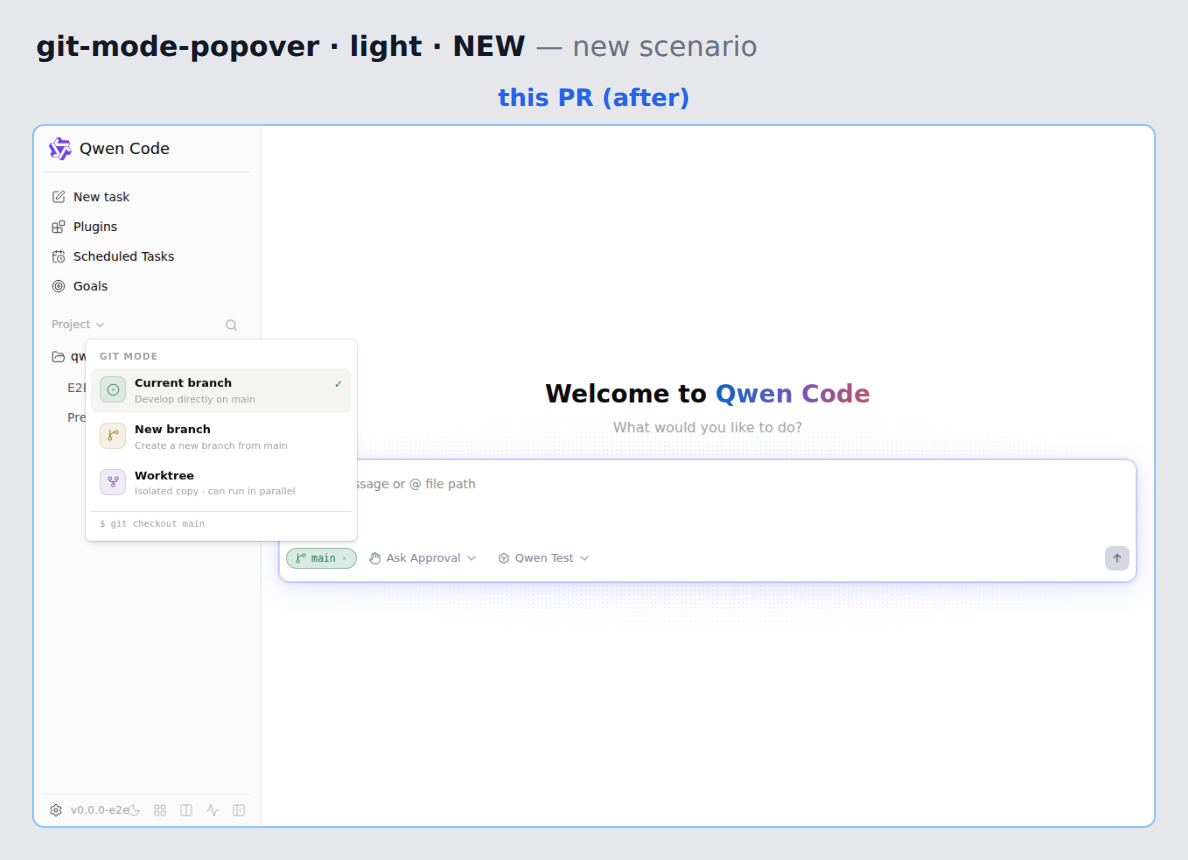

Code Coverage Summary
CLI Package - Full Text ReportCore Package - Full Text ReportFor detailed HTML reports, please see the 'coverage-reports-22.x-ubuntu-latest' artifact from the main CI run. |
🩺 serve daemon A/BBuilt the PR base vs this PR head ✅ No response changes against the PR base across 4 scenario(s). — Qwen Code · serve A/B |
Code Review —
|
 qwen-code-ci-bot
left a comment
qwen-code-ci-bot
left a comment
qwen-code-ci-bot
left a comment
There was a problem hiding this comment.
Not reviewed: reverse audit — an auditor ran and opened its brief, but no agent was launched with the prompt the CLI built — the launch was written by hand, and what the agent was actually asked is not what this skill certifies.
[Critical] DaemonSessionProvider.tsx:2282-2309: createDetachedSession Pick type ('approvalMode' | 'sourceType' | 'worktree') omits 'branch'. On the cold-start (no active session) path, the branch override is silently dropped — session created on current branch with no error despite user selecting 'New branch' in the UI.
— qwen3.7-max via Qwen Code /review
| // ── Branch creation ──────────────────────────────────────────── | ||
| // When `branch` is present, create and checkout a new git branch | ||
| // before spawning. The session runs in the same working directory | ||
| // but on the new branch. Mutually exclusive with `worktree`. | ||
| let branchMeta: { name: string; baseBranch: string } | undefined; |
There was a problem hiding this comment.
[Suggestion] The branch creation path (~116 lines: validation, git ops, concurrency guard, rollback) has no unit tests, while the parallel worktree path has comprehensive coverage in server.test.ts. Six validation checks, two subprocess calls, the activeBranchSessions concurrency map, and multi-step rollback can all regress silently.
Failure scenario: A regex change accepts an invalid name or rejects a valid one; a refactor skips the dirty-tree check; rollback fails to switch back to the base branch (.catch(() => {}) swallows the failure).
Suggested fix: Add unit tests to server.test.ts mirroring the worktree test structure: (1) success, (2) 400 mutual exclusion, (3) 400 invalid name, (4) 400 non-git repo, (5) 409 branch exists, (6) 409 dirty tree, (7) 409 concurrent conflict, (8) 500 checkout failure, (9) rollback verification on spawn failure.
— qwen3.7-max via Qwen Code /review
This PR adds the new-session git-mode selector (current branch / new branch /
worktree) but no visuals scenario renders it, so the before/after preview showed
no image for an entirely new UI — the empty result was a coverage gap, not a
clean bill of health. The PR also removed the `worktree empty state` scenario
(its `worktree-welcome-toggle` no longer exists, replaced by this popover),
leaving the suite with no view of the new-session empty state at all.

Add a `git mode selector` scenario that seeds a trusted git-repo workspace and
lands on the empty state (the only place App.tsx wires the intent props), then
captures the composer chip and the opened three-mode popover in both themes.
Both are byte-stable across runs (0% pixel diff), and asserting an option is
visible makes a regression that fails to open the popover fail here rather than
only in the screenshot.

The branch-name sub-state is deliberately not captured: its input autoFocuses
and the popover then dismisses on the idle frame the capture waits for, so it
can't be shot stably through this pipeline — the functional
web-shell.git-mode.spec.ts already drives that path. Restores the empty-state
coverage this PR dropped and gives the new selector a head-only (NEW) preview.
- Forward the branch override in createDetachedSession so the cold-start
  (no active session) path no longer silently drops a user-selected new
  branch.
- Reserve the workspace before 'git checkout -b' to close the TOCTOU in
  the activeBranchSessions guard; two concurrent branch creations could
  both pass the guard and race on HEAD. The reservation is released on
  every exit path.
- Return (and close the browser) when the branch input never appears in
  the screenshot script instead of falling through to a guaranteed throw.
- Add an e2e test asserting the default current-branch submit sends
  neither branch nor worktree.
|
🤖 Addressed the latest review feedback (round 2/100). What changed, and what I pushed back on: Review feedback addressedCommit Implemented[Critical] 🟠 TOCTOU in the [rc:3628338013] Screenshot script catch block falls through (automated reviewer) [rc:3628338028] No E2E test for the default "current branch" submit path (automated reviewer) Deferred (recorded reasons)
Verification
中文说明已处理的评审反馈提交 已实现[Critical] 🟠 [rc:3628338013] 截图脚本的 catch 块未返回(自动评审机器人) [rc:3628338028] 缺少默认“当前分支”提交路径的 E2E 测试(自动评审机器人) 延后处理(附记录原因)
验证
Base-conflict check: no conflict with main. Re-review when you have a moment. After round 100 this bot stops and leaves the PR for a human. 🧠 Handled by Qwen Code · model/模型 |

 gwinthis
left a comment
gwinthis
left a comment
gwinthis
left a comment
There was a problem hiding this comment.
Architecture Review — PR #7471
Verdict: ✅ Approve — well-designed unified git mode selector.
Design pattern: Unified intent state machine
Replaces the previous pendingWorktreeRef + worktreePending boolean with a single discriminated union:
type SessionGitIntent =
  | { mode: 'current' }
  | { mode: 'branch'; name: string }
  | { mode: 'worktree'; slug?: string };
One state variable, one setter, one clear-on-success path. The old code had two coupled pieces of state (ref + boolean) that could drift; the union makes illegal states unrepresentable.
Key design decisions
-
Composer-embedded UI: The mode selector lives in the composer's bottom toolbar (git chip position), not as a separate welcome block. The entry point is where the user's attention already is — no vertical space cost in the welcome area.
-
Server-side validation only: Branch name validation, dirty tree detection, and conflict checking all happen server-side. The UI does NOT pre-detect dirty state — this avoids divergence from git's actual behavior at execution time.
-
TOCTOU prevention:
inFlightBranchWorkspacesSet closes the race between the conflict guard andactiveBranchSessions.set()(which only happens after spawn). The synchronous check-and-add (no await between) serializes the checkout. -
Symmetric rollback: On spawn failure or client disconnect:
git checkout baseBranch && git branch -D name— mirrors the existing worktree rollback pattern exactly. -
Concurrency guard: Only one branch session per workspace (they share HEAD), but worktree sessions are unlimited (independent directories). The guard correctly distinguishes the two isolation models.
-
Command preview: Popover footer shows the exact git command (
$ git checkout -b feat/x ← main) — transparency principle, the user knows exactly what will happen.
Minor observation
The validateBranchName function is duplicated between GitModePopover.tsx (client-side UX feedback) and routes/session.ts (server-side enforcement). This is intentional and correct — the client copy is for immediate UX feedback, the server copy is the authoritative check. The two could drift, but the server always wins.
Code Review —
|
|
🤖 Addressed the latest review feedback (round 3/100). What changed, and what I pushed back on: Review Feedback Summary — PR #7471Feedback from @gwinthis (Architecture Review, Approve)No action items — the review is a positive architecture assessment with no requested changes. Feedback from @wenshao (Code Review)
Changes
Verification
ConflictNo conflict — 中文说明审查反馈总结 — PR #7471来自 @gwinthis 的反馈(架构审查,批准)无需处理——该审查是对架构的正面评价,未提出任何修改要求。 来自 @wenshao 的反馈(代码审查)
变更内容
验证结果
冲突无冲突—— Base-conflict check: no conflict with main. Re-review when you have a moment. After round 100 this bot stops and leaves the PR for a human. 🧠 Handled by Qwen Code · model/模型 |
Code review —
|
qwen-code-ci-bot
left a comment
qwen-code-ci-bot
left a comment
There was a problem hiding this comment.
Not reviewed: reverse audit of chunks 1, 3, 4, 5, 6, 7, 8, 9, 10, 11, 12, 13 — launched with a prompt that is not the one the CLI built.
Not reviewed: reverse audit — an auditor ran and opened its brief, but no agent was launched with the prompt the CLI built — the launch was written by hand, and what the agent was actually asked is not what this skill certifies.
— qwen3.7-max via Qwen Code /review
| try { | ||
| await createBranch(workspaceCwd, branchName); | ||
| } catch (checkoutErr) { | ||
| inFlightBranchWorkspaces.delete(workspaceCwd); |
There was a problem hiding this comment.
[Critical] createBranch() catch block does not roll back when git partially created the branch. — Failure scenario: A failing post-checkout hook (or timeout after ref update) causes createBranch to reject, but git has already created and checked out the branch. The catch block releases inFlightBranchWorkspaces and returns branch_checkout_failed, but because branchMeta is assigned after the await, none of the existing rollback paths run. The API reports failure and creates no session while silently leaving the shared workspace on the new branch; a retry gets branch_already_exists, and ordinary sessions operate on the unintended branch.
Fix: after any createBranch() rejection, inspect whether HEAD moved or the target branch now exists, restore baseBranch/baseCommit, and delete the partially-created branch when safe.
— qwen3.7-max via Qwen Code /review
…out branch creation (#7471)
|
🤖 Addressed the latest review feedback (round 9/100). What changed, and what I pushed back on: · 已处理最新评审反馈(第 9/100 轮)。改动内容与我反驳保留之处如下: Review feedback addressedRe-review feedback on Implemented1. [Critical] Roll back when
The catch is now transactional: it calls the existing
2. Shared-checkout hazard — the merge gate (@ytahdn's open Critical, endorsed by @wenshao) The reservation guard only prevented branch-vs-branch conflicts; a concurrent current-branch session in the same workspace was not blocked, so Added a same-cwd guard in the 3. [Low] Added byte-length caps to both predicates (kept in sync like the rest of the validation): reject when any 4. Nit (a11y) The three mode options now expose Deferred (recorded, not dropped)
VerificationCommands actually run (in the workflow checkout, after the commit):
No settings source changed, so 中文说明已处理的评审反馈针对 已实现1. [Critical]
现在该 catch 是事务性的:调用已有的
2. 共享 checkout 隐患——合并门槛(@ytahdn 未关闭的 Critical,由 @wenshao 背书) 保留守卫此前只防分支对分支冲突;同一工作区内并发的当前分支会话不受阻拦,因此 在 3. [Low] 在两端谓词中都加了字节长度上限(与校验其余部分一样保持同步):任一 4. 无障碍小问题(Nit) 三个模式选项现在暴露 延后处理(已记录,非丢弃)
验证实际运行的命令(在工作流 checkout 中,提交之后):
未改动任何 settings 源,故无需 Base-conflict check · 基分支冲突检查: no conflict with main. · 与 main 无冲突。 Re-review when you have a moment. After round 100 this bot stops and leaves the PR for a human. · 有空请复审;第 100 轮后本 bot 停止并将 PR 交给人工。 🧠 Handled by Qwen Code · model/模型 |
qwen-code-ci-bot
left a comment
qwen-code-ci-bot
left a comment
There was a problem hiding this comment.
Reviewed. Suggestions are inline. Unresolved, please confirm: [Critical] selection-text.ts:7 — ink patch missing semantic selection types (out of this PR's diff scope; build passes at PR head but types not verified against the patch file) [Critical] @ytahdn shared-checkout session protection — code has a guard for live non-worktree sessions with dirty-tree check mitigation, but whether this is sufficient is a design decision requiring maintainer confirmation [Critical] @ytahdn TOCTOU improvements — the concurrent guard has activeBranchSessions + inFlightBranchWorkspaces with stale-entry self-healing, but whether further hardening is needed is a design decision [Critical] @ytahdn branch metadata persistence — branch data exists only in memory on the live bridge SessionEntry; whether this should be persisted across daemon restart is a design decision [Critical] DaemonSessionProvider.tsx:2282 — branch field on cold-start path (autofix rounds claim addressed but body truncated; could not verify against current code) Not reviewed: reverse audit — no auditor was launched with a prompt this skill builds — the pass that hunts what the rest of the review missed ran, if at all, without the method its brief carries. Not reviewed: verification — the review posts findings, but no verifier was launched with a prompt this skill builds — they were ruled on, if at all, without the verdict bar its brief carries.
— qwen3.7-max via Qwen Code /review
|
🤖 Addressed the latest review feedback (round 10/100). What changed, and what I pushed back on: · 已处理最新评审反馈(第 10/100 轮)。改动内容与我反驳保留之处如下: Autofix review round — PR #7471Addressed the actionable inline review findings. The two review bodies Inline findings
Conflicts
Verification
中文说明Autofix 审查轮次 — PR #7471已处理可操作的行内审查意见。两条 review 正文( 行内意见
冲突
验证
Base-conflict check · 基分支冲突检查: no conflict with main. · 与 main 无冲突。 Re-review when you have a moment. After round 100 this bot stops and leaves the PR for a human. · 有空请复审;第 100 轮后本 bot 停止并将 PR 交给人工。 🧠 Handled by Qwen Code · model/模型 |


qwen-code-ci-bot
left a comment
qwen-code-ci-bot
left a comment
There was a problem hiding this comment.
Reviewed. Suggestions are inline. Unresolved, please confirm: [Critical] session.ts — @ytahdn shared-checkout session protection: code has a guard for live non-worktree sessions with dirty-tree check mitigation, but whether this is sufficient is a design decision requiring maintainer confirmation [Critical] session.ts — @ytahdn TOCTOU improvements: concurrent guard has activeBranchSessions + inFlightBranchWorkspaces with stale-entry self-healing, but whether further hardening is needed is a design decision [Critical] session.ts — @ytahdn branch metadata persistence: branch data exists only in memory on the live bridge SessionEntry; whether this should be persisted across daemon restart is a design decision Not reviewed: reverse audit — an auditor ran and opened its brief, but no agent was launched with the prompt the CLI built — the launch was written by hand, and what the agent was actually asked is not what this skill certifies.
— qwen3.7-max via Qwen Code /review

 ytahdn
left a comment
ytahdn
left a comment
ytahdn
left a comment
There was a problem hiding this comment.
LGTM. 增量 review 无 Critical 缺陷。
核心确认:
- Branch 创建流程:验证 → 并发检查(
activeBranchSessions)→ TOCTOU guard(inFlightBranchWorkspaces)→ dirty tree 检查 →git checkout -b→ spawn → 失败回滚(先 checkout base 再 delete branch,顺序正确) - git-branch-ops:所有操作 30s timeout,
deleteBranch用-Dforce delete(rollback 正确),isDirtyTree用--untracked-files=no(仅 tracked changes) - GitModePopover:radio-style ARIA(
role=radio+aria-checked),validateBranchName镜像服务端(TextEncoderUTF-8 byte 计数),portal containeronInteractOutside处理 - App.tsx:
gitModeIntent替代旧pendingWorktreeRef,sessionBranch从 server 恢复(同 worktree 模式) - sessionPreparation:
branch参数透传 + 返回值并列 - 测试覆盖:server(创建/dirty/并发/TOCTOU/rollback)+ git-branch-ops + GitModePopover + E2E
实现与 worktree 模式一致,防御性编程到位。
— qwen3.7-plus via Qwen Code /review
|
@qwen-code /triage |
qwen-code-ci-bot
left a comment
qwen-code-ci-bot
left a comment
There was a problem hiding this comment.
LGTM, looks ready to ship. ✅

|
🤖 Addressed the latest review feedback (round 11/100). What changed, and what I pushed back on: · 已处理最新评审反馈(第 11/100 轮)。改动内容与我反驳保留之处如下: Review feedback addressed[Suggestion] rc:3642693022 — Missing test for workspace-scoped batch delete clearing branch-session entryDecision: Implemented. Change: Added
This mirrors the existing [Critical] Design-decision questions (3 items)Decision: Declined — not actionable in this headless workflow. All three "Critical" items are framed as design decisions requiring maintainer confirmation:
These are product/architecture questions that require maintainer input, not code defects that can be fixed autonomously. Verification
中文说明已处理的评审反馈[建议] rc:3642693022 — 缺少工作区级批量删除清除分支会话条目的测试决定: 已实现。 变更: 在
这与现有的 [严重] 设计决策问题(3 项)决定: 拒绝 — 在此无头工作流中不可操作。 所有三个"严重"项都被表述为需要维护者确认的设计决策:
这些是需要维护者输入的产品/架构问题,而非可以自主修复的代码缺陷。 验证
Base-conflict check · 基分支冲突检查: no conflict with main. · 与 main 无冲突。 Re-review when you have a moment. After round 100 this bot stops and leaves the PR for a human. · 有空请复审;第 100 轮后本 bot 停止并将 PR 交给人工。 🧠 Handled by Qwen Code · model/模型 |

 doudouOUC
left a comment
doudouOUC
left a comment
doudouOUC
left a comment
There was a problem hiding this comment.
Reviewed. Suggestions are inline. Not reviewed: chunk 6, chunk 8, chunk 2, chunk 3, chunk 1, chunk 12, chunk 14, chunk 10, chunk 7, chunk 9, chunk 11, chunk 5, chunk 4, chunk 13 — launched with a prompt that is not the one the CLI built. Not reviewed: Agent 0: Issue fidelity & root-cause ownership, Test coverage matrix (whole-diff), Agent 1b: Removed-behavior audit, Agent 1c: Cross-file tracer, Agent 7: Build & test verification — its prompt was built, but no agent on record was launched with it. Not reviewed: reverse audit — an auditor ran and opened its brief, but no agent was launched with the prompt the CLI built — the launch was written by hand, and what the agent was actually asked is not what this skill certifies. Not reviewed: verification — a verifier ran and opened its brief, but no agent was launched with the prompt the CLI built — the launch was written by hand, and the posted findings cannot be counted as verified against it.
— qwen3.7-max via Qwen Code /review
| const activeBranchSessions = new Map<string, string>(); | ||
| // Workspaces with a branch creation currently in flight (reserved between | ||
| // the conflict guard and `activeBranchSessions.set`, which only happens |
There was a problem hiding this comment.
[Suggestion] activeBranchSessions has no cleanup hook on natural session end (idle timeout, process exit, crash) — only through explicit DELETE routes (lines 3199, 3228, 3312). The self-healing guard at the conflict check (getSessionSummary + catch/cleanup) mitigates user-visible impact, but the stale entry persists between the session's natural end and the next branch-creation attempt for that workspace.
— Concrete cost: between natural termination and the next POST /session { branch }, the workspace is incorrectly reported as having an active branch session to any concurrent caller.
— Suggested fix: compose clearBranchSessionEntry into the bridge's sessionLifecycle callback so 'removed' events clear the tracking entry regardless of how the session ended.
— qwen3.7-max via Qwen Code /review
| for (const removedId of result.removed) { | ||
| clearBranchSessionEntry(removedId); | ||
| } | ||
| res.status(200).json(result); |
There was a problem hiding this comment.
[Suggestion] Bulk delete endpoints (POST /sessions/delete here and POST /workspaces/:workspace/sessions/delete at ~3311) call clearBranchSessionEntry for each removed session, but no test exercises either path. The single DELETE /session/:id has a dedicated test at server.test.ts:16629, but the bulk delete paths are untested.
— Failure scenario: a future refactor that removes the clearBranchSessionEntry call from bulk delete would go undetected, introducing stale entries that cause spurious 409 branch_session_conflict.
— Suggested fix: add a test that creates a branch session, bulk-deletes it via POST /sessions/delete, then verifies a second branch session for the same workspace succeeds without 409.
— qwen3.7-max via Qwen Code /review
| if (branchMeta) { | ||
| inFlightBranchWorkspaces.delete(workspaceCwd); | ||
| } |
There was a problem hiding this comment.
[Suggestion] This safety net clears inFlightBranchWorkspaces without transferring the session to activeBranchSessions. The comment correctly notes this path is unreachable for branch sessions (sessionScope='thread' forces fresh spawn, never attach), but if it were ever triggered, the workspace would appear available for new branch sessions while the original session is still running.
— Concrete cost: a subsequent POST /session { branch } could check out a new branch, moving HEAD away from the still-running (but untracked) session.
— Suggested fix: also call activeBranchSessions.set(workspaceCwd, session.sessionId) before clearing inFlightBranchWorkspaces, mirroring the catch block at ~1628.
— qwen3.7-max via Qwen Code /review
…rules

Borrow the image-evidence and quantified-verification patterns from
hand-run rounds (#7265, #7471, #7686 r2 and the pr-assets convention):

- publish-verify now hosts agent-produced evidence/*.png on the pr-assets
  branch (verify/pr<N>-<run>-<attempt>/) and appends them below the
  escaped report. Untrusted-payload discipline: strict filename allowlist,
  8-image / 2 MB caps enforced in the find predicates, racing-push retry,
  and every failure degrades to a text-only comment. VERIFY_ASSETS_REMOTE
  is a test seam; the block was dry-run against a local bare remote
  covering hosting, hostile filenames, oversize files, dotfiles, missing
  branch, and no-image runs
- skill: evidence images are named as kebab-case captions binding image to
  claim, before/after pairs over lone after-shots; follow-up rounds lead
  with a previous-finding status table (fixed/stands/superseded/declined,
  with adjudication) and re-measure instead of diffing the old report;
  size/perf claims get measured-metric Δ tables with residual deltas
  accounted for; unreachable branches get the configuration that reaches
  them constructed; defensive guards get their accept path checked against
  real production artifacts, not just mocked rejects
* feat(triage): add sandboxed /verify deep-verification lane

@qwen-code /verify on a PR now runs a local-verification-style evidence
round in the isolated /tmux sandbox contract (container, token-free agent
env, loopback model proxy, author-write gate) and publishes the report via
a separate PR-code-free job:

- new verify job: merge-ref checkout at depth 2 (base tip + PR head for
  A/B), skills pinned from base so the tree under test can never rewrite
  its own verifier, PR-planted tmp/*-verify-* artifacts dropped, git
  exec-vector sweep for the persistent workspace, agent verdict
  allowlisted before it reaches workflow outputs
- new publish-verify job: upserts one marker comment (running status ->
  final report), HTML-escapes the untrusted report, reports skip/na/
  prepare-fail/infra outcomes explicitly since /verify is always an
  explicit request
- new verify-pr skill: A/B load-bearing proof, vacuity check on new
  tests, mock-free wire-oracle harnesses, targeted gates, fixed report/
  verdict/assertions artifact contract, counts-are-sacred rules
- triage skill Stage 2c now names /verify (not just /tmux) as the trigger
  to recommend when a PR's central claim needs behavioral evidence

The verify check-runs ride the issue_comment event, which the finalize
workflow's event == "pull_request" universe structurally excludes, so
they cannot pollute the CI table or the deferred-approval gate.

* feat(triage): teach /verify round continuity and artifact-matched methods

Fold two more hand-verification patterns into the verify lane:

- round continuity: the resolve step snapshots the previous verify report
  (if any) into the agent context before the status upsert overwrites it,
  and the skill re-checks each prior finding at the new head
  (fixed/stands/superseded), scoping new probes to the delta
- harness quality: prefer configuration seams over module interception,
  encode the upstream's real semantics in the fake peer, add decoy targets
- artifact-matched methods: per-commit load-bearing tables for multi-commit
  PRs; workflow/CI PRs get embedded-script replay against real data, repo
  lint gates, and day-one trigger cost math from real event history; every
  new config knob must trace to an observable effect, and default-path
  dispatch combinations get probed
- findings quality: blockers enumerate blast radius, demonstrate the
  sharpest consequence end-to-end when budget allows, and carry a collapsed
  minimal suggested fix preserving the original commit's intent

* feat(triage): host /verify evidence images and encode quantified-A/B rules

Borrow the image-evidence and quantified-verification patterns from
hand-run rounds (QwenLM#7265, QwenLM#7471, QwenLM#7686 r2 and the pr-assets convention):

- publish-verify now hosts agent-produced evidence/*.png on the pr-assets
  branch (verify/pr<N>-<run>-<attempt>/) and appends them below the
  escaped report. Untrusted-payload discipline: strict filename allowlist,
  8-image / 2 MB caps enforced in the find predicates, racing-push retry,
  and every failure degrades to a text-only comment. VERIFY_ASSETS_REMOTE
  is a test seam; the block was dry-run against a local bare remote
  covering hosting, hostile filenames, oversize files, dotfiles, missing
  branch, and no-image runs
- skill: evidence images are named as kebab-case captions binding image to
  claim, before/after pairs over lone after-shots; follow-up rounds lead
  with a previous-finding status table (fixed/stands/superseded/declined,
  with adjudication) and re-measure instead of diffing the old report;
  size/perf claims get measured-metric Δ tables with residual deltas
  accounted for; unreachable branches get the configuration that reaches
  them constructed; defensive guards get their accept path checked against
  real production artifacts, not just mocked rejects

* fix(triage): address /review suggestions on the verify lane

- skill: local invocation resolves --repo and passes it to every gh call
- skill: call out the dependency confound when the base A/B side reuses
  the PR-installed node_modules and the PR touches package.json/lockfile
- workflow: document the pin step's bootstrap logic — issue_comment jobs
  run the default branch's YAML, so base always carries the verify-pr
  skill by the time this job exists

* fix(triage): harden /verify gate, comment budget, and evidence hosting per review

Address review round 5078770575 items 1-3 plus the cheap follow-ups:

- authorize: /verify now requires write from BOTH the PR author (whose
  code runs) and the commenter (who spends a scarce runner slot + model
  budget) — a drive-by account can no longer burn 45 minutes of ecs-qwen
  on someone else's PR; duplicates check once; /tmux and /triage gates
  unchanged. Replayed 8 principal scenarios against a stubbed gh
- authorize acks /verify with the eyes reaction from the always-hosted
  job, so a queued/saturated sandbox pool no longer means total silence
- publish: emit_block escapes FIRST and caps the escaped size (45 KB for
  the report) — a raw-side cap let dense <>& content inflate past
  GitHub's 65,536-char comment limit, 422 the post, and strand the
  running status with no report at all; iconv -c keeps a UTF-8 sequence
  split by the byte cut (likely, given the mandated 中文 summary) from
  shipping broken; replayed: 50 KB dense report -> 45,873-byte body
- publish: image cap is byte-exact (-size -2097153c; find's -2M rounds
  sizes UP to MiB, silently making the documented 2 MB cap 1 MiB), bytes
  must carry the PNG magic (extension is attacker-choosable), duplicate
  sanitized names dedupe instead of overwriting + double-rendering, and
  dropped images are reported in the comment instead of vanishing
- publish: weak terminal notices (cancelled/infra/skipped/n-a) only
  replace this run's own running status; a previous round's real report
  survives as the marker comment and the notice posts fresh
- publish: report.md/assertions.json lookups pin the artifact-dir shape
  and sort (bare find -name order is filesystem-dependent); the verify
  job's verdict.txt lookup sorts likewise
- verify: global npm install runs from RUNNER_TEMP (the persistent
  workspace still holds the PREVIOUS run's tree, whose .npmrc would
  apply to a root install); both cleanup passes remove leftover tmp/
  worktrees (git worktree prune alone only drops metadata); the run step
  no longer re-chowns 50k node_modules files; pr-assets clone sets its
  committer identity once so the racing-push rebase retry can commit
- skill: worktree guidance now tells the agent to remove its base tree
  itself, with the workflow sweep as backstop only

* fix(triage): close runtime-plant and stale-RUNNER_TEMP channels in /verify

Address review round 2 (comment 5079157987) and the CHANGES_REQUESTED
round on the verify lane:

- run step re-sweeps tmp/*-verify-* AFTER npm ci/build and before the
  agent starts: the pin step's sweep runs before PR lifecycle scripts
  (postinstall etc.), which could re-plant a fake artifact dir whose
  zeroed timestamp deterministically wins the sorted collector. From the
  sweep on, only the agent writes those dirs; a steered agent forging its
  own artifacts remains the documented advisory-report residual
- RUNNER_TEMP verify-results/verify-context are rm'd before mkdir: the
  pool is persistent and runner temp hygiene is runner-managed — a stale
  report or previous-report.md from ANOTHER PR must never ride along
- symlinks are stripped from verify-results before upload:
  actions/upload-artifact dereferences them, so a node-planted link would
  exfiltrate whatever it points at into the artifact
- a trusted commenter invoking /verify on a PR whose author lacks write
  now gets an explanation comment from the hosted authorize job instead
  of total silence (the commenter is checked first; drive-by accounts and
  API errors still get nothing); job timeout 45->60 so a slow install can
  never let the JOB limit kill the agent past its own graceful 25m budget
- stale tmp/base-tree (skill's canonical scratch worktree) is removed by
  name at job start — a plain dir isn't git-registered, so the worktree
  sweep alone misses it and the next worktree add would fail
- scripts/tests/qwen-triage-workflow.test.js gains a verify-lane describe
  block: an 8-arm stub-gh replay of the dual principal gate (drive-by
  deny, author-without-write deny + explain flag, self-comment dedupe,
  404 fail-closed, /tmux and /triage unchanged) plus guards for the
  post-prepare sweep placement, the symlink strip, and the RUNNER_TEMP
  resets — the replay found this commit's sweep edit had silently not
  applied, which is exactly the regression class it exists to catch

* fix(triage): close proxy-hijack, gate-bypass, and false-verdict paths in /verify

Address the Codex /review round (19 findings) and the bot's follow-up.
Each fix was replayed locally; the proxy fix has a decisive A/B.

Gate and routing:
- the shell command match is case-insensitive: GitHub Actions expression
  comparisons ignore case, so `@QWEN-CODE /VERIFY` reached the step and
  fell through to the commenter-only branch — running the PR author's
  code with the author never checked
- the verify ack and denial notice require github.event.issue.pull_request:
  /verify on a plain issue was acknowledged but could never report
- publish-verify joins the verify job's per-PR concurrency group, and a
  failed PATCH falls back to posting fresh instead of going silent

Untrusted-input paths:
- the model proxy binds an EPHEMERAL port, reports it through a
  root-owned file, and its health check must echo a per-run nonce with
  the recorded PID alive. A/B with a squatter on 8787: the old code's
  proxy dies EADDRINUSE yet still reports enabled and points qwen at the
  squatter; the new code comes up unaffected on an ephemeral port
- worktree-scoped git config is deleted before hooksPath is resolved:
  `extensions.worktreeConfig` is allowlisted and .git/config.worktree is
  invisible to `git config --local`, so a prior run could set
  core.hooksPath=/ and make the hook sweep's recursive delete walk / as
  root (verified locally). The sweep now also refuses any hooks path
  outside the repository's git dir
- marker-comment lookups accept only bot-owned comments that START with
  the marker: any user can paste the marker and divert the bot into
  PATCHing a stranger's comment
- the upload staging dir is re-flushed after npm lifecycle scripts

Honest verdicts:
- the docs-only classifier no longer uses a pipeline (grep -q made the
  writer take SIGPIPE, so under pipefail a long file list with an early
  code file classified a code PR as docs-only and skipped verification),
  and executable markdown/YAML (.qwen, .github/workflows, scripts) is
  classified as behavioral before the extension rule
- tee's status is checked alongside qwen's: a full results volume made a
  truncated evidence stream publish as pass
- 137 is split by elapsed budget into watchdog timeout vs crash/OOM
- the agent's verdict is honored only for VERDICT=pass with a report and
  zero failed assertions; otherwise the process outcome headlines and
  the scope paragraph says the run did not complete
- verdict.txt is read through a bounded prefix (SIGPIPE under pipefail)

Skill contract corrections: per-commit tables only when the commits are
reachable at depth 2 (else aggregate + Not covered); internal workspace
symlinks must have their realpaths asserted before a base control is
trusted; repo lint gates and event-history cost math are qualified to
what the token-free container can actually run; --repo is never inferred
from `origin` (a fork holds a different PR under the same number).

Tests: 9 new guards, all mutation-verified (reverting each fix turns one
red), including an executable escaping/size-cap/UTF-8 test for the
publisher's own emit_block and a fix to the earlier command-file test,
which matched the tmux job's identically named step.

* fix(triage): re-establish the /verify trust boundary after PR code runs

Third review round (31 findings). The unifying defect: everything the
lane pinned or swept happened BEFORE npm ci/build executed PR-authored
lifecycle scripts as node, so each control could be undone afterwards.

Trust boundary, rebuilt in order before the agent starts:
- kill every process owned by the build user and fail the step if any
  survives — a detached postinstall child could otherwise wait out each
  one-shot sweep and re-plant afterwards
- re-pin .qwen from the base commit again, now root-owned and read-only:
  the prepare step chowns the workspace to node, so a lifecycle script
  could rewrite the very skill that defines /verify-pr
- give the agent a fresh HOME/QWEN_HOME: qwen loads user-scope file
  commands from $HOME/.qwen, and /home/node belongs to the build user,
  so a planted commands/verify-pr.toml could shadow the pinned skill
- the model proxy now requires a per-run bearer token, closing the
  blind-localhost-scan path to an unauthenticated signer for the real
  model credential (a command the agent itself launches still inherits
  it — documented residual, not closed)

Authorization and lifecycle:
- re-verify the PR author's write permission at execution time and pin
  the authorized head OID; refuse if the checked-out HEAD^2 differs, so
  a push during the runner wait cannot smuggle in unreviewed code
- validate each principal separately: an empty author vanished in word
  splitting and left only the commenter checked
- honor MAINTAINER_ECS_RUNNER_DISABLED with an explicit notice instead
  of queueing forever against a disabled pool
- status comments carry a machine state marker; inferring 'running' from
  prose let a report quoting that sentence be overwritten
- previous-report.md snapshots the newest substantive report, never a
  weak/cancelled notice, so prior findings survive into the next round
- bot-identity lookup failures fail closed instead of widening the
  ownership filter to every user's comments
- publish-verify uses a per-run concurrency group: a per-PR group holds
  only one pending job, so a second /verify could cancel a completed
  run's pending publisher

Correctness:
- install/build failures are classified: signals, ENOSPC, registry and
  network errors are infra-error, not a PR verdict
- watchdog classification measures the child's own elapsed time, not
  shell-global $SECONDS which includes proxy setup
- assertions.json must be three non-negative integers with a positive
  total and total == pass + fail before it counts as evidence
- the proxy keeps its upstream deadline armed until the body ends and
  aborts upstream when the client disconnects
- cleanups remove .qwen/tmp itself: PR code can make it a symlink, and
  globbing below it deleted the target's contents as root (verified)
- emit_block materializes the escaped text and truncates on a character
  boundary via node — iconv -c passes an incomplete trailing sequence
  through on BSD (measured), which the new test caught

Skill: local mode requires the same isolation CI provides and must not
assume HEAD^1/HEAD^2 on a plain head checkout; shallow boundaries make
rev-list counts unreliable for per-commit claims; never run
scripts/lint.js with no arguments (it runs prettier --write and rewrites
the tree under the harnesses); a vacuity check must fail the intended
assertion, not the import. pr-workflow.md now says both sandboxed lanes
need the author to have write, so triage stops recommending a
guaranteed denial on external PRs.

Tests: 9 more guards, all mutation-verified, including executable
replays of the docs-only classifier (SIGPIPE + executable-markdown
cases), the uppercase-command gate, the empty-principal deny, and the
untrusted-image hosting path against a bare pr-assets remote.

* test(triage): pass the classifier fixture through a file, not argv

The new docs-only classifier replay passed on macOS and failed on CI
with `Cannot read properties of undefined (reading 'trim')`: its
60,001-entry fixture is ~889 KB and was passed as a single argv element.
Linux caps one argument at MAX_ARG_STRLEN (128 KB), so the spawn failed
with E2BIG and stdout was undefined; macOS has no per-argument limit and
only a ~1 MB total, so the same call succeeded locally (verified both).

Write the list to a temp file and pass the path. The harness now also
asserts the spawn succeeded, so a future spawn failure reports itself
instead of surfacing as a TypeError on undefined output.

* fix(triage): make the /verify report match what the run actually produced

Three publisher findings, all introduced by my own previous round:

- an artifact download failure (the step is continue-on-error) let the
  full-report path run with no results: the headline read 'completed' and
  the scope paragraph claimed the A/B, the harnesses and the gates had
  run when nothing had been delivered. The download outcome is now an
  input, and its failure gets its own body saying the results could not
  be retrieved
- the prepare-failure branch ignored the verdict the prepare step had
  just computed, so an install killed by a registry outage or OOM
  (classified infra-error) still told the author 'this is treated as a
  PR failure verdict rather than an infrastructure failure' — the exact
  opposite. It now branches on the verdict, and an infra-classified
  prepare failure is a weak body that cannot overwrite a real report
- weak notices were being snapshotted as the follow-up round's
  previous-report.md: they lack the running marker, so 'newest
  non-running comment' selected them. Bodies that carry findings now
  mark themselves (qwen-triage:verify-substantive) and the snapshot
  selects on that marker. A/B on the real jq: report A then cancelled B
  now snapshots A (101), the old filter picked B (102)

Tests: 4 more guards, all mutation-verified — the publisher is rendered
for each outcome with a stubbed gh and the assertions read the body it
would post, and the snapshot test runs the workflow's own jq program
verbatim against a paginate-shaped fixture.

* fix(triage): stop PR build output from masquerading as an infra failure

Two review findings plus a test-helper hazard:

- classify_failure grepped the prepare log for bare words like ENOSPC
  and ETIMEDOUT, but that log is written by PR-controlled code: a
  genuine build failure that merely prints 'expected ETIMEDOUT to equal
  ok' would be published as an infrastructure incident, telling the
  author to re-run something that fails identically. The patterns are
  now anchored to lines only npm's reporter or the kernel emits
  ('npm ERR! code E…', 'npm ERR! network …', kernel OOM, bare 'Killed');
  a signal exit still needs no log evidence. Replayed 10 cells: four
  PR-authored logs quoting infra words stay 'fail', five real
  diagnostics and one signal exit are 'infra-error'
- the two execution-time controls added last round — re-verifying the
  author's permission after the runner wait, and refusing a head that
  moved since authorization — had no tests. Both are now executed:
  the re-auth snippet against a stubbed permission API (write proceeds
  and pins head_oid; read skips with a publishable reason), and the pin
  step against a real git repo with a real merge commit (matching head
  proceeds, moved head exits non-zero)
- add a stepIn(job, step) test helper. Several step names exist in both
  the tmux and verify jobs, and the unscoped step() returns the first
  match, so a verify-lane assertion silently tests the tmux copy — that
  has now bitten this suite three times, including in this commit.

* docs(triage): teach verify-pr test-only PRs, differential oracles, gate liveness

Fold techniques from the round-2 verification on QwenLM#7620 (an ANSI parser
PR) that the skill had no equivalent for:

- test-only PRs get their own method: a mutation A/B across TEST FILES
  (same mutants of the unmodified production file, only the test file
  swapped), reporting killed/total on both sides, requiring that no
  mutant regressed from killed to survived, checking that the killing
  assertion is the one the commit claims to have strengthened, and
  adjudicating every survivor as coverage gap or defect with independent
  evidence rather than by inspection
- when the code emulates a known implementation, that implementation is
  the oracle: feed identical input to both and report disagreement
  counts per side, lift reference tables verbatim out of the shipped
  dependency, and build the corpus from bytes captured off a real
  producer alongside synthesized sweeps
- prove a gate is live before citing it: plant a violation the linter
  must catch, confirm it is reported, remove it — a linter that matched
  no files exits 0 exactly like one that passed
- attribute pre-existing failures by byte-identical failing file AND
  test names on both sides, with deltas, not just totals
- when the base is far behind, verify the merge: trial-merge into
  current main, confirm it is conflict-free, and re-run the affected
  suite on the merged tree
- round continuity gains its one legitimate shortcut: a production file
  proven byte-identical (sha256 quoted at both heads) carries prior
  evidence forward by construction

* style(triage): reflow verify-pr skill to prettier's markdown wrapping

The previous commit's added paragraphs were hand-wrapped and prettier
--check flagged the file; the repo runs prettier over all of it.

* test(triage): cover the disabled-runner-pool notice

The kill-switch path had no test: a refactor could drop the notice and
leave a /verify request acknowledged with 👀 but permanently unanswered,
since the verify job refuses to start and publish-verify skips with it.

Fold the step into the existing PR-guard loop (now scoped through
stepIn, so it cannot match a same-named step in another job) and assert
the parts that make the answer useful — the kill-switch and permission
conditions, both languages, the alternative it points at, and the verify
job's own exclusion of the disabled pool. All three mutations turn it
red: removing the step, dropping its PR guard, or letting the verify job
queue against the disabled pool.

* fix(triage): repair a step-killing PIPESTATUS read and six forgeable controls

Sixth review round, 12 findings. Several are regressions from my own two
previous rounds; the first would have broken every single run.

- `AGENT_STATUS=${PIPESTATUS[0]}` is itself a command and resets
  PIPESTATUS, so the next line's ${PIPESTATUS[1]} was unset and `set -u`
  aborted the step immediately after the agent finished — before artifact
  collection, the verdict, or anything else. Verified by replaying the
  exact structure: 'PIPESTATUS[1]: unbound variable'. Both elements are
  now snapshotted in one command
- concurrency predicates were broader than the job conditions they guard,
  and GitHub evaluates concurrency BEFORE the job `if`: a /verify comment
  entered the triage job's shared per-PR group (where it could displace a
  pending /triage and then skip), and a /verify queued while the runner
  kill switch was on did the same to a real verification. Both predicates
  now match their job's runnable set exactly
- an outward-resolving .git/hooks entry was only warned about and left in
  place, so the next root-owned git command would run it. It is now
  unlinked without traversing its target, a root-owned hooks directory is
  restored, and core.hooksPath is unset
- the second .qwen pin re-derived HEAD^1 from git metadata after the
  workspace, including .git, had been handed to the build user. The base
  OID is now recorded while .git is still root-owned and the re-pin
  archives that content-addressed OID
- classify_failure took both of its inputs from PR-controlled sources: a
  lifecycle script can exit with a signal status and can print any line
  the log patterns matched, turning its own deterministic breakage into
  'infrastructure, please re-run' — which hid the failure and preserved a
  stale report. No infra verdict is derivable there, so the prepare step
  reports `fail` and lets the embedded log speak for itself
- cleanups descended through PR-writable parents: `.qwen` itself can be a
  symlink, and the worktree sweep trusted git metadata with only a lexical
  prefix check. Symlinks are unlinked without traversal and worktree paths
  must canonicalize inside the workspace. Replayed all three escapes
- skipped and docs-only outcomes upload no artifact, so the new
  download-failure branch pre-empted them and made their real reason
  unreachable; they are answered first now
- a run that crashed before writing report.md still claimed the
  substantive marker, letting a headline overwrite the previous round's
  evidence. The marker now requires a report

Skill: the byte-identical shortcut needs the whole input closure, not one
file hash; the credential-free local path cannot call `gh` at all (fetch
the metadata outside and mount it read-only); and the A/B base is
`baseRefOid` in local mode, not `HEAD^1`.

Tests: 7 new guards plus 4 updated to the new shapes, all
mutation-verified (50/50).

* fix(triage): answer dropped /verify requests and prove the proxy rejects

Maintainer review (yiliang114), 7 items:

- a third /verify while two runs are in flight is dropped by the
  concurrency group with no job and therefore no comment. The hosted
  authorize job now counts this workflow's other in-flight runs and says
  so; an API hiccup leaves the request alone rather than denying it
- the proxy's bearer check had no executable test. It now starts the real
  proxy against a real upstream and issues real requests: no header and
  a wrong token are 401, this run's token is 200, and a route other than
  /chat/completions is 403 — with the health endpoint echoing the nonce
- the 502 path forwarded the raw upstream error, which can name resolved
  hosts and TLS detail to PR code. It logs server-side and returns a
  generic failure
- publish-verify inherited the 360-minute default; it downloads one
  artifact and posts one comment, so it is bounded at 10
- removing the log classifier last round left the comment block it
  replaced, which still said failures are classified from the exit status
  and the log. Deleted
- that removal also left every install failure reported as the PR's
  fault, including a registry outage. There is exactly one signal here PR
  code cannot write — asking the registry ourselves, as root, with the
  container's resolver — so an install failure is downgraded to
  infra-error only when that probe fails. It proves reachability now
  rather than at failure time, so it can only ever downgrade, never
  confirm; a build failure has no equivalent and stays the tree's problem
- the skill's local-invocation warning ran into the preceding sentence,
  which GFM renders as one paragraph

Tests: 5 new guards, all mutation-verified (55/55).

* fix(triage): resolve hooks hermetically and mirror symlink guards at job end

Maintainer review round (doudouOUC), 6 findings. Two were Critical and
both reproduced:

- the hooks sweep resolved its path with the ambient git config in play.
  With a global core.hooksPath set — which the reviewer has and I do not,
  which is why my earlier replay showed a false pass — `git rev-parse
  --git-path hooks` returns that global path, the in-git-dir guard reads
  'outside', and a planted `.git/hooks` symlink survives untouched. A/B:
  old code leaves the symlink under a global hooksPath, new code removes
  it in both environments and never touches the link target. Resolution
  now runs with GIT_CONFIG_GLOBAL and GIT_CONFIG_SYSTEM pointed at
  /dev/null
- the END-of-job cleanup still used the bare `rm -rf .qwen/tmp` that the
  start-of-job cleaner was hardened against two rounds ago. The agent
  executes PR code between the two, so the end is no safer than the
  start: it now unlinks symlinks without descending and canonicalizes
  worktree paths inside the workspace before deleting

Plus four suggestions, all valid:

- the saturation notice counted this workflow's in-flight runs across
  every PR while the concurrency group is per-PR, so a run on another PR
  would trigger a warning about a queue that does not exist. It now
  matches on the PR title (the only per-PR handle an issue_comment run
  record carries) and stays silent when that cannot be resolved
- the skill recommended `require.resolve` for the workspace-realpath
  check; these packages are ESM-only with import-only exports, so it
  throws ERR_PACKAGE_PATH_NOT_EXPORTED and reads like a missing module.
  Verified, and replaced with `readlink -f node_modules/@qwen-code/...`
- the symlink-escape test inherited the developer's git config, which is
  what hid the first finding. It now runs with global/system config
  neutralized AND repeats the case with a global core.hooksPath planted
- the publisher's build-phase arm was never rendered by any test (every
  case used 'install'), so a typo in that command name would have
  shipped. Now covered, along with an unrecognized phase

Mutation-verified 4/4. The hooks guard needed a discriminating assertion:
git's own `*.sample` files must survive the sweep, because the
outward-path fallback removes the whole directory and would otherwise
satisfy a bare 'planted hook is gone' check.

* fix(triage): count only /verify runs for saturation, and test the PATCH arm

Bot review round, 2 suggestions, both valid:

- the saturation notice matched runs by PR title, which narrowed to this
  PR but not to /verify. /triage and /tmux live in their own concurrency
  groups, so two of those in flight would warn about a verify queue that
  is actually empty. It now also requires the run to have a job named
  'verify' — the run record carries no command, but its job list does.
  Replayed: two non-verify runs stay silent, two verify runs warn
- every publish fixture returned an empty comments listing, so the PATCH
  arm was never executed: a broken PATCH would have stranded the running
  status comment and posted a duplicate below it, with the suite green.
  The publisher now runs against a stubbed listing and the test asserts
  which verb went to which comment id — bot-owned live status is PATCHed
  in place, an absent comment posts fresh, and a marker comment owned by
  someone else is left alone and posted around

Mutation-verified 3/3: counting every command, never PATCHing, and
accepting foreign-owned markers each turn one test red.

Two stub bugs found while writing these, both mine and both silent:
${*#pattern} applies per positional parameter rather than to the joined
string (yielding a wrong run id), and the paginate fixture needs one
array per page, not an array of pages.

* fix(triage): fix the real silent drop and drop the step built on a wrong premise

Review round 4. The blocker was mine twice over: the saturation notice I
added last round had GitHub's concurrency semantics backwards, and the
silent drop it claimed to cover was somewhere else entirely.

- GitHub cancels the OLDER pending run in a group and admits the new one
  (confirmed against the workflow-syntax reference). My step told the
  person who had just typed /verify that their request might be dropped,
  when theirs is the one that runs — and said nothing to the person whose
  queued run actually died. This PR already had it right in
  publish-verify's own comment, so the file contradicted itself and the
  user-facing copy followed the wrong half. The step is removed rather
  than reworded: with the fix below there is nothing left for it to warn
  about, and it cost 2+N API calls on every /verify.
- the actual drop: a verify job cancelled while still PENDING never
  reaches a runner, so its outputs block — where the
  "|| github.event.issue.number" fallback lived — is never evaluated.
  publish-verify then read an empty PR_NUMBER, hit its own guard and
  exited 0, making the cancelled branch unreachable in exactly the
  scenario that produces cancellations. The fallback now lives where the
  value is read. Reproduced both arms by executing the real step: with a
  number the cancelled notice posts, with an empty one it only warns.
- same one-line class in publish-tmux, fixed alongside.

Two copy defects from the classifier removal, both mis-attribution
pointed the other way:

- the infra-error body still named a signal/OOM kill and a full disk,
  none of which the current prepare step can produce — infra-error now
  requires npm ci to fail AND the registry probe to fail. It names that
  condition only, and offers a re-run instead of asserting it is the fix.
- the code comment above it still described the deleted classifier.

Also fixes the indentation break an earlier scripted edit left in the
publish body builder, and replaces the saturation test with one that
executes the cancelled path. Mutation-verified 2/2; the copy needed its
own guard, since reverting the wording alone left every test green.

* docs(triage): teach verify-pr survivor accounting and observability regressions

Fold techniques from the re-verification on QwenLM#7709 that the skill had no
equivalent for:

- the mutation matrix must report the mutations that changed NOTHING, not
  only the ones that failed. Each survivor gets classified as an ordinary
  coverage gap or as dead code — a guard whose deletion leaves every test
  green is one of those two, and the difference is what the author needs.
  Survivors mirroring a pre-existing gap are labelled as such, and the set
  is framed as completeness reporting rather than merge conditions
- the sharper case that report demonstrates: a test that passes for the
  WRONG REASON. If deleting the new guard leaves its own new test green,
  that test is pinned by an earlier early-return, not by the change, and
  asserts nothing about it. Name what actually pins it
- and do not generalize from one dead guard to its siblings: the same
  report shows a clause that is unreachable on one path while being the
  only protection on another. Check each, report the contrast
- observability regressions: when a change suppresses output, follow the
  value before calling the suppression correct. A bare catch on the path
  plus a field with no readers anywhere in the repo means the cause is now
  unobservable even in devtools — a real loss that no behavioural
  assertion can see
- report structure gains a Corrections section: when an earlier round or
  bot comment described the code inaccurately, state the correct fact with
  evidence and label it as a correction to the description, not a request
  to change code. A wrong description left standing costs the next reader
  more than the original finding did

---------

Co-authored-by: wenshao <wenshao@example.com>
…LM#7753)

* feat(triage): add sandboxed /verify deep-verification lane

@qwen-code /verify on a PR now runs a local-verification-style evidence
round in the isolated /tmux sandbox contract (container, token-free agent
env, loopback model proxy, author-write gate) and publishes the report via
a separate PR-code-free job:

- new verify job: merge-ref checkout at depth 2 (base tip + PR head for
  A/B), skills pinned from base so the tree under test can never rewrite
  its own verifier, PR-planted tmp/*-verify-* artifacts dropped, git
  exec-vector sweep for the persistent workspace, agent verdict
  allowlisted before it reaches workflow outputs
- new publish-verify job: upserts one marker comment (running status ->
  final report), HTML-escapes the untrusted report, reports skip/na/
  prepare-fail/infra outcomes explicitly since /verify is always an
  explicit request
- new verify-pr skill: A/B load-bearing proof, vacuity check on new
  tests, mock-free wire-oracle harnesses, targeted gates, fixed report/
  verdict/assertions artifact contract, counts-are-sacred rules
- triage skill Stage 2c now names /verify (not just /tmux) as the trigger
  to recommend when a PR's central claim needs behavioral evidence

The verify check-runs ride the issue_comment event, which the finalize
workflow's event == "pull_request" universe structurally excludes, so
they cannot pollute the CI table or the deferred-approval gate.

* feat(triage): teach /verify round continuity and artifact-matched methods

Fold two more hand-verification patterns into the verify lane:

- round continuity: the resolve step snapshots the previous verify report
  (if any) into the agent context before the status upsert overwrites it,
  and the skill re-checks each prior finding at the new head
  (fixed/stands/superseded), scoping new probes to the delta
- harness quality: prefer configuration seams over module interception,
  encode the upstream's real semantics in the fake peer, add decoy targets
- artifact-matched methods: per-commit load-bearing tables for multi-commit
  PRs; workflow/CI PRs get embedded-script replay against real data, repo
  lint gates, and day-one trigger cost math from real event history; every
  new config knob must trace to an observable effect, and default-path
  dispatch combinations get probed
- findings quality: blockers enumerate blast radius, demonstrate the
  sharpest consequence end-to-end when budget allows, and carry a collapsed
  minimal suggested fix preserving the original commit's intent

* feat(triage): host /verify evidence images and encode quantified-A/B rules

Borrow the image-evidence and quantified-verification patterns from
hand-run rounds (QwenLM#7265, QwenLM#7471, QwenLM#7686 r2 and the pr-assets convention):

- publish-verify now hosts agent-produced evidence/*.png on the pr-assets
  branch (verify/pr<N>-<run>-<attempt>/) and appends them below the
  escaped report. Untrusted-payload discipline: strict filename allowlist,
  8-image / 2 MB caps enforced in the find predicates, racing-push retry,
  and every failure degrades to a text-only comment. VERIFY_ASSETS_REMOTE
  is a test seam; the block was dry-run against a local bare remote
  covering hosting, hostile filenames, oversize files, dotfiles, missing
  branch, and no-image runs
- skill: evidence images are named as kebab-case captions binding image to
  claim, before/after pairs over lone after-shots; follow-up rounds lead
  with a previous-finding status table (fixed/stands/superseded/declined,
  with adjudication) and re-measure instead of diffing the old report;
  size/perf claims get measured-metric Δ tables with residual deltas
  accounted for; unreachable branches get the configuration that reaches
  them constructed; defensive guards get their accept path checked against
  real production artifacts, not just mocked rejects

* fix(triage): address /review suggestions on the verify lane

- skill: local invocation resolves --repo and passes it to every gh call
- skill: call out the dependency confound when the base A/B side reuses
  the PR-installed node_modules and the PR touches package.json/lockfile
- workflow: document the pin step's bootstrap logic — issue_comment jobs
  run the default branch's YAML, so base always carries the verify-pr
  skill by the time this job exists

* fix(triage): harden /verify gate, comment budget, and evidence hosting per review

Address review round 5078770575 items 1-3 plus the cheap follow-ups:

- authorize: /verify now requires write from BOTH the PR author (whose
  code runs) and the commenter (who spends a scarce runner slot + model
  budget) — a drive-by account can no longer burn 45 minutes of ecs-qwen
  on someone else's PR; duplicates check once; /tmux and /triage gates
  unchanged. Replayed 8 principal scenarios against a stubbed gh
- authorize acks /verify with the eyes reaction from the always-hosted
  job, so a queued/saturated sandbox pool no longer means total silence
- publish: emit_block escapes FIRST and caps the escaped size (45 KB for
  the report) — a raw-side cap let dense <>& content inflate past
  GitHub's 65,536-char comment limit, 422 the post, and strand the
  running status with no report at all; iconv -c keeps a UTF-8 sequence
  split by the byte cut (likely, given the mandated 中文 summary) from
  shipping broken; replayed: 50 KB dense report -> 45,873-byte body
- publish: image cap is byte-exact (-size -2097153c; find's -2M rounds
  sizes UP to MiB, silently making the documented 2 MB cap 1 MiB), bytes
  must carry the PNG magic (extension is attacker-choosable), duplicate
  sanitized names dedupe instead of overwriting + double-rendering, and
  dropped images are reported in the comment instead of vanishing
- publish: weak terminal notices (cancelled/infra/skipped/n-a) only
  replace this run's own running status; a previous round's real report
  survives as the marker comment and the notice posts fresh
- publish: report.md/assertions.json lookups pin the artifact-dir shape
  and sort (bare find -name order is filesystem-dependent); the verify
  job's verdict.txt lookup sorts likewise
- verify: global npm install runs from RUNNER_TEMP (the persistent
  workspace still holds the PREVIOUS run's tree, whose .npmrc would
  apply to a root install); both cleanup passes remove leftover tmp/
  worktrees (git worktree prune alone only drops metadata); the run step
  no longer re-chowns 50k node_modules files; pr-assets clone sets its
  committer identity once so the racing-push rebase retry can commit
- skill: worktree guidance now tells the agent to remove its base tree
  itself, with the workflow sweep as backstop only

* fix(triage): close runtime-plant and stale-RUNNER_TEMP channels in /verify

Address review round 2 (comment 5079157987) and the CHANGES_REQUESTED
round on the verify lane:

- run step re-sweeps tmp/*-verify-* AFTER npm ci/build and before the
  agent starts: the pin step's sweep runs before PR lifecycle scripts
  (postinstall etc.), which could re-plant a fake artifact dir whose
  zeroed timestamp deterministically wins the sorted collector. From the
  sweep on, only the agent writes those dirs; a steered agent forging its
  own artifacts remains the documented advisory-report residual
- RUNNER_TEMP verify-results/verify-context are rm'd before mkdir: the
  pool is persistent and runner temp hygiene is runner-managed — a stale
  report or previous-report.md from ANOTHER PR must never ride along
- symlinks are stripped from verify-results before upload:
  actions/upload-artifact dereferences them, so a node-planted link would
  exfiltrate whatever it points at into the artifact
- a trusted commenter invoking /verify on a PR whose author lacks write
  now gets an explanation comment from the hosted authorize job instead
  of total silence (the commenter is checked first; drive-by accounts and
  API errors still get nothing); job timeout 45->60 so a slow install can
  never let the JOB limit kill the agent past its own graceful 25m budget
- stale tmp/base-tree (skill's canonical scratch worktree) is removed by
  name at job start — a plain dir isn't git-registered, so the worktree
  sweep alone misses it and the next worktree add would fail
- scripts/tests/qwen-triage-workflow.test.js gains a verify-lane describe
  block: an 8-arm stub-gh replay of the dual principal gate (drive-by
  deny, author-without-write deny + explain flag, self-comment dedupe,
  404 fail-closed, /tmux and /triage unchanged) plus guards for the
  post-prepare sweep placement, the symlink strip, and the RUNNER_TEMP
  resets — the replay found this commit's sweep edit had silently not
  applied, which is exactly the regression class it exists to catch

* fix(triage): close proxy-hijack, gate-bypass, and false-verdict paths in /verify

Address the Codex /review round (19 findings) and the bot's follow-up.
Each fix was replayed locally; the proxy fix has a decisive A/B.

Gate and routing:
- the shell command match is case-insensitive: GitHub Actions expression
  comparisons ignore case, so `@QWEN-CODE /VERIFY` reached the step and
  fell through to the commenter-only branch — running the PR author's
  code with the author never checked
- the verify ack and denial notice require github.event.issue.pull_request:
  /verify on a plain issue was acknowledged but could never report
- publish-verify joins the verify job's per-PR concurrency group, and a
  failed PATCH falls back to posting fresh instead of going silent

Untrusted-input paths:
- the model proxy binds an EPHEMERAL port, reports it through a
  root-owned file, and its health check must echo a per-run nonce with
  the recorded PID alive. A/B with a squatter on 8787: the old code's
  proxy dies EADDRINUSE yet still reports enabled and points qwen at the
  squatter; the new code comes up unaffected on an ephemeral port
- worktree-scoped git config is deleted before hooksPath is resolved:
  `extensions.worktreeConfig` is allowlisted and .git/config.worktree is
  invisible to `git config --local`, so a prior run could set
  core.hooksPath=/ and make the hook sweep's recursive delete walk / as
  root (verified locally). The sweep now also refuses any hooks path
  outside the repository's git dir
- marker-comment lookups accept only bot-owned comments that START with
  the marker: any user can paste the marker and divert the bot into
  PATCHing a stranger's comment
- the upload staging dir is re-flushed after npm lifecycle scripts

Honest verdicts:
- the docs-only classifier no longer uses a pipeline (grep -q made the
  writer take SIGPIPE, so under pipefail a long file list with an early
  code file classified a code PR as docs-only and skipped verification),
  and executable markdown/YAML (.qwen, .github/workflows, scripts) is
  classified as behavioral before the extension rule
- tee's status is checked alongside qwen's: a full results volume made a
  truncated evidence stream publish as pass
- 137 is split by elapsed budget into watchdog timeout vs crash/OOM
- the agent's verdict is honored only for VERDICT=pass with a report and
  zero failed assertions; otherwise the process outcome headlines and
  the scope paragraph says the run did not complete
- verdict.txt is read through a bounded prefix (SIGPIPE under pipefail)

Skill contract corrections: per-commit tables only when the commits are
reachable at depth 2 (else aggregate + Not covered); internal workspace
symlinks must have their realpaths asserted before a base control is
trusted; repo lint gates and event-history cost math are qualified to
what the token-free container can actually run; --repo is never inferred
from `origin` (a fork holds a different PR under the same number).

Tests: 9 new guards, all mutation-verified (reverting each fix turns one
red), including an executable escaping/size-cap/UTF-8 test for the
publisher's own emit_block and a fix to the earlier command-file test,
which matched the tmux job's identically named step.

* fix(triage): re-establish the /verify trust boundary after PR code runs

Third review round (31 findings). The unifying defect: everything the
lane pinned or swept happened BEFORE npm ci/build executed PR-authored
lifecycle scripts as node, so each control could be undone afterwards.

Trust boundary, rebuilt in order before the agent starts:
- kill every process owned by the build user and fail the step if any
  survives — a detached postinstall child could otherwise wait out each
  one-shot sweep and re-plant afterwards
- re-pin .qwen from the base commit again, now root-owned and read-only:
  the prepare step chowns the workspace to node, so a lifecycle script
  could rewrite the very skill that defines /verify-pr
- give the agent a fresh HOME/QWEN_HOME: qwen loads user-scope file
  commands from $HOME/.qwen, and /home/node belongs to the build user,
  so a planted commands/verify-pr.toml could shadow the pinned skill
- the model proxy now requires a per-run bearer token, closing the
  blind-localhost-scan path to an unauthenticated signer for the real
  model credential (a command the agent itself launches still inherits
  it — documented residual, not closed)

Authorization and lifecycle:
- re-verify the PR author's write permission at execution time and pin
  the authorized head OID; refuse if the checked-out HEAD^2 differs, so
  a push during the runner wait cannot smuggle in unreviewed code
- validate each principal separately: an empty author vanished in word
  splitting and left only the commenter checked
- honor MAINTAINER_ECS_RUNNER_DISABLED with an explicit notice instead
  of queueing forever against a disabled pool
- status comments carry a machine state marker; inferring 'running' from
  prose let a report quoting that sentence be overwritten
- previous-report.md snapshots the newest substantive report, never a
  weak/cancelled notice, so prior findings survive into the next round
- bot-identity lookup failures fail closed instead of widening the
  ownership filter to every user's comments
- publish-verify uses a per-run concurrency group: a per-PR group holds
  only one pending job, so a second /verify could cancel a completed
  run's pending publisher

Correctness:
- install/build failures are classified: signals, ENOSPC, registry and
  network errors are infra-error, not a PR verdict
- watchdog classification measures the child's own elapsed time, not
  shell-global $SECONDS which includes proxy setup
- assertions.json must be three non-negative integers with a positive
  total and total == pass + fail before it counts as evidence
- the proxy keeps its upstream deadline armed until the body ends and
  aborts upstream when the client disconnects
- cleanups remove .qwen/tmp itself: PR code can make it a symlink, and
  globbing below it deleted the target's contents as root (verified)
- emit_block materializes the escaped text and truncates on a character
  boundary via node — iconv -c passes an incomplete trailing sequence
  through on BSD (measured), which the new test caught

Skill: local mode requires the same isolation CI provides and must not
assume HEAD^1/HEAD^2 on a plain head checkout; shallow boundaries make
rev-list counts unreliable for per-commit claims; never run
scripts/lint.js with no arguments (it runs prettier --write and rewrites
the tree under the harnesses); a vacuity check must fail the intended
assertion, not the import. pr-workflow.md now says both sandboxed lanes
need the author to have write, so triage stops recommending a
guaranteed denial on external PRs.

Tests: 9 more guards, all mutation-verified, including executable
replays of the docs-only classifier (SIGPIPE + executable-markdown
cases), the uppercase-command gate, the empty-principal deny, and the
untrusted-image hosting path against a bare pr-assets remote.

* test(triage): pass the classifier fixture through a file, not argv

The new docs-only classifier replay passed on macOS and failed on CI
with `Cannot read properties of undefined (reading 'trim')`: its
60,001-entry fixture is ~889 KB and was passed as a single argv element.
Linux caps one argument at MAX_ARG_STRLEN (128 KB), so the spawn failed
with E2BIG and stdout was undefined; macOS has no per-argument limit and
only a ~1 MB total, so the same call succeeded locally (verified both).

Write the list to a temp file and pass the path. The harness now also
asserts the spawn succeeded, so a future spawn failure reports itself
instead of surfacing as a TypeError on undefined output.

* fix(triage): make the /verify report match what the run actually produced

Three publisher findings, all introduced by my own previous round:

- an artifact download failure (the step is continue-on-error) let the
  full-report path run with no results: the headline read 'completed' and
  the scope paragraph claimed the A/B, the harnesses and the gates had
  run when nothing had been delivered. The download outcome is now an
  input, and its failure gets its own body saying the results could not
  be retrieved
- the prepare-failure branch ignored the verdict the prepare step had
  just computed, so an install killed by a registry outage or OOM
  (classified infra-error) still told the author 'this is treated as a
  PR failure verdict rather than an infrastructure failure' — the exact
  opposite. It now branches on the verdict, and an infra-classified
  prepare failure is a weak body that cannot overwrite a real report
- weak notices were being snapshotted as the follow-up round's
  previous-report.md: they lack the running marker, so 'newest
  non-running comment' selected them. Bodies that carry findings now
  mark themselves (qwen-triage:verify-substantive) and the snapshot
  selects on that marker. A/B on the real jq: report A then cancelled B
  now snapshots A (101), the old filter picked B (102)

Tests: 4 more guards, all mutation-verified — the publisher is rendered
for each outcome with a stubbed gh and the assertions read the body it
would post, and the snapshot test runs the workflow's own jq program
verbatim against a paginate-shaped fixture.

* fix(triage): stop PR build output from masquerading as an infra failure

Two review findings plus a test-helper hazard:

- classify_failure grepped the prepare log for bare words like ENOSPC
  and ETIMEDOUT, but that log is written by PR-controlled code: a
  genuine build failure that merely prints 'expected ETIMEDOUT to equal
  ok' would be published as an infrastructure incident, telling the
  author to re-run something that fails identically. The patterns are
  now anchored to lines only npm's reporter or the kernel emits
  ('npm ERR! code E…', 'npm ERR! network …', kernel OOM, bare 'Killed');
  a signal exit still needs no log evidence. Replayed 10 cells: four
  PR-authored logs quoting infra words stay 'fail', five real
  diagnostics and one signal exit are 'infra-error'
- the two execution-time controls added last round — re-verifying the
  author's permission after the runner wait, and refusing a head that
  moved since authorization — had no tests. Both are now executed:
  the re-auth snippet against a stubbed permission API (write proceeds
  and pins head_oid; read skips with a publishable reason), and the pin
  step against a real git repo with a real merge commit (matching head
  proceeds, moved head exits non-zero)
- add a stepIn(job, step) test helper. Several step names exist in both
  the tmux and verify jobs, and the unscoped step() returns the first
  match, so a verify-lane assertion silently tests the tmux copy — that
  has now bitten this suite three times, including in this commit.

* docs(triage): teach verify-pr test-only PRs, differential oracles, gate liveness

Fold techniques from the round-2 verification on QwenLM#7620 (an ANSI parser
PR) that the skill had no equivalent for:

- test-only PRs get their own method: a mutation A/B across TEST FILES
  (same mutants of the unmodified production file, only the test file
  swapped), reporting killed/total on both sides, requiring that no
  mutant regressed from killed to survived, checking that the killing
  assertion is the one the commit claims to have strengthened, and
  adjudicating every survivor as coverage gap or defect with independent
  evidence rather than by inspection
- when the code emulates a known implementation, that implementation is
  the oracle: feed identical input to both and report disagreement
  counts per side, lift reference tables verbatim out of the shipped
  dependency, and build the corpus from bytes captured off a real
  producer alongside synthesized sweeps
- prove a gate is live before citing it: plant a violation the linter
  must catch, confirm it is reported, remove it — a linter that matched
  no files exits 0 exactly like one that passed
- attribute pre-existing failures by byte-identical failing file AND
  test names on both sides, with deltas, not just totals
- when the base is far behind, verify the merge: trial-merge into
  current main, confirm it is conflict-free, and re-run the affected
  suite on the merged tree
- round continuity gains its one legitimate shortcut: a production file
  proven byte-identical (sha256 quoted at both heads) carries prior
  evidence forward by construction

* style(triage): reflow verify-pr skill to prettier's markdown wrapping

The previous commit's added paragraphs were hand-wrapped and prettier
--check flagged the file; the repo runs prettier over all of it.

* test(triage): cover the disabled-runner-pool notice

The kill-switch path had no test: a refactor could drop the notice and
leave a /verify request acknowledged with 👀 but permanently unanswered,
since the verify job refuses to start and publish-verify skips with it.

Fold the step into the existing PR-guard loop (now scoped through
stepIn, so it cannot match a same-named step in another job) and assert
the parts that make the answer useful — the kill-switch and permission
conditions, both languages, the alternative it points at, and the verify
job's own exclusion of the disabled pool. All three mutations turn it
red: removing the step, dropping its PR guard, or letting the verify job
queue against the disabled pool.

* fix(triage): repair a step-killing PIPESTATUS read and six forgeable controls

Sixth review round, 12 findings. Several are regressions from my own two
previous rounds; the first would have broken every single run.

- `AGENT_STATUS=${PIPESTATUS[0]}` is itself a command and resets
  PIPESTATUS, so the next line's ${PIPESTATUS[1]} was unset and `set -u`
  aborted the step immediately after the agent finished — before artifact
  collection, the verdict, or anything else. Verified by replaying the
  exact structure: 'PIPESTATUS[1]: unbound variable'. Both elements are
  now snapshotted in one command
- concurrency predicates were broader than the job conditions they guard,
  and GitHub evaluates concurrency BEFORE the job `if`: a /verify comment
  entered the triage job's shared per-PR group (where it could displace a
  pending /triage and then skip), and a /verify queued while the runner
  kill switch was on did the same to a real verification. Both predicates
  now match their job's runnable set exactly
- an outward-resolving .git/hooks entry was only warned about and left in
  place, so the next root-owned git command would run it. It is now
  unlinked without traversing its target, a root-owned hooks directory is
  restored, and core.hooksPath is unset
- the second .qwen pin re-derived HEAD^1 from git metadata after the
  workspace, including .git, had been handed to the build user. The base
  OID is now recorded while .git is still root-owned and the re-pin
  archives that content-addressed OID
- classify_failure took both of its inputs from PR-controlled sources: a
  lifecycle script can exit with a signal status and can print any line
  the log patterns matched, turning its own deterministic breakage into
  'infrastructure, please re-run' — which hid the failure and preserved a
  stale report. No infra verdict is derivable there, so the prepare step
  reports `fail` and lets the embedded log speak for itself
- cleanups descended through PR-writable parents: `.qwen` itself can be a
  symlink, and the worktree sweep trusted git metadata with only a lexical
  prefix check. Symlinks are unlinked without traversal and worktree paths
  must canonicalize inside the workspace. Replayed all three escapes
- skipped and docs-only outcomes upload no artifact, so the new
  download-failure branch pre-empted them and made their real reason
  unreachable; they are answered first now
- a run that crashed before writing report.md still claimed the
  substantive marker, letting a headline overwrite the previous round's
  evidence. The marker now requires a report

Skill: the byte-identical shortcut needs the whole input closure, not one
file hash; the credential-free local path cannot call `gh` at all (fetch
the metadata outside and mount it read-only); and the A/B base is
`baseRefOid` in local mode, not `HEAD^1`.

Tests: 7 new guards plus 4 updated to the new shapes, all
mutation-verified (50/50).

* fix(triage): answer dropped /verify requests and prove the proxy rejects

Maintainer review (yiliang114), 7 items:

- a third /verify while two runs are in flight is dropped by the
  concurrency group with no job and therefore no comment. The hosted
  authorize job now counts this workflow's other in-flight runs and says
  so; an API hiccup leaves the request alone rather than denying it
- the proxy's bearer check had no executable test. It now starts the real
  proxy against a real upstream and issues real requests: no header and
  a wrong token are 401, this run's token is 200, and a route other than
  /chat/completions is 403 — with the health endpoint echoing the nonce
- the 502 path forwarded the raw upstream error, which can name resolved
  hosts and TLS detail to PR code. It logs server-side and returns a
  generic failure
- publish-verify inherited the 360-minute default; it downloads one
  artifact and posts one comment, so it is bounded at 10
- removing the log classifier last round left the comment block it
  replaced, which still said failures are classified from the exit status
  and the log. Deleted
- that removal also left every install failure reported as the PR's
  fault, including a registry outage. There is exactly one signal here PR
  code cannot write — asking the registry ourselves, as root, with the
  container's resolver — so an install failure is downgraded to
  infra-error only when that probe fails. It proves reachability now
  rather than at failure time, so it can only ever downgrade, never
  confirm; a build failure has no equivalent and stays the tree's problem
- the skill's local-invocation warning ran into the preceding sentence,
  which GFM renders as one paragraph

Tests: 5 new guards, all mutation-verified (55/55).

* fix(triage): resolve hooks hermetically and mirror symlink guards at job end

Maintainer review round (doudouOUC), 6 findings. Two were Critical and
both reproduced:

- the hooks sweep resolved its path with the ambient git config in play.
  With a global core.hooksPath set — which the reviewer has and I do not,
  which is why my earlier replay showed a false pass — `git rev-parse
  --git-path hooks` returns that global path, the in-git-dir guard reads
  'outside', and a planted `.git/hooks` symlink survives untouched. A/B:
  old code leaves the symlink under a global hooksPath, new code removes
  it in both environments and never touches the link target. Resolution
  now runs with GIT_CONFIG_GLOBAL and GIT_CONFIG_SYSTEM pointed at
  /dev/null
- the END-of-job cleanup still used the bare `rm -rf .qwen/tmp` that the
  start-of-job cleaner was hardened against two rounds ago. The agent
  executes PR code between the two, so the end is no safer than the
  start: it now unlinks symlinks without descending and canonicalizes
  worktree paths inside the workspace before deleting

Plus four suggestions, all valid:

- the saturation notice counted this workflow's in-flight runs across
  every PR while the concurrency group is per-PR, so a run on another PR
  would trigger a warning about a queue that does not exist. It now
  matches on the PR title (the only per-PR handle an issue_comment run
  record carries) and stays silent when that cannot be resolved
- the skill recommended `require.resolve` for the workspace-realpath
  check; these packages are ESM-only with import-only exports, so it
  throws ERR_PACKAGE_PATH_NOT_EXPORTED and reads like a missing module.
  Verified, and replaced with `readlink -f node_modules/@qwen-code/...`
- the symlink-escape test inherited the developer's git config, which is
  what hid the first finding. It now runs with global/system config
  neutralized AND repeats the case with a global core.hooksPath planted
- the publisher's build-phase arm was never rendered by any test (every
  case used 'install'), so a typo in that command name would have
  shipped. Now covered, along with an unrecognized phase

Mutation-verified 4/4. The hooks guard needed a discriminating assertion:
git's own `*.sample` files must survive the sweep, because the
outward-path fallback removes the whole directory and would otherwise
satisfy a bare 'planted hook is gone' check.

* fix(triage): count only /verify runs for saturation, and test the PATCH arm

Bot review round, 2 suggestions, both valid:

- the saturation notice matched runs by PR title, which narrowed to this
  PR but not to /verify. /triage and /tmux live in their own concurrency
  groups, so two of those in flight would warn about a verify queue that
  is actually empty. It now also requires the run to have a job named
  'verify' — the run record carries no command, but its job list does.
  Replayed: two non-verify runs stay silent, two verify runs warn
- every publish fixture returned an empty comments listing, so the PATCH
  arm was never executed: a broken PATCH would have stranded the running
  status comment and posted a duplicate below it, with the suite green.
  The publisher now runs against a stubbed listing and the test asserts
  which verb went to which comment id — bot-owned live status is PATCHed
  in place, an absent comment posts fresh, and a marker comment owned by
  someone else is left alone and posted around

Mutation-verified 3/3: counting every command, never PATCHing, and
accepting foreign-owned markers each turn one test red.

Two stub bugs found while writing these, both mine and both silent:
${*#pattern} applies per positional parameter rather than to the joined
string (yielding a wrong run id), and the paginate fixture needs one
array per page, not an array of pages.

* fix(triage): fix the real silent drop and drop the step built on a wrong premise

Review round 4. The blocker was mine twice over: the saturation notice I
added last round had GitHub's concurrency semantics backwards, and the
silent drop it claimed to cover was somewhere else entirely.

- GitHub cancels the OLDER pending run in a group and admits the new one
  (confirmed against the workflow-syntax reference). My step told the
  person who had just typed /verify that their request might be dropped,
  when theirs is the one that runs — and said nothing to the person whose
  queued run actually died. This PR already had it right in
  publish-verify's own comment, so the file contradicted itself and the
  user-facing copy followed the wrong half. The step is removed rather
  than reworded: with the fix below there is nothing left for it to warn
  about, and it cost 2+N API calls on every /verify.
- the actual drop: a verify job cancelled while still PENDING never
  reaches a runner, so its outputs block — where the
  "|| github.event.issue.number" fallback lived — is never evaluated.
  publish-verify then read an empty PR_NUMBER, hit its own guard and
  exited 0, making the cancelled branch unreachable in exactly the
  scenario that produces cancellations. The fallback now lives where the
  value is read. Reproduced both arms by executing the real step: with a
  number the cancelled notice posts, with an empty one it only warns.
- same one-line class in publish-tmux, fixed alongside.

Two copy defects from the classifier removal, both mis-attribution
pointed the other way:

- the infra-error body still named a signal/OOM kill and a full disk,
  none of which the current prepare step can produce — infra-error now
  requires npm ci to fail AND the registry probe to fail. It names that
  condition only, and offers a re-run instead of asserting it is the fix.
- the code comment above it still described the deleted classifier.

Also fixes the indentation break an earlier scripted edit left in the
publish body builder, and replaces the saturation test with one that
executes the cancelled path. Mutation-verified 2/2; the copy needed its
own guard, since reverting the wording alone left every test green.

* docs(triage): teach verify-pr survivor accounting and observability regressions

Fold techniques from the re-verification on QwenLM#7709 that the skill had no
equivalent for:

- the mutation matrix must report the mutations that changed NOTHING, not
  only the ones that failed. Each survivor gets classified as an ordinary
  coverage gap or as dead code — a guard whose deletion leaves every test
  green is one of those two, and the difference is what the author needs.
  Survivors mirroring a pre-existing gap are labelled as such, and the set
  is framed as completeness reporting rather than merge conditions
- the sharper case that report demonstrates: a test that passes for the
  WRONG REASON. If deleting the new guard leaves its own new test green,
  that test is pinned by an earlier early-return, not by the change, and
  asserts nothing about it. Name what actually pins it
- and do not generalize from one dead guard to its siblings: the same
  report shows a clause that is unreachable on one path while being the
  only protection on another. Check each, report the contrast
- observability regressions: when a change suppresses output, follow the
  value before calling the suppression correct. A bare catch on the path
  plus a field with no readers anywhere in the repo means the cause is now
  unobservable even in devtools — a real loss that no behavioural
  assertion can see
- report structure gains a Corrections section: when an earlier round or
  bot comment described the code inaccurately, state the correct fact with
  evidence and label it as a correction to the description, not a request
  to change code. A wrong description left standing costs the next reader
  more than the original finding did

* fix(triage): carry the /verify lane's hardening across to /tmux

The /tmux job executes the same untrusted PR code, as the same user, on the
same persistent self-hosted pool as the /verify lane that QwenLM#7710 hardened.
Five of those controls had no equivalent here. Each was found on the verify
side by reproducing an attack or a failure, not by reading the code, so the
same evidence applies unchanged.

- the model proxy bound a FIXED port (8787). PR lifecycle scripts run before
  it, so a detached child can squat that port: the real proxy then dies with
  EADDRINUSE while the health probe succeeds against the squatter, and the
  agent takes its chat completions. Now an ephemeral port published through
  a root-owned file, a per-run nonce the health endpoint must echo, and a
  liveness check on the PID we started. Replayed with 8787 occupied: the
  proxy comes up on an OS-chosen port and answers with the nonce.
- nothing swept planted artifact directories. npm ci/build run the PR's
  lifecycle scripts, which can create tmp/<name>-tmux-<ts>/ holding a
  report.md and a transcript; the collector globs *-tmux-* and the publisher
  takes the first match, so a planted directory could supply the comment's
  contents. Swept after the last PR-controlled process and before the agent.
- the global npm install ran with the workspace as cwd, where the PREVIOUS
  run's checked-out tree still sits. npm reads a cwd .npmrc, and a
  --registry flag does not override script-shell or hooks, so that config
  reached a root-privileged install. It now runs from RUNNER_TEMP.
- the end-of-job cleanup globbed below .qwen/tmp. PR code ran in this
  workspace, so either .qwen or .qwen/tmp can be a symlink out of the tree —
  verified on the verify lane, where the glob deleted the link target's
  contents as root. Symlinks are unlinked without descending.
- emit_block capped the raw log then escaped it. Escaping inflates every
  & < > by 4-5 bytes, so dense content can push the assembled body past
  GitHub's 65,536-character comment limit, 422 the post, and leave no
  comment at all. It now escapes first, caps the escaped bytes, and
  truncates on a character boundary via node — BSD iconv -c passes an
  incomplete trailing UTF-8 sequence through unchanged.

Tests: a tmux-lane-parity suite, all six mutations verified (restoring the
fixed port, dropping the sweep, moving the install back, dropping the
symlink guard, reverting to a raw-side cap, and dropping the
character-boundary truncation each turn one test red; a no-op control
correctly changes nothing). One pre-existing assertion updated: it pinned
emit_block's old inline-capture shape, and the guarantee it protects —
a render failure is caught — is asserted in the new form.

Also adds the regression guard for the publish-tmux PR_NUMBER fallback that
landed in QwenLM#7710 without one: a job cancelled while pending never evaluates
its outputs, so without the fallback the result comment silently does not
post.

* fix(triage): address review — symlink guard, artifact strip, bearer auth (QwenLM#7753)

* fix(triage): address R2 review — proxy parity, bearer wire tests, process kill (QwenLM#7753)

* fix(triage): address R3 review — publisher parity, dedup ownership, cap budget tests (QwenLM#7753)

* fix(triage): address R4 review — drop redundant tmux-lane .mjs guards (QwenLM#7753)

* fix(triage): address R5 review — tmp symlink sweep guard, proxy timer clear (QwenLM#7753)

* fix(triage): address R6 review — hoist proxy timer out of try, dead-upstream 502 tests (QwenLM#7753)

* fix(triage): address R7 review — make proxy watchdog idle, end stalled response (QwenLM#7753)

---------

Co-authored-by: wenshao <wenshao@example.com>
Co-authored-by: qwen-code-dev-bot <qwen-code-dev-bot@users.noreply.github.com>
Co-authored-by: qwen-code-ci-bot <qwen-code-ci-bot@users.noreply.github.com>

6 participants


What this PR does
Adds a unified git mode selector to the Web Shell's new session flow, embedded in the composer's git chip as a popover. Users can now choose between three git workflows when creating a session:
git checkout -b <name>before spawning the session, with validation (branch name, dirty tree check, existing branch check) and automatic rollback on failureThe selector replaces the previous worktree-only toggle. The chip shows color-coded state: green for current branch, orange for new branch (with
→ feat/xxxlabel), purple for worktree. A✕button resets to current branch mode.Why it's needed
Daily development involves three distinct git workflows. Previously only "current branch" and "worktree" were supported at session creation time. Users who wanted to "start a new branch for this task" had to manually
git checkout -bbefore creating a session, or were forced into worktree isolation (which introduces unnecessary directory separation for simple branch work).Reviewer Test Plan
How to verify
npm run dev:daemon) and open Web Shell⎇ main) in the toolbar — it should have a chevron indicating it's clickablefeat/test-mode) and click "Create branch" → the chip turns orange showing→ feat/test-modegit branchin the workspace)✕on the chip → resets to current branch modeGitBranchIconbadge, worktree sessions show the existingGitForkIconbadgeEvidence (Before & After)
Before: Worktree-only toggle in the welcome header, no branch creation support.
After: Unified git mode popover in the composer git chip (real Playwright captures):
API changes
POST /sessionnow acceptsbranch: { name: string }(mutually exclusive withworktree):409 branch_dirty_treeif uncommitted changes exist409 branch_already_existsif the branch existsNew response fields:
DaemonSession.branchandDaemonSessionSummary.branch({ name, baseBranch }).Design doc
docs/design/2026-07-22-webshell-session-git-mode.md