ci: stop failing the Test job on a starved vitest worker RPC alone - #11103
ci: stop failing the Test job on a starved vitest worker RPC alone#11103yiliang114 wants to merge 3 commits into
Conversation


Vitest reports a worker whose onTaskUpdate RPC went unanswered as a run-level unhandled error and exits 1 for it even when every test passed. The RPC is worker->collector IPC with a fixed 60s budget (QwenLM#10438), so it starves on CPU contention rather than on elapsed time. On the shared ecs-qwen pool, measured at load 218-270 with 37-74 concurrent vitest processes per host, five of thirteen consecutive red Test jobs on 2026-09-05 had zero failing tests: cli printed '1014 passed (1014)' and core '643 passed | 1 skipped', then each exited 1 on one to three of these timeouts.

Nothing already in the lane covers it. --retry=2 is per test and this is reported after the run; testTimeout/hookTimeout bound a test, not the collector channel; and the 110-minute step ceiling never engages, since no job in that sample was cancelled and the longest test step finished on its own at 96m55s.

The sanctioned fix elsewhere here is dangerouslyIgnoreUnhandledErrors, which every vitest config carries as 'process.platform !== linux' and unit-vitest-configs.test.ts pins. Linux stays fatal deliberately: archive-safety.test.ts documents a minipass 'write after end' that escaped as an uncaught exception under contention and exited an all-green suite non-zero (release run 33576013293). That was a real defect in an unawaited stream, so flipping the flag on Linux would blind the lane to the next one. This draws the distinction that flag cannot: onTaskUpdate is vitest's own IPC and says nothing about the code under test, so tolerate it by name and keep everything else fatal.

Every branch fails closed. Tolerated only when the log carries the signature, vitest's own unhandled tally equals the signature count (so a second kind of unhandled error riding along is never masked), no real FAIL line appears anywhere, npm named the failing workspaces, and each of those wrote a junit.xml reporting zero failures - a worker that was OOM-killed or segfaulted writes no junit and stays red. A tolerated run emits a ::warning:: carrying the runner and the peak DFSAMPLE load, so over-capacity stays visible instead of going quiet behind a green job.

Replayed against the thirteen real job logs from that window: five tolerated, eight refused, matching a manual classification of the same runs. QWEN_CI_TOLERATE_RPC_TIMEOUT=0 restores the old behaviour without a PR.

|
|


 qwen-code-ci-bot
left a comment
qwen-code-ci-bot
left a comment
qwen-code-ci-bot
left a comment
There was a problem hiding this comment.
@yiliang114 the description is missing three sections that .github/pull_request_template.md requires — and that the last six PRs merged into main all carry, five of them yours (#11095, #11078, #11075, #11049, #11037):
## Risk & Scope— the three bullets (main risk or tradeoff / not validated or out of scope / breaking changes). The content exists, but it's folded into## Notes.## Linked Issues— #10438, #10892, #10879 and #10490 are referenced in prose under## Notes. The section exists so those land in one predictable place. Keeping them non-closing is the right call here, since this PR closes none of them.- The
<details><summary>中文说明</summary>block — the template asks for a full paragraph-by-paragraph translation of the English body, not a summary.
Template: https://github.com/QwenLM/qwen-code/blob/main/.github/pull_request_template.md
This is a description-only ask. I've deliberately stopped short of reviewing the code so the two don't get tangled, and I'll pick the review up on the next pass once the sections are in.
One thing worth putting in ## Risk & Scope while you're there, because it is squarely a "not validated / out of scope" line: the tolerance can only ever engage for packages/cli, packages/core and packages/web-shell. Those are the only 3 of the 23 workspace vitest configs that add a junit reporter — and condition 5 needs a junit to read. The other 17 workspaces that run under npm run test:ci:workspaces write none, so they refuse with wrote no junit.xml and the job stays red. That's fail-closed and therefore safe, and it does cover the three legs your thirteen-run sample actually implicates. But a reader who assumes the classifier covers the whole test:ci:workspaces set will be surprised the first time a channels/* leg starves.
中文说明
@yiliang114 PR 描述缺少 .github/pull_request_template.md 要求的三个部分——而最近合并进 main 的六个 PR 都带有这三部分,其中五个是你自己的(#11095、#11078、#11075、#11049、#11037):
## Risk & Scope—— 三个要点(主要风险或取舍 / 未验证或超出范围 / 破坏性变更)。内容其实已经写了,只是被并入了## Notes。## Linked Issues—— #10438、#10892、#10879、#10490 目前以正文形式写在## Notes下面。设置这一节是为了让这些引用集中在固定位置。这里保持非关闭式引用是正确的,因为本 PR 不会关闭其中任何一个。<details><summary>中文说明</summary>区块 —— 模板要求对英文正文逐段完整翻译,而不是摘要。
模板地址:https://github.com/QwenLM/qwen-code/blob/main/.github/pull_request_template.md
这只是对描述的要求。我特意没有继续审代码,以免两件事混在一起;等这些部分补齐后,下一轮我会接着审。
趁补 ## Risk & Scope 的时候,有一件事值得写进去,因为它正好属于"未验证 / 超出范围":这个容忍逻辑实际上只可能对 packages/cli、packages/core、packages/web-shell 生效。在 23 个 workspace vitest 配置中,只有这 3 个加了 junit reporter——而条件 5 需要读 junit。npm run test:ci:workspaces 下运行的另外 17 个 workspace 完全不写 junit,因此会以 wrote no junit.xml 被拒绝,job 仍然变红。这是 fail-closed 的,因此是安全的,也确实覆盖了你 13 次运行样本中实际涉及的那三个 leg。但如果有人以为这个分类器覆盖了整个 test:ci:workspaces 集合,那么第一次遇到 channels/* leg 被饿死时会感到意外。
— Qwen Code · qwen3.8-max-2026-09-02

|
All three sections are in, plus On the junit coverage point — you were right and it is now the first line of "not validated / out of scope". I re-counted rather than take the figure on faith, and the shape is slightly worse than 3-of-23: So the denominator that matters is 22, not 23 — 19 of the workspaces the classifier could be asked about can never satisfy condition 5 and refuse with I left extending the junit reporter to the other 19 out of this PR on purpose: it touches 19 configs plus the Description-only change; no code touched since your pass. |
|
@qwen-code /triage |
|
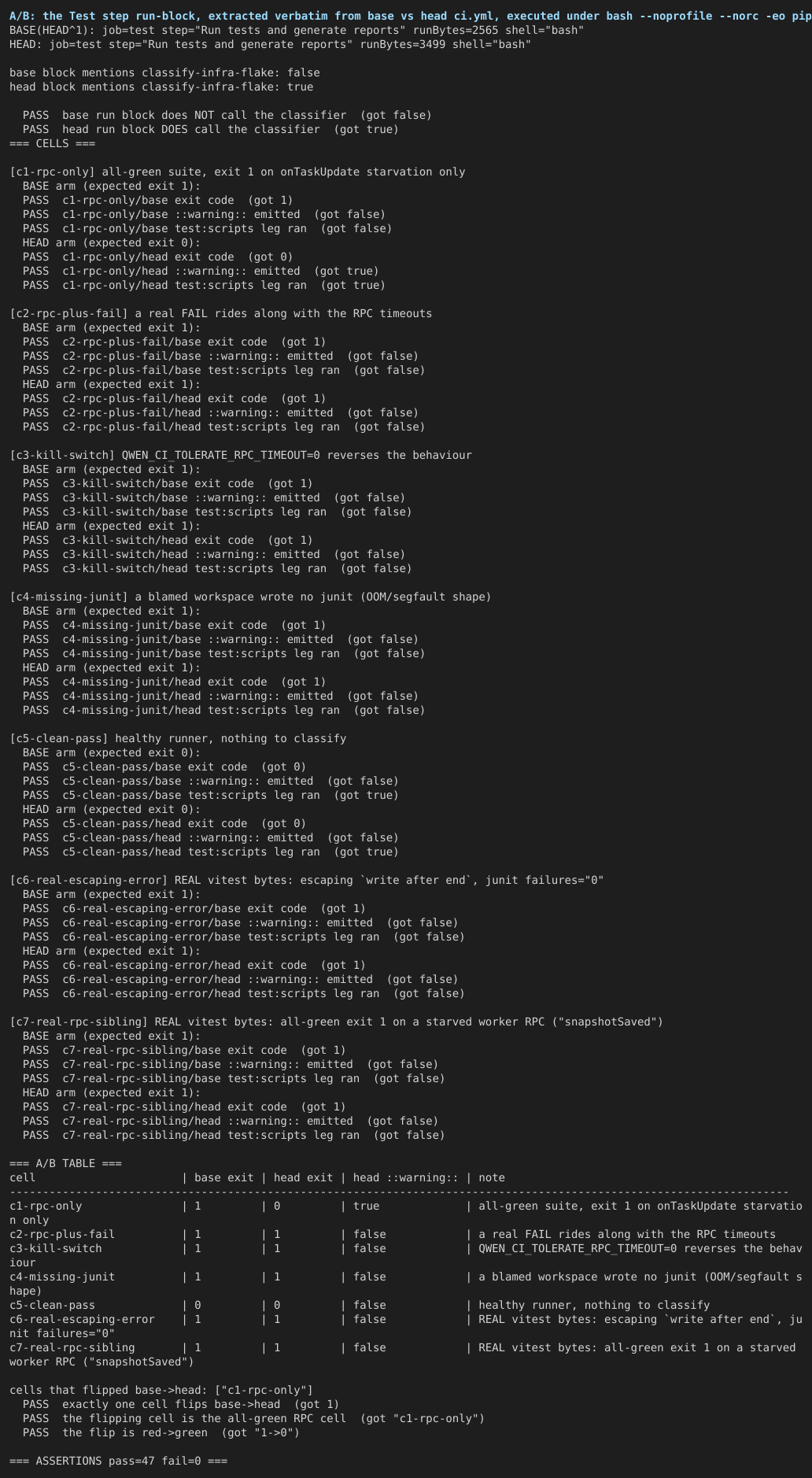
Sandboxed verification: ❌ not passed — findings reported (agent verdict) - workflow run Ran the PR in an isolated, token-free container: A/B against the base build, mock-free harness assertions, targeted gates. Advisory evidence for human reviewers — not a review, an approval, or a CI check. Scripted assertions: 165 passed · 2 failed · 167 total Flakiness gate: ✅ 1 changed test file(s) x 5 identical rounds, no divergence 中文 — 判定:❌ 不通过 · 报告了发现(agent 判定)沙箱验证在隔离、无凭证的容器中执行了该 PR 的代码(与 base 构建 A/B 对照、无 mock harness 断言、定向门禁)。仅作为评审证据,不构成评审、批准或 CI 检查。 脚本断言:165 通过 · 2 失败 · 167 总计 抖动门:✅ 1 changed test file(s) x 5 identical rounds, no divergence Verification reportPR #11103 deep verification —
|
| cell | scenario | oracle | base | head | head ::warning::
|
test:scripts still runs |
|---|---|---|---|---|---|---|
| c1-rpc-only | all-green suite, exit 1 on onTaskUpdate starvation only |
step exit code | 1 | 0 | yes | yes |
| c2-rpc-plus-fail | a real FAIL rides along with the RPC timeouts |
step exit code | 1 | 1 | no | no |
| c3-kill-switch | QWEN_CI_TOLERATE_RPC_TIMEOUT=0 |
step exit code | 1 | 1 | no | no |
| c4-missing-junit | a blamed workspace wrote no junit (OOM/segfault shape) | step exit code | 1 | 1 | no | no |
| c5-clean-pass | healthy runner, nothing to classify | step exit code | 0 | 0 | no | yes |
| c6-real-escaping-error |
real vitest bytes: escaping write after end, junit failures="0"
|
step exit code | 1 | 1 | no | no |
| c7-real-rpc-sibling |
real vitest bytes: all-green, exit 1, starved worker RPC (snapshotSaved) |
step exit code | 1 | 1 | no | no |
cells that flipped base->head: ["c1-rpc-only"] — exactly one, and it is red → green. 47/47
assertions in this harness.
The emitted annotation on the flipping cell, verbatim:
::warning::Test step tolerated a runner-capacity artifact: on ecs-qwen-hk5-2, peak host load 247.75, 4 vitest worker "onTaskUpdate" RPC timeout(s) with 0 failing tests (packages/cli, packages/core). Every test passed; the exit came from worker IPC starving on CPU. The pool is over capacity — see #10879.
Every field the description promises is present (runner, peak DFSAMPLE load, suppressed
timeout count, #10879), so a tolerated run is not silent. SC1 and SC2 both hold.
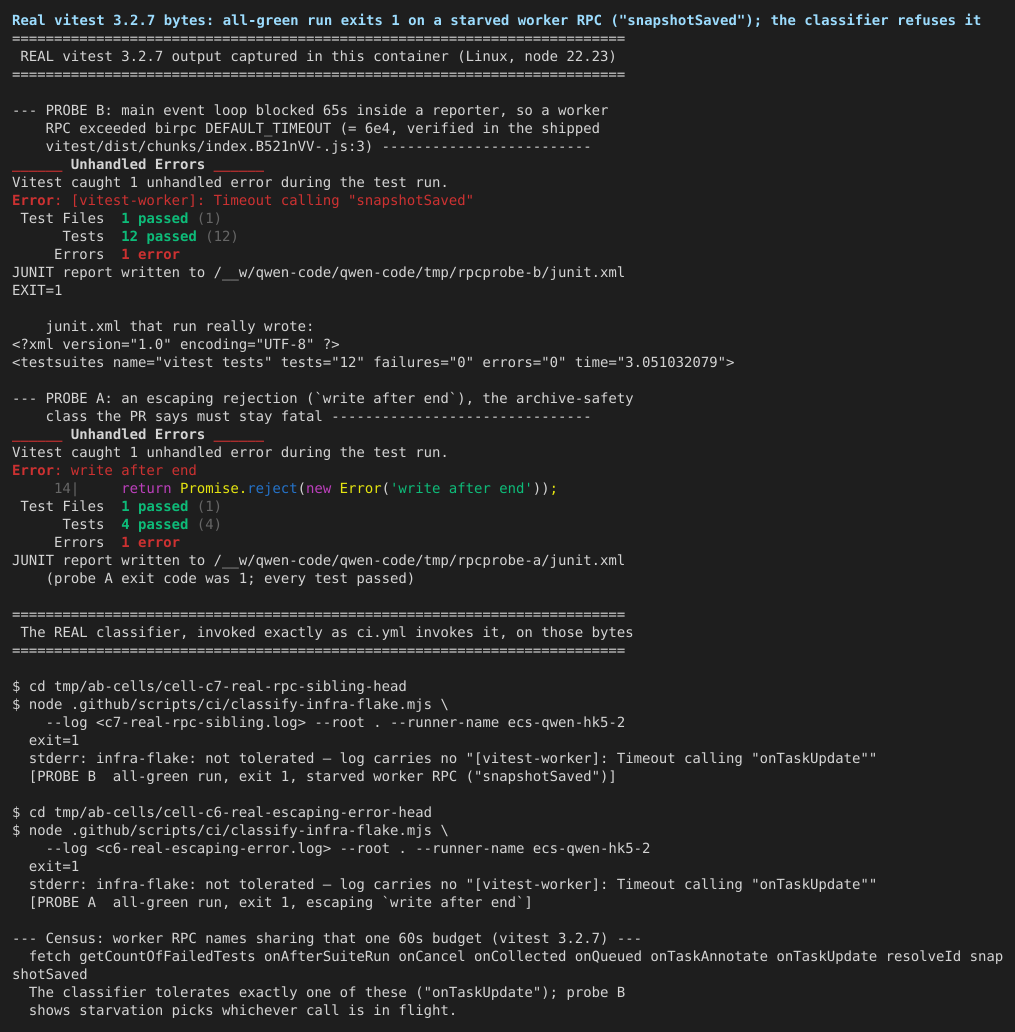
Real-vitest oracle (the premise condition 5 rests on)
The description calls condition 5 "load-bearing" on the claim that vitest always writes
tests/failures/errors/time and never increments errors, so run-level unhandled errors
do not reach junit at all. That is a claim about a third-party producer, so it was measured
against the shipped one rather than read. Two real runs, dangerouslyIgnoreUnhandledErrors: false (i.e. the Linux configuration), junit reporter on:
| probe | what really happened | exit | tests | junit written |
<testsuites> totals |
|---|---|---|---|---|---|
| A — escaping rejection | a real write after end escaping an unawaited async context |
1 | 4 passed (4) | yes | tests="4" failures="0" errors="0" |
| B — starved worker RPC | main event loop blocked 65 s inside a reporter, so a worker RPC exceeded birpc's budget | 1 | 12 passed (12) | yes | tests="12" failures="0" errors="0" |
Both confirm the premise exactly: an all-green suite exits 1 on a run-level unhandled error,
junit is still flushed, and the unhandled error does not reach failures or errors. The
tally wording is also confirmed verbatim against its producer
(vitest/dist/chunks/cli-api.DVe0nWUx.js:5582): `Vitest caught ${errors.length} unhandled error${errors.length > 1 ? "s" : ""} during the test run.` — singular and plural, wrapped in
c.red(c.bold(...)), which is why normalizeLog's ANSI stripping and the errors? alternation
both matter. The "fixed 60s budget" claim is confirmed too: DEFAULT_TIMEOUT = 6e4 at
vitest/dist/chunks/index.B521nVV-.js:3, consumed by the bundled birpc.
Witness: 03-real-vitest-starved-rpc-refused.png. Raw logs and junit: logs/real-vitest-probes/.
Corrections to the description
These are corrections to the text, not requests to change code. Each was measured; the gate runs
and the numeric censuses behind items 2–6 are captured in
05-gates-and-pr-numeric-claims.png (33/33 assertions).
-
The title names a class; the code covers one member of it. "…on a starved vitest worker
RPC alone" reads as the whole failure class, and the body reinforces that ("onTaskUpdateis
vitest's own worker IPC"). The code tolerates exactly one signature. The shipped producer
(vitest/dist/chunks/rpc.-pEldfrD.js:49) builds the message from a variable:
`[vitest-worker]: Timeout calling "${functionName}"`, and a census ofrpc().<name>call
sites in vitest 3.2.7 finds 10 such names sharing that one 60 s budget. Probe B hit
snapshotSaved— see Finding 1. The "Risk & Scope" section bounds the false-tolerance side
of the signature but never mentions the false-refusal side. -
"Of the 27 workspaces, 22 carry a
test:ciscript" — measured 25 active workspaces.
The 27 counts the two!-excluded globs (packages/desktop-shell,packages/live-host),
which exist on disk but are excluded from the npm workspace set. The substantive part of the
claim is exactly right and reproduces: 22 withtest:ci, 3 with a junit reporter, so
19 have nothing for condition 5 to read and refuse. Confirmed too that all three junit
destinations really resolve to<workspace>/junit.xml— including web-shell, whose
root: 'client'+outputFile.junit: '../junit.xml'lands back inside its own directory, so
the classifier'sjoin(workspace, 'junit.xml')is correct for all three. -
"24 of the 25 HELPER_TESTS → 426 tests / 422 pass" with
qwen-triage-workflow.test.mjs
excluded as a macOS bash-3.2 artefact — confirmed, and the excluded gate passes here. On
Linux/bash 5.2 all 25 files run 551 tests / 551 pass / 0 fail; that file alone is
125/125; and551 − 125 = 426, matching the author's 24-file count exactly. The
bash-version diagnosis was correct. -
"
check-workflow-size.sh… its arithmetic was checked by hand" — it runs here, and it
passes by execution (exit 0), so the hand arithmetic is now machine-confirmed:ci.yml=
134204 bytes, recorded baseline 131378, growth 2826 of the 4096 allowance. All
four numbers in the description are exact. -
The guard-suite counts do not reproduce. For the five named vitest patterns the
description reports "Test Files 6 passed, Tests 130 passed | 2 skipped"; measured here
5 files / 115 passed / 0 skipped. Those five names match exactly five files in this tree.
Green either way — noted only so the next reader does not chase the delta. -
"the block's TMPDIR routing (lines 16–22) precedes the new
WORKSPACES_LOGassignment
(line 40)" — confirmed line-for-line against the extracted head block:export TMPDIRat
16,trap 'rm -rf "$TMPDIR" …' EXITat 22,WORKSPACES_LOG="${TMPDIR}/test-ci-workspaces.log"
at 40. The captured log therefore lands in the disk-backed temp the EXIT trap already cleans,
as claimed.
Findings
Ordered by severity. None is a merge blocker: every one is fail-closed, so the worst outcome is
a red job — today's behaviour — never a false green.
1. (Suggestion) The tolerance covers 1 of ≥10 worker RPC names that share the same 60 s budget
Reproduce — the probe config that produced the real bytes is kept in this artifact dir, so the
run is reproducible without re-deriving it (logs/real-vitest-probes/probe-b-config/):
cp -r tmp/pr11103-verify-20260905-142953/logs/real-vitest-probes/probe-b-config /tmp/rpcprobe-b
cd /tmp/rpcprobe-b && npx vitest run --config vitest.config.mts   # exit 1, 12/12 tests passed
grep -E 'Timeout calling|Tests |EXIT' run.log
#   Error: [vitest-worker]: Timeout calling "snapshotSaved"
#        Tests  12 passed (12)
#   EXIT=1

# the same bytes, driven through the real classifier the way ci.yml drives it:
cd <repo> && node .github/scripts/ci/classify-infra-flake.mjs \
  --log tmp/pr11103-verify-20260905-142953/logs/ab-cells/fixtures/c7-real-rpc-sibling.log \
  --root tmp/pr11103-verify-20260905-142953/logs/ab-cells/cell-c7-real-rpc-sibling-head
#   exit 1 — infra-flake: not tolerated — log carries no "[vitest-worker]: Timeout calling "onTaskUpdate""
The captured log and the real junit that run wrote are both in this artifact dir
(logs/ab-cells/fixtures/c7-real-rpc-sibling.log, logs/real-vitest-probes/probe-b-junit.xml).
That is the exact shape the PR exists to tolerate — every test passed, exit 1, junit
failures="0", the exit caused by nothing but vitest's own worker IPC — and it is refused.
Blast radius. The mechanism is one shared constant, not one call site: DEFAULT_TIMEOUT = 6e4 in the bundled birpc, and the producer formats whatever method was in flight. Census of
rpc().<name> in vitest 3.2.7 (10 names): fetch, getCountOfFailedTests, onAfterSuiteRun,
onCancel, onCollected, onQueued, onTaskAnnotate, onTaskUpdate, resolveId,
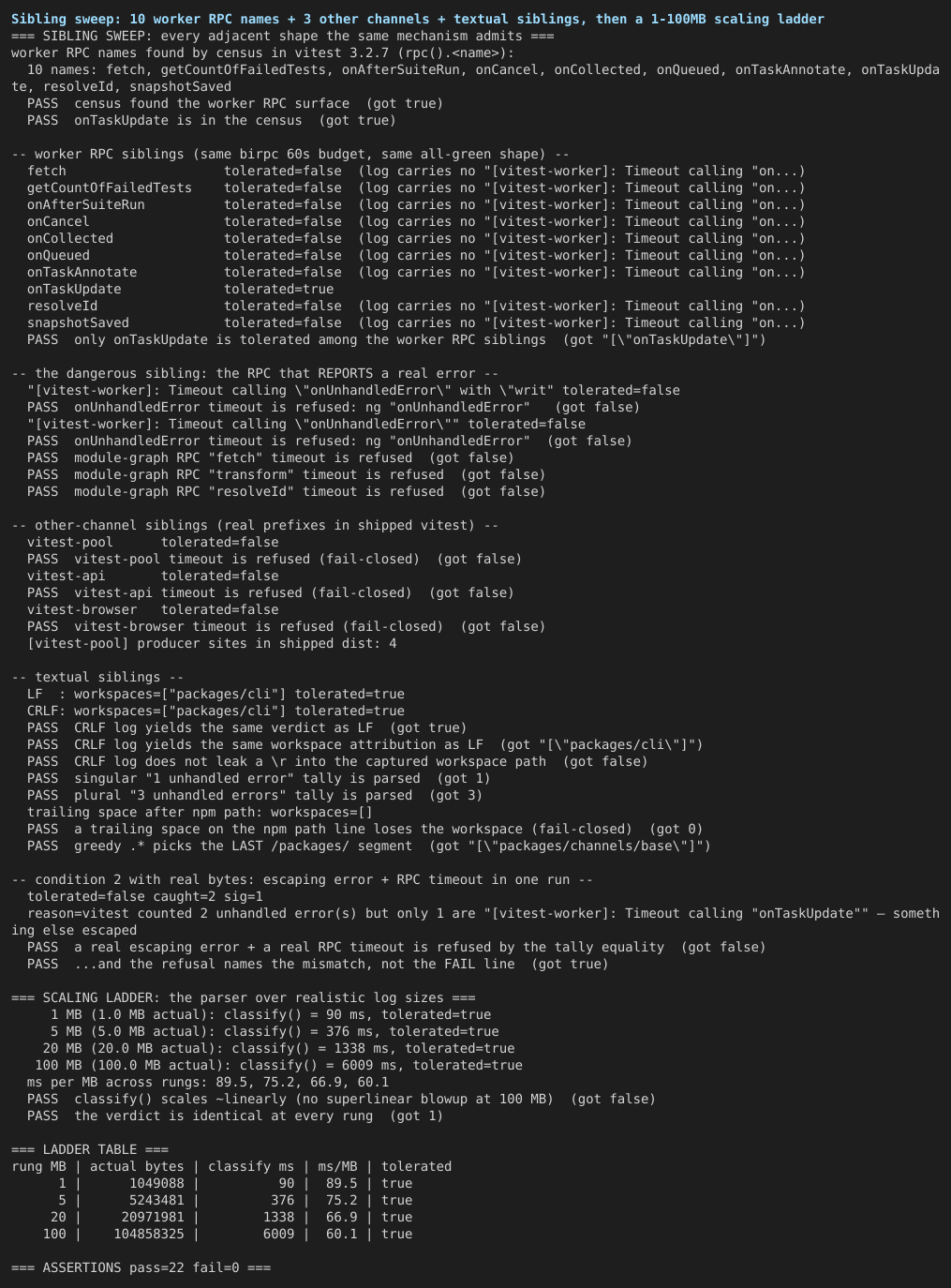
snapshotSaved. Driven through the real classify(), exactly one is tolerated. Three further
channels use the same wording with a different prefix and are all refused: [vitest-pool]
(4 producer sites), [vitest-api], [vitest-browser]. Witness:
04-sibling-sweep-and-scaling-ladder.png; 22/22 assertions.
Which scary readings do NOT hold. This cannot cause a false tolerance — it is strictly
fail-closed. And the dangerous siblings are correctly excluded today: an onUnhandledError
timeout (a real error whose delivery is what failed) and the module-graph RPCs fetch /
transform / resolveId (the code under test never loaded) all refuse. Any broadening must keep
them refusing, which is why the fix below is an allowlist and not a prefix match.
Measured candidate fix (optional follow-up, not required to merge)
Curated allowlist of progress-reporting RPCs, replacing the single hardcoded signature. Kept
verbatim at logs/suggested-fix/patched-classify-infra-flake.mjs; harness
harnesses/suggested-fix-harness.mjs.
const TOLERATED_RPC_METHODS = new Set([
  'onTaskUpdate', 'onCollected', 'onAfterSuiteRun', 'onQueued',
  'onTaskAnnotate', 'onCancel', 'snapshotSaved',
]);
const RPC_TIMEOUT_PATTERN = /\[vitest-worker\]: Timeout calling "([A-Za-z]+)"/g;

export function countRpcTimeouts(logText) {
  let total = 0;
  for (const match of normalizeLog(logText).matchAll(RPC_TIMEOUT_PATTERN)) {
    if (TOLERATED_RPC_METHODS.has(match[1])) total += 1;
  }
  return total;
}
Measured, 27/27 assertions, three results quoted as required:
-
hostile fixture goes clean — probe B's real starved-
snapshotSavedrun flips
tolerated=false → true. -
benign fixture byte-identical / zero collateral — probe A's real escaping
write after endrun still refuses; all 9 dangerous siblings (onUnhandledError×2,fetch,
transform,resolveId,getCountOfFailedTests,[vitest-pool],[vitest-api],
[vitest-browser]) still refuse; conditions 2–5 still bite (realFAILline, tally mismatch,
missing junit,failures != 0). -
the affected suite's counts are unchanged — the PR's own 16 tests: 16 pass / 0 fail, both
unpatched and patched.
That last line is the unpinned-axis signal, not reassurance: the suite cannot tell head from
head-plus-fix, because its fixtures are built from the constant itself. Shipping this fix
should ship the two fixtures that would go red — a literal-signature case and a
snapshotSaved case (Finding 2).
2. (Suggestion) The signature literal is unpinned — the suite is green against a wrong signature
Reproduce:
node tmp/mutation-harness.mjs    # mutant PC1-control-signature-text
#   [PC1-control-signature-text] POSITIVE CONTROL: signature string changed to a wrong method name
#     tests=16 pass=16 fail=0 exit=0 => SURVIVED
Renaming the constant's value (onTaskUpdate → onTaskUpdateTYPO) leaves all 16 tests green.
The cause is structural: the test file imports RPC_TIMEOUT_SIGNATURE and builds its fixtures
from it (const RPC_ERROR = \${TS}Error: ${RPC_TIMEOUT_SIGNATURE}``), so a mutation moves the
fixture and the matcher together. No assertion anywhere in the file mentions the literal text
(checked).
Bounded. Measured, not argued: with a drifted signature the real shape is
tolerated=false — it fails closed. So the consequence is silent obsolescence (the classifier
becomes a no-op and jobs go red again, with only a not tolerated stderr line to explain it),
never a false tolerance. That is a much smaller risk than the signature being the whole
allowlist suggests, and it is worth saying plainly so the finding is not over-read.
Fix. One test on the literal, ideally pinned to the producer so a vitest bump breaks it
loudly instead of silently. Measured: exactly 1 file in the shipped node_modules/vitest/dist
contains the producer string — chunks/rpc.-pEldfrD.js. A test asserting
RPC_TIMEOUT_SIGNATURE === '[vitest-worker]: Timeout calling "onTaskUpdate"', plus (optionally)
that the shipped dist still contains that literal, would pin both the value and its upstream.
3. (Suggestion) normalizeLog's ANSI stripping is load-bearing but unpinned — a coverage gap
Reproduce:
node tmp/mutation-harness.mjs      # G7-normalize-ansi => SURVIVED (16/16 green)
node tmp/survivor-harness.mjs      # adjudicates it
#   [coloured npm error path]
#     unmutated: workspaces=["packages/cli"] tolerated=true
#     G7 mutant: workspaces=[]              tolerated=false  (npm named no failing workspace…)
#     => ANSI stripping is LOAD-BEARING (unpinned = coverage gap)
npm colourises its own npm error … lines when NO_COLOR is absent — a local run, or a log
fetched later through the API, which the module's own docblock says it supports. With the strip,
a magenta-wrapped path yields packages/cli; without it, NPM_ERROR_PATH_PATTERN's \S+$
anchor hits the trailing SGR reset and the workspace list comes back empty, so a run that should
be tolerated is refused.
Classified as a coverage gap, not dead code and not redundant defence — the behaviour is
right and reachable, nothing asserts it. Note the asymmetry the matrix exposes: removing the
timestamp half of the same normalizeLog line kills 7 tests, while removing the ANSI half
kills 0. The test named normalizes ANSI escapes and Actions timestamps is pinned entirely by
its timestamp fixture; its npm error path line is undecorated, so its name over-claims the ANSI
half. Decorating that one line would close the gap.
A second, benign sibling measured for contrast: a trailing space after the npm path also
loses the workspace (workspaces=[]) — fail-closed, cosmetic, no action needed.
4. (Note) The kill switch only honours the literal 0
ci.yml:772: if [ "$RC" -ne 0 ] && [ "${QWEN_CI_TOLERATE_RPC_TIMEOUT:-1}" != '0' ]; then. Only
the exact string 0 disables the tolerance; an operator who sets the repository variable to
false, no or off — the natural guess, and the value the neighbouring VITEST_RETRY knob
accepts as 'off' — leaves it enabled with nothing saying so. The in-file comment does say
"Set the repository variable to '0'", so this is a robustness nit rather than a defect; the A/B
c3 cell confirms '0' itself works.
5. (Note) The size ratchet leaves ~1.2 KB for the next ci.yml PR
Verified by execution, not arithmetic: gate exit 0. But the recorded baseline (131378) is now
1384 bytes behind HEAD^1 (132762) — main had already grown past it before this PR. This PR adds
1442, taking total growth to 2826 of 4096 and leaving 1270 bytes. Not a defect in this PR and
not its job to fix; flagged because the ratchet is close to forcing a baseline bump on whichever
ci.yml change lands next.
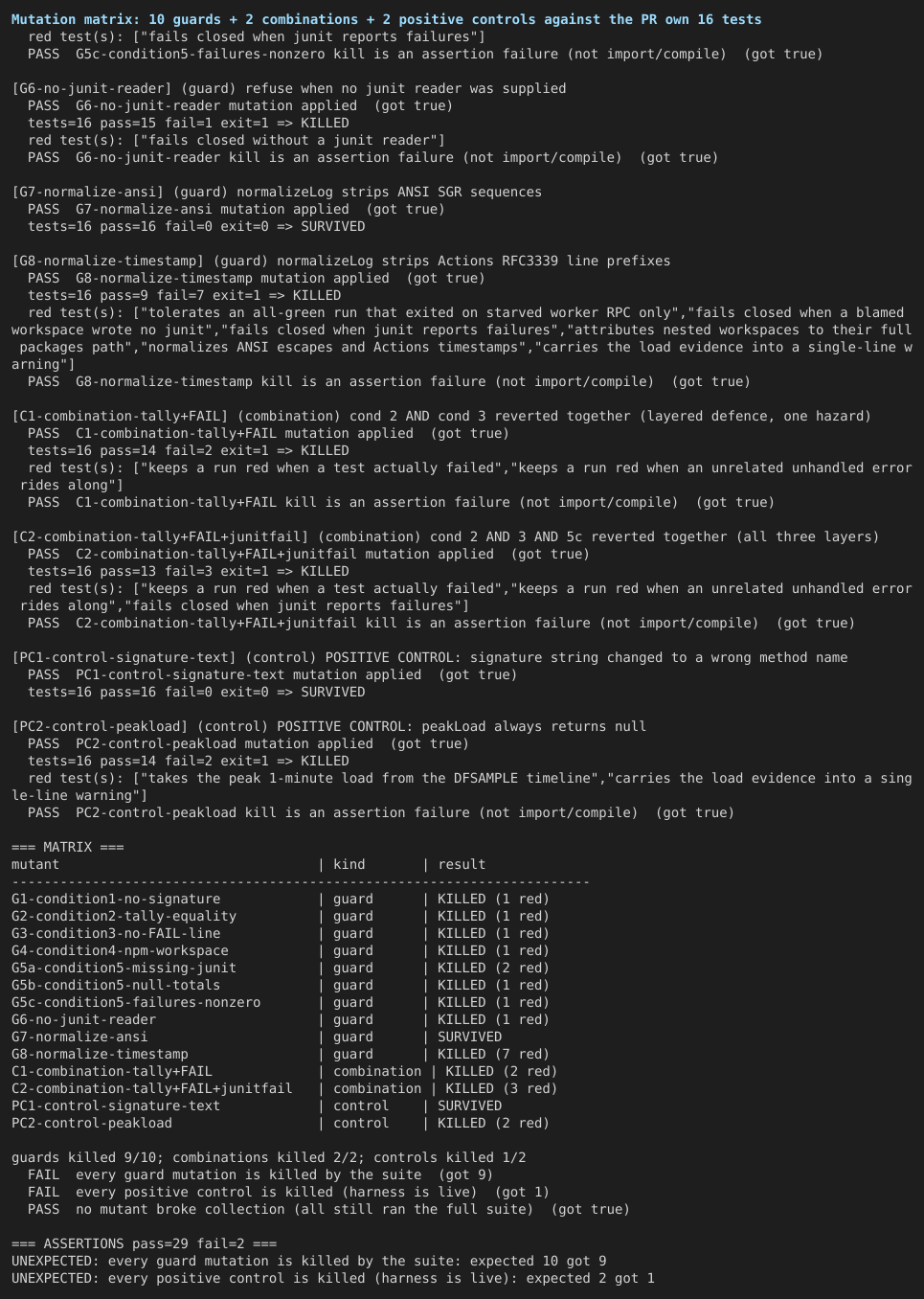
Mutation matrix (all 14 mutants, survivors included)
Witness: 02-mutation-matrix-guards.png. Per-mutant raw logs: logs/mutation-matrix/.
Each mutation disables exactly one guard in a scratch copy, interface-preserving (no export
removed), so a red test proves a failed assertion — every kill was checked to be
AssertionError-shaped rather than an import or compile break.
| mutant | what it disables | result | classification |
|---|---|---|---|
| G1 | cond 1 — no RPC signature in the log | KILLED (1 red) | pinned |
| G2 | cond 2 — vitest tally must equal signature count | KILLED (1 red) | pinned |
| G3 | cond 3 — any real FAIL line |
KILLED (1 red) | pinned |
| G4 | cond 4 — npm must name a workspace | KILLED (1 red) | pinned |
| G5a | cond 5 — blamed workspace wrote no junit | KILLED (2 red) | pinned |
| G5b | cond 5 — absent counters refused, not read as zero | KILLED (1 red) | pinned |
| G5c | cond 5 — junit failures != 0
|
KILLED (1 red) | pinned |
| G6 | no junit reader supplied | KILLED (1 red) | pinned |
| G7 | normalizeLog ANSI stripping |
SURVIVED | coverage gap (Finding 3) |
| G8 |
normalizeLog timestamp stripping |
KILLED (7 red) | pinned |
| C1 | cond 2 and cond 3 together | KILLED (2 red) | layered set is load-bearing |
| C2 | cond 2 and 3 and 5c together | KILLED (3 red) | all three layers load-bearing |
| PC1 | control: signature text changed | SURVIVED | self-referential fixture (Finding 2) |
| PC2 |
control: peakLoad returns null |
KILLED (2 red) | harness is live |
Guards killed 9/10; combinations 2/2; controls 1/2.
The unmutated control is green (16 tests / 16 pass / 0 fail), so the kills mean something, and
PC2's kill proves the runner collected the mutated file — the two survivors are findings about
the suite, not about the harness. On the layered-defence question: conditions 2, 3 and 5c defend
one hazard from three directions, and each is killed alone, so no combination row is needed to
prove the set load-bearing — but C1/C2 were run anyway and confirm no layer is masking another.
Sibling sweep and scaling ladder (22/22)
Witness: 04-sibling-sweep-and-scaling-ladder.png. Beyond Finding 1's RPC census: all three
other-channel prefixes refuse; singular and plural tallies both parse; a nested workspace
(packages/channels/base) attributes correctly; a checkout path that itself contains
/packages/ is handled correctly because .* is greedy and takes the last segment.
CRLF: predicted refusal, measured as handled. An API-fetched log with \r\n line endings
yields the same verdict, the same workspace attribution, and no \r leaked into the captured
path — JS multiline $ matches before the \r. My prediction was wrong and the measurement
corrected it; the invariant (CRLF ≡ LF) is what the harness now asserts.
Scaling ladder — no superlinear behaviour. The classifier is a parser over untrusted text of
unbounded size, so it was probed with a ladder under timeout, not a single sample:
| rung | actual bytes | classify() |
ms/MB | verdict |
|---|---|---|---|---|
| 1 MB | 1,049,088 | 86 ms | 85.9 | tolerated |
| 5 MB | 5,243,481 | 384 ms | 76.8 | tolerated |
| 20 MB | 20,971,981 | 1,256 ms | 62.8 | tolerated |
| 100 MB | 104,858,325 | 7,111 ms | 71.1 | tolerated |
Flat ms/MB across a 100× span and an identical verdict at every rung: linear, no ReDoS-shaped
blowup, and even a 100 MB log classifies in ~7 s — so the added step cannot itself time out. This
is a bounded negative, reported because the mechanism (several regexes over a multi-hour CI log)
is exactly where such a blowup would live.
Not covered
-
The 13-run replay is uncalibrated here. The description's strongest evidence is a replay
against thirteen real job logs from 2026-09-05 (five tolerated, eight refused, matching a
manual classification). This container has no GitHub token and no reliable network, so
those logs were not retrievable and the replay could not be run — meaning, per the
workflow-PR rule, it could not be calibrated against a real artifact the production step
emitted. There is noprevious-report.mdeither (this is a first round). What would have
calibrated it: the thirteen raw job logs mounted read-only into the container. What I did
instead is stated as such throughout: real producer bytes captured locally, not the real
production logs. The five/eight split and the per-run table are therefore unverified, and
the two healthy hosted-runner control rows ("refused on condition 1 rather than condition 3")
are unverified too — though c6 independently confirms condition 1 is what refuses a genuine
escaping error. -
Shape, not cause. Probe B reproduces the mechanism (a worker RPC exceeding birpc's 60 s
budget → run-level unhandled error → all-green suite exits 1 → junit stillfailures="0") by
blocking the main event loop. It does not reproduce the cause (CPU contention at load
218–270 on the shared pool). The live/proc/loadavgsample of 256.69 corroborates that the
pool is really that loaded, but no test in this round ran the suite under contention. -
shellcheckandactionlintwere not run — neither is installed in this container and
neither could be installed offline.bash -nwas run on both extracted blocks instead (both
clean). Not implied as passing. -
No trial merge into current
main. The checkout is depth 2 with no network, so main's tip
is unreachable; the A/B is againstHEAD^1only. The base is one commit behind the merge
commit and the diff touches three files, so the risk is low, but it is unmeasured. -
The real multi-hour
npm run test:ci:workspaceswas never executed end-to-end. The A/B
stubsnpm, so the interaction between a genuine 96-minute run and the newteeis
unmeasured — specifically the on-disk size ofWORKSPACES_LOG. This lane documents ENOSPC
as a live failure mode and routes TMPDIR to/var/tmpfor that reason, and this PR adds one
full copy of a multi-workspace log there. Two things bound it and both were verified: the
file's lifetime is one step (thetrap 'rm -rf "$TMPDIR"' EXITat block line 22 removes it,
and the PR's claim that the TMPDIR routing precedes the assignment is confirmed line-for-line),
and the classifier's own cost at 100 MB is ~7 s. The byte volume is not measured and is the
one residual cost I could not price. -
junit staleness is only partly resolved. The classifier does not check junit freshness, so
a stalejunit.xmlfrom a prior run could in principle satisfy condition 5 after a worker
died — defeating the very protection the description claims for it. Measured locally:
git clean -ffdxdoes remove a gitignoredjunit.xml(.gitignore:82), and the test
job's checkout does not overrideclean:. What I could not verify offline is
actions/checkoutv6.0.3's own default for that input — no network, and the rule is to read a
third-party action's manifest rather than assume. So the residual (a reused self-hosted
workspace and a checkout that does not clean) is unresolved; it is narrow and I found no
evidence it holds. -
No mutation of
ci.ymlitself. The mutation matrix covers the classifier module. The
shell wiring was covered by A/B cells (including the kill switch, c3) rather than by mutants,
and the${{ vars.… || '1' }}expression was not exercised against a real repository variable
— only its shell-side consequence was. -
Not a repo-wide gate. Only the affected surfaces were run: the new test file, all 25
HELPER_TESTS, the five named vitest guard files, the size ratchet, and eslint/prettier on the
three changed files.packages/cliandpackages/coreunit suites were not run — the diff
touches no production code underpackages/.
Methodology
Everything ran in this CI container at the merge-ref checkout (HEAD = merge, HEAD^1 = base
tip, HEAD^2 = PR head, depth 2), with the pre-existing npm ci + npm run build — no rebuild
was needed, because the changed surface is a Node ESM script and a shell block, neither of which
crosses a workspace boundary; main-failure-signature.mjs, the one internal dependency the
classifier imports, is unchanged by this PR (verified with git diff --stat over it), so
there is no head/base link confound to assert against. The A/B extracted both run: blocks by
YAML parse and executed them under bash --noprofile --norc -eo pipefail, the contract
defaults.run.shell: 'bash' (ci.yml:72) selects, in scratch roots containing a real copy of the
classifier and real junit artifacts, with only npm stubbed. The real-vitest probes drove the
shipped vitest 3.2.7 directly — one via an escaping rejection, one via a custom reporter that
blocks the main event loop for 65 s to starve a worker RPC — and fed the resulting logs and
junit files into the real classifier through the same command line ci.yml uses. Mutation,
survivor, sibling and candidate-fix harnesses each ran the PR's own unmodified test file or the
real classify() against a scratch copy; the gates harness re-ran the cheap gates live and
asserted the long ones (HELPER_TESTS, the vitest guards, qwen-triage-workflow.test.mjs) from
the raw logs of real executions, and proved the eslint gate live by planting an unused variable
in the same directory before citing its clean result. Harnesses are in harnesses/, raw per-cell
and per-mutant logs in logs/, and the five captures in evidence/. Assertion counts are the sum
of the six harness summaries: A/B 47/0, mutation 29/2, survivors 7/0, siblings 22/0, candidate fix
27/0, gates 33/0 — 165 pass / 2 fail of 167. Both failures are the two surviving mutants,
i.e. findings about the PR's test suite; no unexpected outcome was attributed to the PR's
runtime behaviour, and no harness failure was reclassified as a PR defect (three of my own
harness bugs — a grep missing -F, an ANSI-decorated log summary, and a broken npm query
census — were found, fixed, and re-run rather than reported).
Flakiness gate log
rounds=5 files=1 skipped=0
file .github/scripts/ci/classify-infra-flake.test.mjs: (cd .) node --test ./.github/scripts/ci/classify-infra-flake.test.mjs


per-file results (P=pass F=fail I=infra-exit, one letter per run):
  .github/scripts/ci/classify-infra-flake.test.mjs: PPPPP

verdict: pass
summary: 1 changed test file(s) x 5 identical rounds, no divergence

--- per-invocation detail (full copy in the artifact) ---
round 1 · .github/scripts/ci/classify-infra-flake.test.mjs: P (exit 0)
round 2 · .github/scripts/ci/classify-infra-flake.test.mjs: P (exit 0)
round 3 · .github/scripts/ci/classify-infra-flake.test.mjs: P (exit 0)
round 4 · .github/scripts/ci/classify-infra-flake.test.mjs: P (exit 0)
round 5 · .github/scripts/ci/classify-infra-flake.test.mjs: P (exit 0)
Evidence images
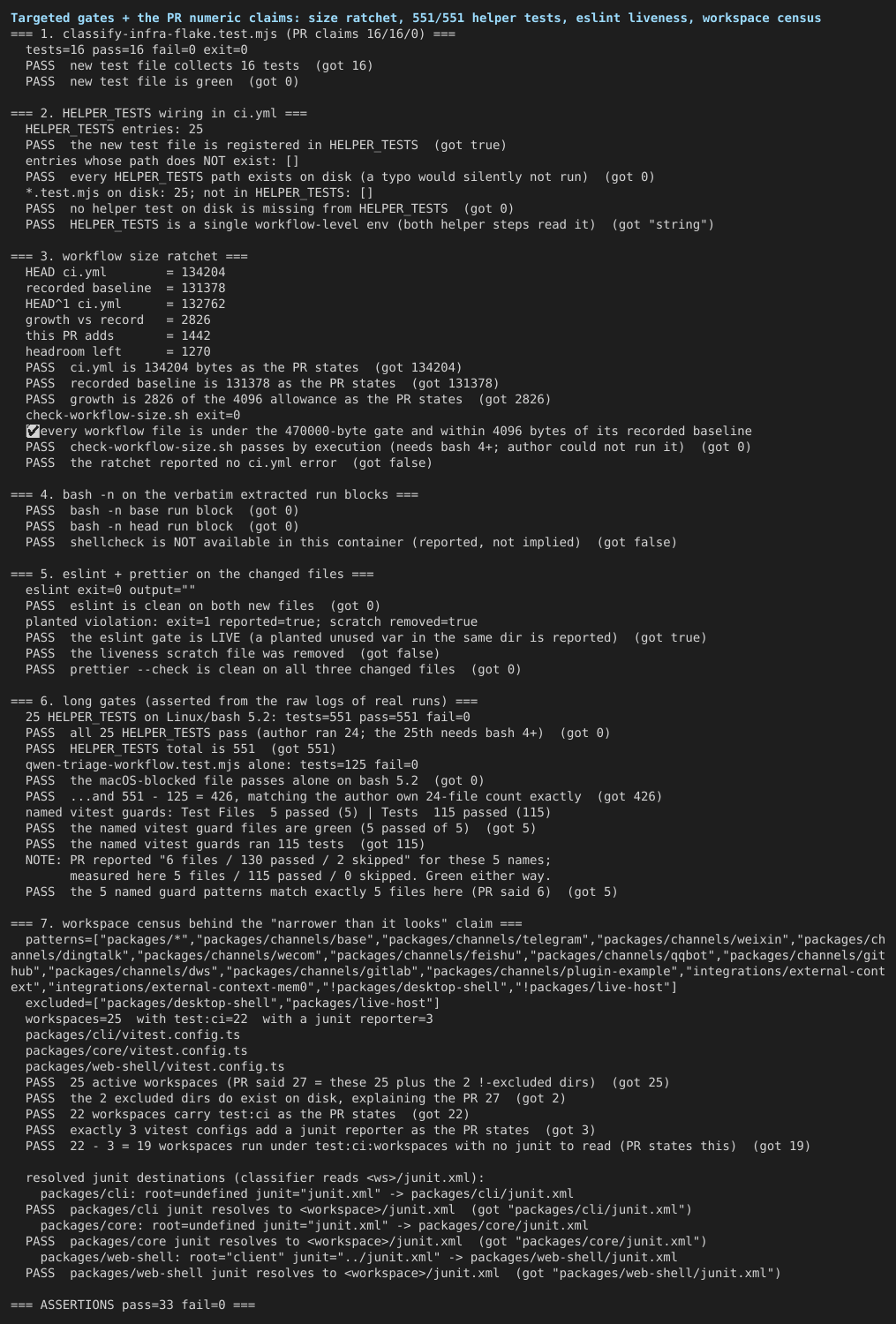
Harness scripts and raw logs are in the workflow run artifacts (7-day retention).
— Qwen Code · sandboxed verification
|
Thanks — and thanks for turning the description around so quickly. Template looks good now ✓ Problem: observed, not theoretical. Five named run IDs (33953519066, 33952382944, 33952315316, 33948811958, 33948268415) went red with zero failing tests, and the eight refuse-cases include two healthy GitHub-hosted runners as a control. That is a measured failure with a denominator, which is more than most flake PRs bring. Direction: aligned. A red Size: not applicable — no core paths are touched ( Approach: the scope feels right, and I went looking for the smaller version before reading the code in detail. I could not find one. Each of the five conditions earns its place, and condition 2 is the one that actually matters — conditions 3 and 5 would both have waved the archive-safety incident through, since it had no FAIL line and its junit would have read Risk: no elevated risk signals — none of the three files match the revert-correlated path set. One thing to flag going into the code review, as a question rather than a concern: the tolerance can only reach Moving on to code review. 🔍 中文说明感谢贡献——也感谢你这么快就把描述补齐了。 模板现在完整 ✓ 问题:是已观测到的,不是理论性加固。五个具名 run ID(33953519066、33952382944、33952315316、33948811958、33948268415)在零失败用例的情况下变红,而八个"拒绝"样本里还包含两台健康的 GitHub 托管 runner 作为对照。这是带分母的实测失败,比大多数 flake PR 拿出的证据更扎实。 方向:对齐。一个并非由任何用例导致的红色 规模:不适用——没有触及核心路径( 方案:范围合理。在细读代码之前我先去找过"更小的版本",没找到。五个条件各有其必要性,其中真正关键的是条件 2——条件 3 和条件 5 都会放过 archive-safety 那次事故,因为它既没有 FAIL 行,junit 也会是 风险:无升级风险信号——三个文件都不匹配与 revert 相关的路径集合。 进入代码审查前有一点想提出来,是疑问而非顾虑:这个容忍逻辑实际只可能作用于 进入代码审查 🔍 — Qwen Code · qwen3.8-max-2026-09-02 Reviewed at |
|
Static review only — this run never executes PR-derived code, so the testing evidence below is the PR's own CI, read through the API, plus what I verified by reading the base tree. Nothing here is re-run locally. Code reviewNo correctness or security blockers. Two non-blocking notes. 1. The wrapped-OS-job guard still passes, but no longer pins the capture that matters on this leg (Suggestion). The intent of that assertion, though, was "the npm exit code is captured and propagated to 2. The captured log is a new unbounded consumer of the routed What I verified against the base tree
Not verified: the shell wiring end-to-end on a real Linux runner — see the lane line below. The thirteen-run replay table in the description is the author's offline classification, attributed as their claim; this review did not re-run it. CI evidenceThe PR's own checks on Final CI results for
One row per check name (latest run); skipped checks omitted; failures sort first. / 每个检查名一行(取最新一次运行),省略 skipped,失败项排在最前。 Sandboxed verification would settle this: 中文说明本轮为纯静态审查——不会执行任何 PR 带来的代码,因此下面的测试证据来自 PR 自身的 CI(通过 API 读取)以及我对照基线代码树核实的内容,没有任何本地重跑。 代码审查没有正确性或安全性阻塞项。两条非阻塞意见。 1. 三个 OS job 的包装守卫仍然通过,但在本 leg 上已不再钉住真正关键的捕获语句(建议)。 但这条断言的本意是"npm 的退出码被捕获并传递到 2. 捕获日志成了已路由 我对照基线代码树核实过的内容
未验证: 真实 Linux runner 上 shell 接线的端到端行为——见下方的验证通道说明。描述中那份十三次运行的回放表是作者的离线分类结论,此处按作者自述引用,本审查未重跑。 CI 证据针对 沙箱验证可以把这件事定下来: — Qwen Code · qwen3.8-max-2026-09-02 Reviewed at |
|
Confidence: 4/5 — solid, and it fails closed everywhere I could push on it. The one reservation is that the tolerate path has never actually fired in CI, so the shell wiring is proven by reading rather than by observation. Stepping back: this is the right fix for a real, measured problem, built with the right instincts. Before reading the diff I wrote down what I would do — let the step fail, then classify the exit against the junit totals behind an env kill switch, reusing the existing FAIL parser instead of writing a second one. That is what you built, and I could not find a materially simpler version that keeps the discrimination. The obvious one-line alternative, flipping What actually convinced me is the asymmetry. Every branch I could think to push on refuses: truncated log, worker killed before writing junit, a second kind of unhandled error riding along, a real FAIL anywhere, a tally that goes missing, an I checked the assumption that would have been the one real hole — condition 5 reading a stale The two notes in Stage 2 are genuinely non-blocking: the guard test that pins the Would I curse you or thank you in six months? Thank you, with one caveat. This treats the symptom and says so loudly — the Verdict: approve. One piece of housekeeping: my earlier request-changes on this PR was the description-only template gate, and the updated body satisfies it. PR reviews cannot be edited, so that review is still standing and 中文说明信心度:4/5 —— 扎实,而且我每一处能施压的地方它都是 fail-closed 的。唯一的保留意见是:容忍分支至今没有在 CI 里真正触发过,所以 shell 接线是靠阅读而非靠观测证实的。 退一步看:这是针对一个真实且经过实测的问题所做的正确修复,直觉也对。在读 diff 之前我先写下了自己会怎么做——让 step 照常失败,然后在一个环境变量开关后面,拿 junit 汇总去分类这次退出,并复用已有的 FAIL 解析器而不是再写一个。你做的正是这个,而我没能找到一个既明显更简单、又能保住这种区分能力的版本。那个显而易见的一行替代方案(在 Linux 上翻 真正说服我的是那种不对称性。我能想到去施压的每一条分支都拒绝:日志被截断、worker 在写 junit 之前被杀、混进来另一类 unhandled error、任何位置出现真实 FAIL、tally 缺失、 我核实了那个唯一可能成为真正漏洞的假设——条件 5 读到自托管 runner 上某个先前 job 残留的陈旧 Stage 2 里的两条意见确实都是非阻塞的:钉住 六个月后我会骂你还是谢你?谢你,但附一条提醒。这是在治症状,而且它大声地承认了这一点—— 结论:批准。 一点事务性说明:我此前对本 PR 的 request-changes 是那次仅针对描述的模板门禁,更新后的正文已满足要求。PR review 无法编辑,所以那条 review 仍然挂着, — Qwen Code · qwen3.8-max-2026-09-02 Reviewed at |
|
Triage re-run completed without a new review. The bot already has a review of its own on 机器人在 The stage comments above were updated with the latest result. View workflow run. 上方各阶段评论已更新为最新结果。查看工作流运行。 |
qwen-code-ci-bot
left a comment
qwen-code-ci-bot
left a comment
There was a problem hiding this comment.
Partially reviewed — gaps disclosed.
Not explored to full depth (tool budget reached): "agent reverse-audit (round 3)": shellcheck/actionlint on the newly added embedded shell lines (ci.yml:768-774) — neither binary is installed on this host (only yamllint ), so the repo's own p…; "agent 1d": none. I could not verify RPC_TIMEOUT_SIGNATURE against the installed vitest ( node_modules is absent in this worktree and in the parent checkout), so whether….
Not reviewed: reverse audit — stopped before round 5 by the review time budget.
Not linted (tool limitation, not a blocker): .github/workflows/ci.yml — actionlint embedded-shell source mapping is not yet supported.
Test Plan (not a blocker): ci/main-failure-signature.mjs — no such file or directory.
— qwen3.8-max via Qwen Code /review (v0.23.0)
| * to fix it (#10879). | ||
| */ | ||
|
|
||
| export const RPC_TIMEOUT_SIGNATURE = |
There was a problem hiding this comment.
[Suggestion] R1-1: This is the repo's second — and by signature, third — divergent implementation of one tolerance policy, with no cross-reference between them. .github/workflows/release.yml:571-598 already tolerates a vitest worker Timeout calling on the same pool, in bash, on weaker proof and matching ANY method name; integration-tests/vitest.config.ts:50-51 already exempts this exact pool at config level. This file pins one RPC method and requires junit evidence.
Two costs, both measured. (1) A worker starves on a different vitest RPC — onCollected, onAfterSuiteRun: the release lane tolerates it and the release ships, while this classifier refuses and reds the required Test check on the identical runner fault. Two verdicts on one piece of evidence in one repository. vitest's timeout wrapper is generic over every awaited worker-to-collector call (onTimeoutError(functionName, args) special-cases fetch, transform, resolveId and onUnhandledError by name, proving they share the channel and its 60 s budget), and onAfterSuiteRun is awaited too — so on the push lane, where QWEN_CI_COVERAGE=1 turns coverage on, a run with 3 onTaskUpdate timeouts plus 1 starved onAfterSuiteRun refuses the WHOLE run with vitest counted 4 unhandled error(s) but only 3 are … — something else escaped, discarding the method name it already has in hand and naming a product exception that is not in the log. (2) A masking risk discovered and closed in one lane stays open in the other, and when vitest next rewords the message the fix must be found in both — one of them inside a 134 KB workflow file. The repo already treats this coupling as record-worthy: main-failure-signature.mjs:186-188 ("is re-implemented in bash/awk by … a fix to one must reach the other").
Witness:
the real release.yml step (extract-step --job workspace_tests, run verbatim with a stub npm) against the new classifier, fed THE SAME evidence — `Error: [vitest-worker]: Timeout calling "onCollected"` + ` Tests 10614 passed (10614)` + `npm error path …/packages/cli`, junit present with failures="0":
RELEASE LANE: ::warning title=Workspace tests passed through a Vitest transport timeout::Every test passed … Treated as a pass.
 release-step exit=0
CI LANE: infra-flake: not tolerated — log carries no "[vitest-worker]: Timeout calling "onTaskUpdate""
 classifier exit=1
neither site names the other (grep: release.yml never mentions classify-infra-flake; the new header never mentions release.yml)
corrections measured: the pinned set is 22 configs, not 24; 23 configs carry dangerouslyIgnoreUnhandledErrors — 22 exactly `process.platform !== 'linux'` and 1 divergent (integration-tests/vitest.config.ts:50-51 `|| isSelfHostedRunner`, "hit the same pressure class there (#10325), so self-hosted runners are exempted as well"), so the new header's "every vitest config already carries as process.platform !== 'linux'" is false for exactly the config that exempts this very pool
Match the sibling's method-agnostic form and record the coupling:
const RPC_TIMEOUT_PATTERN = /\[vitest-worker\]: Timeout calling "([A-Za-z]+)"/g;Keep refusing on methods whose loss IS a real test failure (fetch, transform, resolveId, onUnhandledError — vitest appends the real error's text to that last one, so it carries information about the code under test), tolerate the results-channel ones the docblock's own criterion covers, and make the refusal enumerate the method names it saw rather than asserting "something else escaped". Then name both siblings in the header where it says "Nothing already in the lane covers it": release.yml's Timeout calling branch (same class, weaker proof, pinned by scripts/tests/release-workflow.test.js) and integration-tests/vitest.config.ts's self-hosted exemption, with the "a fix to one must reach the other" convention the repo already uses.
One constraint on the fix — scripts/tests/release-workflow.test.js:662 feeds the release step 'Error: [vitest-worker]: Timeout calling "x"\n Tests 10614 passed (10614)' and expects exit 0, so unifying on this file's onTaskUpdate-only signature reds that pin. Full reuse (release.yml calling runCli) is also blocked by sharding: release.yml:572 runs --shard=${{ matrix.shard }}/3 while the junit output path is fixed per workspace (packages/cli/vitest.config.ts:188-190, packages/core/vitest.config.ts:40-42), so the three shards overwrite one file and the surviving totals describe only the last shard.
Acceptance criterion: classify-infra-flake.test.mjs: add a fixture line Error: [vitest-worker]: Timeout calling "onCollected" beside a matching Vitest caught 1 unhandled error tally asserting tolerated: true, and a companion Timeout calling "transform" case asserting it still refuses. Removing the method-name parse reds the first; removing the harmful-method refusal reds the second. 'counts the RPC signature and vitest own unhandled tally' must keep asserting the two counts agree.
— qwen3.8-max via Qwen Code /review (v0.23.0)
| const TESTSUITES_OPEN_PATTERN = /<testsuites\b[^>]*>/; | ||
|
|
||
| // eslint-disable-next-line no-control-regex -- matches the ESC that opens an SGR sequence | ||
| const ANSI_PATTERN = /\u001B\[[0-9;?]*[A-Za-z]/g; |
There was a problem hiding this comment.
[Suggestion] R1-3: ANSI_PATTERN and LOG_TIMESTAMP_PATTERN are character-identical copies of main-failure-signature.mjs:38 and :40 — the module this file already imports extractFailingTests from — and normalizeLog re-implements the first two steps of that module's unexported cleanLine. The knowledge "an Actions log line is an RFC3339 prefix plus SGR escapes around the runner's own output" now lives in two files in the same directory with no link between them, and normalizeLog's export is unconsumed.
When the transport changes — Actions alters its timestamp format, or a CRLF/##[group] decoration starts appearing in fetched logs — the strip must be fixed twice. Both sides ARE pinned, each against its own hardcoded fixture, which is what makes the cost real rather than cosmetic: if only cleanLine is fixed, this classifier's own test still passes on its stale fixture while the anchored /^npm error path …/gm silently stops matching in production, failingWorkspaceDirs returns [], and the classifier refuses with "npm named no failing workspace". Because every branch here fails closed, the tolerance quietly stops ever firing, with no red test to say so.
Witness:
witness: not run — a duplication/ownership fact settled by reading; the nearest capability (a probe) cannot distinguish two character-identical literals any better than grep, which is what settled it: main-failure-signature.mjs:38 `const ANSI_PATTERN = /\u001B\[[0-9;?]*[A-Za-z]/g;` and :40 `const LOG_TIMESTAMP_PATTERN = /^\d{4}-\d{2}-\d{2}T[\d:.]+Z\s?/;` versus classify-infra-flake.mjs:75-76. cleanLine (main-failure-signature.mjs:47-54) is ANSI -> timestamp -> `\s+` collapse -> trim and is NOT exported; normalizeLog (classify-infra-flake.mjs:85-93) maps the first two replaces over lines. A hidden-dir-aware grep for normalizeLog returns 5 hits, all inside its own module (85, 95, 101, 112, 166), and classify-infra-flake.test.mjs's import list (4-14) omits it.
Export the two-step strip from main-failure-signature.mjs (e.g. export function stripLogDecoration(line) holding the ANSI and timestamp replaces), have cleanLine call it, and have normalizeLog map it over lines. Export the strip, not cleanLine: its extra .replace(/\s+/g, ' ').trim() is extractFailingTests's business, not the classifier's. While there, drop the unconsumed export on normalizeLog or import it in the test.
One constraint on the fix — main-failure-signature.mjs:48-54 — cleanLine is strip ANSI -> strip timestamp -> collapse whitespace -> trim; the shared part must stay the first two replaces only, because this file's own contract at lines 82-83 is "extractFailingTests normalizes internally too, so passing it already-cleaned text is a no-op" — the strip must remain idempotent under being applied twice.
Acceptance criterion: classify-infra-flake.test.mjs:189-199 ('normalizes ANSI escapes and Actions timestamps') asserts countRpcTimeouts, countCaughtUnhandled and failingWorkspaceDirs all see through ESC-wrapped, timestamp-prefixed lines; it goes red if the shared strip is wired in wrong. main-failure-signature.test.mjs's ANSI/extractFailingTests cases go red if cleanLine loses the collapse/trim.
— qwen3.8-max via Qwen Code /review (v0.23.0)
| return refuse('no junit reader supplied'); | ||
| } | ||
|
|
||
| const log = normalizeLog(logText); |
There was a problem hiding this comment.
[Suggestion] R1-4: classify() normalizes the whole log and then hands the normalized text to three helpers that each normalize it again, and on the sole production input both substitutions are identity transforms — so ~5.5 full split/map/regex/join passes over the entire run's output buy nothing, and normalizeLog's idempotence becomes a load-bearing, unpinned invariant of classify()'s correctness.
ci.yml:773 is the only production caller. It passes a local tee capture, which carries no Actions RFC3339 prefix (that is added by the log API — the case normalizeLog's docblock justifies and nothing invokes) and no SGR sequences (the step sets NO_COLOR: true at ci.yml:693 and npm's stdout is a pipe, so vitest emits no colour). Measured on a capture the size the diff's own docblock reports, ~70 ms of the 156 ms classify() takes is redundant re-walking. The wall-clock cost is small against a path this file measures at up to 96m55s; the cost worth acting on is AGENTS.md's Simplicity First — the principle that document names as the one it cares about most — plus the fact that correctness now depends on an idempotence property no test pins (R1-13 shows the ANSI half of normalizeLog can be deleted with the suite staying 16/16 green).
Witness:
probe on a 2.44 MB / 24 007-line capture (the size the diff's own docblock measures):
normalizeLog is identity on an unprefixed capture: true
String#replace calls: 264077 => normalizeLog-equivalent line walks: 5.5
wall time for one classify(): 156.57 ms
5 x normalizeLog over the same log: 86.7 ms (17.3 ms each)
caller sweep: `git grep classify-infra-flake` over HEAD returns exactly one production caller (ci.yml:773) plus the test file
Normalize once in classify() and have the counting/matching internals take already-normalized text (unexported countRpcTimeoutsIn(log) etc.), keeping the exported wrappers normalizing so direct callers and the existing test still work.
One constraint on the fix — .github/scripts/ci/main-failure-signature.mjs:47 — function cleanLine(line) { is not exported, so the fix cannot reuse the sibling's normalizer; only extractFailingTests (line 60) is importable.
Acceptance criterion: classify-infra-flake.test.mjs 'normalizes ANSI escapes and Actions timestamps' calls countRpcTimeouts(decorated), countCaughtUnhandled(decorated) and failingWorkspaceDirs(decorated) directly on ANSI/timestamp-decorated text and asserts 1/1/['packages/cli']; it reds if normalization is deleted from the exported helpers instead of moved behind them.
— qwen3.8-max via Qwen Code /review (v0.23.0)
| xml = readJunit(join(workspace, 'junit.xml')); | ||
| } catch { | ||
| return refuse( | ||
| `${workspace} wrote no junit.xml — a worker that died, not one whose RPC starved`, |
There was a problem hiding this comment.
[Suggestion] R1-5: The junit gate the whole tolerance rests on can only be satisfied by 3 of the 22 workspaces this lane runs, and for the other 19 the refusal message states a cause — a dead worker — that is false by configuration: those workspaces simply have no junit reporter.
Only packages/cli, packages/core and packages/web-shell configure a junit reporter. When a starved RPC reddens, say, packages/channels/base — a leg this classifier's own test anticipates naming — readJunit throws on every such run and stderr reads packages/channels/base wrote no junit.xml — a worker that died, not one whose RPC starved. Two costs: the exact flake class this PR set out to absorb stays red for 19 of 22 legs, and oncall is sent hunting an OOM/segfault that never happened while the real reason (a static config fact — no reporter) appears nowhere. And because the loop returns on the first missing junit, one non-junit leg timing out in the same run as cli also cancels cli's and core's clean evidence, so the tolerance fails for the legs it was written for too.
Witness:
sweep over the real population (authority: `npm query .workspace` for the workspace set, each workspace's own vitest.config.ts for the reporter):
workspaces resolved: 25; with test:ci: 22
junit-capable = 3 (packages/cli, packages/core, packages/web-shell)
NO-JUNIT = 19 (acp-bridge, audio-capture, chrome-extension, node-repl, qwen-live,
 sdk-typescript, vscode-ide-companion, channels/{base,telegram,weixin,dingtalk,
 wecom,feishu,qqbot,github,dws,gitlab}, integrations/{external-context,external-context-mem0})
probe — a packages/channels/base leg that printed a COMPLETE passing tally and died on one RPC timeout:
Vitest caught 1 unhandled error… / Error: [vitest-worker]: Timeout calling "onTaskUpdate"
 Test Files 20 passed (20) / Tests 1233 passed (1233)
release.yml gate 'Tests N passed': MATCHES    release.yml gate 'no failed tally': SATISFIED
infra-flake: not tolerated — packages/channels/base wrote no junit.xml — a worker that died, not one whose RPC starved
EXIT=1
Either put the invariant where the repo already owns repo-wide vitest-config invariants — add reporters: ['default','junit'] plus outputFile.junit to every workspace with a test:ci script and pin it per-project in scripts/tests/unit-vitest-configs.test.ts — or apply the release lane's tally fallback (.github/workflows/release.yml:586-588 accepts a run whose log carries Tests N passed and no failed tally) for a workspace with no reporter. At minimum split the reason so a workspace with no configured reporter is not described as "a worker that died".
One constraint on the fix — The file's own fail-closed rule at classify-infra-flake.mjs:17-19 ("a worker that was OOM-killed or segfaulted writes no junit and stays red"), echoed at ci.yml:766-767: a tally fallback must still refuse when the blamed workspace printed no Tests … passed line, because a killed worker prints none. Also ci.yml:817 publishes path: 'packages/*/junit.xml', which does not match nested packages/channels/<x>/junit.xml; and packages/web-shell/vitest.config.ts sets root: 'client' with outputFile.junit: '../junit.xml', so any workspace-to-junit mapping must resolve against the config's root. Note also that scripts/tests/unit-vitest-configs.test.ts's enumeration omits packages/qwen-live (pre-existing, untouched by this diff), so extending that enumeration inherits its hole.
Acceptance criterion: classify-infra-flake.test.mjs: a case blaming a non-junit workspace (e.g. packages/channels/base) whose leg printed Test Files 20 passed (20) / Tests 1233 passed (1233), asserting tolerated: true (red today), plus a companion where that leg printed no summary at all asserting tolerated: false. The existing 'fails closed when a blamed workspace wrote no junit' asserts /packages\/core wrote no junit\.xml/ and core DOES configure a reporter, so it must stay meaningful for cli/core/web-shell.
— qwen3.8-max via Qwen Code /review (v0.23.0)
| npm run test:ci:workspaces -- "${retry_arg[@]}" 2>&1 | tee "$WORKSPACES_LOG" | ||
| RC=${PIPESTATUS[0]} | ||
| if [ "$RC" -ne 0 ] && [ "${QWEN_CI_TOLERATE_RPC_TIMEOUT:-1}" != '0' ]; then | ||
| node .github/scripts/ci/classify-infra-flake.mjs --log "$WORKSPACES_LOG" --root . --samples "$DISK_SAMPLES" --runner-name "${RUNNER_NAME:-}" && RC=0 |
There was a problem hiding this comment.
[Suggestion] R1-20: Forcing RC=0 makes the check green, and both existing consumers of "this red was infrastructure, not the code" gate on conclusion == 'failure' — so the ::warning:: that classify-infra-flake.mjs:54-56 calls "the only pressure to fix it (#10879)" has no automated reader, and the DFSAMPLE timeline it quotes is deleted with $RUNNER_TEMP.
A push-to-main Test job on ecs-qwen exits 1 on three onTaskUpdate timeouts with zero failing tests, so RC=0 and the conclusion is success. main-ci-failure-issue.yml:35 gates on conclusion == 'failure', so no per-commit issue is filed any more — where before this diff each occurrence produced one. qwen-autofix.yml:2677-2679 selects check_runs[] | select(.conclusion == "failure") before it fetches annotations, so the warning is never read, and its INFRA_FAILURE_SIGNATURES carries no vitest/transport pattern either, so AF-100's fleet telemetry never records the class. ci.yml writes no $GITHUB_STEP_SUMMARY anywhere, and Upload disk-pressure samples is if: failure(), so the peak-load figure the annotation quotes is not persisted. Net effect: repeated starvation on main leaves one annotation inside a run log nobody opens. Narrowing: the Linux test job is if: !cancelled() && github.event_name != 'schedule' (ci.yml:367), so the nightly arm of this scenario does not exist — the push-to-main arm is the live one, and it is the unargued sibling of the docblock's rationale, which argues the warning as pressure for the PR lanes where going green is the point.
Witness:
the real extracted ci.yml step driven with a stub npm that exits 1 on two RPC timeouts with every test passing:
::warning::Test step tolerated a runner-capacity artifact: on ecs-qwen-hk5-2, 2 vitest worker "onTaskUpdate" RPC timeout(s) with 0 failing tests (packages/cli, packages/core). Every test passed; … see #10879.
STEP EXIT=0
population sweep (grep every .yml/.mjs/.sh under .github/ for `annotations`), not just the two named gates:
 exactly ONE reader of check-run annotations repo-wide: qwen-autofix.yml:2684, reached only past
 `.check_runs[] | select(.conclusion == "failure") | select(((.output.annotations_count // 0) > 0))`
 main-ci-failure-issue.yml:35: github.event.workflow_run.conclusion == 'failure' && head_branch == 'main' && …
 INFRA_FAILURE_SIGNATURES (qwen-autofix.yml:130): no vitest/transport pattern
 grep -c GITHUB_STEP_SUMMARY .github/workflows/ci.yml -> 0
 'Upload disk-pressure samples' (ci.yml:788-789): if: '${{ failure() }}'
comparative half off the diff's own `-` lines: at base the step was `npm run test:ci:workspaces …; RC=$?` with no tolerance, so a zero-failing-test red on main reached conclusion == 'failure' and main-ci-failure-issue.yml:220-226 files unconditionally once analyze runs
Give the verdict a reader, or restate the claim. Cheapest durable record: write warningLine(verdict) to $GITHUB_STEP_SUMMARY in the tolerated branch and keep the annotation. If the capacity case needs counts, make one of the existing consumers see it — e.g. add the RPC signature to INFRA_FAILURE_SIGNATURES so AF-100 records the class — or edit classify-infra-flake.mjs:54-56 to say the auto-filed main-CI issue is intentionally given up for tolerated runs.
One constraint on the fix — main-ci-failure-issue.yml:35 — github.event.workflow_run.conclusion == 'failure'. A durable record that depends on that filer would have to keep the run red, which defeats the tolerance; the record must be written from inside the green run.
Acceptance criterion: classify-infra-flake.test.mjs 'runCli exits 0 on a tolerated verdict and 1 otherwise' already asserts "a tolerated verdict must be announced, never silent" against captured stdout; extend that assertion to the new channel so deleting the step-summary write reds the test. A comment-only fix has no witness (N/A).
— qwen3.8-max via Qwen Code /review (v0.23.0)
| node .github/scripts/ci/classify-infra-flake.mjs --log "$WORKSPACES_LOG" --root . --samples "$DISK_SAMPLES" --runner-name "${RUNNER_NAME:-}" && RC=0 | ||
| fi | ||
| if [ "$RC" -eq 0 ]; then | ||
| npm run test:scripts -- "${retry_arg[@]}" |
There was a problem hiding this comment.
[Suggestion] R1-21: The classifier guards only the workspaces leg. The npm run test:scripts leg the same step runs next executes the same vitest on the same starved host, is not tee'd, and is not classified — and its exit code becomes the step's, so the Test job can still go red on a zero-failure run.
test:scripts is vitest run --config ./scripts/tests/vitest.config.ts (root package.json:52, measured at 2144 tests) and scripts/tests/vitest.config.ts:56 carries dangerouslyIgnoreUnhandledErrors: process.platform !== 'linux', i.e. fatal on this Linux lane. On a host at load 270 the worker RPC starves there exactly as it does in the workspaces leg, so a run where cli and core were tolerated at line 773 and the scripts leg then exits 1 on one onTaskUpdate timeout produces the same false red the PR set out to remove — with nothing captured to classify afterwards, since only the workspaces command is tee'd. The added workflow comment ("classify the exit against the junit totals instead of reporting a failure no test caused") reads as covering the step, so nothing tells the next reader it covers half of it.
Witness:
ARM A (workspaces leg green; scripts leg prints the identical RPC signature, exits 1):
 STEP_EXIT=1  test:scripts leg ran: 1  classifier invoked: 0
ARM B (workspaces leg tolerated; scripts leg then dies on the same signature):
 STEP_EXIT=1  ::warning::Test step tolerated … (packages/cli) …  classifier invoked: 1 (workspaces leg only)
the extracted step tees exactly one log:
 WORKSPACES_LOG="${TMPDIR}/test-ci-workspaces.log"   (extracted line 64)
 … | tee "$WORKSPACES_LOG"                           (extracted line 66)
exposure corroborated from the repo itself: scripts/tests/vitest.config.ts:56 `dangerouslyIgnoreUnhandledErrors: process.platform !== 'linux'` under the comment 'RPC-timeout exemption; see scripts/tests/unit-vitest-configs.test.ts', whose configs map includes 'scripts/tests' as one of the exposed projects — 78 test files, same step, same host
Either tee and classify the scripts leg too, or say in the added comment that the tolerance covers the workspaces half only and why:
npm run test:scripts -- "${retry_arg[@]}" 2>&1 | tee "$SCRIPTS_LOG"
RC=${PIPESTATUS[0]} TEE_RC=${PIPESTATUS[1]}
if [ "$RC" -ne 0 ] && [ "$TEE_RC" -eq 0 ]; then … fi
Note this leg writes no junit at all and npm blames the repo root (which NPM_ERROR_PATH_PATTERN does not match), so classifying it needs the tally fallback from R1-8.
One constraint on the fix — no-ak-integration-ci.test.js:104-125 requires, in all three legs and in order, set +e -> npm run test:ci -> RC=$? -> set -e -> pkill -TERM -P "$SAMPLER_PID" … -> kill "$SAMPLER_PID" … -> exit "$RC", and package-scripts.test.js:117-118 require the literals npm run test:ci:workspaces -- "${retry_arg[@]}" and npm run test:scripts -- "${retry_arg[@]}" to remain substrings of the step.
Acceptance criterion: scripts/tests/ci-platform-lanes.test.js already asserts properties of this step's run block (lines 645-651 pin --test-concurrency=1 on every HELPER_TESTS invocation); add an assertion there that the classifier is invoked for the scripts leg too, so removing the second guard fails the scripts suite. package-scripts.test.js:118's toContain('npm run test:scripts -- "${retry_arg[@]}"') survives a tee because it is a substring match, so it is not the witness.
— qwen3.8-max via Qwen Code /review (v0.23.0)


Two ways the infra-flake classifier could certify a run it never
checked. `npm run test:ci:workspaces` runs the integrations/* workspaces
too, but the blame-line pattern captured only paths under packages/, so
a workspace npm blamed under integrations/ was neither junit-checked nor
refused and rode another leg's RPC timeout to a green required check.
And a workspace whose vitest include matched nothing writes a
well-formed report with tests="0", which read as "zero failures" — no
test failed and no test ran are different claims.

Co-authored-by: Qwen-Coder <qwen-coder@alibabacloud.com>
Patrol-Run: qwen-pr-closeout/jmtow5pgslz
The classifier's only evidence is the tee capture, so a sink that hit a
write error on the job TMPDIR — the ENOSPC this same step documents —
handed it a prefix of the run, and every "no FAIL line" gate then read
text that was never captured. Read both pipeline statuses in one
statement, since PIPESTATUS is reset by anything in between, and refuse
to classify when tee itself failed.

The kill switch also compared != '0', so an operator reaching for 'off'
during an incident, or a trailing space, left the tolerance silently on.
Only '1' enables it now; the || '1' default in the binding keeps today's
behaviour when the repository variable is unset.

Co-authored-by: Qwen-Coder <qwen-coder@alibabacloud.com>
Patrol-Run: qwen-pr-closeout/jmtow5pgslz
2 participants


What this PR does
Stops the Linux
Testjob from going red when the only thing that broke is vitest's own worker IPC. It adds.github/scripts/ci/classify-infra-flake.mjs, which the test step consults after a non-zeronpm run test:ci:workspaces, and wires it in with a::warning::on a tolerated run plus aQWEN_CI_TOLERATE_RPC_TIMEOUTkill switch.Why it's needed
Vitest reports a worker whose
onTaskUpdateRPC went unanswered as a run-level unhandled error and exits 1 for it even when every test passed. That RPC is worker→collector IPC with a fixed 60s budget (#10438), so it starves on CPU contention rather than on elapsed time.On the shared
ecs-qwenpool — measured at load 218–270 with 37–74 concurrent vitest processes per host — five of thirteen consecutive redTestjobs on 2026-09-05 had zero failing tests. cli printedTest Files 1014 passed (1014)/Tests 28582 passed | 90 skippedand core printed643 passed | 1 skipped/23521 passed, then each exited 1 on one to three of these timeouts. Sampled runs: 33953519066, 33952382944, 33952315316, 33948811958, 33948268415.Nothing already in the lane reaches it:
--retry=2retries individual tests; this is reported after the run.testTimeout/hookTimeout(60s on ECS) bound a test, not the collector channel.cancelled, and the longest test step finished on its own at 96m55s.Why not just set
dangerouslyIgnoreUnhandledErrorson Linux. Every vitest config already carries it asprocess.platform !== 'linux', pinned byscripts/tests/unit-vitest-configs.test.ts. Linux is deliberately left fatal, and rightly:packages/core/src/extension/archive-safety.test.tsdocuments a minipasswrite after endthat escaped as an uncaught exception under contention and exited an all-green suite non-zero (release run 33576013293). That was a real defect in an unawaited stream, and the remedy was to fix the test — flipping the flag would blind the lane to the next one.That is the distinction this draws.
onTaskUpdateis vitest's own IPC and carries no information about the code under test; an escaping product exception does. A whole-run boolean cannot tell them apart, so the tolerance is by signature instead.Reviewer Test Plan
How to verify
The classifier fails closed on every branch. It tolerates only when all of these hold:
[vitest-worker]: Timeout calling "onTaskUpdate";Vitest caught N unhandled error…, summed across projects) equals the signature count — so an unrelated unhandled error riding along in the same run is never masked by them;FAILline appears anywhere (reuses the already-testedextractFailingTestsfromci/main-failure-signature.mjs);npm error path …/packages/<name>;junit.xmlwhose<testsuites>totals reportfailures="0"— a worker that was OOM-killed or segfaulted writes no junit and stays red.Condition 5 is load-bearing: vitest always writes
tests/failures/errors/timeand never incrementserrors, so run-level unhandled errors do not reach junit at all, which makesfailuresthe authoritative "did a test fail" signal.The strongest evidence is a replay against the thirteen real job logs from that window — five tolerated, eight refused, matching a manual classification of the same runs:
MessageList.dom.test.tsx)MessageList.dom.test.tsx)MessageList.dom.test.tsx, on main)InProcessBackend.test.ts)BackgroundTasksDialog.test.tsx)build-artifact.test.ts)acpAgent.test.ts)no-ak-integration-ci.test.js)The two healthy hosted runners are the useful control: load ~5.5, zero RPC timeouts, and their failures were genuine — the classifier refuses both, on condition 1 rather than condition 3.
Guard suites, all green on the rebased branch:
qwen-triage-workflow.test.mjsis the 25th and is excluded above: it fails identically on a pristineorigin/maincheckout on this machine (45 failures, byte-identical failing set), because its shell-driven cases need bash 4+ and macOS ships 3.2. Same reasoncheck-workflow-size.shcannot run locally (declare -A); its arithmetic was checked by hand instead —ci.ymlgrows to 134204 bytes against a 131378 baseline, 2826 of the 4096 allowance.bash -non the extractedrun:block passes, and the block's TMPDIR routing (lines 16–22) precedes the newWORKSPACES_LOGassignment (line 40), so the captured log lands in the disk-backed temp the EXIT trap already cleans. The cancelled run 33965479612 on this PR confirms the pipeline spawns as intended on a real ECS runner — its orphan cleanup names bothnpm run test:ci:workspaces --retry=2andteeas live processes.Evidence (Before & After)
N/A — no user-visible surface. A tolerated run is not silent: it emits one
::warning::naming the runner, the peakDFSAMPLEload, the suppressed timeout count and #10879, so over-capacity stays visible instead of going quiet behind a green job.Tested on
Only the Linux
testleg calls the classifier; the macOS and Windows legs already get the exemption throughdangerouslyIgnoreUnhandledErrors: process.platform !== 'linux'. The classifier itself is platform-independent and was exercised on macOS against real Linux CI logs. Linux end-to-end is what this PR's own CI run will supply.Environment (optional)
Unit tests and guard suites only —
node --testandnpx vitest runagainst a localnpm cicheckout. No daemon, sandbox or browser involved.Risk & Scope
failures="0". The residual risk is a product defect that manifests only as a worker RPC stall with nothing else wrong — which by definition leaves no other evidence to act on.QWEN_CI_TOLERATE_RPC_TIMEOUT=0reverses the whole behaviour without a PR.packages/cli,packages/coreandpackages/web-shell. Of the 27 workspaces, 22 carry atest:ciscript and so run undernpm run test:ci:workspaces, but only those 3 add ajunitreporter — condition 5 has nothing to read for the other 19, so they refuse withwrote no junit.xmland the job stays red. That is fail-closed and therefore safe, and it does cover the three legs the thirteen-run sample implicates, but the classifier is narrower thantest:ci:workspaceslooks. Extending junit reporters to the remaining 19 configs touches theunit-vitest-configs.test.tspin and is deliberately left to a follow-up. Also out of scope: the pool capacity itself (hk4 is pinned as the release host but still carries the shared ecs-qwen label, so releases compete with PR CI #10879), which this treats honestly rather than fixes.Linked Issues
Non-closing references; this PR resolves none of them.
onTaskUpdateRPC-timeout failure class this tolerates.中文说明
这个 PR 做了什么
当唯一出问题的东西是 vitest 自己的 worker IPC 时,不再让 Linux 的
Testjob 变红。新增.github/scripts/ci/classify-infra-flake.mjs,由 test 步骤在npm run test:ci:workspaces返回非零之后调用;接入时会在放行一次运行的同时发出::warning::,并提供QWEN_CI_TOLERATE_RPC_TIMEOUT作为应急开关。为什么需要
vitest 会把「某个 worker 的
onTaskUpdateRPC 没有应答」记为 run 级的 unhandled error,并据此以退出码 1 结束——即使所有测试都通过。这个 RPC 是 worker→collector 的进程间通信,预算固定为 60 秒(#10438),所以它是因为 CPU 争抢而饿死,不是因为耗时超限。在共享的
ecs-qwen池上——实测 load 218–270、同主机并发 37–74 个 vitest 进程——2026-09-05 连续 13 个变红的Testjob 里,有 5 个的失败测试数为零。cli 打印的是Test Files 1014 passed (1014)/Tests 28582 passed | 90 skipped,core 打印的是643 passed | 1 skipped/23521 passed,然后各自因为 1 到 3 个这类超时以退出码 1 结束。抽样运行:33953519066、33952382944、33952315316、33948811958、33948268415。现有这条 lane 里没有任何机制能够覆盖它:
--retry=2重试的是单个测试;而这个问题是在整轮跑完之后才上报的。testTimeout/hookTimeout(ECS 上 60 秒)约束的是单个测试,不是 collector 通道。cancelled,最长的 test 步骤自己在 96 分 55 秒时结束。为什么不直接在 Linux 上打开
dangerouslyIgnoreUnhandledErrors。 每个 vitest 配置都已经带着它,取值是process.platform !== 'linux',并由scripts/tests/unit-vitest-configs.test.ts钉住。Linux 被刻意保留为 fatal,而且这个决定是对的:packages/core/src/extension/archive-safety.test.ts记录过一个 minipass 的write after end,它在争抢下作为 uncaught exception 逃逸,把一个全绿的套件判成非零退出(release run 33576013293)。那是一个未被 await 的流里的真实缺陷,正确的处理是修测试——翻这个 flag 会让这条 lane 对下一个同类问题失明。这正是本 PR 要划清的区别。
onTaskUpdate是 vitest 自己的 IPC,不携带任何关于被测代码的信息;而逃逸出来的产品异常携带。一个作用于整轮运行的布尔值无法区分两者,所以这里的容忍是按签名进行的。评审测试计划
如何验证
分类器在每一个分支上都 fail closed。只有当以下条件全部成立时才放行:
[vitest-worker]: Timeout calling "onTaskUpdate";Vitest caught N unhandled error…,跨 project 求和)恰好等于签名出现次数——因此同一轮里夹带的其他种类 unhandled error 绝不会被这些超时掩护过去;FAIL行(复用ci/main-failure-signature.mjs里已有测试覆盖的extractFailingTests);npm error path …/packages/<name>指名了失败的 workspace;junit.xml,且其<testsuites>汇总为failures="0"——被 OOM kill 或 segfault 的 worker 写不出 junit,因此保持红。条件 5 是承重的:vitest 总会写出
tests/failures/errors/time,且从不递增errors,所以 run 级的 unhandled error 根本不会进入 junit——这使failures成为「有没有测试真的失败」的权威信号。单测结果为 16 tests / 16 pass / 0 fail。
最有力的证据是把那个时间窗内 13 份真实 job 日志回放一遍——放行 5 个、拒绝 8 个,与对同一批运行的人工分类完全一致(详见上方表格)。其中
MessageList.dom.test.tsx在 3 个运行里失败(含 main 本身),InProcessBackend.test.ts、BackgroundTasksDialog.test.tsx、build-artifact.test.ts各 1 个,另有 2 个落在健康的 GitHub 托管 runner 上、失败是真实的(acpAgent.test.ts、no-ak-integration-ci.test.js)。那两个健康的托管 runner 是有用的对照组:load 约 5.5、零 RPC 超时,而它们的失败是真实的——分类器把两个都拒绝了,依据是条件 1 而不是条件 3。
守卫套件在 rebase 后的分支上全绿:24 个 HELPER_TESTS 文件跑出 426 tests / 422 pass / 0 fail;vitest 侧的 ci-platform-lanes、no-ak-integration-ci、unit-vitest-configs、package-scripts、capture-tmux-ci 共 6 个文件 130 passed / 2 skipped。
第 25 个
qwen-triage-workflow.test.mjs被排除在上面之外:它在本机对纯净origin/main检出也以完全相同的方式失败(45 个失败,失败集合逐字节相同),原因是它的 shell 驱动用例需要 bash 4+ 而 macOS 自带 3.2。check-workflow-size.sh因同样原因无法在本机运行(declare -A),所以改为手工核算——ci.yml增长到 134204 字节,基线 131378,用了 4096 额度中的 2826。对抽出的
run:块执行bash -n通过;该块的 TMPDIR 路由(16–22 行)在新增的WORKSPACES_LOG赋值(40 行)之前,所以捕获的日志落在 EXIT trap 已经会清理的磁盘型临时目录里。本 PR 那次被取消的运行 33965479612 反而证实了管道在真实 ECS runner 上按预期启动——它的孤儿进程清理同时点名了npm run test:ci:workspaces --retry=2和tee两个存活进程。前后对比证据
不适用——没有用户可见界面。被放行的运行不是静默的:它会发出一条
::warning::,写明 runner、DFSAMPLE峰值负载、被抑制的超时次数以及 #10879,因此「池子超容量」这件事仍然可见,不会躲在一个绿色 job 后面安静下来。测试平台
macOS ✅;Windows 不适用;Linux⚠️ 未本地验证。
只有 Linux 的
testleg 会调用分类器;macOS 与 Windows 的 leg 已经通过dangerouslyIgnoreUnhandledErrors: process.platform !== 'linux'获得豁免。分类器本身与平台无关,是在 macOS 上针对真实的 Linux CI 日志验证的。Linux 的端到端验证由本 PR 自己的 CI 运行提供。环境(可选)
只涉及单测与守卫套件——在本地
npm ci检出上跑node --test和npx vitest run。不涉及 daemon、sandbox 或浏览器。风险与范围
failures="0"的 junit。剩下的残余风险是「某个产品缺陷只表现为 worker RPC 停滞、且没有任何其他异常」——而这种情况按定义就不会留下其他可据以行动的证据。QWEN_CI_TOLERATE_RPC_TIMEOUT=0可以在不提 PR 的情况下整体回退这个行为。packages/cli、packages/core、packages/web-shell生效。27 个 workspace 中有 22 个带test:ci脚本、因此会被npm run test:ci:workspaces跑到,但只有这 3 个加了junitreporter——条件 5 对另外 19 个无文件可读,于是它们以wrote no junit.xml被拒绝、job 保持红。这是 fail-closed 的,因此是安全的,也确实覆盖了 13 次运行样本所涉及的那三个 leg,但分类器的覆盖面比test:ci:workspaces看上去要窄。把 junit reporter 扩展到其余 19 个配置会动到unit-vitest-configs.test.ts的钉住,刻意留给后续 PR。同样超出范围:池子容量本身(hk4 is pinned as the release host but still carries the shared ecs-qwen label, so releases compete with PR CI #10879)——本 PR 诚实地处理症状,而不是修根因。关联 Issue
均为非关闭式引用;本 PR 不解决其中任何一个。
onTaskUpdateRPC 超时失败类。