Option to roll back Thompson MP to WRFv3.8.1 (RAPv5/HRRRv4), add stochastic perturbations code#28
Conversation


|
Regression testing on hera.intel against official EMC baseline using |
|
Regression testing on hera.intel against existing baseline (created from gsd/develop) using rt_ccpp_gsd_create_original_baseline.log |
|
Regression testing on hera.intel using rt_ccpp_gsd_create_new_baseline.log |
|
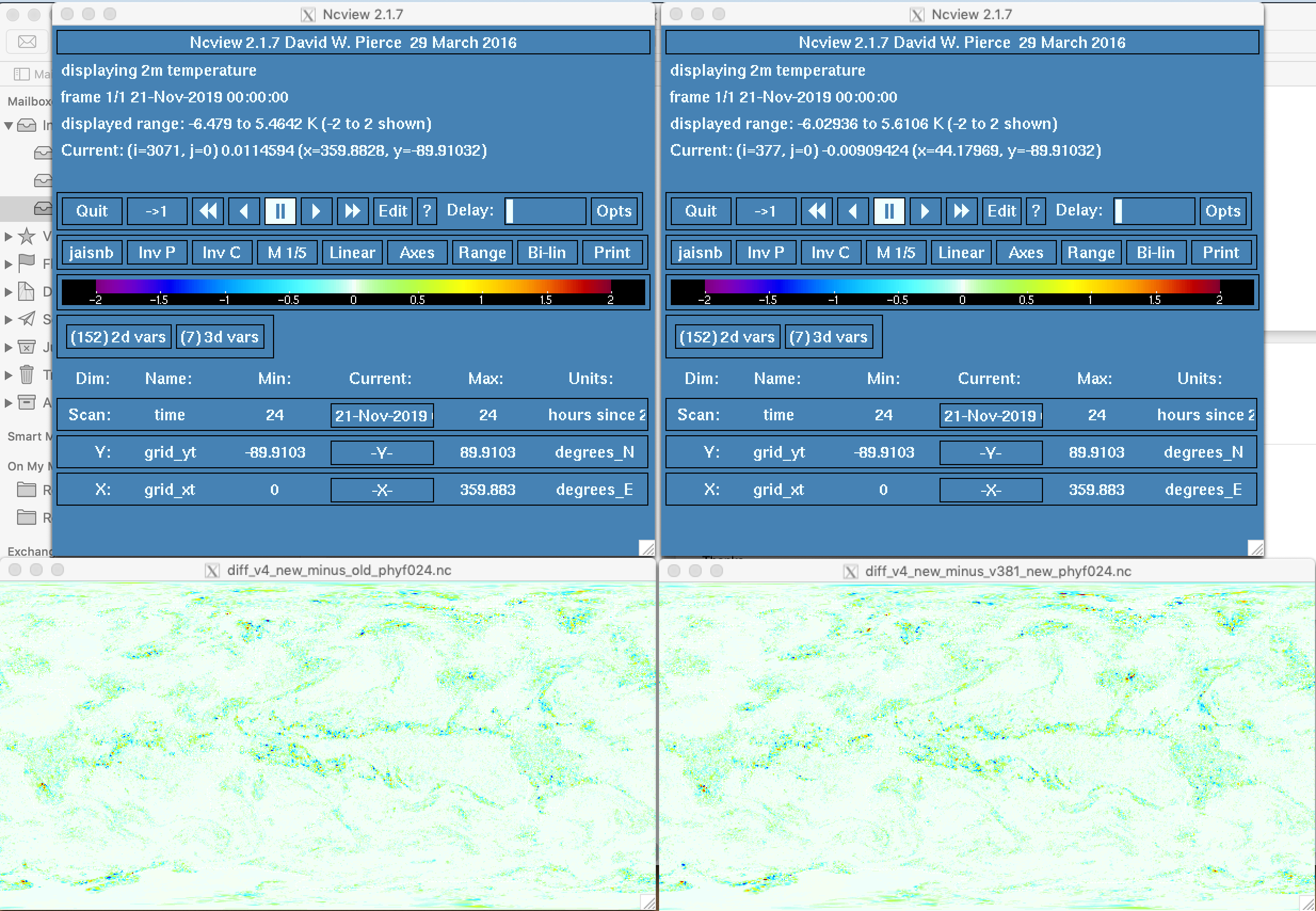
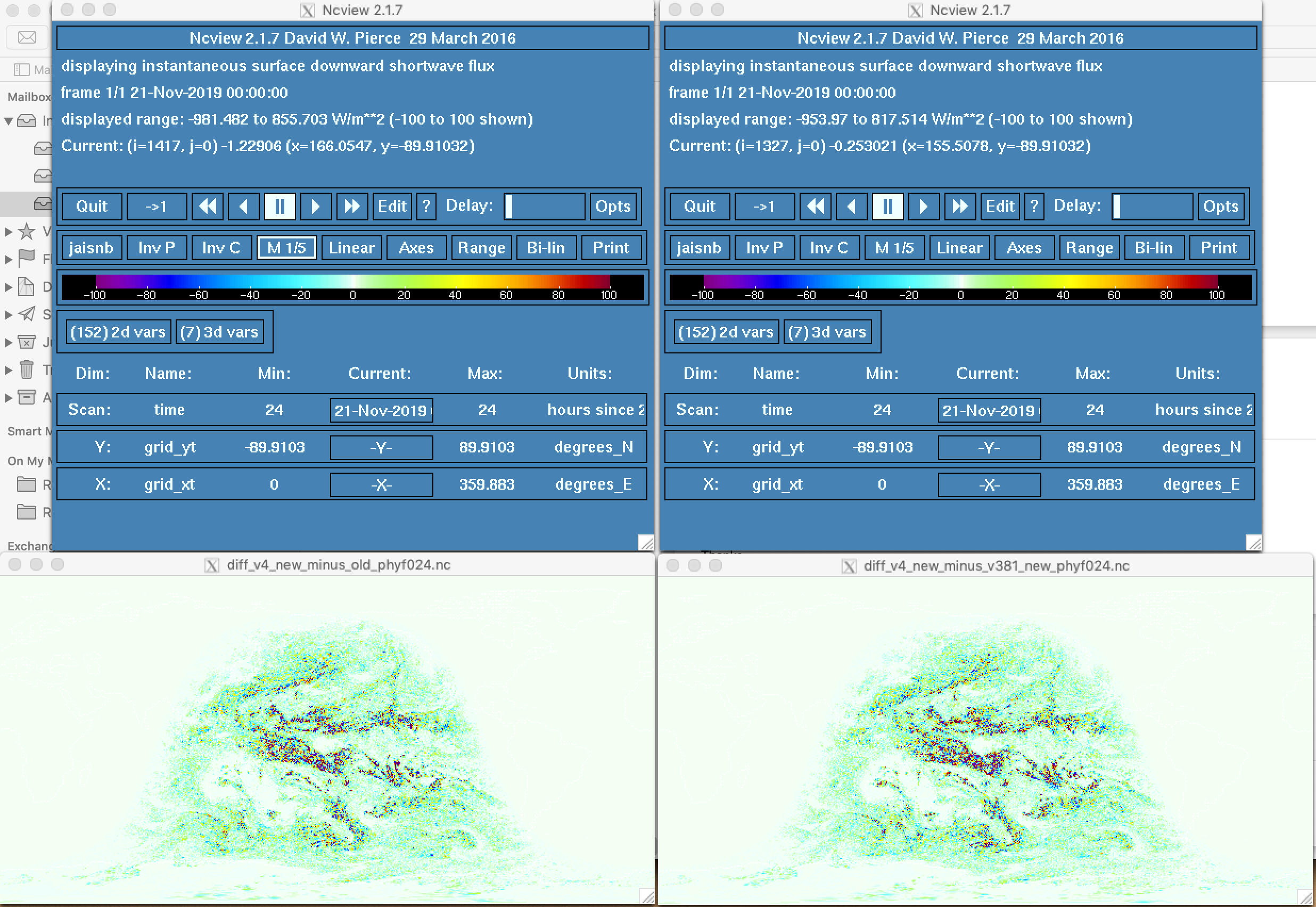
The following plots show the differences between the updated Thompson v4 code minus the original (head of gsd/develop) Thompson v4 code on the left, and the differences between the updated Thompson v4 code minus the retrofitted Thompson v3.8.1 code after 24h integration of our typical C768 2019/11/20 test case. The clean up of the effective radii calculation leads to an increase - and fairly similar signals for v4 and v3.8.1 - in 2m temperature compared to the old v4 code. Because the signal is larger than I expected, I would like to see another set of retrospective runs after this PR is merged (with the still default v4 code, but cleaned up cloud effective radii). 2m temperature instantaneous downward shortwave at sfc |

|
Dom, |
Which level do you want to see? I didn't have time to compute the composite reflectivity yet. Also, you can look at the data yourself: |
|
I still do not support this change: I think that WRFV3,8.1 should also have R1*1000. Could we check with Greg about this? |
I can easily make the change. It will make the v3.8.1 results look even closer to v4, but that doesn't worry me. I would just like to know if the v4 changes are ok. |

Regarding the plots, I'm a little surprised to see
The current v3.8.1 code we are using in the operational RAPv4 / HRRRv3 (and will be using in RAPv5 / HRRRv4 once we get past the current RAPv5 boundary issues) uses R110. This is in the fallout part of subroutine mp_thompson. I'm not aware of why R110. should be a problem, but willing to learn. The downward shortwave differences look OK to me. The downward solar appears to differ by ~ 20 W/m^2 (with a mixture of positive and negative differences) away from areas of deep convection (South Pacific Convergence Zone, ITC, Maritime Continent). The big values in these convection regions appear to be due to slight position differences in predicted areas of deep convection. Likewise, the 2-m temp differences are almost everywhere < 0.5K, it appears to me. The exceptions are mainly in areas of deep convection, where small location differences together with sharp gradients between cloudy and clear (or partly cloudy) areas combine to make the speckle pattern. The changes deserve a closer look in a retro, for sure, but I don't see evidence for obvious bugs at this point. |

|
@climbfuji I can run a retro when you are ready. Just so you are aware we decided to hold of on running the retro for the latest version of GSD/Develop until the updated sfc_diff.f from EMC is committed. |
|
Dom, |

|
Thanks! I will merge the code in a bit.
… On Jun 12, 2020, at 2:11 PM, tanyasmirnova ***@***.***> wrote:
Dom,
I looked at the reflectivity - thank you for the links to your experiments. The reflectivities at many levels that I checked out look very similar in all three experiments (v4-old, v4-new and v3.8.1, even in the areas of deep convection with the presence of graupel. Maybe at the C768 resolution we can't expect to see the differences we saw in 3-km HRRR. Because, the reflectivity is so close with different version of Thompson MP, I think the code works correctly.
—
You are receiving this because your review was requested.
Reply to this email directly, view it on GitHub <#28 (comment)>, or unsubscribe <https://github.com/notifications/unsubscribe-auth/AN7FF5CW6ZKHKZAAV7MCVRDRWKDWLANCNFSM4NZWXHJQ>.
|
Let's keep R1 = 10 for the WRF381 flavor for the time being. We will need to conduct more experiments anyway between the two versions in order to converge to one version that works best. |
Ok, I don't know if that is a good idea. Wouldn't it be better to be able to separate the effects of the Thompson MP update from the sfc_diff bugfixes? |


|
@climbfuji I was not aware that this change was coming so fast. Our original idea with waiting was that we knew the current sfc_diff.f version is not working properly so we wanted to wait until we had a version that was better. I will check with Joe, Shan, and Georg and see what they think. |
5 participants


This PR only updates the submodule pointer for fv3atm.
Associated PRs:
NOAA-GSL/ccpp-physics#34
NOAA-GSL/fv3atm#35
#28
For regression testing information, see below.