GitHub Issue NOAA-EMC/GSI#468 Enhancements to SDL and VDL for simultaneous multiscale EnVar and parallel ensemble IO for EnVar for FV3-LAM#504
Conversation


 Wangy1111
force-pushed
the
develop
branch
2 times, most recently
from
Wangy1111
force-pushed
the
develop
branch
2 times, most recently
from
666f34a to
a11cc21
Compare

 Wangy1111
force-pushed
the
develop
branch
4 times, most recently
from
Wangy1111
force-pushed
the
develop
branch
4 times, most recently
from
f2473af to
dcef087
Compare

|
I ran regression test suite on Hera. 18 out of 19 cases passed. The one crashed is fv3lam netcdf case, which report the error information on missing physics file. |

|
@hu5970 Thanks for this finding. However, should we let the program don't read physics files when they are not needed? |
|
@hu5970 I will open an issue on regression tests soon or you can go ahead too:). |
|
Thank you for your comments. @hu5970 @TingLei-NOAA We should have the codes to let this branch read/write physics files only when if_model_dbz is set to .true. (direct assimilation of dbz). Please let us know if you need anything from us to proceed with the regression tests. |
|
@Wangy1111 Thanks for your update. Yes, it will be better to use if_model_dbz to control if physics files are needed. |

|
@Wangy1111 I'm testing the GSI-EnKF code represented by this pull request for the experimental RRFS_B. Currently, RRFS_B assimilates conventional (non-zero static B) and then radar-reflectivity observations (zero static B) in separate executions of GSI. I would like to propose changing line 2014 of gsimod.F90 from to This change would allow the conventional and radar DA in RRFS_B to use the same convinfo file, and avoid a failure from the non-zero static B in the conventional DA. What are your thoughts on this proposed change? |

@daviddowellNOAA Thanks for your comments. We have changed it as you suggested. |
@Wangy1111 Yongming, are you OK to make this change to the code also? Thanks, Ming |
@hu5970 I forgot to mention that using if_model_dbz has been added to the code. Sorry about that. |

|
@Wangy1111 I'm still on the way of the review, but I let you know what I noticed at this moment.
@hu5970 I confirmed that this branch brings different results from the current RRFS branch in dbz assimilation. It is probably caused by a bug of the current RRFS branch ( https://github.com/NOAA-GSL/GSI/blob/feature/rrfs_dev/src/gsi/gsi_rfv3io_mod.f90#L2207 ). I guess it should be fixed from uu2d(4:nxcase-3,4:nycase-3) to uu2d(1:nxcase,1:nycase). @TingLei-NOAA This branch does not include the modification to output netCDF diag files. ( NOAA-GSL/GSI#20 ) Is it better to add the modification also in this branch? |
@shoyokota Thanks for your comments and review. We will address the remaining comments soon. |
|
Thank you for the clarification. Yes, coding in the branch of this PR looks correct. I just wanted to point out Ming that coding in the current RRFS branch ( https://github.com/NOAA-GSL/GSI/tree/feature/rrfs_dev/src/gsi/gsi_rfv3io_mod.f90 ) is not correct. In my recognision, the current RRFS uses the same grid size for all files but uses uu2d(4:nxcase-3,4:nycase-3) probably by mistake. |
|
@shoyokota Good catch regarding the dbz assimilation. My tests agree with yours. Specifically, (1) For conventional GSI EnVar data assimilation with RRFS background ensemble, I get identical results when I use the RRFS GSI and the new GSI represented by this pull request (PR 504). (2) For radar-reflectivity DA, I get different results with the two versions of GSI. Here are some analysis difference plots (analysis with PR 504 GSI minus analysis with RRFS GSI) for the November 4 case. The plots are for T in the southern plains (model level 64) and U in the northwest (model level 54).
As you suggested, we'll need the capability to output netcdf diag files in order to test EnKF. |
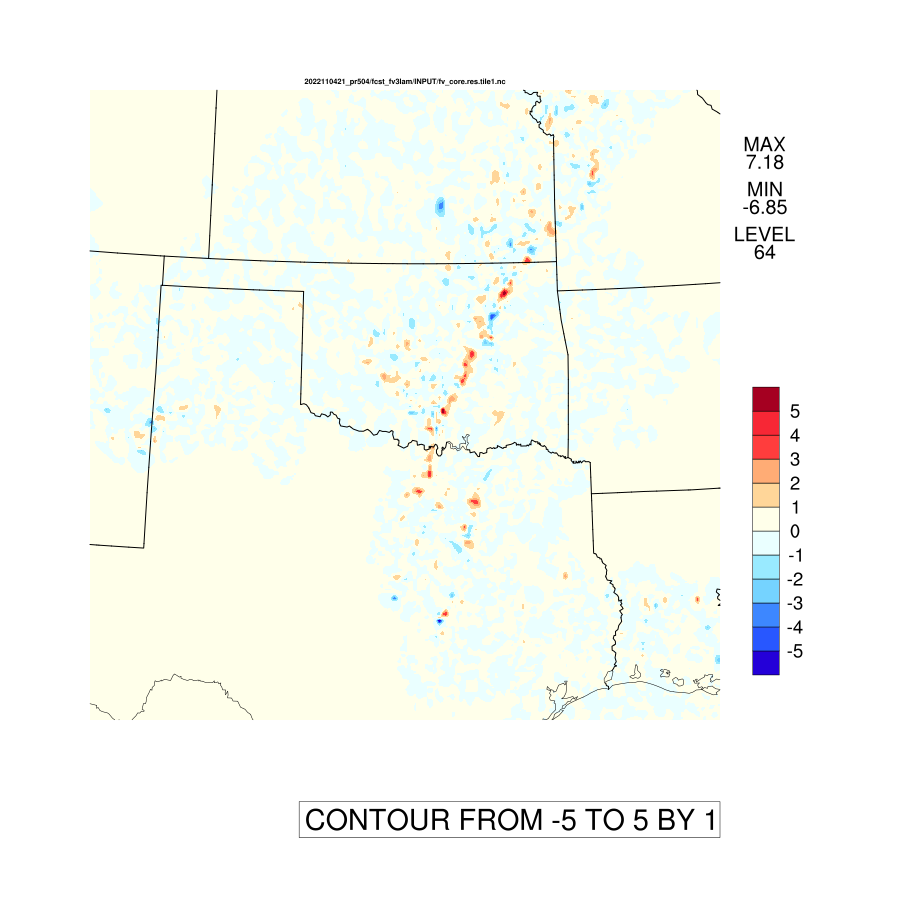
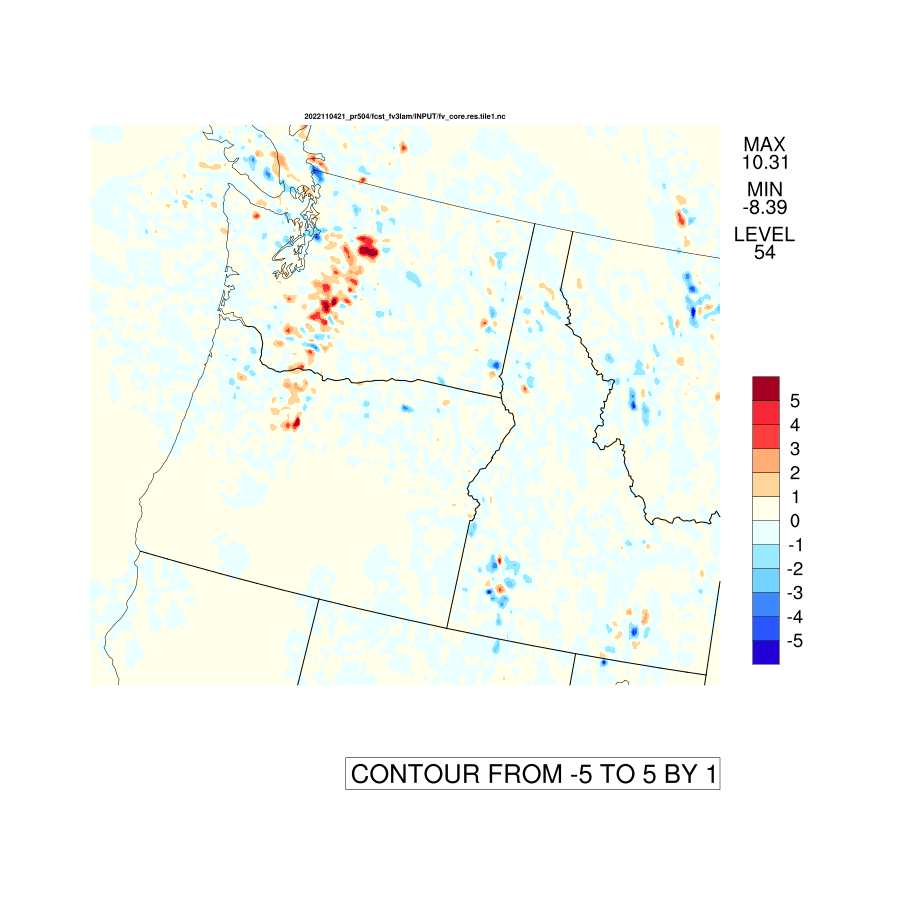
@shoyokota We have addressed the above comments in the code. Thank you. |
|
I confirmed that the branch of this PR and the current RRFS branch bring the same results in dbz assimilation if using same "uu2d". I also confirmed that "assign_vdl_nml=.true., nsclgrp=2, ngvarloc=1" and "assign_vdl_nml=.false., nsclgrp=1, ngvarloc=2" can bring the same results. It is great! @Wangy1111 Could you check the additional comments as follows?
|

|
@Wangy1111 , it is not necessary to force push changes to your forked |
@RussTreadon-NOAA Thanks for your information. |
|
@Wangy1111 , I'm not a git guru but my understanding is that |
I use |
@RussTreadon-NOAA Could you please let us know if "the file history" here means the history from the other PR's previous commits OR the history only from this PR's commit? For apply_scaledepwgts.f90, this is a new file, so only one revision is shown. Thank you for your time. |
|
I am referring to the entire development history of this file. Yes, this is a new file, but it has gone through several revisions in your development. As you state the development history of this file in your PR has been reduce to only the most recent change. The full development history of this file has been lost. |
@RussTreadon-NOAA Thank you for the clarification. |
|
@Wangy1111 when the capabilities in this PR were all under the name of "The following capabilities developed by OU MAP lab ", I hope EMC's major contribution to the GSI coding for the global SDL application (1a in the summary) could be stated. |
|
@Wangy1111 Could you sync with EMC develop branch again? There is a PR merged during weekend for fixing the regression tests. This will not impact your PR. But need to be synced to conduct regression tests. |
@hu5970 Done. |
Added, see above. |
|
@TingLei-NOAA @CatherineThomas-NOAA Ting and Cathy, could you review the PR and approve it again if the PR is OK. |
|
The regression tests finished on Orion: For three failed cases, they all failed because of They are not a fatal failure. |
|
Hera ctests Examination of A check of the A rerun of the |
|
The regression tests on WCOSS2 finishedL The "netcdf_fv3_regional" failure is because of "scalability" Both are not fatal failures. |
|
@Wangy1111 Thanks for the prompt response, Would you change from Ting Lei to Ting Lei and Daryl Kleist? Thanks. |
Changed. |
|
@Wangy1111 Please allow me make another suggestion. Would it be more accurate to say " as described by Huang et al 2021, MW..." rather than "following Huang et al 2021, MW..". EMC 's work on this was mainly done in 2018 and 2019. |
Changed as suggested. |

|
Thank Ting, Sho, Cathy for reviewing this big PR thoroughly and Yongming for quick response to all comments. |


…s multiscale EnVar and parallel ensemble IO for EnVar for FV3-LAM (NOAA-EMC#504)

The following capabilities developed by OU MAP lab are included

(1) Further development for simultaneous multiscale EnVar for both
global and regional DA
(1a) spatial scale-dependent localization (SDL; contributed by Ting Lei
and Daryl Kleist/EMC) is implemented in EnVar as described in Huang et
al 2021, MWR for the global NWP application.
(1b) variable-dependent localization (VDL) method by Wang and Wang 2022,
JAMES is implemented in EnVar.

(2)Development of parallel ensemble IO for EnVar for FV3-LAM
Implement an approach to simultaneously read in all ensemble members for
EnVar. Specifically, parallel ensemble IO for both conventional and
radar EnVar for FV3-LAM is implemented by reading in all ensemble
members simultaneously.

(3) Direct assimilation of radar reflectivity for EnVar for RRFS
The direct radar reflectivity assimilation approach by Wang and Wang
2017, MWR is implemented and tested for FV3-LAM.

Fixes NOAA-EMC#468
9 participants


The following capabilities developed by OU MAP lab are included
(1) Further development for simultaneous multiscale EnVar for both global and regional DA
(1a) spatial scale-dependent localization (SDL; contributed by Ting Lei and Daryl Kleist/EMC) is implemented in EnVar as described in Huang et al 2021, MWR for the global NWP application.
(1b) variable-dependent localization (VDL) method by Wang and Wang 2022, JAMES is implemented in EnVar.
(2)Development of parallel ensemble IO for EnVar for FV3-LAM
Implement an approach to simultaneously read in all ensemble members for EnVar. Specifically, parallel ensemble IO for both conventional and radar EnVar for FV3-LAM is implemented by reading in all ensemble members simultaneously.
(3) Direct assimilation of radar reflectivity for EnVar for RRFS
The direct radar reflectivity assimilation approach by Wang and Wang 2017, MWR is implemented and tested for FV3-LAM.
Fixes #468