Improve rendering speed of phone input component#6890
Conversation


 zachmargolis
left a comment
zachmargolis
left a comment
zachmargolis
left a comment
There was a problem hiding this comment.
LGTM! I think the cached code is worth a shot, since updating the names of countries is not a common development task. We could drop a comment that this wouldn't auto reload in development if needed?

 aduth
left a comment
aduth
left a comment
aduth
left a comment
There was a problem hiding this comment.
Good find! This change alone looks to be quite a significant improvement, but I'm always up for some extra microoptimization in a hot path like this, so the caching could be a good supplement.
…of phone input component
 mitchellhenke
force-pushed
the
mitchellhenke/phone-index-rendering-performance
branch
from
mitchellhenke
force-pushed
the
mitchellhenke/phone-index-rendering-performance
branch
from
4912618 to
e1736a7
Compare
There was a problem hiding this comment.
I'd wonder if it's even worth bothering with this development-mode handling. I'd be shocked if this caching ever turned out to be a problem.
(To future git blame-ers, I apologize if it turned out to be a problem)
There was a problem hiding this comment.
Alternatively, could we just add a line like this at the start of the method, which would force the initialization each time?
remove_instance_variable(:@translated_intl_codes_data) if Rails.env.development?There was a problem hiding this comment.
I agree, different develpment branch of code seems like more of a maintenance burden, I'd see if we can share code
There was a problem hiding this comment.
There's some precedent within our code (and I ran into a hidden one while trying to profile with https://github.com/heartcombo/simple_form/blob/86429bceb950096df3c29616f31bd5a5ce706c06/lib/simple_form.rb#L175)
It's going to be inconsistent in some form along either path (either by not changing content when certain YML files are updated or having dev behave differently than other environments). Another option is configuration, but it doesn't feel like a good use-case for that.
I lean towards
remove_instance_variable(:@translated_intl_codes_data) if Rails.env.development?since it's much simpler, but I don't feel incredibly strongly
There was a problem hiding this comment.
Also, if it's always going to be a hash, could you just do a simple truthy check instead of defined? ?
def self.translated_international_codes
  @translated_intl_codes_data = nil if Rails.env.development?
  return @translated_intl_codes_data[I18n.locale] if @translated_intl_codes_data
  @translated_intl_codes_data = Hash.new { |h, k| h[k] = {} }
  # ...
endThere was a problem hiding this comment.
Ah I like that, so I've pushed up a commit to do it.
mitchellhenke
force-pushed
the
mitchellhenke/phone-index-rendering-performance
branch
from
e1736a7 to
22f6305
Compare

Co-authored-by: Zach Margolis <zachmargolis@users.noreply.github.com>
mitchellhenke
deleted the
mitchellhenke/phone-index-rendering-performance
branch
3 participants


I noticed we spend a disproportionate amount of time rendering templates on phone input pages in NewRelic
Ex:
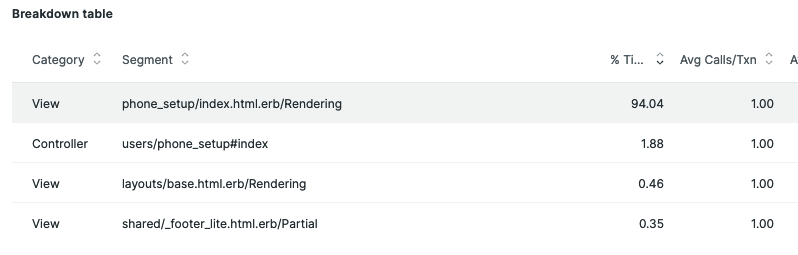
I did a bit of profiling and it looks like it is in large part due to many calls to
PhoneNumberCapabilities.translated_international_codes. It is not clear that it is an expensive operation that iterates over all of the country codes (currently 220) and translates them.PhoneInputComponent#international_phone_codescalls it for every country code (up to a total of 220^2 times).I tried two approaches. The first being caching the results of
PhoneNumberCapabilities.translated_international_codesand the second to skip recalculatingPhoneNumberCapabilities.translated_international_codesin the component.The caching did provide a ~25% improvement on top of the ~4500% improvement of simply not recalculating every time. However, I wasn't sure whether it was worth it since it's additional complexity and would require some more work to disable it in dev to avoid causing issues with updating translated content. If others think it's worth it, I can bring it in.
Both the caching code and benchmark code are on the
mitchellhenke/phone-index-rendering-performance-testsbranch.